In July 2025, a drone sat on display in the inner courtyard of the Pentagon, the U.S. Department of Defense headquarters. Next to it was a printed quote from President Trump. Citing lessons from Ukraine, it called for an American alternative to Iran's Shahed drones.
That drone is called LUCAS. The U.S. military built a unit around it, tried it from a warship, and in February 2026 announced its first use in combat.
Why did the United States copy an Iranian drone? This article follows the dates from a training target to combat, and it names the source of every number, such as price, that official statements leave out. This article reflects the situation as of October 2026.
A training target that imitated the Shahed
Training to stop drones needs an aircraft that plays the other side. Such an aircraft is called a target drone. It is a bit like a boxer sparring with a partner who copies the next opponent's habits.
There is a difference, though. A sparring partner stays a sparring partner, but a target drone's design can be turned to another use.
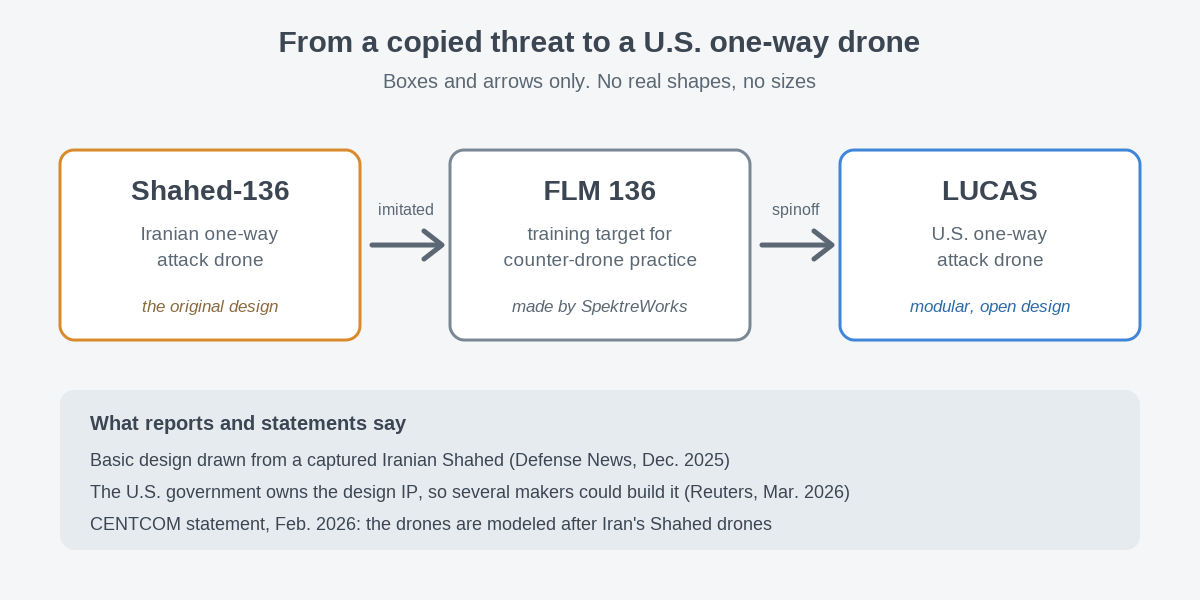
LUCAS is one such case. The U.S. company SpektreWorks built FLM 136, a counter-drone training target that imitates Iran's Shahed. In Defense News's account, LUCAS branched off from that target and is a single-use strike drone that copies Iran's Shahed-136 through reverse engineering. A December 2025 report from the same outlet also said its basic design came from a captured Iranian Shahed.
Training was the first purpose, and a Defense One report adds two points. The aircraft's modular, open structure lets it carry several kinds of payload. A month after the Pentagon display, the U.S. Air Force also began looking for an "exact replica" of the Shahed-136. The article The Shahed series explains how the name Shahed covers a family of aircraft.
July 2025: a memo and a courtyard display
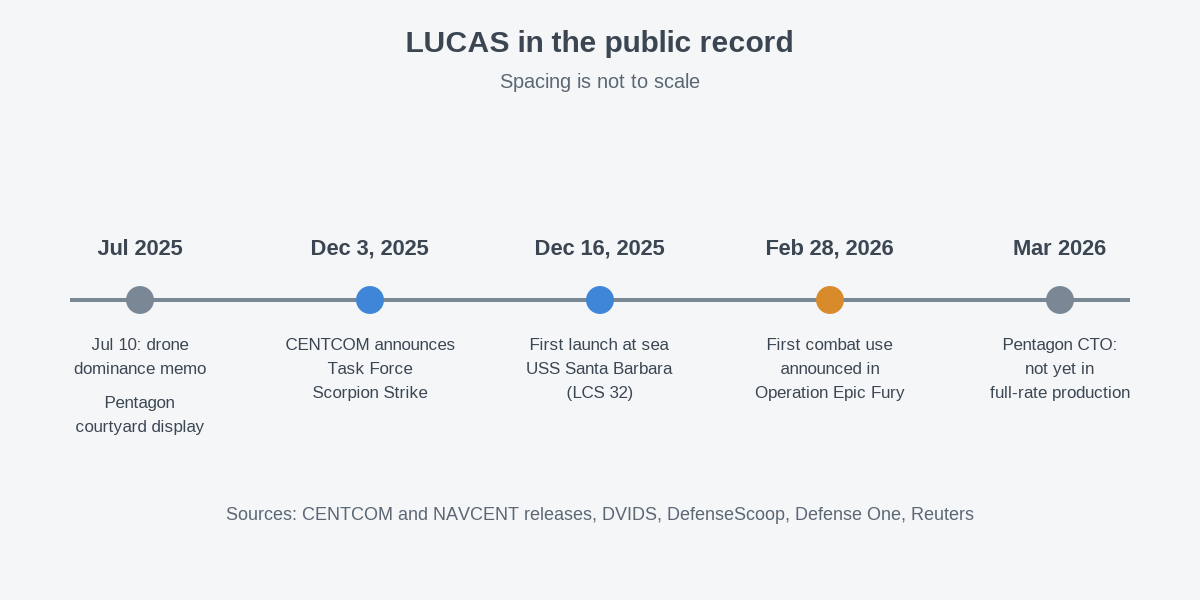
On July 10, 2025, Defense Secretary Hegseth issued a memo titled "Unleashing U.S. Military Drone Dominance." It described uncrewed systems as the biggest battlefield innovation in a generation. It also set a goal for every squad to carry low-cost, expendable drones by late 2026, with Indo-Pacific units first.
In the same month, over a dozen firms vying for military contracts showed their products in the Pentagon courtyard, and the defense secretary walked among them. LUCAS was there. Its price was not made public at the time.
The first one-way attack drone unit
On December 3, 2025, U.S. Central Command (CENTCOM) said it had formed a task force to run the first U.S. squadron of one-way attack drones stationed in the Middle East. It is called Task Force Scorpion Strike (TFSS). The announcement came four months after the defense secretary ordered faster buying and fielding of low-cost drone technology, and a LUCAS squadron was already in the Middle East.
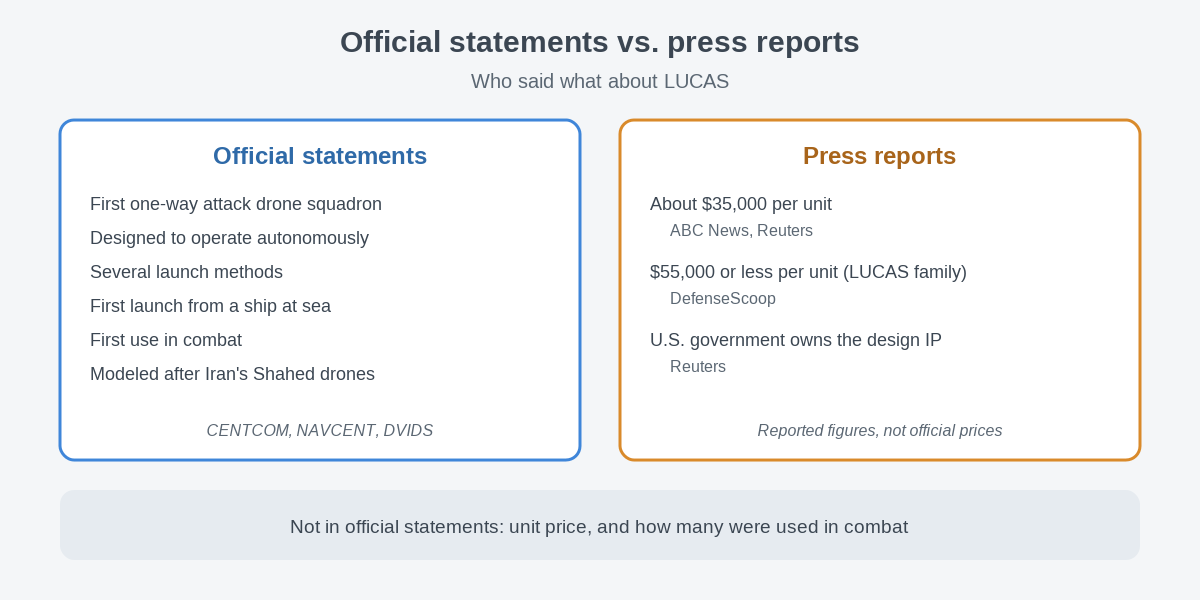
The release described LUCAS as an unmanned aerial system (UAS) with an extensive range, designed for autonomy in operation. It also listed several ways to launch them: from a catapult, with a rocket boost at takeoff, or from mobile systems on the ground and on vehicles. The squadron is being built under the lead of Special Operations Command Central personnel.
Adm. Cooper, the CENTCOM commander, said the task force sets the conditions for using innovation as a deterrent. A photo dated November 23 and released by CENTCOM public affairs shows LUCAS drones parked in a row on an airfield inside the command's area. One day earlier, on December 2, the Pentagon set up the Drone Dominance Program and laid out a plan to purchase over 200,000 drones from industry by 2027.
The first launch at sea
On December 16, 2025, a LUCAS took off from the deck of the littoral combat ship USS Santa Barbara (LCS 32) as it sailed through the Arabian Gulf. U.S. Naval Forces Central Command announced that this was the first time a one-way attack drone had been launched from a ship at sea.
Task Force 59, the command's unmanned and autonomous operations unit, carried out the launch. This drone also belonged to the Scorpion Strike squadron. A warship deck joined the list of launch options on land.
First use in combat
On February 28, 2026, the United States began Operation Epic Fury, a military operation against Iran coordinated with Israel. In a statement, CENTCOM said this operation was a first in history: Scorpion Strike was sending one-way attack drones into combat. The statement itself described these low-cost drones as "modeled after Iran's Shahed drones."
About two and a half months passed between the first launch at sea and the announcement of first combat use. The number of drones used was not disclosed. In March 2026, Pentagon chief technology officer (CTO) Emil Michael said LUCAS was not yet in full-rate production, so the department shipped the drones it had on hand.
Why copy it, and what is still unknown
The public explanation for copying points to Ukraine. The president's quote at the July 2025 display cited lessons from Ukraine in calling for an American alternative to the Shahed. Officials also linked the fast timeline to the same lessons: defense officials told Reuters that the short timeline reflects lessons learned from watching the drone war in Ukraine.
Reuters reported that the U.S. government owns the intellectual property for the LUCAS design, so several manufacturers could build it, while SpektreWorks holds the current production contracts. Growing the supply of such cheap, expendable drones ties in with the Drone Dominance Program, a $1 billion effort approved in a 2025 law.
Some numbers still have no official source. The first is price. In December 2025, a defense official declined to name the brand, variant or price of the LUCAS drones in use.
The reported figures are about $35,000 per unit from ABC News and Reuters, and no more than $55,000 per unit for the LUCAS family from DefenseScoop. The second is quantity, and the number used in combat has not been made public either.
Where this meets lasers
Cheap one-way drones are not only a story about the side that launches them. The defending side always faces the question of how much it spends to stop each one. In recent years the U.S. Navy has used expensive interceptors against Shaheds fired by the Houthis in the Red Sea. Defense News wrote that this led to closer study of the cost balance of those exchanges.
This cost question leads straight to directed-energy weapons (DEW). How to compare aircraft prices with defense costs is in The cost of drone defense, and what a laser weapon really is appears in What is a laser weapon?.
What to read next
- The Shahed series: same name, different drones: what the Shahed name that LUCAS copies actually covers.
- Loitering munitions: between missile and drone: where a single-use attack drone parts ways with a missile.
- The cost of drone defense: the math on the side that stops cheap drones.
- One-way attack drones: how they differ from cruise missiles: an article in the same series, still being written.