At 00:00 Moscow time on November 10, 2020, a cease-fire began in the mountains of the South Caucasus. It was the first of nine points in a statement issued in the names of the president of Azerbaijan, the prime minister of Armenia and the president of Russia. Fighting that had started on September 27 stopped after 44 days. Azerbaijan had taken back much of the land it lost in the early 1990s, 26 years after the 1994 cease-fire.
Far beyond military circles, people often called it "the drone war." So why did fighting break out again in 2020, how did it unfold, and why did drones get so much attention? This article follows the war through a Congressional Research Service (CRS) report, the text of the cease-fire statement, records from both governments and think-tank analysis. Many places have different names in Armenian and Azerbaijani, so both names are given the first time a place appears.
A long dispute over one mountain region
Nagorno-Karabakh means "Mountainous Karabakh." In Armenian it is called Artsakh. It is a highland area in the South Caucasus, between the Black Sea and the Caspian Sea. Armenians and Azerbaijanis have long lived side by side, but their religions differ: Azerbaijanis are mostly Muslim and Armenians mostly Christian.
The region's political past, and the record of who lived there, are bitterly disputed by the two nations. Its modern borders date from the Soviet era. In 1921 the area was assigned to Soviet Azerbaijan, and in 1923 it was formally established and its borders drawn. Until the end of the USSR it was an autonomous region (oblast) inside Soviet Azerbaijan.
The 1989 census counted 189,000 people in the region: 77% Armenian and 22% Azerbaijani. The conflict began in 1988. The region's Armenian population sought to move it under Soviet Armenia, but Soviet authorities would not redraw the borders. Mass mobilization and violent clashes followed, and in 1991 the Armenians of Nagorno-Karabakh declared independence while Azerbaijan abolished the region's autonomous status.
After the USSR dissolved in December 1991, the armies of the two countries fought directly. When a cease-fire was signed in May 1994, Armenian and Nagorno-Karabakh forces controlled most of the region plus several districts around it. Together these covered roughly 14% of Azerbaijan's territory. Estimates by observers, cited by CRS, put the toll at about 20,000 dead and over a million people forced from their homes.
People on both sides lost their homes. About 500,000 Azerbaijanis fled Nagorno-Karabakh and the areas around it, about 185,000 Azerbaijanis left Armenia, and over 350,000 Armenians left Azerbaijan. In 1993 the UN Security Council passed four resolutions on the conflict. They restated that Azerbaijan's sovereignty and territorial integrity must be respected and that land may not be taken by force.
Twenty-six years after the 1994 cease-fire
Talks after the cease-fire were led by the Minsk Group of the Organization for Security and Co-operation in Europe (OSCE). In 1992, OSCE participating states agreed to hold a conference in Minsk. That conference never took place, but it gave the process its name and framework.
Sources differ on when the Minsk Group itself was set up: 1992 in OSCE records, 1994 in the CRS report. From 1997 on, France, Russia and the United States served as its co-chairs.
From 2007, the co-chairs based their efforts on six "Basic Principles," also called the Madrid Principles. The first was returning the districts around Nagorno-Karabakh to Azerbaijani control. The second was an interim status for the region with guarantees for security and self-governance, and the third a corridor linking Armenia and Nagorno-Karabakh.
The fourth was deciding final status through a legally binding expression of popular will. The fifth was the right of displaced people and refugees to return, and the sixth international security guarantees with a peacekeeping operation.
The two countries negotiated on this basis but made little progress. The positions were far apart. Armenian and Nagorno-Karabakh leaders saw the surrounding districts as a buffer and as leverage in talks on final status. Azerbaijani leaders insisted on sovereignty, territorial integrity and the right of Azerbaijanis to return to their homes.
The front line was not quiet either. The line of contact ran for more than 150 miles. From 1994 to 2016, dozens of soldiers and civilians on both sides are estimated to have died there and along the border each year. In April 2016, three days of heavy fighting left at least 200 reported casualties.
After Armenia changed governments in 2018, new attempts were made to settle the conflict. In 2020, however, tensions rose again.
From July 12 to 16, artillery fire crossed the two countries' shared border, about 185 miles north of Nagorno-Karabakh. By official count, at least 17 soldiers died (12 Azerbaijani, 5 Armenian), along with 1 Azerbaijani civilian. The July clashes, and then the autumn war, took many observers by surprise.
From September 27 to November 10, 2020
On September 27, 2020, major fighting broke out between Azerbaijani forces and the Armenian and Nagorno-Karabakh forces defending the region. Many observers see the war as having started with an Azerbaijani push to recover at least part of the land lost in the 1990s. Azerbaijani officials first said they were responding to Armenian fire, but CRS writes that the evidence for that claim is unclear.
The fighting lasted six weeks, with Azerbaijani forces gaining ground step by step. In the mountains of the north, Armenian and Nagorno-Karabakh forces held off the first advances. In October, the front moved most in the south, on the lowlands between Nagorno-Karabakh and Iran. Azerbaijani forces took the Fuzuli, Jabrayil and Zangilan districts and secured the whole border with Iran, and there was also fighting around the town of Hadrut in southern Nagorno-Karabakh.
The next objective was Lachin. The town sits on the road between Armenia and Stepanakert (Khankendi in Azerbaijani), the main city of Nagorno-Karabakh. After heavy fighting, Armenian counterattacks pushed this attempt back.
The fighting then shifted to Shusha (Shushi in Armenian). Shusha is a city of historical and cultural importance, and it stands on the road linking Armenia and Nagorno-Karabakh, overlooking Stepanakert. Azerbaijani forces captured the city on or about November 8, 2020.
The day before the cease-fire, Russian forces were drawn in. On November 9, a Russian Mi-24 helicopter was shot down by Azerbaijani forces over Armenian territory; two people died and one was wounded. Azerbaijan quickly apologized and promised an investigation. The cease-fire began at midnight that night.
Three failed truces and the November statement
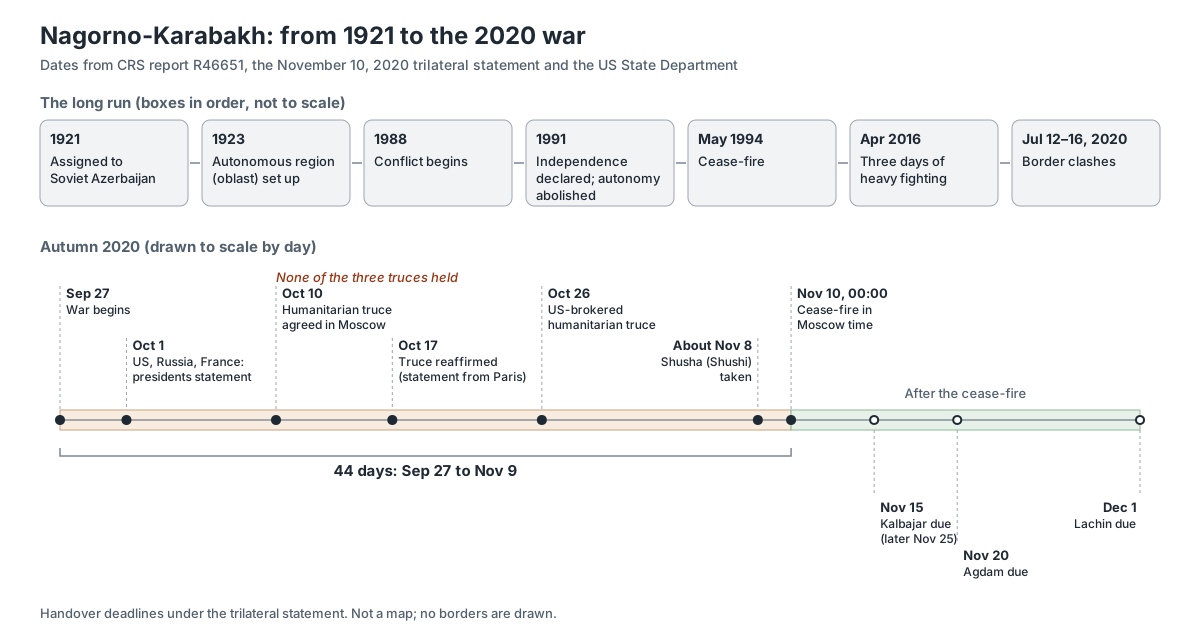
There were three attempts at a truce. On October 1, the American, Russian and French presidents issued a joint statement calling for an immediate end to hostilities. A humanitarian cease-fire was agreed in Moscow on October 10 and reaffirmed in a statement from Paris on October 17. A third humanitarian cease-fire, brokered by the United States, was set to start at 8:00 a.m. local time on October 26, but like the first two, it did not hold.
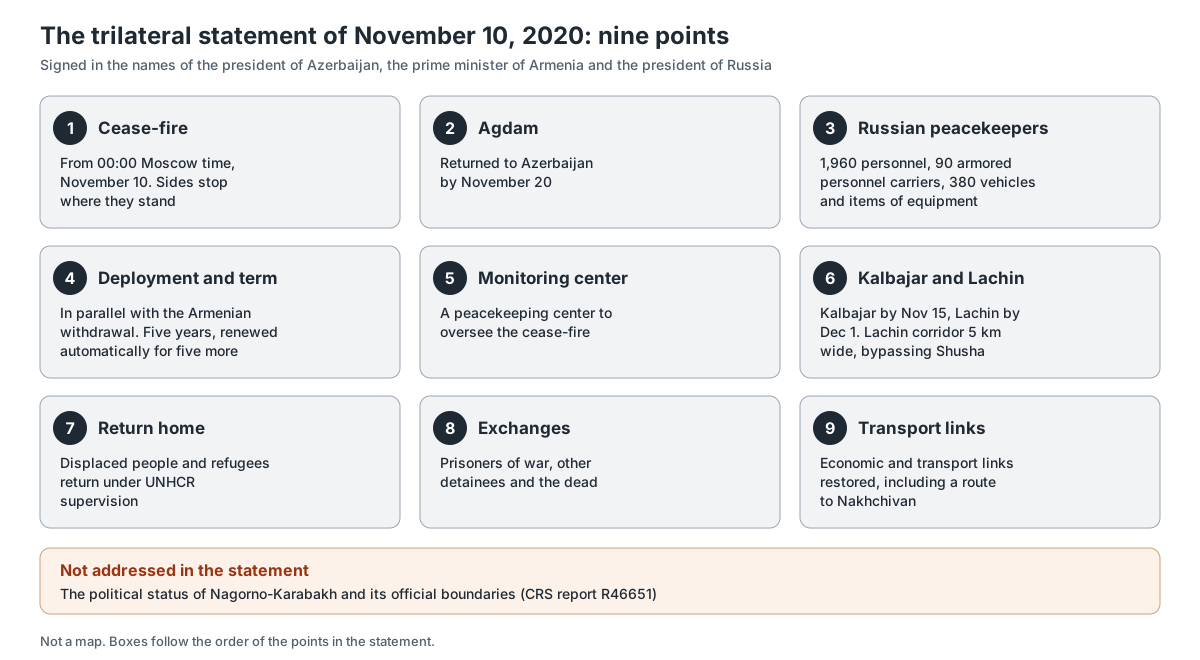
What stopped the war was the trilateral statement dated November 10. Its first point declared a complete cease-fire from 00:00 Moscow time on November 10 and told both sides to stop where they stood. In the view of CRS, this in practice let Azerbaijan keep the ground it had won during the war.
In addition, Armenia agreed to hand Agdam back to Azerbaijan by November 20, Kalbajar by November 15 and Lachin by December 1. At Armenia's request, the Kalbajar deadline was later pushed back to November 25.
Russia agreed to send 1,960 peacekeepers with 90 armored personnel carriers plus 380 vehicles and pieces of special equipment, placed along the contact line and the Lachin corridor. They are to stay for five years, extended automatically by five more years unless one side gives notice six months ahead. The Lachin corridor, 5 km wide, links Nagorno-Karabakh and Armenia without passing through Shusha.
Displaced people and refugees are to return under the supervision of the UN High Commissioner for Refugees (UNHCR), and the sides are to exchange prisoners, detainees and the dead. Trade and transport routes across the region are to be reopened, including a route between mainland Azerbaijan and Nakhchivan, the Azerbaijani exclave west of Armenia.
How the statement was signed is also on record. In his address to the nation, President Aliyev said it was signed by videoconference, and Prime Minister Pashinyan wrote that he signed it at 1:00 a.m.
What the statement left out matters as much. The text is silent on Nagorno-Karabakh's political status and on where its official borders lie. Some parts overlap with the Basic Principles, such as the return of districts and the corridor. But the Basic Principles treated a decision on final status and guarantees for the region's security and self-governance as one package, and neither is in the statement.
The principles also assumed an international peacekeeping mission rather than a Russian-only one, while this peacekeeping force was Russian only.
Why drones drew so much attention
The two armies' basic equipment came from similar roots. Russia was a major arms supplier to both, and both fielded mainly Russian gear and modernized Soviet-era equipment, tanks and artillery among them. What changed things was the large military buildup Azerbaijan carried out over the previous 10 years. The advanced weapons it bought made Azerbaijan better at reconnaissance and at precision strikes.
Uncrewed aerial vehicles (UAVs) stood out among those purchases. A UAV works together with a ground control station and a data link as an unmanned aerial system (UAS). Throughout the war, drones were central to the Azerbaijani effort, including equipment bought from Turkey and Israel. Its forces also flew armed drones and used loitering munitions, often called kamikaze drones, bought from Israel.
Deals before the war were reported as well. In the first nine months of 2020, Turkey reportedly sold more than $120 million in military equipment to Azerbaijan, and the purchases included Bayraktar TB2 drones.
The TB2 can carry MAM laser-guided smart munitions. Laser guidance links this story to other articles on this site. To see how a weapon follows the bright spot a laser makes on a target, read the article on precision-guided bombs.
Azerbaijan was not the only side flying drones. A Missile Defense Project analysis from the Center for Strategic and International Studies (CSIS) describes Russian, Turkish, Israeli and local drones flying reconnaissance for artillery and strike missions. Armenia's drones were small, locally built types used mostly for reconnaissance.
Still, video did much to make this "the drone war." Azerbaijani drones were the main focus of attention, and attack videos from TB2 cameras were posted online and shown on public screens in Baku. Short clips seen from the sky spread as if they were the defining images of the war.
How to read those videos was a matter of debate. One UK analysis came from the Royal United Services Institute (RUSI). It argued that it is a mistake to dismiss the clips as offering no lessons because the Armenian troops in them look unskilled.
One reason it gave was that the clips were picked to show Azerbaijani successes. Even so, it called the conclusion that tanks no longer have a future a serious error. Land warfare, in that view, is still about taking and holding ground.
The CSIS analysis likewise warns that drones, despite their large role, should not be overrated, and it names "full-spectrum air defense" as the main lesson. In its reading, single weapon systems do not change the nature of war, but using new weapons together in a coordinated way makes the battlefield more lethal.
Why drone defense rarely comes down to one tool is the subject of the counter-drone systems article. The basics of laser weapons, one of the tools often mentioned, are covered separately.
What it left for people
Drawing on official statements and reports gathered by CRS, more than 6,000 people died in combat. About 3,360 were Armenian and about 2,820 Azerbaijani, and more than 150 civilians were killed. Every one of those numbers stands for a family somewhere in the two countries.
Far more people left their homes. Armenian officials said that, as of November 2, 90,000 of Nagorno-Karabakh's estimated 147,000 people had fled, and by early December more than 25,000 had reportedly returned. On the Azerbaijani side, officials said about 40,000 people living near the conflict zone had to leave home for a time.
Shelling also reached towns away from the front. According to media and nongovernmental organizations, towns in Nagorno-Karabakh came under shelling, Stepanakert among them. So did Azerbaijani cities beyond the conflict zone, such as Ganja and Barda, and at least dozens of civilians were killed or wounded in all. Reports of prisoners being killed came from both sides, and in December Azerbaijani authorities detained four of their own soldiers over suspected war crimes.
The danger stayed in the ground after the fighting ended. New unexploded ordnance was added to the mines already there. Towns and villages in the conflict zone were damaged or run down, and mines and unexploded ordnance were seen as a risk to anyone returning. After the cease-fire, the United States provided $5 million in humanitarian aid to support the International Committee of the Red Cross (ICRC) and other organizations.
After the war: two countries and the negotiating framework
The two countries reacted in opposite ways. Prime Minister Pashinyan wrote that the statement was "unspeakably painful for me personally and for our people," adding, "This is not a victory." After it was announced, protesters in Armenia stormed government buildings and briefly took over parliament, and opposition politicians and protesters demanded his resignation. The foreign, defense and economy ministers resigned.
In Azerbaijan, crowds celebrated, and backing for the government and its military campaign ran high. In his address to the nation, President Aliyev called the statement "our glorious victory" and said that "our people's 30-year longing will come to an end." The same document meant pain to one side and victory to the other.
The positions of neighboring powers shifted too. Officially, Russia stayed neutral, and the Russian presidential spokesman said its security commitments to Armenia through the Collective Security Treaty Organization (CSTO) did not extend to Karabakh. Turkey gave Azerbaijan strong diplomatic support and supplied drones. CRS judged that the war increased the influence of Russia and Turkey.
The US State Department called the end of the fighting only a first step toward a peaceful settlement reached through negotiation. The war did not settle the region's political status, and it upended the international framework for resolving the conflict that had existed since the 1990s.
That framework was formally closed a few years later. On September 1, 2025, after a joint appeal from Armenia and Azerbaijan, the OSCE Ministerial Council decided to shut down the Minsk Process and the bodies linked to it. That work was finished on November 30, 2025. A negotiating framework that began in the early 1990s ended after some thirty years.
What to read next
- Loitering munitions: between missile and drone: what the weapons called kamikaze drones in this war actually are.
- ISR drones: why endurance matters: the job of reconnaissance drones that support artillery.
- Counter-drone systems: why one device is not enough: why stopping drones takes a mix of tools.
- What is a laser weapon? Film versus reality: the basics of laser weapons, often mentioned as a way to stop drones.