Carrying water and ammunition to positions near the front, or bringing a wounded comrade back, has long been work for people. In Ukraine in 2026, more and more of it falls to small vehicles that move on wheels or tracks. Ukraine's Ministry of Defence reported 7,511 ground robot missions in January and 25,143 in August.
What do these robots carry, and who counted those missions, and how? The records released by the ministry, the armed forces and Brave1, the government's defense-tech body, answer more than you might expect. Ground robots in general are covered in Robots for dangerous places.
The war is still going on. For that reason this article leaves out how effective the robots were in combat and how they are driven. It reflects the situation as of October 2026.
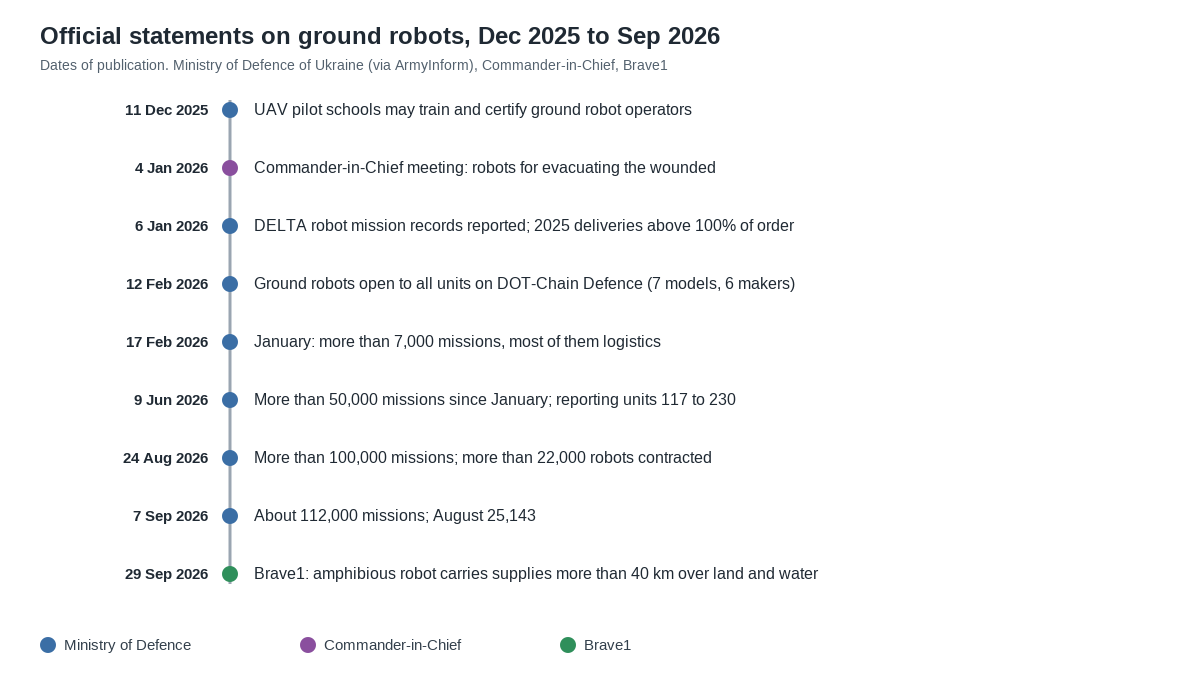
Ground drones, called NRK in Ukraine
An unmanned ground vehicle (UGV) moves over land with no one aboard. Ukrainian-language statements use НРК (NRK), short for "ground robotic complex," and English articles render it as GRS or GRC. The phrase "ground drones" appears as well. This article calls them all ground robots.
What are they for? In February 2026, the head of the ministry's procurement agency said ground robots handle evacuation, logistics, delivering ammunition and carrying out missions. The aim is to get combat and logistics work done without sending people into the strike zone.
Not every ground robot is a cargo carrier. The range spans logistics platforms through to strike systems. This article follows the part that moves supplies and people.
How the numbers are counted: DELTA and combat points
Ukraine's armed forces use a combat digital system called DELTA. DELTA has a function for planning and reporting ground robot missions. After a mission, the result is verified, the system writes a report, and it works out e-points according to set rules.
The points are worth something to a unit. A unit can trade them on a marketplace called Brave1 Market for drones, ground robots, electronic warfare equipment and components. Evacuating one wounded person earns 70–120 points, depending on how hard the mission was.
Numbers from the early weeks survive too. Over two weeks in December 2025, 82 units signed up. In that time 4,300 logistics missions and about 60 evacuation missions were verified.
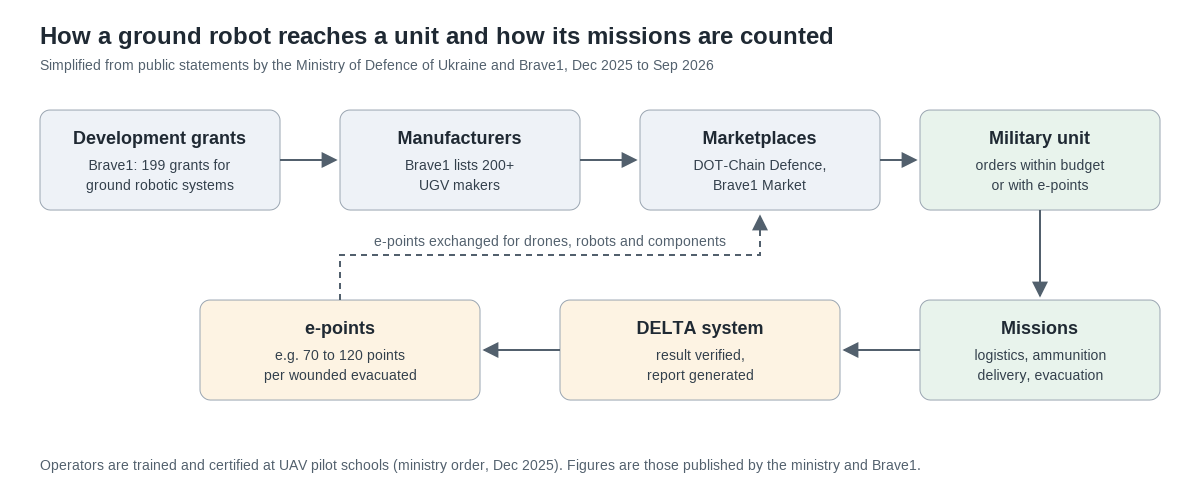
One thing to keep in mind before reading the numbers. Every mission count in this article is a figure the ministry published after counting records entered in DELTA. The records are verified, but no outside body counted them separately. The statements also do not say how many km one mission covers or what and how much it carries.
2026: missions rising month by month
On February 17, the defense minister said robotic systems had carried out more than 7,000 missions in January alone, most of them frontline logistics. Half a year earlier, evacuating the wounded with robots had been extremely rare. The main task is to hand as much of the supply work at the front as possible to ground robots.
The numbers grew every month after that. In a ministry statement of September 7, the monthly logistics and evacuation missions were 7,511 in January, 11,028 in April, 19,940 in July and 25,143 in August. August was 3.3 times January, and missions so far in 2026 stood at about 112,000 by early September.
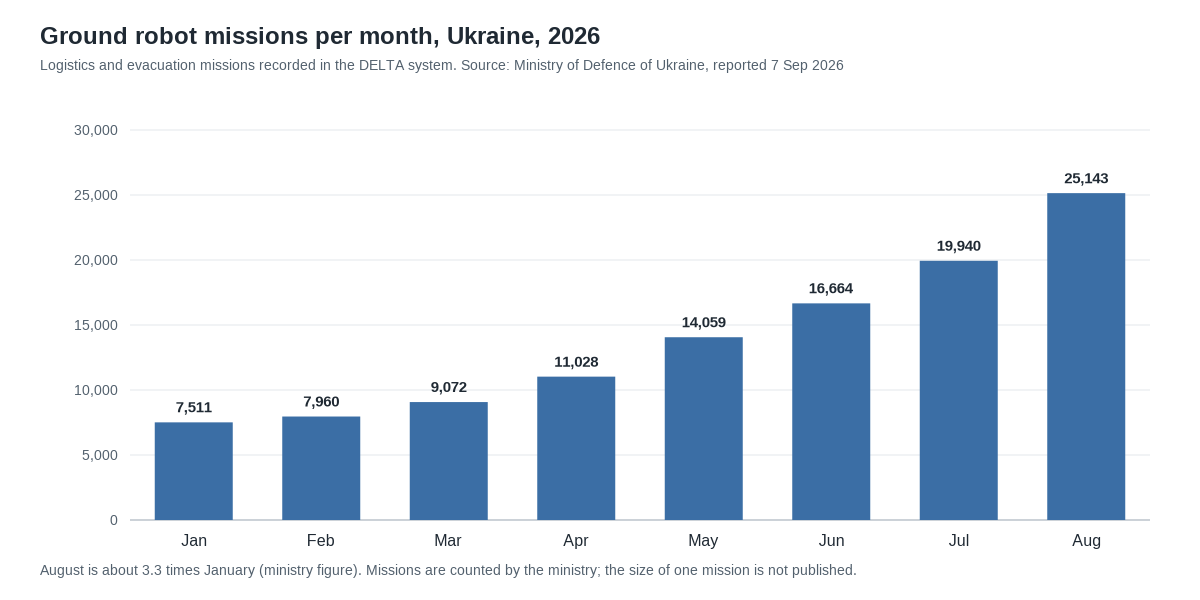
The number of units reporting missions rose as well. By June it had nearly doubled in five months, from 117 to 230.
The statements do not always agree exactly. The August 24 statement gave July as 19,969 missions, and the September 7 statement gave 19,940. The gap is 29, and the chart uses the later figure.
Robots that carry the wounded out
In early January 2026, the Commander-in-Chief of Ukraine's armed forces held a video meeting on the medical service. He stressed the need for new organizational and technical answers in evacuating the wounded. The meeting gave separate attention to using ground robots to evacuate wounded troops from the forward edge. Among his key tasks for the medical service in January was continued work on unmanned systems that evacuate the wounded.
This job is called casualty evacuation (CASEVAC). The robot does not take the wounded all the way to a hospital. It carries them from the contact line to a handover point, where a medical evacuation crew takes over.
A single record shows what this looks like. In March 2026, an article described a video posted by the 1st Separate Medical Battalion. A soldier stepped on a mine and was hurt in the legs. His comrades gave urgent care with help from a remote telemedicine consultation, then loaded him onto the robot.
The area was densely mined, which made the evacuation harder, and the mission took 5 hours and 15 minutes. Throughout it, the team kept talking with him through the built-in audio system of the robot's capsule. Once out of the danger area, he was handed over to a medical evacuation team.
How a robot reaches a unit
There is more than one route from factory to unit. In January 2026 the ministry said it had met the armed forces' full request for ground robots in 2025, with deliveries above 100% of the order. Separately, units received 62 ground robots through DOT-Chain Defence, a digital procurement marketplace.
From February 12, every unit could choose ground robots on DOT-Chain Defence and order them within its budget. At that point the marketplace listed 7 models from 6 Ukrainian manufacturers. Until then, ground robots on that marketplace were available only through the Army of Drones Bonus program. In mid-February, Brave1 Market had 13 robot models that units could obtain with combat points.
The scale kept growing. According to the ministry on August 24, more than 22,000 ground robots had been contracted in 2026. Troops had also ordered nearly 1.9 billion hryvnias' worth of robots on Brave1 Market through the points program. In June the minister said 25,000 robots were being contracted in the first half of the year, twice the total for all of 2025.
Government grants go to the makers. Since 2023, Brave1 has given out over 1,000 grants worth 6.2 billion hryvnias for defense technology. Of 977 standard grants, 199 went to ground robotic systems, second only to the 215 for UAVs. More than 200 UGV manufacturers belong to the Brave1 cluster.
The robots also need people who can run them. Under an order from the defense minister in December 2025, schools that train UAV operators were allowed to train ground robot operators and instructors and to certify them. A person who is not yet serving can get a training voucher from a unit and, after finishing the course, can be mobilized into the ground robot operator specialty.
The difficulties that remain
Official statements list difficulties too. Water comes first. A Brave1 statement from September 2026 notes that rivers, canals and marshy ground can make routes hard or impossible for ordinary ground robots. Flying the cargo in is not always the best answer either.
The same statement goes on to an amphibious robot: a unit of the 93rd Separate Mechanized Brigade sent an amphibious ground robot more than 40 km over land and water. It brought supplies and ammunition to positions at the front. The platform had been refined over several months together with soldiers, and Brave1 funded it with a grant. In June 2026, Brave1 opened a separate "Amphibious UGVs" track in its grant program.
Communications and control come next. In February the defense minister said that this year, along with more production and procurement of robots, the communications and control systems would be improved. Letting units buy the modules and components they need to adapt robots to a given mission is also on the list of priorities.
Then there is time. The evacuation through the minefield described above took 5 hours and 15 minutes. A robot can take a dangerous road in a person's place, but the wait for the wounded does not disappear.
Where this meets lasers: eyes for the road
A robot driving over land needs sensors to see ahead. Ukraine's statements give the number of robots and missions in detail, but not the sensors the robots use to see the road.
On test vehicles elsewhere, lasers have been one of those eyes. An example of lidar carried on a US autonomous ground vehicle test is in Unmanned ground vehicles. How a laser pulse measures distance is explained in Measuring with lasers: range finding and lidar basics.
What to read next
- Unmanned ground vehicles: robots for dangerous places: the basics of ground robots, from remote control to autonomy.
- The Russia-Ukraine War: A Timeline from Public Records Since 2022: the larger dates of this war.
- FPV drones: flying through the drone's eyes: small drones flown from a first-person view (FPV).
- Autonomous weapons and human control: the international debate around armed robots.
- Drones in the War in Ukraine: A Timeline from 2022: the dates on the flying side.