Picture a first visit to a friend who lives far away. On the highway, you follow the navigation app. Once you turn into the friend's street, you look out the window at house numbers and gate colors instead of the screen. The long road and the last few dozen meters call for different ways of finding the place.
A long-range missile also picks its way twice. Midcourse guidance uses information from outside to bring it near the target. Terminal guidance uses the missile's own seeker to remove the last errors. This article looks at why the flight is split in two, and what is needed when one phase hands over to the next.
A friend's house stays put. What a missile is looking for may move in the meantime.
Three phases and multiple modes
The Johns Hopkins Applied Physics Laboratory (APL) Technical Digest divides guided missile flight, in the general case, into three phases: boost, midcourse and terminal. Not every missile uses all three. Every precision guided missile, though, has a terminal phase. Using two or more guidance phases in a row is called multiple-mode guidance.
Whether boost and midcourse phases are needed depends on several things. The biggest are how far away the intercept will happen and which sensors are available on and off the missile.
At the other end are missiles that use homing guidance all the way, usually shorter-range ones. Such a missile acquires the target with its own seeker before launch and starts homing as soon as it is fired.
What each phase is for
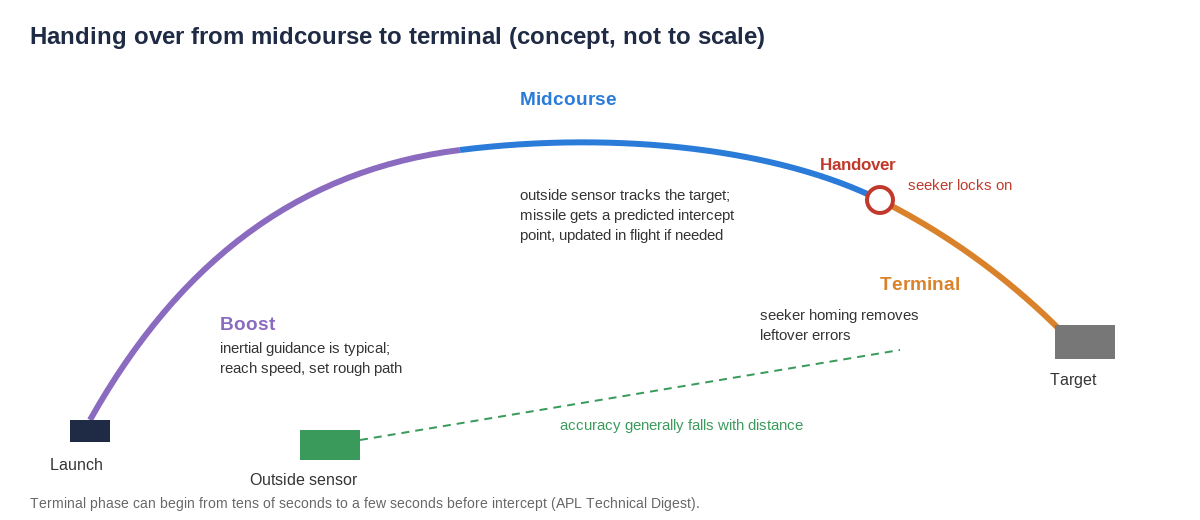
Inertial guidance is typical in the boost phase. The missile reaches flight speed and roughly sets the path that will meet the target. Inertial guidance works by counting its own motion without looking outside, so errors build up over time, as covered in Inertial and satellite navigation: knowing where you are.
In the midcourse phase, the missile receives information from outside. The goal here is not to hit the target. It is to get reasonably close, and to be in a good position at the moment the seeker locks on.
The terminal phase comes last, and it usually matters most. Its start depends on the missile and the mission, somewhere between tens of seconds and a few seconds before intercept. Its job is single: remove the errors left over from earlier phases and bring the final distance between missile and target below a set level.
Why not let the outside sensor guide all the way
In the midcourse phase of a multiple-mode missile, a sensor outside the missile tracks the target. That spares the missile's own sensor from having to find the target at long range.
So why not let the outside sensor guide the missile all the way? APL's "Basic Principles of Homing Guidance" explains why that is hard. Sensor accuracy generally falls with distance.
A single sensor standing far off is unlikely to track both target and missile well enough to bring the missile close enough for intercept. So the midcourse goal stops at putting the missile where its own sensor can acquire the target and take over for terminal homing.
Predicted intercept points and in-flight updates
A missile in midcourse cannot see the target directly, so the weapon control side has to pass along information about it. That may be an estimate of how the target is moving, or a predicted intercept point (PIP), the place where missile and target are expected to meet.
The catch is that the prediction rests on assumptions about how the target will move. That is why APL calls the PIP highly prone to errors. In-flight target updates may sometimes be needed before handover to terminal homing. Some missiles, such as the Harpoon described below, receive in-flight updates over a data link.
Saving speed in midcourse
There is another concern in midcourse. A form of proportional navigation can be used in this phase too. But the back-and-forth maneuvering adds atmospheric drag and generally costs too much speed.
In the terminal phase, the missile needs high accuracy and quick reaction. Near the very end, it may have to maneuver as hard as it can against a fast-moving target. To keep speed for that moment, it has to save speed in midcourse. That is why different guidance laws can suit different phases of the same flight.
How it ends: burst nearby or hit directly
How accurate the terminal phase must be depends on the warhead. According to the APL introduction, missiles that use a fuze and a blast-fragmentation warhead (for example, SM-2 and PAC-2) need a final miss distance smaller than the warhead's lethal radius. That radius absorbs some lack of guidance precision. Hit-to-kill missiles (for example, SM-3 and PAC-3) can tolerate only very small misses from a chosen aimpoint on the target.
An example from history and one from today
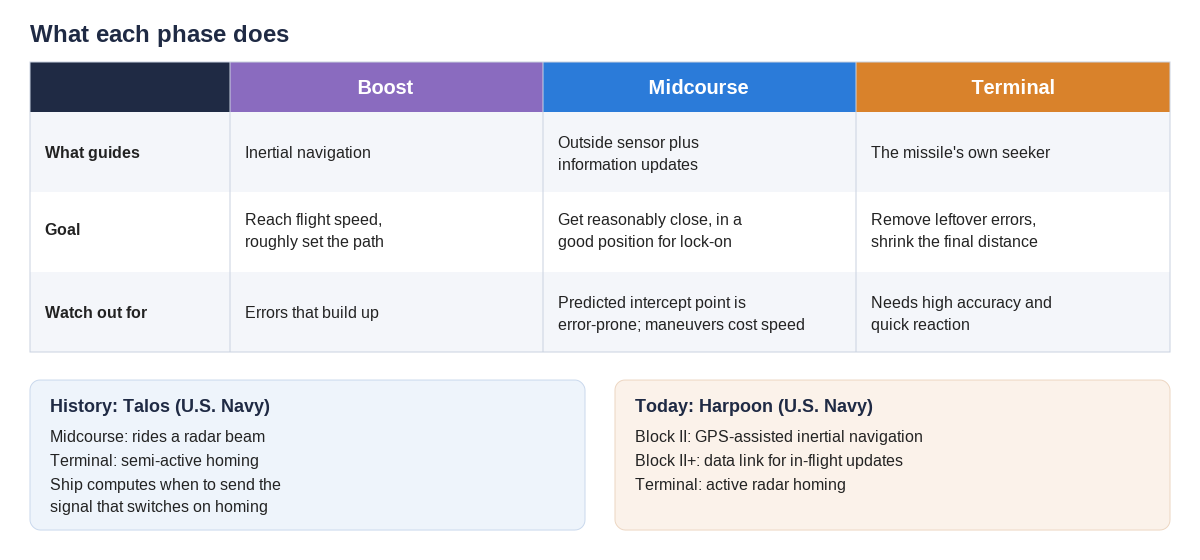
Splitting the flight is an old idea. The U.S. Navy's Talos rode a radar beam in midcourse and used semi-active homing at the end. Why it changed that way is covered in Beam-Riding Guidance: Missiles That Ride a Laser Beam.
What matters here is the moment of handover. The ship's fire control computers tracked the missile's range and worked out when to signal it to switch on homing, so in effect the ship decided the handover.
A current example is the U.S. Navy's Harpoon anti-ship missile. According to the Navy fact file, Block II added GPS-assisted inertial navigation, and Block II+ added a new data link interface that allows in-flight updates. The final guidance is active radar terminal homing. Coordinates and updates carry it through the middle, and its own radar finishes the job.
Where this meets lasers
Sometimes the terminal eye looks for a laser spot. In semi-active laser guidance, a laser lights the target from outside and the missile follows the reflection, which is one way to cover the last stretch after handover. The equipment that makes that light is covered in Laser Designators: Pointing Out a Target with Light.
What to read next
- Guidance Types Side by Side: Command, Semi-Active, Active, Imaging and Inertial/Satellite: the guidance types used in each phase
- Missile seekers: the eye at the front: the device that handles the terminal phase
- Tactical data links: when equipment shares information: the connection that carries in-flight updates