To hit something that moves, you have to go where it will be, not where it is now. The chaser, though, cannot know ahead of time where the target will go. If the target changes course, any meeting point worked out in advance moves with it.
Proportional navigation (PN) is one of the oldest answers to this problem. Instead of computing a meeting point, it focuses on keeping the direction to the target from turning. This article follows where that idea comes from, what a missile has to measure, why the rule has lasted so long and where its limits showed.
If the bearing holds, the paths meet
Start with a rule from the sea. Under Rule 7 of the international and inland navigation rules, a compass bearing on an approaching vessel that barely changes is a sign of collision risk. If another ship stays in the same direction but keeps getting bigger, both ships are heading for the same point.
Why does that work? A velocity always has to be stated relative to something. Take a person on a train moving east at 10 m/s, next to a second train moving east at 15 m/s. Relative to the faster train, the person moves west at 5 m/s.
In relative terms, a steady direction to the other object means it is coming straight at you.
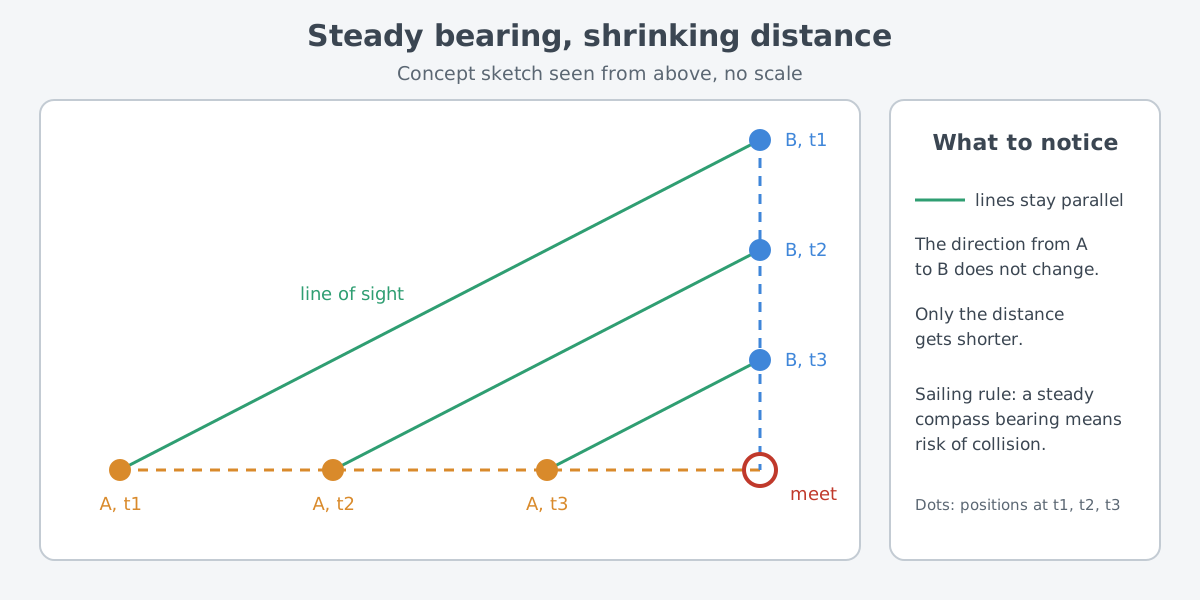
Ships and missiles use this rule in opposite ways. A ship watches for this situation so it can avoid it, while a missile tries to create it on purpose.
The rule itself carries a caveat. With a huge ship, a ship towing another, or any ship that is already close, the danger can be real even if the bearing clearly shifts. Treating an object of real size as a single point can miss things.
The line of sight and its rate of turn
The line from a missile to its target is called the line of sight (LOS). As the missile and target move, this line changes length and also turns. The relative velocity splits into those two parts. One part is the distance shrinking or growing, and the other is the line of sight rotating.
The rate at which the distance shrinks is called the closing velocity (Vc). When the two are approaching, the distance shrinks and the closing velocity is positive. The rate at which the line of sight rotates is the LOS rate. It is a change of angle per second (in the formula below, measured in radians).
The sailing rule can now be restated in these terms. An intercept is guaranteed when three conditions hold together. The LOS rate is zero, the missile can accelerate along the line of sight at least as much as the target can, and the distance is shrinking from the start. The first of the three is the sailing rule's steady bearing.
Guidance analysis often assumes that the missile is already on such a collision course, or close to it. In reality, that is usually not the case. Early in an engagement especially, the target's position can be quite uncertain, and its future maneuvers cannot be predicted. That is why a rule is needed that keeps correcting the path in flight.
The rule of proportional navigation
Proportional navigation is that correcting rule. It issues guidance commands proportional to the LOS rate between the guided missile and the target. When the line of sight starts to turn, the missile turns to cancel that rotation. The faster the line turns, the harder the missile turns.
For motion in a plane, the rule fits on one line. Here a is the commanded acceleration, N is a constant called the navigation ratio, Vc is the closing velocity, and λ̇ is the LOS rate. The diagrams write λ̇ as dλ/dt.
a = N × Vc × λ̇
The commanded acceleration points at right angles to the line of sight. Read directly, the formula asks for a sharper turn at a higher closing velocity, even for the same rotation of the line of sight. The navigation ratio cannot take just any value. Even in simplified theory, guidance becomes unstable when the navigation ratio is 2 or less.
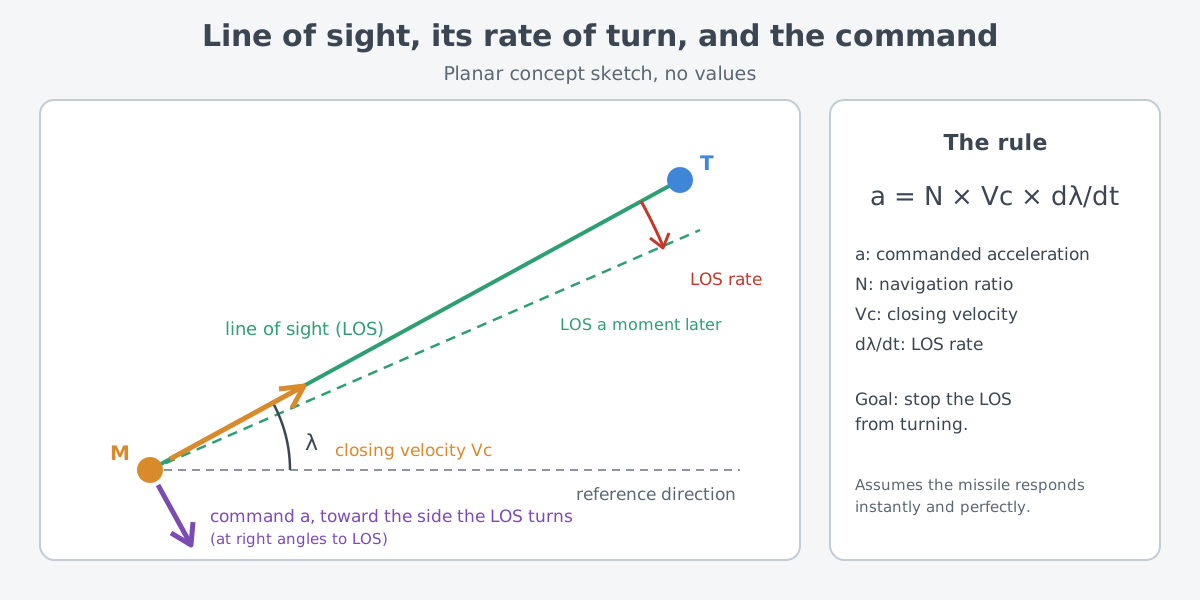
One big assumption hides in this formula. It assumes the missile follows each command instantly and perfectly. Real acceleration comes from deflecting aerodynamic control surfaces such as fins, from control thrusters, or from both. That takes time, so a real missile does not move as ideally as the formula suggests.
There are variants as well. The form above is called "true PN," while "pure proportional navigation" (PPN) commands acceleration at right angles to the missile's own velocity instead of the line of sight. The rule is short, but working out its results is not easy. The equations of motion are strongly nonlinear, so attempts to solve them analytically have had only limited success.
How the missile senses the line-of-sight rate
The formula needs two values: the closing velocity and the LOS rate. How they are obtained depends on which sensor the missile uses to see the target and how that sensor is mounted on the body.
Take closing velocity first. Some missiles send out radio waves, or pick up radio waves that another source aims at the target. For them, the Doppler shift of the returning signal gives a good estimate of closing velocity. In other designs, range or closing velocity can be sent up to the missile from outside at regular intervals.
The LOS rate comes from the seeker. Some seekers sit on a gimbal, which isolates them from the body's motion and widens the area they can look at.
Seekers that do not need a wide view, or that use an infrared focal plane array, may be fixed directly to the body. This is called a strapdown design. Missile seekers: the eye at the front explains how seekers are built in more detail.
The data from a sensor is noisy. A guidance filter therefore takes the raw data and estimates and cleans the signals that the guidance law uses. Once the guidance law sets an acceleration command, the autopilot issues the fin or thrust commands needed to produce it.
An inertial navigation system (INS) reports the missile's own motion, such as its position, velocity and attitude. As the missile moves, the positions of missile and target relative to each other change, and the seeker measures again.
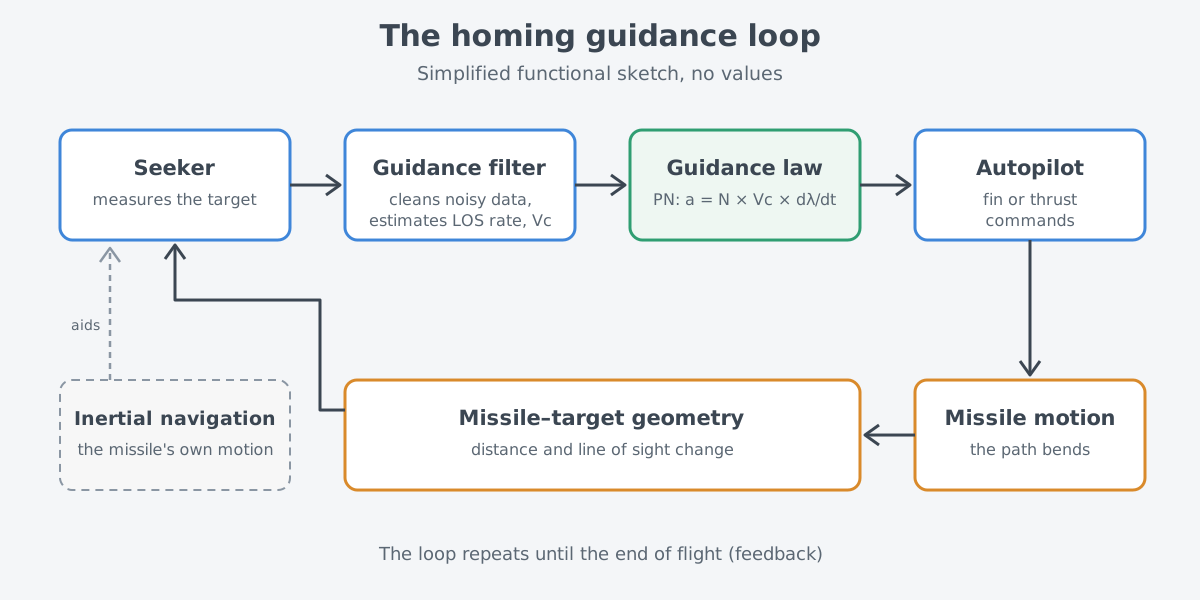
This loop is the backbone of homing guidance. A guidance, navigation and control system runs on the principle of feedback. Proportional navigation is the one box in the middle of that loop that decides how hard to turn.
Why it has lasted, and where it falls short
Proportional navigation is one of the oldest and most widely used guidance laws. Many guided missiles use some version of it in the final homing phase. It appears in air-to-surface, air-to-air and surface-to-air missiles, and in space tasks such as a rendezvous between two spacecraft.
Simplicity is one reason it has lasted. The basic form needs less information about the target's motion than more elaborate schemes, which eases the demands on the sensors a missile has to carry. In the 50 years up to about 2010, it also proved dependable and sturdy.
By the mid-1970s, its limits had also come into view. According to the guest editor's introduction to a 2010 special issue of the APL Technical Digest, PN stayed the preferred law into the 1970s and later. At that point, though, it became clear that new kinds of threat, such as highly maneuverable aircraft and supersonic cruise missiles, might blunt weapons guided by PN. This insight, combined with smaller computers and growing computing power, gave rise to new guidance techniques built mainly around linear-quadratic optimization.
That did not push PN aside. The same introduction notes that in 2010 many guided missiles still used PN or a close variant. Two assumptions behind the rule do not hold in practice: that the missile reacts instantly, and that the needed values are known without noise. That gap is where the design difficulty lies.
Where this meets lasers: holding the line of sight
In proportional navigation, the key value is how fast the line of sight is turning. To measure it, the seeker has to keep track of the direction to the target even while the body moves. A gimbal that isolates the sensor from the body's motion helps with that job.
Laser weapons face a similar task. To hold a beam on one spot on a target, they must keep measuring and correcting the direction to it. That story continues in Gimbals, pointing and tracking: holding the beam on one spot.
What to read next
- Missile seekers: the eye at the front: what the seeker that measures the LOS rate is made of.
- Air-to-air missiles: what the missile sees: one of the missile families that use proportional navigation.
- Gimbals, pointing and tracking: holding the beam on one spot: how laser weapons hold their direction.