When a missile follows a laser, what is that laser shining on? It may be the target. It may also be the road the missile is meant to fly.
Picture a boat trying to reach a lighthouse on a dark night. It has two choices. It can steer for a rock lit by the lighthouse, or it can keep its bow inside the band of light thrown across the water. The first boat watches the target, and the second watches the road.
Laser-guided missiles split the same way. Semi-active laser guidance puts a laser spot on the target and follows the reflection. Beam riding keeps the missile inside a path drawn by a beam, and this article is about that kind.
A real beam does not sit still like a lighthouse, though. It keeps moving to follow the target, and the missile must keep correcting its position to match a moving road.
Light on the target, or light on the road
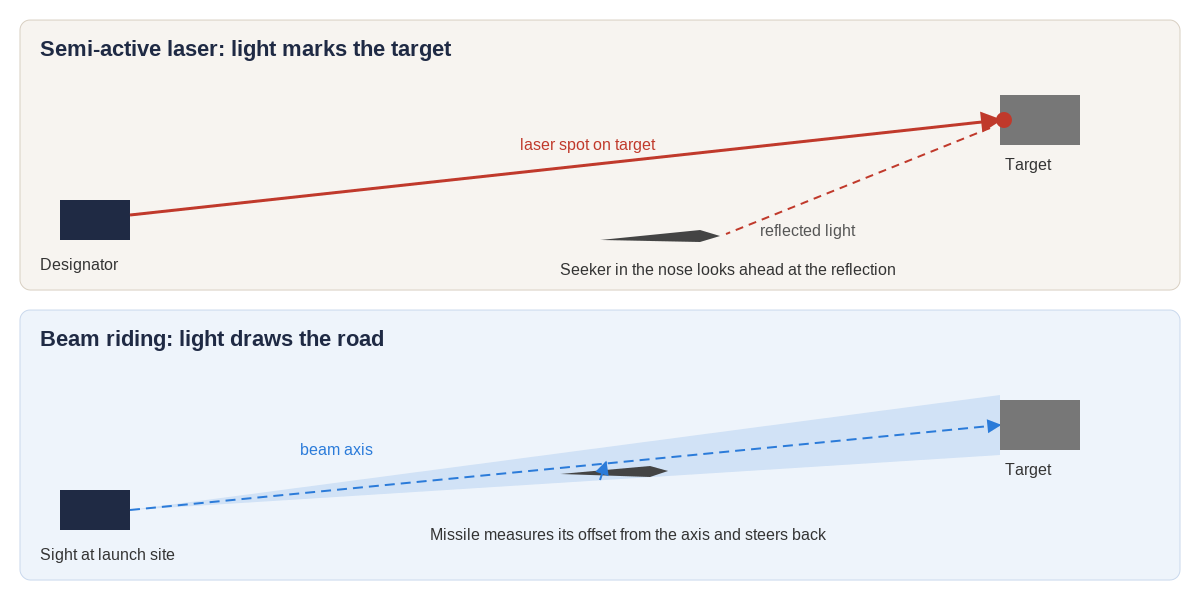
In semi-active guidance, a beam of light, laser, infrared or radio energy is pointed at the target to designate it. The missile's seeker follows the energy reflected from the target. The U.S. Navy's Hellfire uses a semi-active laser seeker that can be guided by a laser from inside the aircraft or from outside it. The equipment that lights the target is a laser designator.
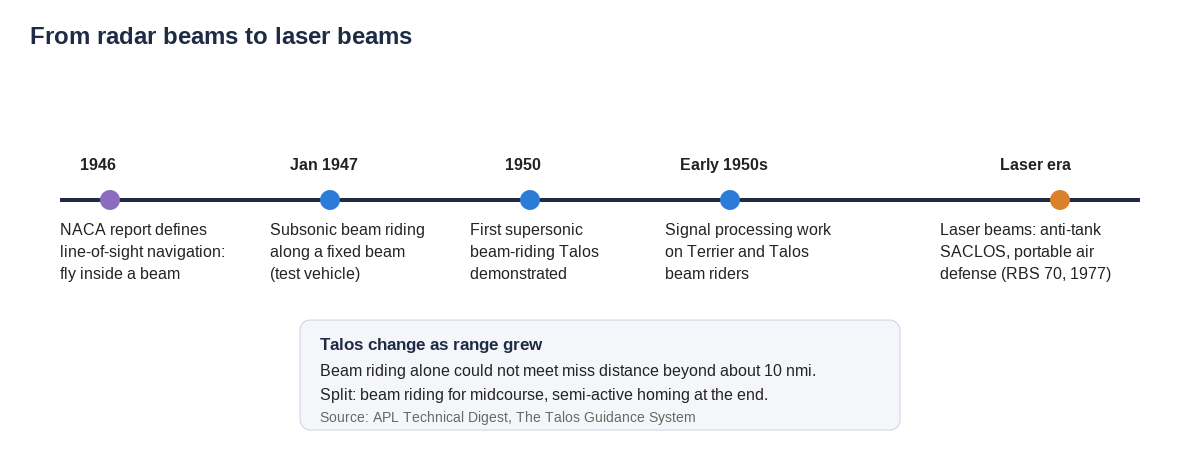
In beam riding, the beam also points toward the target. The difference is that the missile rides the beam itself, not the reflection coming back from the target. A 1946 report by the National Advisory Committee for Aeronautics (NACA) called this line-of-sight navigation.
With the seeker placed near the launcher and its beam pointed toward the target, the missile flies inside that beam to reach the target. The eye that sees the target stays at the launch site. The missile only needs a way to know where it sits inside the beam.
Drift off the axis, steer back
What does staying inside a beam actually involve? The Johns Hopkins Applied Physics Laboratory (APL) article on Talos guidance describes radar beam riding this way. When the missile drifts off the axis of a radar beam that is scanned in a cone, its control surfaces move to bring it back to the beam axis. To do that, the missile has to work out its own direction and distance from that axis.
The contrast with a seeker is sharp. A semi-active missile looks ahead for the target's reflection. A beam-riding missile does not search for the target at all. It only measures how far it has slipped from the center of the beam.
The first beam riders
Beam riding was tested early, in the U.S. Navy's Bumblebee program of the 1940s. The program's first guidance concept was a radar beam that followed the target and guided the missile to it. A guidance test vehicle achieved subsonic beam riding along a fixed beam in January 1947, and the first supersonic beam-riding Talos was demonstrated in 1950.
In the early 1950s, APL researchers worked on signal processing to improve beam rider performance for the Terrier and Talos missiles. The task was defending the fleet against air attack, especially enemy planes flying very low.
Trouble with distance
Beam riding ran into a distance limit. According to the APL Talos article, it became clear early that beam riding alone could not meet the allowed miss distance beyond about 10 nautical miles.
The fix was to split the job. As the intercept range grew, Talos was redesigned to fly the midcourse phase by beam riding and the terminal phase by semi-active homing. Miss distances became very small and almost independent of intercept range.
The beam leads the long stretch, and the missile's own eye handles the last few steps. This way of splitting the work continues in Midcourse and Terminal Guidance: Why a Long-Range Missile Picks Its Way Twice.
Moving to laser beams
Beam riding also moved from radar to lasers. Second-generation anti-tank guided weapons use semi-automatic command to line of sight (SACLOS). Their guidance commands can reach the missile by three routes: wire, radio or a laser beam.
A public example is the RBS 70 portable air defense system from Saab of Sweden. Saab presents the original RBS 70 of 1977 as a laser beam riding missile. For its successor, the RBS 70 NG, Saab calls the guidance "unjammable laser guidance," which is the maker's wording.
The sight module includes day and night thermal imaging and an auto-tracker that helps the operator during an engagement. Saab also tells how, early in its laser guidance work, a remote-controlled car stood in for the missile.
The operator's share
The price of beam riding is the operator's time. The beam has to stay on the target, so the aim cannot be released until the missile arrives.
Third-generation anti-tank weapons solved this with passive seekers. These fire-and-forget systems guide the missile with no operator input in flight. Small Arms Survey notes that they were first developed in the 1980s.
So beam riding and seeker homing differ less in age than in what they hand over. Beam riding keeps the eye that judges the target at the launch site. Fire-and-forget puts that eye in the missile.
Where this meets lasers
In beam riding, the beam is the road the missile travels. A laser beam also grows slightly wider with distance, so the same beam gives a road of a different width near and far. Why laser beams spread continues in Why a beam spreads: divergence, focus and aperture.
What to read next
- Laser Designators: Pointing Out a Target with Light: when the light marks the target
- Anti-tank guided missiles: rockets versus guided missiles: from hand control to SACLOS and fire-and-forget
- Guidance Types Side by Side: Command, Semi-Active, Active, Imaging and Inertial/Satellite: five approaches in one table