A shell's path is fixed the moment it is fired. A guided missile is different. The technical journal of the Johns Hopkins Applied Physics Laboratory (APL) defines it as a projectile that can still change its flight path after launch. So how does a missile know which way to turn?
There are five broad answers. A person sends commands, or the missile follows light shone from outside. It may send out its own radio waves, watch the target's heat, or know the coordinates from the start. After a look at each in turn, the last section shows how they link up inside one missile.
Command guidance: a person aims, a wire carries the message
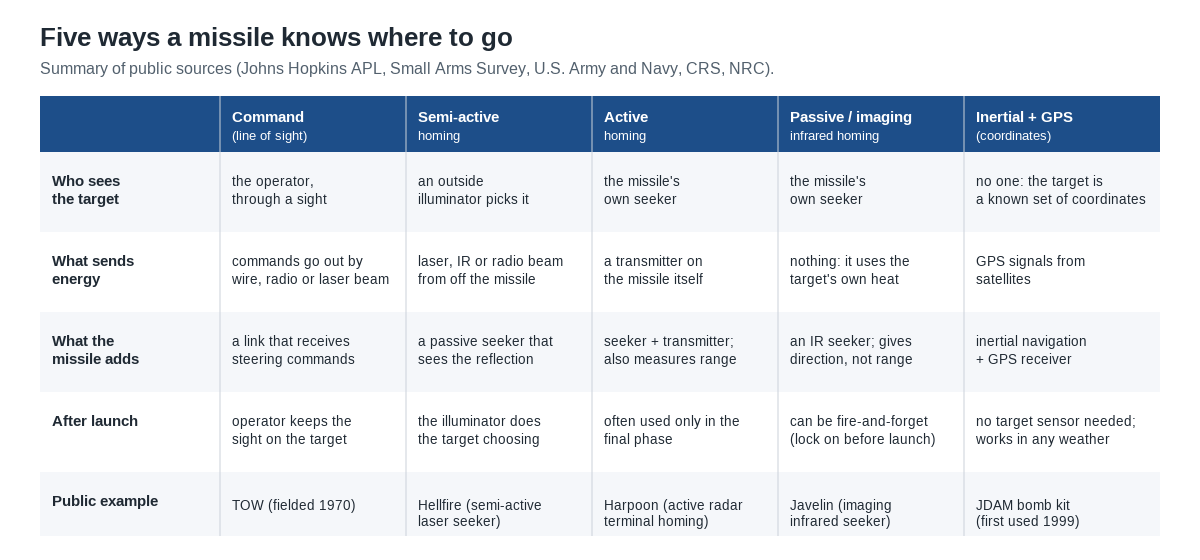
The oldest approach is for a person to steer the missile directly. According to a Small Arms Survey report on anti-tank guided weapons, the first generation was steered by hand along the line of sight, a method called MCLOS. The operator steered the missile by hand, often with a joystick, and commands traveled down a wire trailing from the missile.
The second generation handed half the job to machines. In SACLOS, short for semi-automatic command to line of sight, the operator only keeps the sight on the target. Automatic steering commands then reach the missile by wire, radio or laser beam.
The U.S. Army's TOW says it in its name: tube-launched, optically tracked, wire-guided. The first version was fielded in 1970.
The weak spot is that the operator has to stay in place while the missile is in flight.
Homing: giving the missile eyes
When the missile itself sees the target instead of the operator, it is called homing guidance. A sensor on board supplies the target data behind each guidance decision. Because the target information keeps improving as the missile closes in, APL rates homing's intercept accuracy above every other form of guidance.
Homing seekers come in three groups: passive, semi-active and active. The dividing question is simple. Who creates the energy coming back from the target?
Semi-active: following light shone from outside
In a semi-active system, someone off the missile shines light, a laser, infrared or a radio beam on the target. The missile's seeker sees that energy after it reflects off the target and follows it. So the choice of target rests mostly with whoever does the shining.
There is an advantage. Far more power can be put on the target without making the missile bigger or heavier. The Hellfire missile uses a semi-active laser guidance seeker.
Active: the missile lights the target itself
An active system puts the illuminator, a transmitter, on the missile too. Because the missile sends a signal and receives what comes back, it can learn not only the target's direction but also its range and closing speed.
The cost is weight and power. For that reason active homing is usually saved for the final phase, after some other guidance has brought the missile close. The U.S. Navy's Harpoon anti-ship missile is one example. Its guidance is active radar terminal homing, and it can be fired from ships, submarines, coastal batteries or aircraft.
Passive and imaging: watching the target's heat
A passive seeker shines nothing. The best-known type is the infrared seeker, which detects and follows the heat a target gives off. A passive seeker measures the target's direction but does not readily give range or closing speed. In return, since it emits nothing, the target cannot tell it is being tracked.
Some infrared seekers see a picture rather than a point. The Javelin anti-tank missile uses an imaging infrared seeker that locks on before launch, so the gunner can fire and take cover right away. This is called fire-and-forget, and Small Arms Survey says such guidance for anti-tank weapons was first developed in the 1980s.
Inertial and satellite: flying to coordinates
The last approach does not look at the target at all. Inertial guidance makes precise delivery of long-range ballistic missiles possible when the target is a known set of Earth coordinates.
Adding satellite signals gives today's common form.
A National Research Council report describes JDAM as a new tail for an unguided bomb. The tail holds an inertial navigation system and a GPS guidance unit, improving accuracy in any weather. The Congressional Research Service notes that the U.S. Air Force first used JDAM in 1999. Guidance to coordinates does rest on the assumption that the target stays where it was.
One missile, several types
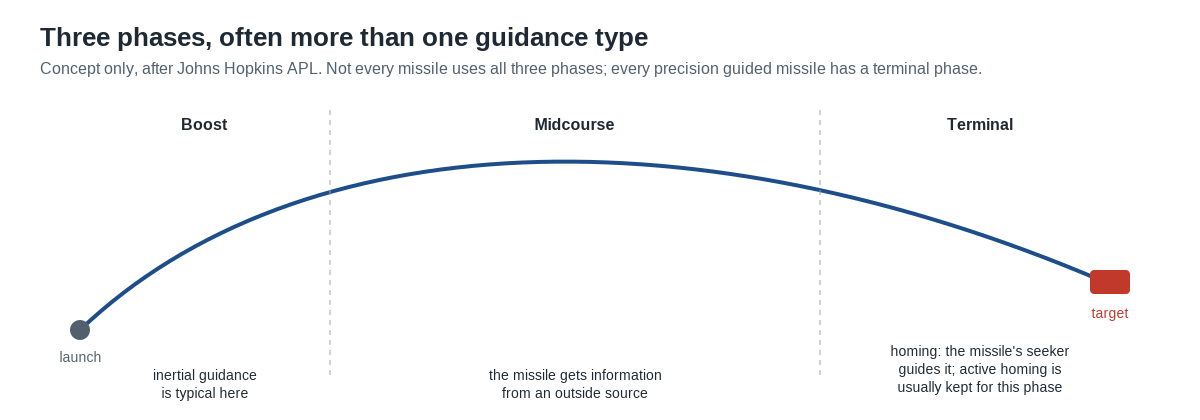
Real missiles often use more than one of the five. Guided flight usually falls into three phases, called boost, midcourse and terminal. Inertial guidance is typical in the boost phase. In midcourse the missile takes in information from outside, and homing takes over in the terminal phase.
Not every missile uses all three. Still, every precision guided missile has a terminal phase. The five columns in the table separate different weapons, but they can also be stages that follow one another inside a single weapon. The math of chasing a moving target continues in Proportional Navigation: The Basic Idea Behind Chasing a Moving Target.
Further reading
- Air-to-air missiles: what the missile sees: how the three seeker types are used
- Anti-tank guided missiles: rockets versus guided missiles: from command guidance to fire-and-forget
- GPS-Guided Munitions: How a Tail Kit Changed the Bomb: combining inertial navigation and GPS