Have you ever watched a crossing signal start to flash and wondered whether you could still make it across? U.S. traffic rules set the walking speed used for exactly that calculation. It is 3.5 feet per second, or about 1.07 m per second.
Start at 1 m per second and get ten times faster with each rung. How far up do you have to go? Past sound, a hypersonic research aircraft and the orbiting space station, light is a little more than eight rungs away. Every speed here is in meters per second (m/s).
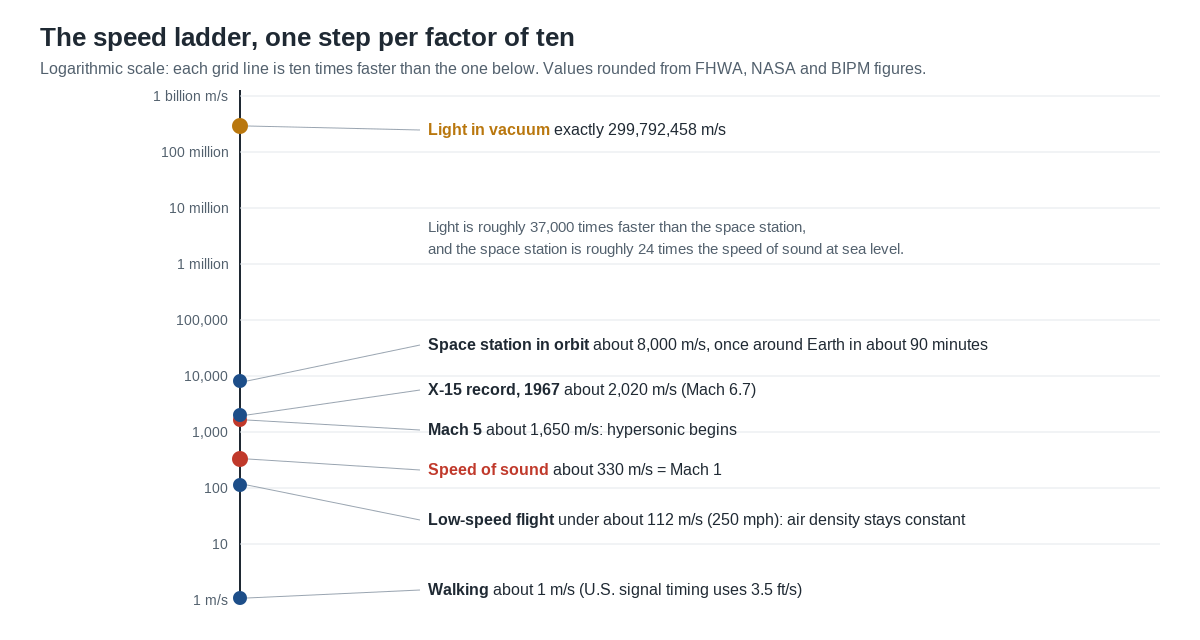
Bottom rung: walking
The 11th edition of the Federal Highway Administration's traffic signal manual (MUTCD) uses 3.5 feet per second as the base walking speed when setting crossing times for pedestrian signals. The same manual adds that a slower speed should be considered where slower walkers or wheelchair users cross often. People do not all walk at one speed.
The figure is a design value for signals, not an average person. It still gives a good feel for scale. Every other rung on the ladder can be read against this 1 m per second.
The sound barrier: about 330 m/s
Climb two rungs, about 100 times faster, and you reach airplanes. NASA Glenn Research Center explains that when an aircraft passes at low speed, typically under 250 mph (about 112 m/s), the density of the air stays constant. At these speeds air can be treated as a fluid that does not compress.
Sound sits just above. NASA gives the speed of sound as about 330 m/s, roughly 310 times walking speed. That speed is not fixed, though. It depends on temperature and falls as altitude increases.
So aviation divides an aircraft's speed by the local speed of sound. The result is the Mach number. Mach 2 means twice the speed of sound at that place.
Four zones by Mach number
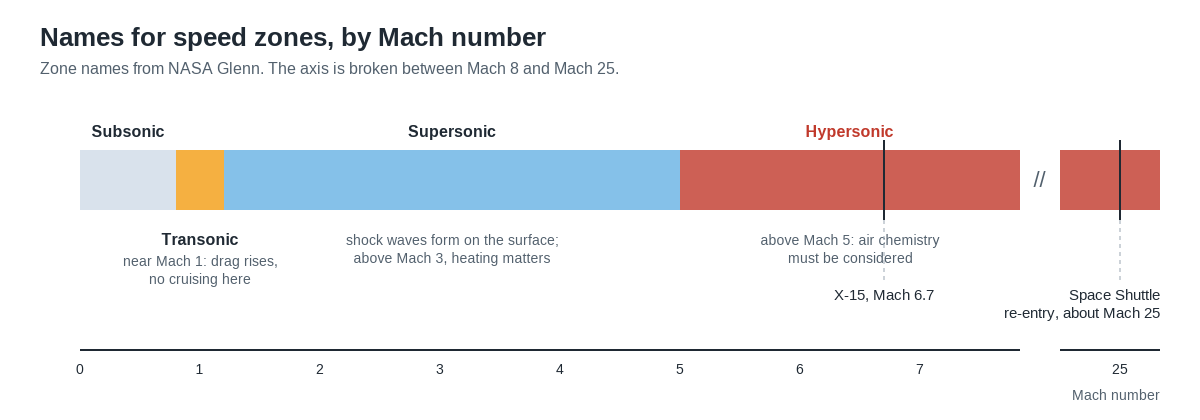
Below Mach 1 the flow is subsonic. At the lowest subsonic speeds the squeezing of air can be ignored. Near Mach 1 the flow is called transonic, and over parts of the aircraft the air is already moving faster than sound.
NASA explains that compressibility effects are strongest in this zone and once led people to believe in a "sound barrier." High drag keeps aircraft from cruising close to Mach 1.
Above Mach 1 the flow is supersonic. Shock waves form on the surface of the aircraft, and above Mach 3 heating from the air becomes a major design problem. Shock waves have their own article, Supersonic Flight and Shock Waves.
Above Mach 5 the flow is hypersonic. Using the sea-level speed of sound, that is roughly 1,650 m/s. At these speeds, NASA notes, chemical changes in the air have to be included when working out the forces.
The "hypersonic" in news about hypersonic weapons refers to this zone. How missiles fly through it is covered in Hypersonic glide vehicles.
Real flights that reached hypersonic speed
Hypersonic speed is not just a number on paper. On October 3, 1967, the X-15 rocket plane reached 4,520 mph, or Mach 6.7, with Air Force pilot Pete Knight at the controls. That is about 2,020 m/s. According to NASA, the X-15 was designed from the start to study heating, stability and control, and effects on the human body in flight at Mach 5 and above.
There are much faster examples. The Space Shuttle re-entered the atmosphere at about Mach 25. A vehicle coming down from orbit hits the air at speeds no airplane can reach.
Orbital speed: about 8 km/s
The next rung is orbit. NASA says the International Space Station travels at five miles per second, about 8 km/s, and circles Earth about every 90 minutes. It makes 16 orbits a day, so the crew sees 16 sunrises and 16 sunsets.
That is about 24 times the speed of sound at sea level. In orbit there is almost no air, however, so nobody calls it "Mach 24." The Mach number is a yardstick for moving through air. The station's orbit belongs to low Earth orbit (LEO).
Top rung: light
Light sits at the top. The speed of light in a vacuum is not a measured value but a fixed one. The International Bureau of Weights and Measures (BIPM) sets it at exactly 299,792,458 m/s and defines the length of one meter from it.
From the space station to light is another climb of about 37,000 times. From walking to light is close to 300 million times. That is why the figure uses a logarithmic scale, where each step is ten times the last. On an ordinary scale, everything from walking to the space station would collapse into one dot at the bottom.
The "speed of light" that appears in laser weapon news belongs on this rung. How the speed at which light arrives differs from the time it takes to have an effect on a target is covered in What is a laser weapon?.
What to keep in mind when reading the ladder
Most numbers on the ladder are rounded. The speed of sound changes with weather and altitude, and the walking speed is a design value for signals. Even the Mach 5 line for hypersonic flight is not a law of physics. It is a convenient name for the zone where the behavior of air changes a great deal.
Further reading
- Supersonic Flight and Shock Waves: what happens to the air past Mach 1
- Hypersonic glide vehicles: what is different about weapons that fly above Mach 5
- Engine Speed Map: From Propellers to Scramjets and Rockets: which engine fits which speed