Read enough missile news and you keep running into phrases like "can lock on after launch" or "fire-and-forget." The words feel familiar, but what they mean exactly is fuzzy.
The three terms ask different things. Lock-on before launch (LOBL) and lock-on after launch (LOAL) ask when the missile's seeker grabs the target. Fire-and-forget asks whether a person must keep doing anything after firing. Separating the two questions makes those news lines much clearer.
Lock-on means the seeker grabs the target
Lock-on is the moment the seeker in the missile's nose grabs the target and starts following it. The seeker measures which direction the target lies in from the missile, and homing guidance can only begin once that direction is known.
The Johns Hopkins Applied Physics Laboratory (APL) Technical Digest explains that for a long-range missile, seeker lock-on happens just before terminal homing. The midcourse phase before it brings the missile to a good spot for the seeker to acquire the target. So lock-on names a single moment within one flight.
Lock-on before launch: grab, then fire
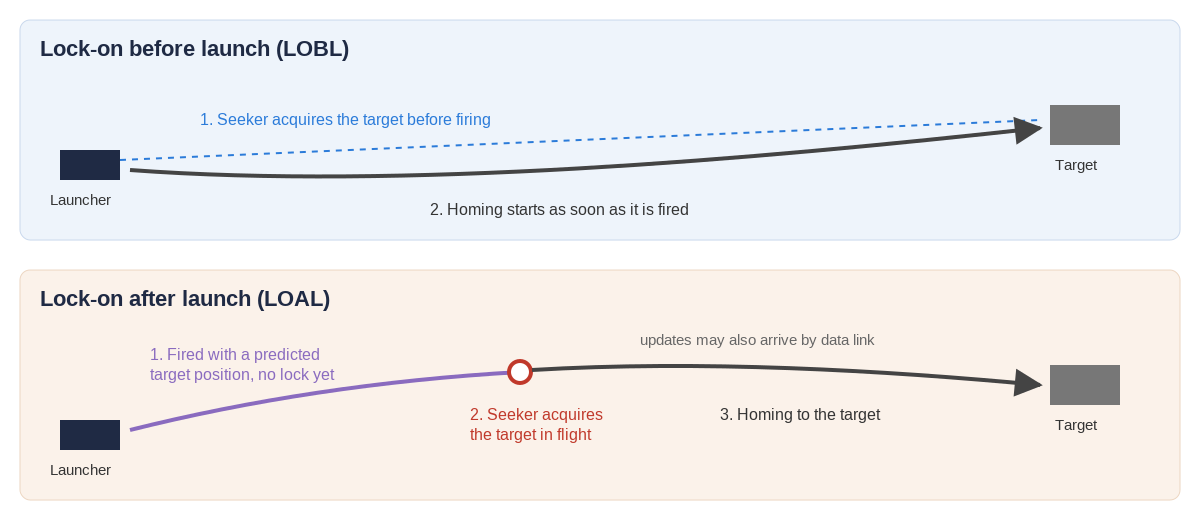
According to the APL Technical Digest, some missiles, usually shorter-range ones, home all the way. Such a missile must acquire the target with its own seeker before launch so it can start homing the moment it is fired. That is lock-on before launch.
A public example is Javelin, the portable anti-tank system of the U.S. Army and Marine Corps. The U.S. Army Redstone Arsenal history office lists an imaging infrared seeker and "target lock-on before launch" among its features. The first two Javelin missiles were formally delivered to the government on September 29, 1995.
Lock-on after launch: fire, then grab
The same APL passage describes a variation. The missile is told where the target is expected to be a while after launch, and it is fired before its seeker has acquired the target. A short inertial leg points it toward the predicted spot. Then, using that prediction as a guide, it finds and acquires the target and begins homing.
That is lock-on after launch.
The AIM-9X Block II air-to-air missile reached full-rate production on August 17, 2015. Describing that milestone, the Naval Air Systems Command (NAVAIR) named lock-on after launch as its most significant change. The pilot no longer has to see the target and lock the missile on before firing, and can launch without knowing the target's exact position. After launch, the seeker inside the missile finds the target by its infrared emissions or through a data link.
One missile can do both. In a 2014 news release, Lockheed Martin says the Longbow missile's millimeter-wave seeker can acquire a target either before it leaves the launcher or after it is in the air. According to the maker, the U.S. Army and Navy demonstrations described there were the first vertical launches of Longbow and its first lock-on after launch against maritime targets. The U.S. Army Redstone history office also describes Longbow Hellfire as a radar-aided, inertially guided missile that uses millimeter wave radar technology.
Fire-and-forget: the person's share after firing
Fire-and-forget guidance belongs to the other question. It means no one has to keep aiming at or lighting the target after the shot.
The history of anti-tank guided weapons shows the difference well.
With second-generation semi-automatic command to line of sight (SACLOS) systems, the operator could not let go of the aim until the missile arrived. According to Small Arms Survey, the third generation used passive seekers to guide the missile with no operator input in flight. These fire-and-forget systems were first developed in the 1980s. Javelin, too, does not need the gunner to keep aiming after the shot.
The three terms in one table
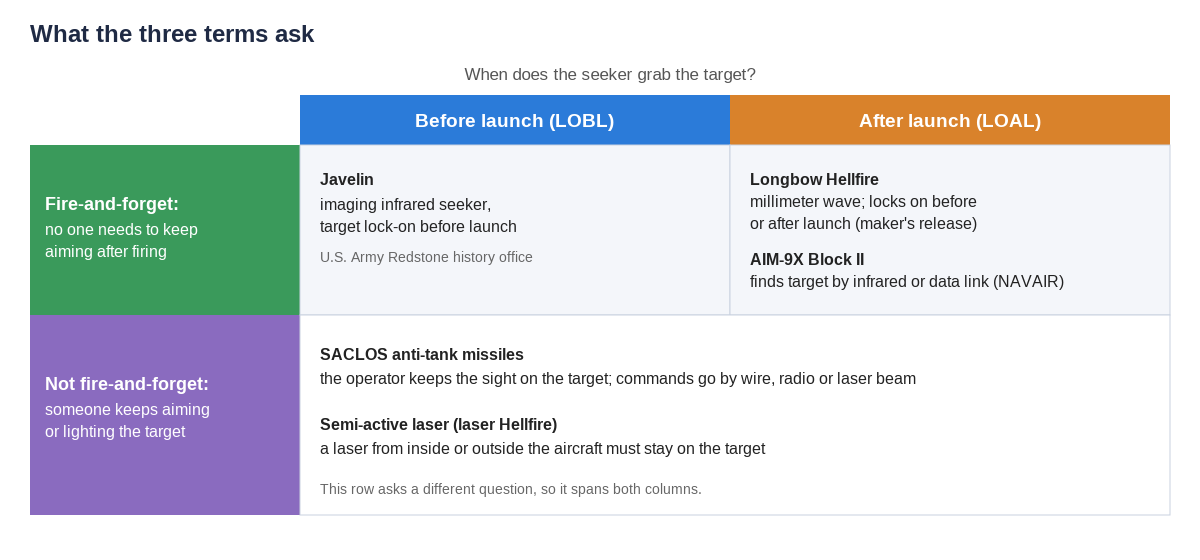
Put the two questions together and things fall into place. Javelin locks on before launch and is forgotten after the shot. Longbow and AIM-9X Block II can lock on after launch. A SACLOS missile, by contrast, leaves the job of holding the target to the operator's sight, so a person cannot let go after firing.
Semi-active laser guidance sits in that row too. The U.S. Navy fact file says Hellfire can be guided by a laser from inside the aircraft or by one outside it. While the missile follows the target, someone has to keep the laser on it. So within the same Hellfire family, the laser version and the Longbow version leave different work to people.
Where this meets lasers
Many of the methods that are not fire-and-forget are tied to lasers. In semi-active laser guidance, a laser designator lights the target. In beam riding, a laser beam is the missile's road. The first is covered in Laser Designators: Pointing Out a Target with Light, the second in Beam-Riding Guidance: Missiles That Ride a Laser Beam.
What to read next
- Anti-tank guided missiles: rockets versus guided missiles: from the first generation to the third
- Missile seekers: the eye at the front: the device that does the locking on
- Imaging Infrared Seekers: Recognizing a Target from a Heat Picture: Javelin's eye