Parade photos often show a long vehicle with many wheels. A thick tube lies along its back, and in other photos the same tube points at the sky. This vehicle is called a transporter erector launcher, or TEL.
A missile could simply be fired from a fixed launcher on the ground. So why carry it around on a truck and then stand it up? Part of the answer is already in the three words of its name.
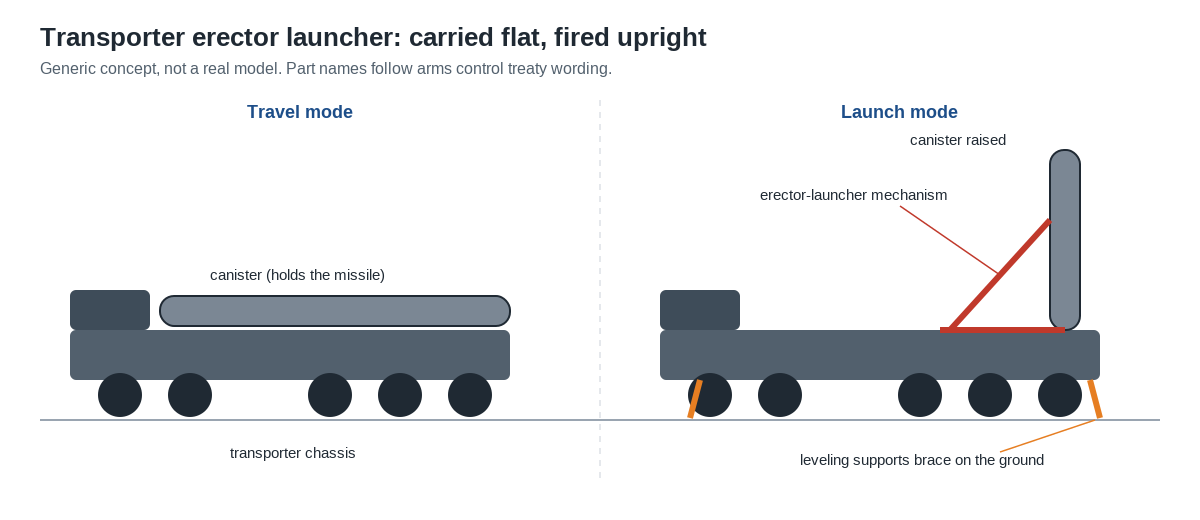
A three-word name: transport, erect, launch
TEL stands for transporter erector launcher. One vehicle carries the missile (transporter), raises it (erector) and fires it (launcher). Splitting a photo into those three jobs makes the parts easier to read.
Arms control documents name the parts clearly. A Congressional Research Service (CRS) report on the New START treaty describes a mobile launcher as an erector-launcher mechanism plus the self-propelled device it is mounted on. The elimination rules of the older START treaty told each side to remove the erector-launcher mechanism and the leveling supports from the launcher chassis.
There are four parts. The chassis carries the wheels and the engine. The erector-launcher mechanism lifts the missile, while the leveling supports brace against the ground so the vehicle stays steady. In many cases there is also a canister, the tube that holds the missile.
One example: China's DF-31, as described in a 2005 CRS missile survey, rides in a canister on a transporter-launcher vehicle; the missile itself has three solid-propellant stages.
Why make a launcher mobile?
The answer is about hiding. During the START talks in the mid-1980s, the Soviet Union began deploying the road-mobile SS-25 and the rail-mobile SS-24 ICBMs. According to CRS, the United States at first proposed banning mobile ICBMs outright. In a war, it argued, American forces could neither find these launchers nor aim at them.
A fixed launcher sits where the other side already knows it is. A moving launcher first has to be found. In May 2024 an Army official told Congress that competitors' ballistic missiles are becoming more mobile and survivable, and CRS quoted that line in its missile defense primer.
Putting a missile on a truck also adds a step before launch. The missile rides lying down, so it has to be raised, and the vehicle has to stay level while it stands. Those jobs belong to the erector-launcher mechanism and the leveling supports.
Road, rail and fixed sites
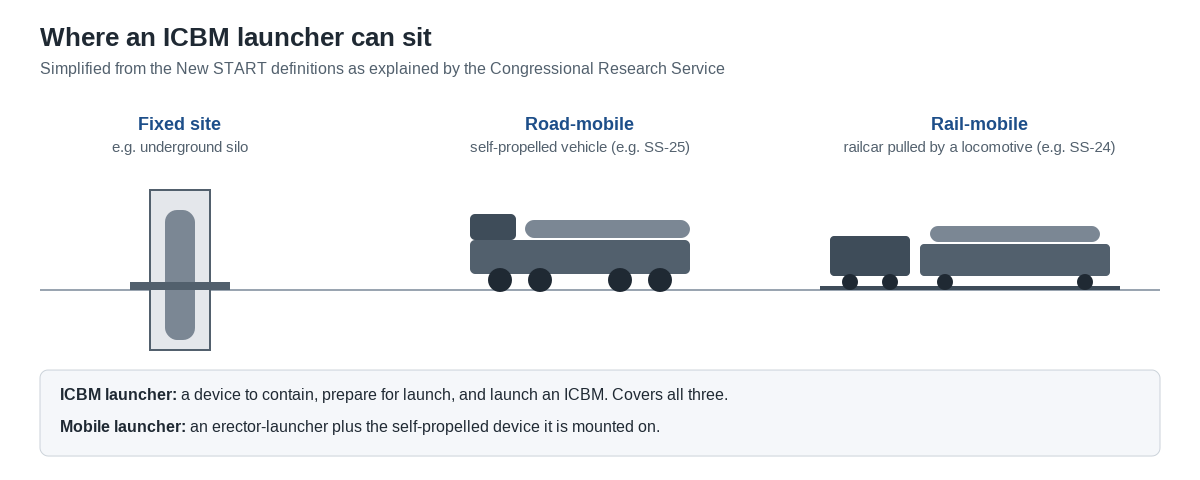
ICBM launchers sit in three broad kinds of places: a fixed site such as an underground silo, a road vehicle, or a railcar. New START defines an ICBM launcher as a device to contain, prepare for launch, and launch an ICBM. CRS explains that the wording reaches every erector-launcher: in a silo, on a road vehicle, or on a train.
The definition of a mobile launcher adds one more condition. The device carrying the erector-launcher must be self-propelled. A road-mobile vehicle drives under its own power, so it fits.
A railcar is different. A locomotive pulls it, so it is not self-propelled. Two launchers that both move can fall on opposite sides of a single word in a treaty.
TELs in public sources
TELs are not only for attack missiles. A U.S. interceptor program used one too. The Kinetic Energy Interceptor (KEI) was a boost-phase defense program. According to the National Research Council, its TEL carried and launched one round per launcher and could be moved by C-17 or C-5A aircraft.
There is a recent example as well. CRS reports that a December 2024 Defense Department test marked the first time the Long-Range Hypersonic Weapon (LRHW) was fired live with its Battery Operations Center and a TEL. Naming the TEL in a test description shows that the launcher is tested as part of one system with the missile.
How many rounds one vehicle carries depends on the system. In the U.S. Army's Redstone Arsenal history pages, a Patriot battery has up to eight launchers, each holding four ready-to-fire missiles. KEI carried one round per vehicle; a Patriot launcher carries four. Vehicle launchers can look very different depending on the missile they carry.
How treaties count and eliminate TELs
Arms control treaties count launchers, not just missiles. If the missiles are cut but the means to fire them remain, the cut means less. So treaty documents even spell out how a TEL is to be destroyed.
The Intermediate-Range Nuclear Forces (INF) Treaty is one example. According to the Army history office, the Pershing launchers were dismantled, and the main pieces of their erection mechanisms and chassis were sawn into two. CRS explains that under New START the elimination process for road-mobile ICBM launchers became far simpler and less destructive than under START. In both treaties, the part chosen for cutting was the mechanism that stands the missile up.
Reading a TEL in a photo
A single photo tells less than it seems. You can see the number of wheels, the width of the tube and the angle it is raised to. You cannot tell from the photo which missile is inside or how far it flies. Two tubes can look alike and hold different things.
Still, knowing the four parts, chassis, erector-launcher mechanism, leveling supports and canister, is enough to tell what job a vehicle in a news photo is built to do. How the missile leaves the tube leads to the difference between cold launch and hot launch.
Further reading
- Cold launch: why some missiles pop out before igniting: pushing a missile out of an upright tube
- Ballistic missiles: why they climb high and come down: the flight of the missiles TELs often carry
- ICBMs: what they share with space launch vehicles: the largest missiles that treaties count
- Inclined vs Vertical Launch: Why Some Missiles Are Fired Tilted and Others Upright: what the launcher angle changes