Photos of warships firing missiles fall into two groups. In one, a box or rail on deck swings around, tilts toward the sea and fires. In the other, a flat hatch in the deck opens and a missile climbs straight into the sky.
Why do missiles doing similar jobs leave in such different ways? One kind turns its launcher toward the target before firing. The other rises straight out of a cell that always faces up. Each gains something and gives something up.
Point, then fire: the trainable launcher
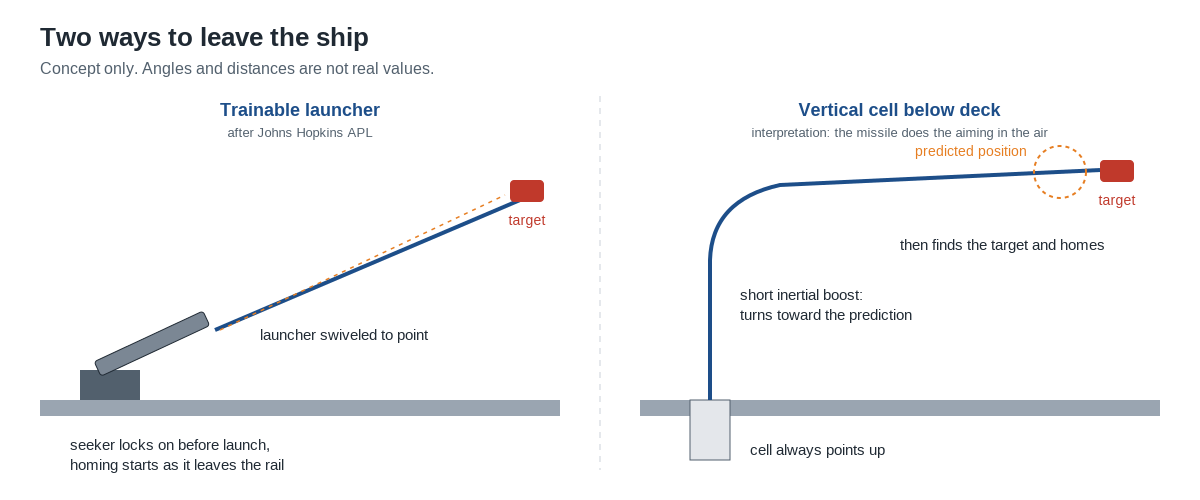
The technical journal of the Johns Hopkins Applied Physics Laboratory (APL) describes how a missile that homes all the way to the target, usually a shorter-range one, is launched. The missile rests on a rail launcher that can be turned, or in a launch canister, and the whole launcher is swung around to face the chosen direction.
The key is the order of events. With the launcher already turned toward the target, the missile locks on with its own seeker before it is fired. So it can begin homing guidance the moment it leaves the rail.
Fire upright, then pick a direction
A missile fired upright starts out pointing at the sky. If the target is out toward the horizon, it has to turn somewhere. The idea of finding a direction in the air shows up elsewhere in the APL journal. It describes a variation on the trainable launcher: before launch the missile receives an estimate of the target's future location, and it leaves without having locked on.
Right after launch comes a short inertial boost phase. During it, the missile bends its course toward that estimated position. After that it looks where the prediction says, finds the target and starts homing. The same journal splits guided flight, in the general case, into boost, midcourse and terminal phases.
APL does not tie this variation to vertical launch. Still, applying the same idea to an upright missile makes the picture clearer. To reach a target near the horizon, a missile that climbs straight up has to take over in the air the aiming that a trainable launcher would have done.
Cells below deck: what vertical launch gains
The Congressional Research Service (CRS) explains that the missile cells on U.S. Navy cruisers and destroyers are grouped in one installation, the vertical launch system (VLS). Instead of a launcher that turns, many upward-facing cells are bundled into one block.
Lockheed Martin lists several advantages for its MK 41 VLS. It is installed below deck, it does away with problems of older, single-purpose deck launchers, and it is designed so that any missile can go into any cell. The basic unit is an eight-cell module. All of these are the manufacturer's descriptions.
There are claims about direction as well. L&T MBDA says the soft vertical launch used by Sea Ceptor gives full 360° coverage. MBDA Inc. writes that the same technology cuts system weight and makes installation more flexible. One way to read this is that when a missile goes straight up, it no longer matters which way a launcher happens to face.
One missile, two kinds of launcher
The two approaches do not exclude each other. A 1993 APL article on ship self-defense describes a two-phase upgrade of the NATO Sea Sparrow (RIM-7). The near-term goal was a missile that could leave either a trainable launcher or a vertical one.
Ships already carry different launchers, so fitting one missile to both kinds widens the set of ships that can use it. The launch method is tied to the design of the whole ship, not just the missile.
The cost of firing upright
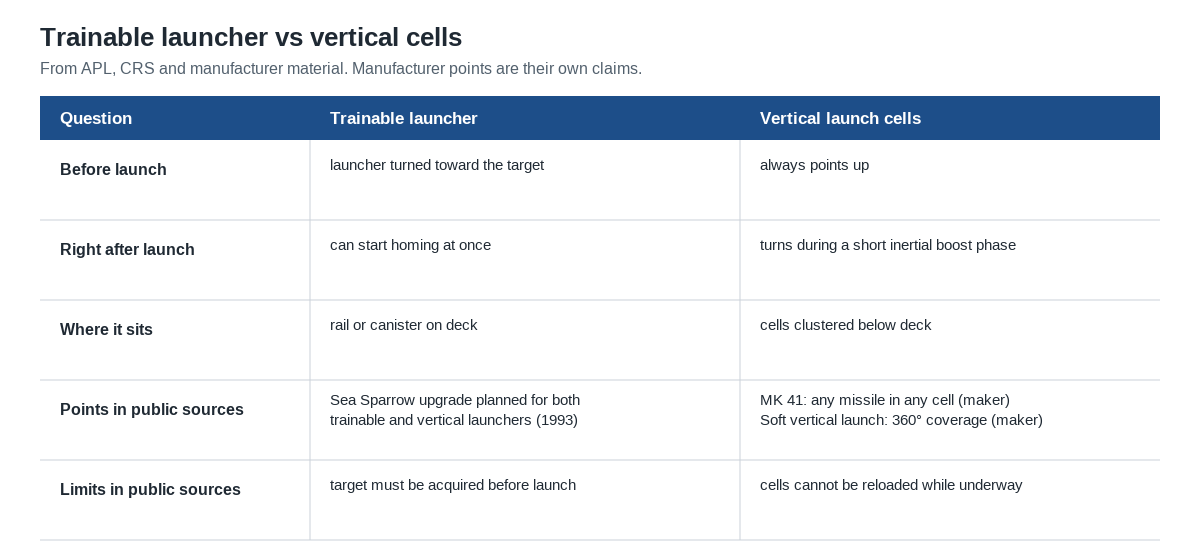
Vertical cells have weak points too. According to CRS, a ship cannot refill its VLS cells while it is under way. It has to return to port or to sheltered, calm water at anchor. Once the cells are empty, that ship has no more of those missiles to fire.
An upright missile also has one more job left in the air: finding its direction. The aiming a trainable launcher would finish before firing has to be done by the missile itself after it climbs. That is why neither method can be called better in a single line.
A different question from hot and cold launch
Vertical versus inclined is a different question from hot launch versus cold launch. The first is about the direction the missile leaves in. The second is about when the motor lights.
Sea Ceptor's soft vertical launch fires upright and uses the cold method. A gas charge pushes the missile out of its canister, and the main motor lights only after the missile is safely clear of the ship. The maker compares this with conventional hot vertical launch.
Roketsan says its MİDLAS can hold several types of missiles in canisters below deck and fire them by either hot or cold launch. One set of vertical cells can hold both ignition methods.
Where this meets lasers
Vertical cells also turn up in the story of Navy shipboard lasers. The amphibious ship USS Portland is one example. According to a 2022 CRS report, its laser sits near the bow inside a trunk built for a vertical launch system the ship never received. A space planned for missile cells became a space for a laser.
A laser also has no cells to refill. A shipboard solid-state laser draws on the ship's electrical power. CRS notes that it can keep firing for as long as the laser works and the ship can burn fuel to generate power. Set beside VLS cells that cannot be refilled at sea, it shows that the two weapons run into different limits.
Further reading
- Vertical launch systems: what sits below a warship deck: cells, modules and how many each ship carries
- Cold launch: why some missiles pop out before igniting: pushing a missile out of an upright tube
- Guidance Types Side by Side: Command, Semi-Active, Active, Imaging and Inertial/Satellite: the three phases of flight and guidance types
- Transporter Erector Launchers (TEL): Why a Truck Stands a Missile Up: vehicles that raise a missile on land