In a lecture hall, a speaker points a laser pointer at one place on the screen. The audience looks at the red dot on the screen, not at the pointer. The person who makes the dot and the people who look at it are different, and they can be far apart. One dot is enough to say "here."
A laser designator does this job in the world of weapons. The device itself destroys nothing. It puts a spot of light on a target, and the seeker on a weapon arriving from somewhere else homes on that spot. The real difference is that the one looking at the spot is a machine, not a person, and that machine moves separately from the designator.
This article follows what a designator does, how it differs from a rangefinder that looks similar, where designators are carried, and their history from the 1960s to the Gulf War. It also looks at the limits set by weather and the rules that protect people's eyes.
A device that puts a spot on a target
Seekers on guided weapons fall into three groups by how they get energy from the target: passive, semi-active, and active. A semi-active system "designates" the target by shining a beam of light, laser, infrared, or radio energy at it. The beam starts at whatever fired the weapon, or somewhere close to it, and the weapon's seeker follows the energy that bounces back from the target. Doing this with a laser is called semi-active laser guidance.
An active system carries its own illuminator inside the weapon. The Johns Hopkins Applied Physics Laboratory (APL) Technical Digest notes that putting such an illuminator on board raises the cost and makes the weapon heavier. In a semi-active system the illuminating equipment stays outside the weapon, and the weapon carries only the receiving side.
Laser-guided bombs are a good example. A Congressional Research Service (CRS) report describes the Paveway family of kits this way. The front of the bomb carries a seeker that searches for the laser marking the target, and a tail kit at the back steers the bomb onto it. The designator is the device that provides that "mark."
The seeker can see the spot because of how light reflects. Light that hits a rough surface strikes different parts of it at different angles and bounces off in many directions. This scattering is also why a sheet of paper can be seen from any angle. The designator's beam travels in one direction, but part of the light scattered by the rough target surface reaches a seeker that is not where the designator is.
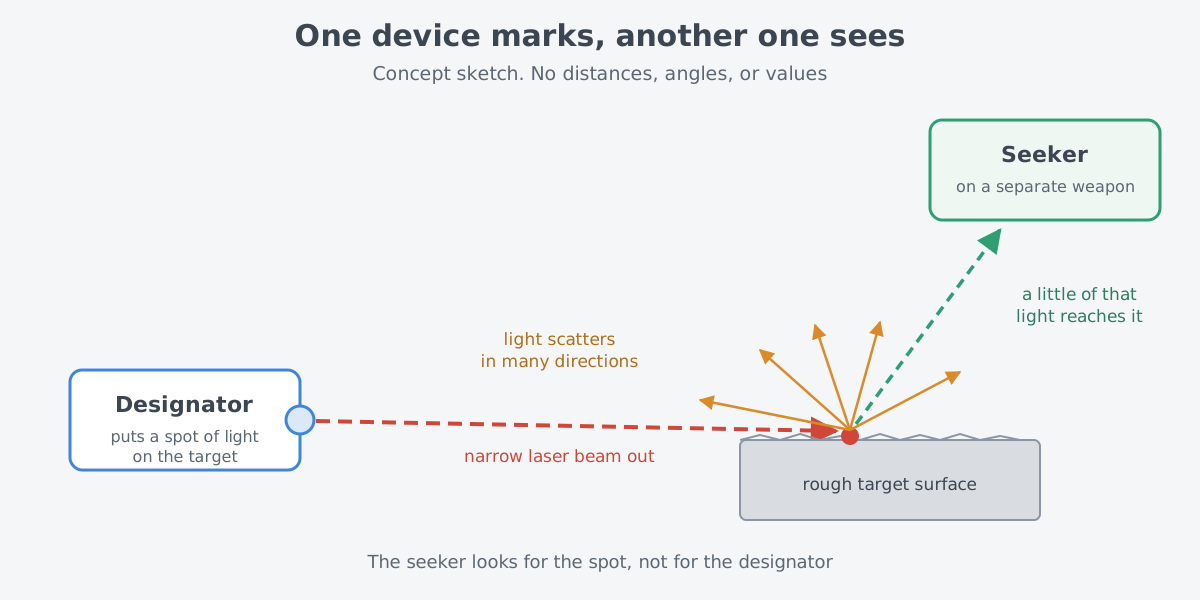
The semi-active approach also shifts a responsibility. In a semi-active system, most of the job of choosing the target falls on the source of the light. What gets pointed out is decided more on the designator's side than on the weapon's side.
How it differs from a rangefinder
A device that measures distance with a laser also sends light toward a target. The National Oceanic and Atmospheric Administration (NOAA) describes lidar as a way of sensing from a distance, in which pulses of laser light measure how far away things are. The light reflects off the surface it hits, and a sensor records that reflected light to measure the range. Military laser rangefinders start from the same idea.
The difference is who catches the light. A rangefinder receives its own light and gets a distance. A designator only sends the light, and a seeker somewhere else receives the reflection. They use the same kind of light, but one produces "a distance" and the other produces "a marked spot."
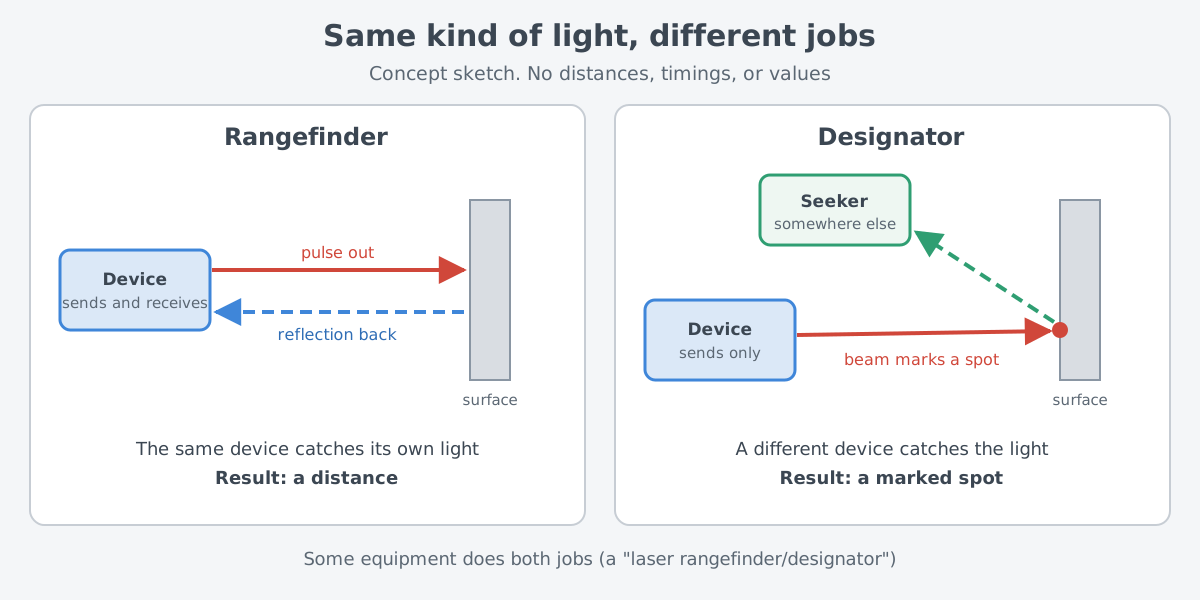
Many devices combine both jobs. One piece of U.S. Army equipment carries both in its name: the Lightweight Laser Designator Rangefinder (LLDR). Army drones also carry "laser rangefinder/designator" payloads.
One CRS report looks at how the Department of Defense uses the electromagnetic spectrum. In a footnote, it puts target designators and laser range finders, along with remote sensors, under "other directed energy technologies." In those documents, "directed energy" does not mean only laser weapons. The ranging principle is covered in more detail in Measuring with lasers: range finding and lidar basics.
On the ground and in the air
Designators are carried in several places. The HELLFIRE timeline of the U.S. Army missile history office lists the Ground/Vehicular Laser Locator Designator (G/VLLD). It was used to designate moving or stationary targets for laser-homing weapons such as HELLFIRE, and it could also give accurate target information to conventional artillery.
Some designators are held in the hand. In 2016 the U.S. Army signed a contract for a handheld device called JETS. The Army explained that it gives exact positions of targets and can mark them with a laser for precision munitions.
In the air, aircraft and drones carry designators. The CRS report on unmanned aircraft describes the Predator's Multi-Spectral Targeting System (MTS) sensor ball. It adds a laser designator to the drone's electro-optical and infrared cameras and lets it follow moving targets. Precision target designation is also among the tasks that unmanned systems perform.
From the 1960s to the 1990s
The history of designators cannot be longer than the history of the laser. The very first laser, built in 1960, was a solid-state laser. Guided weapons go back as far as the First World War. In the 1960s, laser guidance, semiconductors, and other advances arrived and let munitions hit targets more accurately.
The Vietnam War showed this change. The APL Technical Digest gives an often-cited example, the Thanh Hóa Bridge. For 6 years the United States dropped hundreds of bombs on it and lost aircraft and pilots in the process. In April 1972, a handful of laser-guided bombs finally brought it down.
Around the same time, the U.S. Army developed designators of its own. The Army missile history office timeline shows the steps. In April 1972, advanced development began on the ground laser locator designator (GLLD), and in April 1973 contracts went out to develop the airborne laser locator designator (ALLD). In March 1975, every armed service signed off on a joint plan, shared by all three services, for developing ground laser designators.
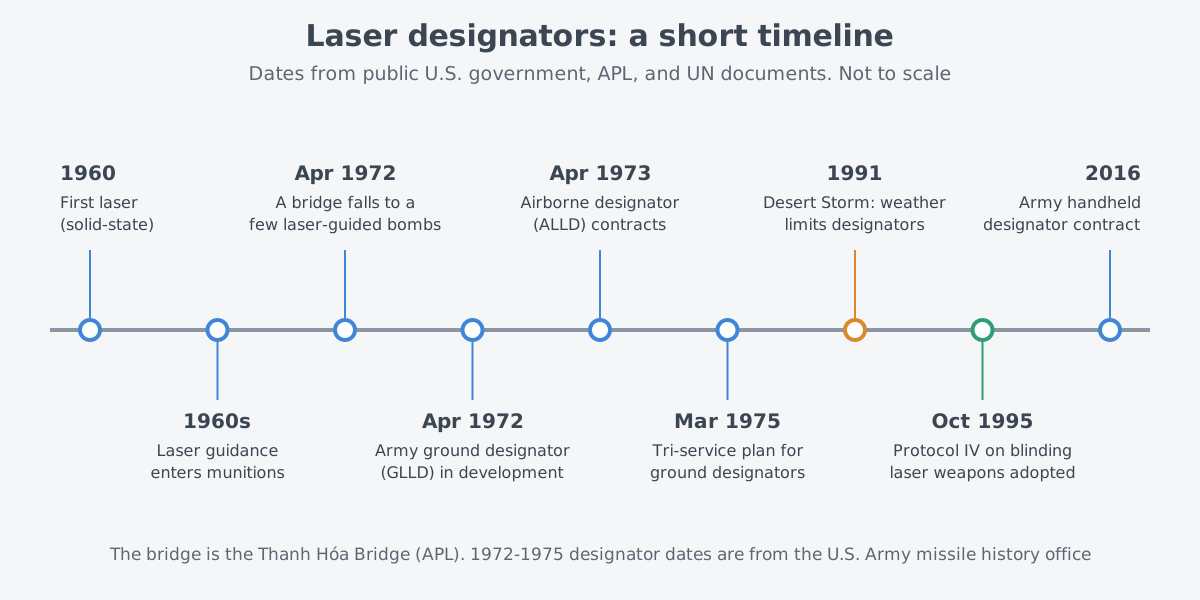
Laser-guided bombs stood out during Operation Desert Storm, in 1991. Even so, CRS notes that precision-guided munitions (PGMs) made up only 6% of all munitions used in that campaign.
Up against clouds and smoke
A designator's light has to travel to the target and then back to a seeker. What happens when clouds or smoke get in the way? A 1997 review of the air war in Desert Storm by the U.S. General Accounting Office (GAO) answers that question.
GAO found that flying at medium and high altitude put aircraft in clouds, haze, smoke, and high humidity more often. That got in the way of infrared and electro-optical sensors and of the laser designators for laser-guided bombs. Even in mild weather, including humidity, precision bombing sensors such as laser target designation systems were degraded or could not work at all.
GAO also pointed out that some of these sensors had earlier been described to Congress as capable in "all weather," "adverse weather," or "poor weather." It wrote that such problems should be treated as warning signs about how well various systems and technologies would work under harder conditions. What light goes through on its way through air continues in Light through air: absorption, scattering, turbulence, thermal blooming.
Labels and rules that protect eyes
A designator is a laser, so the rules of eye safety apply to it in full. A 2012 article from the U.S. Army Combat Readiness/Safety Center says that every laser system must carry a warning label showing its laser safety class. That includes the rangefinders and target designators soldiers use.
The article's table, based on the 2007 American National Standards Institute (ANSI) classes, shows that each class is hazardous in different situations. Class 3 lasers are a hazard when you look straight into the beam or at a mirror-like (specular) reflection, but reflections from rough surfaces (diffuse reflections) usually pose no hazard. Class 4 (high-power) lasers are hazardous for direct exposure to the beam, and some can be hazardous even through diffuse reflections.
The first safety rule in the article is "Never point a laser at anyone's face." The Army Surgeon General advises treating lasers with the same respect and care as a loaded weapon. Soldiers injured in laser incidents reported seeing a flash, or hearing a short sizzle and then seeing a dark spot, and their symptoms included headaches, blurred vision, and temporary blindness. How to read classes and eyewear labels is covered in Laser safety: classes and how to read eyewear labels.
International rules also address this point.
Protocol IV of the Convention on Certain Conventional Weapons (CCW), adopted on 13 October 1995, deals with blinding laser weapons. Article 2 requires all feasible precautions against permanent blindness to unenhanced vision when laser systems are used, and those precautions include training of armed forces. Under Article 3, blinding that happens only as a side effect of lawful military use of laser systems falls outside the protocol's ban. The full articles are discussed in Eye safety and international rules: the protocol on blinding laser weapons.
Where this meets lasers: a laser that is not the weapon
When "laser" and "weapon" appear in the same sentence, many people picture a beam burning something. A designator sits at the other end. The weapon that arrives separately does the striking, and the designator's laser only makes a spot that the weapon's seeker can see.
Still, both kinds of equipment rest on the same physics. The light has to cross the air to reach the target, and it reflects or scatters at the target's surface. What a laser weapon really is, and how it differs from the movies, continues in What is a laser weapon? Film versus reality.
What to read next
- Precision-guided bombs: what gets added to a plain bomb: the history on the side of the bombs that use the designated spot.
- Laser-Guided Bombs: Following a Reflected Laser Spot: the principle on the side of the seeker that follows the spot.
- Measuring with lasers: range finding and lidar basics: how a device measures distance by catching its own light.
- Eye safety and international rules: the protocol on blinding laser weapons: the international rules for using laser systems.