Throw a ball for a dog and you may see two styles of running. One dog watches the ball, keeps turning its head toward it, and ends up trotting right behind it. Another dog runs at an angle to where the ball is going and meets it in front.
Both dogs see the ball. They just follow different turning rules.
A missile faces the same question. How it sees a target was covered in Guidance Types Side by Side. This article compares the rule that turns what the missile sees into a steering decision. That rule is called the guidance law.
Unlike a dog, though, a missile cannot twist however it likes. It can only turn so hard, and a path that asks for more than that cannot be flown.
What a guidance law does
A guidance law takes estimates of where the target is and how it moves, and decides which way the missile should head to intercept it. The Johns Hopkins Applied Physics Laboratory (APL) Technical Digest describes this as an anticipatory job. Its commands steer the missile onto a path that meets the target. That path is called a collision course.
There is more than one such rule. In 1946, Charles E. Watkins worked at the Langley laboratory of the National Advisory Committee for Aeronautics (NACA). He sorted the ways a missile could use a target seeker into four methods and worked out the path each one produces.
The report was secret at the time. Today anyone can read it on the NASA Technical Reports Server.
Four methods in the 1946 report
The four methods differ in how the seeker is tied to the missile. The line of sight that appears below is the line from the eye that watches the target to the target itself.
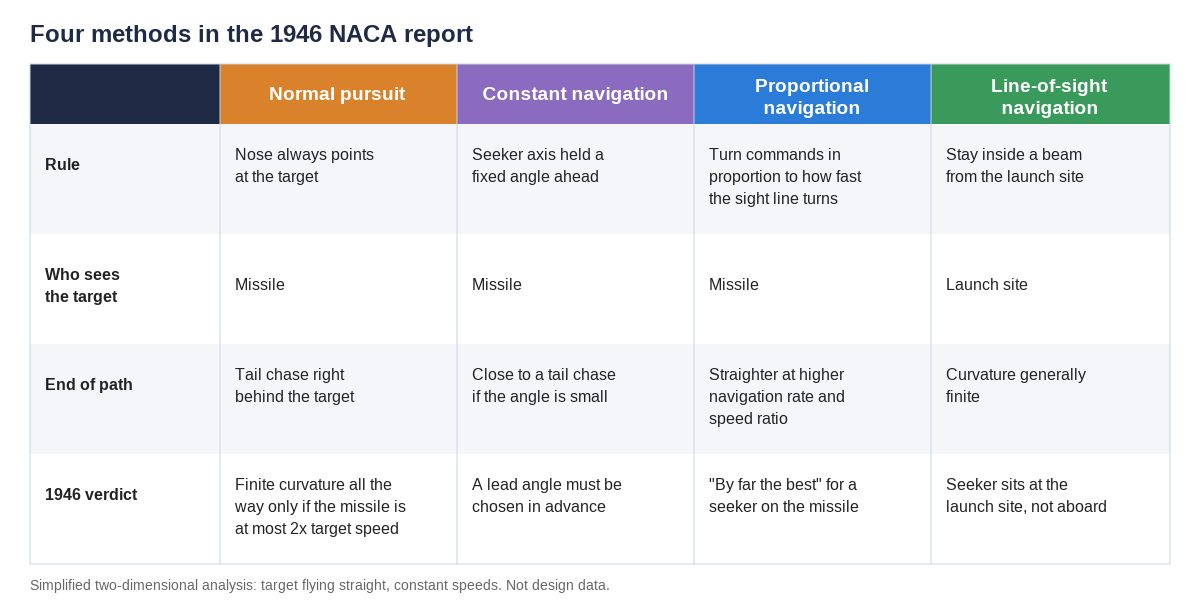
- Normal pursuit: the seeker's line of view stays parallel to the missile's body axis. The missile always heads straight at the target.
- Constant navigation: the seeker axis is held at a fixed angle to the body axis, so the missile always aims a little ahead of the target.
- Proportional navigation: the seeker axis turns by a set fraction of the angle the missile axis turns.
- Line-of-sight navigation: the seeker sits on or near the launcher and points a radio beam at the target. The missile flies inside that beam to the target.
The report judged the paths by turning rate. Turning brings unwanted aerodynamic effects that grow as the turn gets faster, so a path that needs gentler turns is a better path.
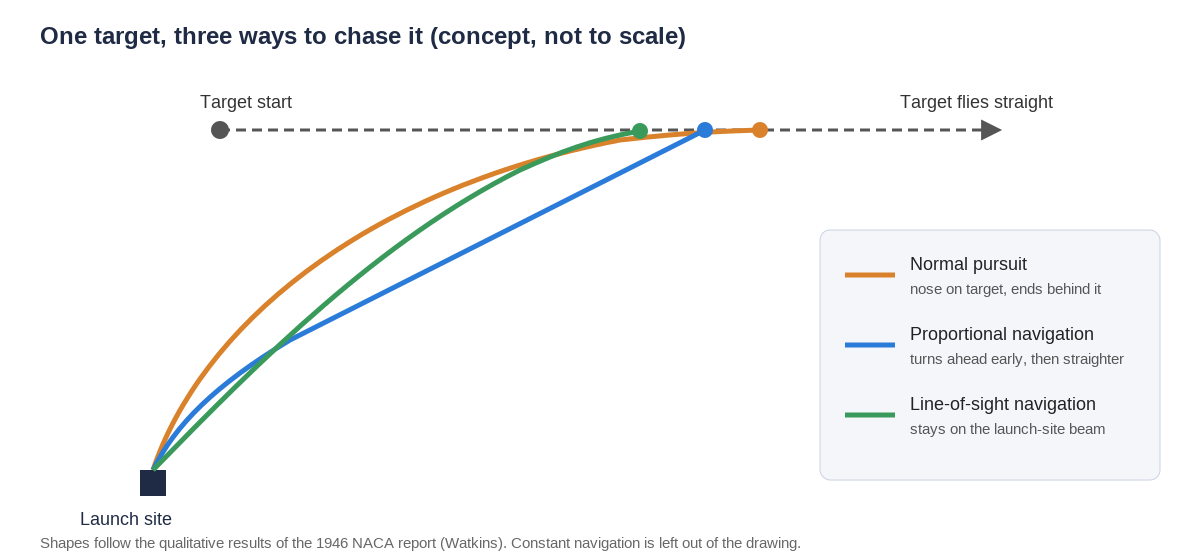
Normal pursuit: nose always on the target
The simplest rule is to point the nose wherever the target appears. But when the target crosses in front, the missile keeps swinging around to follow the spot it just left. In the NACA calculations, a normal pursuit path always ended tangent to the target's path. If the missile manages that last turn, it finishes in a tail chase right behind the target.
The turn can also get sharper near the end. The report used simple two-dimensional assumptions. Under them, the path kept a finite curvature all the way only when the missile was faster than the target but no more than twice as fast. It looks a lot like the dog that twists hard at the last moment behind the ball.
Two ways to aim ahead
Constant navigation aims ahead from the start. That avoids a tail chase, but if the set angle is small, the path drifts back toward one. It also means picking one lead angle in advance without knowing how the target will move.
Proportional navigation does not fix the angle in advance. It issues turn commands in proportion to how fast the line of sight from missile to target is turning. That ratio is called the navigation rate. In the report's results, the paths generally improved as the navigation rate went up or as the missile got faster relative to the target.
Its equations could not be solved by hand, so they were run on a General Electric differential analyzer. The conclusion was clear: for a seeker carried in the missile, proportional navigation was "by far the best" of the methods studied.
Line-of-sight navigation: riding a beam
The fourth method works differently. The eye that sees the target is at the launch site, not in the missile. The missile only has to stay inside the beam that joins the launch site and the target. The report found that line-of-sight paths generally keep a finite curvature.
The same idea also runs through a human operator. Second-generation anti-tank guided weapons use semi-automatic command to line of sight (SACLOS). The operator keeps the sight on the target, and the missile is led along that aiming line. Flying along the beam itself is the subject of a separate article, Beam-Riding Guidance: Missiles That Ride a Laser Beam.
Why proportional navigation lasted
The idea behind proportional navigation is familiar to anyone who steers a boat. Rule 7 of the U.S. Coast Guard navigation rules treats a closing vessel whose compass bearing hardly shifts as a collision risk. A steady bearing means the line of sight is not turning.
A missile uses this in reverse. The APL Technical Digest article on Talos guidance explains the idea. To intercept, the missile only needs to control its turning rate so that the line-of-sight rate stays at zero.
What came later is also on record. According to the APL Technical Digest, proportional navigation was the guidance law of choice through the 1970s and beyond, for practical and performance reasons. Many guided missiles still use it or a close variant. Over the past 50 years it has proven reliable and robust.
The same source notes its limits. By the mid-1970s it was clear that new threats, such as highly maneuverable aircraft, supersonic cruise missiles and ballistic missile reentry vehicles, could make proportional navigation weapons less effective. As computers became smaller and faster, a flood of new homing guidance methods followed. The 1946 verdict was a starting point, not the last word.
Where this meets lasers
In line-of-sight navigation and SACLOS, the beam becomes the missile's road. When that beam is a laser, the way the beam widens with distance sets how wide the road is. Why laser beams spread is explained in Why a beam spreads: divergence, focus and aperture.
What to read next
- Proportional Navigation: The Basic Idea Behind Chasing a Moving Target: how the line-of-sight rate is measured, and the limits
- Guidance Types Side by Side: Command, Semi-Active, Active, Imaging and Inertial/Satellite: where the target information comes from
- Missile seekers: the eye at the front: the device that tells the guidance law where the line of sight points