On October 12, AUSA 2026, the Association of the US Army's annual exhibition, opened in Washington. That same day, European missile maker MBDA and US counter-drone company Fortem Technologies made a joint announcement. The targets named for their new interceptor were Shaheds/Gerans and Orlans. It is news from the world of interceptor drones, where drones are used to catch drones.
The two companies said they are widening their counter-drone partnership and offering FireThorn, an autonomous interceptor they built together. This letter separates what their releases actually say from what they leave out, and looks at what changed since their first partnership announcement in 2024.
This letter in brief
- On October 12, MBDA and Fortem announced a wider counter-UAS (C-UAS) partnership. MBDA will offer Fortem's net-capture interceptor, DroneHunter, as a layer on its customers' existing air defense networks.
- FireThorn is an autonomous interceptor that the two companies say they built together. A fast, radar-guided airframe carries a warhead from MBDA that NATO has approved, and its intended targets are one-way attack drones.
- FireThorn's speed, range, price, test results, first customer and production schedule are not public.
What was announced
The first source is an article posted on MBDA's website on October 12. Fortem issued a press release the same day, datelined Warsaw and Washington. Fortem's chief executive announced the partnership ahead of attending the 2026 Warsaw Security Forum.
The two releases share the same core. A technical collaboration that began in 2024 becomes a market partnership, and MBDA will offer two interceptors to its air defense customers.
The companies said FireThorn would be on display at the MBDA booth at AUSA 2026, held on October 12–14. Both releases come from the companies, and no government or military purchase was announced alongside them.
What is publicly known
The table lists only what the two releases state.
| Item | What the releases say |
|---|---|
| Date | October 12, 2026 (MBDA article, Fortem press release) |
| Starting point | 2024, when DroneHunter was integrated into the C-UAS architecture of MBDA's ground-based air defense system SKY WARDEN |
| What is new | MBDA will offer DroneHunter as a layer on customers' existing air defense networks |
| FireThorn | A fully autonomous interceptor built jointly by the two companies: Fortem supplies a fast radar-guided airframe, MBDA a NATO-approved warhead |
| FireThorn's targets | One-way attack drones and other hostile drones; named examples are Shaheds/Gerans and Orlans |
| Roles of the two | FireThorn for hard kill in high-threat situations, DroneHunter for low-collateral net capture in dense areas |
| Sales condition | Subject to applicable export authorizations (Fortem release) |
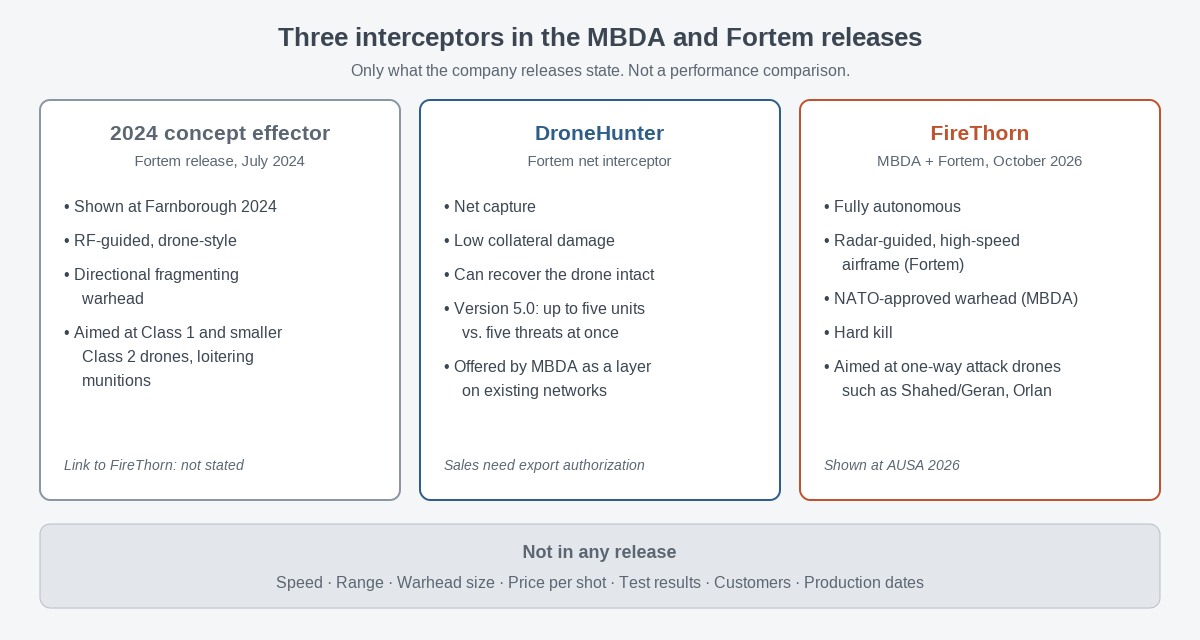
Look at the FireThorn row. It says what was put together, but not how fast it flies or how far it reaches. The releases name who supplied the airframe and the warhead, and little more.
The technology, explained
The two interceptors stop a drone in different ways. A hard kill physically destroys the target, and FireThorn does this with a warhead. DroneHunter fires a net that tangles and holds the drone.
Net capture has its own uses. Fortem says it suits places where surrounding infrastructure must be protected or where the drone needs to be recovered intact as evidence.
Fortem announced first deliveries of DroneHunter 5.0 in January. The company says it can carry a captured drone and drop it at a chosen spot. It adds that one command and control system can coordinate up to five units against five threats at once.
The wider idea of catching drones with drones is covered in Interceptor Drones. What the Shahed family is can be found in The Shahed series.
Neither interceptor works alone. Stopping a drone runs in order: detect, identify, track, defeat. An interceptor is a tool for the last step. The sequence is laid out in The Counter-Drone Chain.
The Fortem release says operators can add its interceptors as a layer on an existing network instead of setting up a separate system. In practice, that reads as adding one more effector slot under sensors and command and control that are already in place.
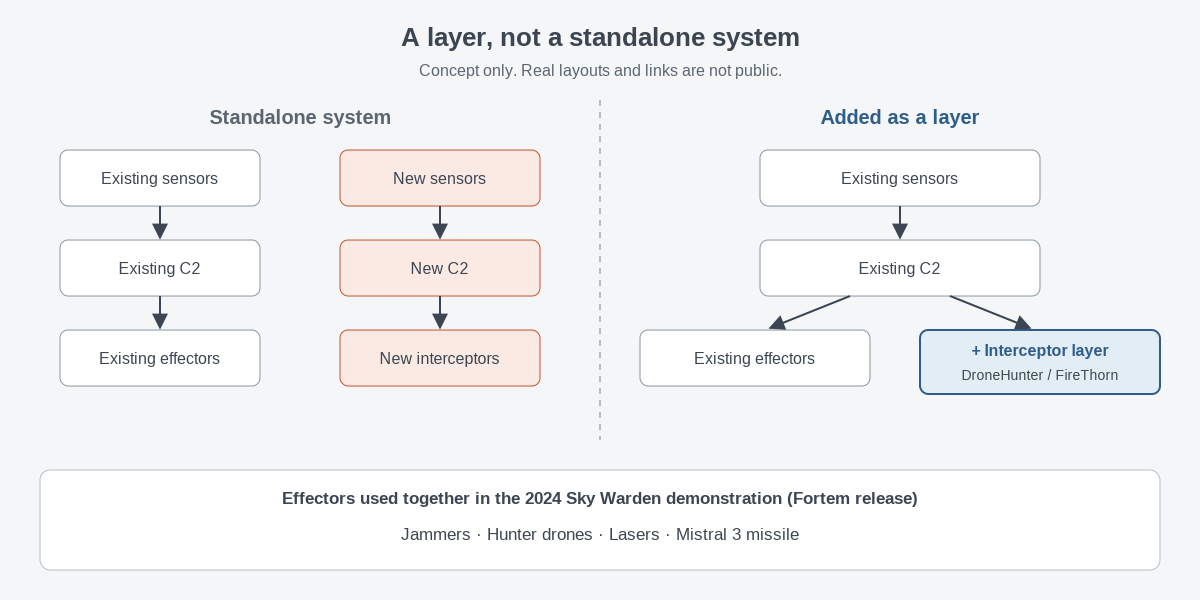
The Fortem chief executive's remark that militaries do not need "another standalone gadget" makes the same point. But the releases do not say which country's network this would join, or how. Tying many sensors and effectors into one picture is the subject of Integrated air defense and sensor fusion.
What is new
The first announcement of the partnership is a Fortem press release dated July 23, 2024. At the Farnborough International Airshow that year, the two companies showed a new effector concept for Sky Warden.
That concept was a drone-style airframe guided by radio frequency (RF) signals and fitted with a directional fragmenting warhead. It was aimed at Class 1 and smaller Class 2 small drones and at loitering munitions. Drone size classes are explained in How Drones Are Classified.
The same release says that in a demonstration in Italy, Sky Warden used jammers, hunter drones, lasers and the Mistral 3 missile together to neutralize a range of threats. It also describes Sky Warden as a system in which artificial intelligence helps operators sort threats using radar, passive RF and electro-optical cameras.
So did the 2024 concept grow into FireThorn? The two companies do not say. The FireThorn name does not appear in the 2024 release.
That means the two cannot be treated as one product that changed. Still, setting the wording of the two releases side by side shows three differences.
The 2024 release says "RF-guided," while the 2026 one says "radar-guided." Only the 2026 release names targets: Shaheds/Gerans and Orlans. And the 2024 item was a demonstration concept, while the 2026 one is a product package that MBDA offers its customers.
Limits and open questions
The biggest gap is performance. FireThorn's speed, range, warhead size and cost per shot appear nowhere. For an interceptor meant to face cheap drones, price is the key number, and it is missing. A framework for comparing costs is in The cost of drone defense.
The second gap is testing. Neither release says whether FireThorn has hit a drone, or under what conditions it was tested. A trade-show display is not a test result.
The third gap is customers. The releases do not say which country or military will buy this combination, or when deliveries would happen. Fortem says only that sales need export authorization.
Fourth, the 2024 release mentions lasers used alongside other effectors, but the new announcement says nothing about how the interceptors would share the work with lasers or other tools. For a comparison of those roles, see Lasers, interceptor missiles and guns.
Further reading
- Using Drones to Catch Drones: Interceptor Drones: for the main types of interceptor drones that FireThorn and DroneHunter belong to.
- Low-Cost Interceptors for Cheap Drones: The Return of the Guided Rocket: to compare this approach with guided rockets.
- BAE Systems unveils a high-power microwave (HPM) counter-drone demonstrator at AUSA 2026: for another counter-drone announcement from the same show.