The radar on a single ship can only see so much of the sky. An aircraft over the same sea and a ground unit on the coast each see only a piece as well. What if all three could put their pieces together?
The connection that does this is a data link. As the name says, it links data between pieces of equipment. With data links, the first hurdle is not the hardware but "shared rules." Who sets those rules, and what happens when they do not match?
What a data link connects
The military uses the electromagnetic spectrum across intelligence work and operations. At one end are very low-frequency radio waves for reaching submarines underwater. At the other are microwaves for data links that join weapon systems such as aircraft, satellites, ground forces and ships. The Congressional Research Service (CRS) also gives a continuous data link between aircraft as an example.
Drones show how basic a data link is. Only together with data links and ground control stations does an unmanned aerial vehicle (UAV) count as an unmanned aerial system (UAS). The aircraft in the sky is not the whole system on its own. Drones built to stay up for long periods are covered in ISR drones.
A data link is also not something fitted once and then forgotten. From 1987 through 2001, the U.S. Air Force upgraded its E-3 airborne warning and control aircraft under the Block 30/35 program. Part of that work improved the data links so the E-3 could talk to more aircraft. That aircraft, often described as a control tower in the sky, has its own article: Airborne early warning and control.
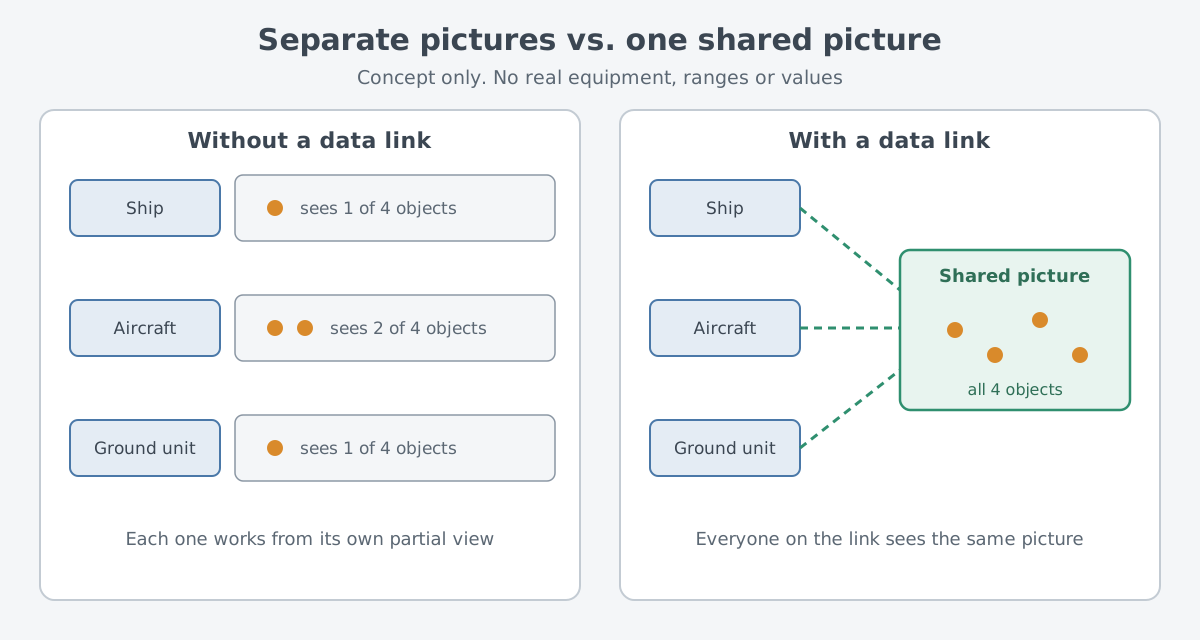
Picture several people, each holding one piece of a map, taping the pieces into a single sheet. The real job is harder. The pieces keep changing, and to join them, every piece of equipment has to write and read the data the same way. That is where standards come in.
Standards: a shared language
NATO explains that countries taking part in multinational operations have to agree on shared standards. They cover everything from ammunition sizes and rail gauges to the words troops use with each other. With standards, people from different countries can have compatible equipment, understand each other's procedures, and work smoothly even when they are new to working together. That is what interoperability means, and NATO calls it the final aim of standardization.
The document that records such an agreement is a Standardization Agreement (STANAG). It is a NATO document in which member countries agree to implement a standard. Examples of such agreements include specifications so that national communications systems can work together, and formats that ease the sharing of intelligence and other information.
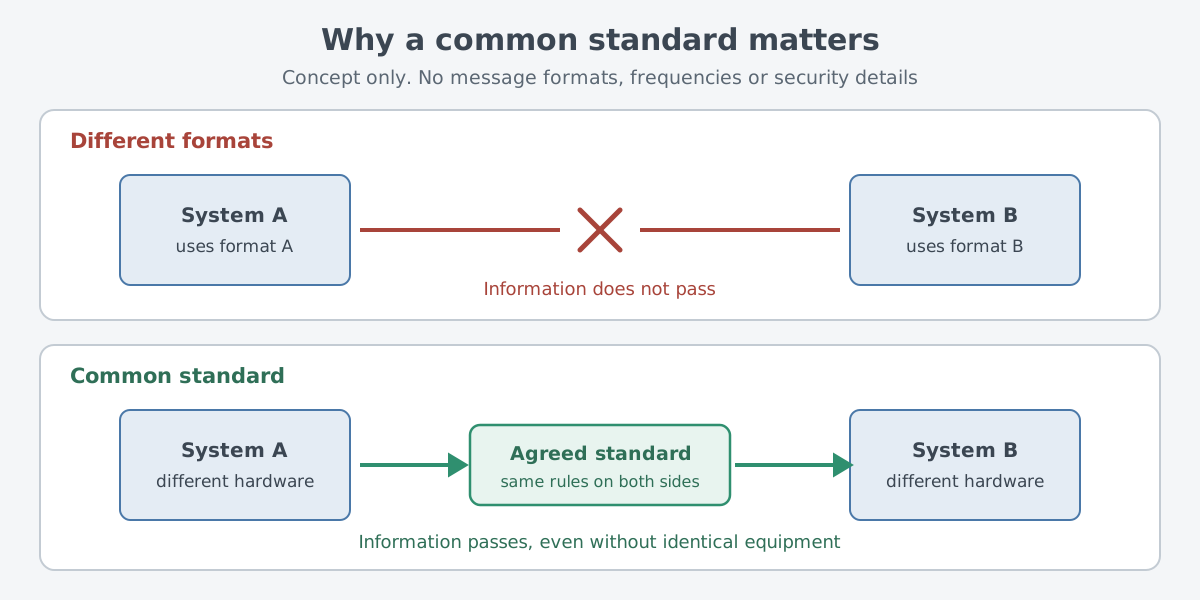
Interoperability does not necessarily require the same equipment. What matters is whether one piece of equipment can connect and communicate with another, and trade data and services with it. Interoperability also reaches beyond technology into procedures, people and information. Air defense, where sensors and weapons are tied together, is covered in Integrated air defense and sensor fusion.
Link 16 and MIDS terminals
One name that appears in CRS reports and U.S. Navy material is Link 16. In CRS reports, too, Link 16 appears as one of the data links. People often mix two things here: the name of a link and the equipment that joins it are not the same.
The U.S. Naval Air Systems Command (NAVAIR) describes the Multifunctional Information Distribution System (MIDS) as the Link 16 terminal family fielded more widely than any other. The family includes products for aircraft, ships, ground mobile equipment and fixed sites. The diagram below separates the link, the radio set that joins it, and what carries that radio.
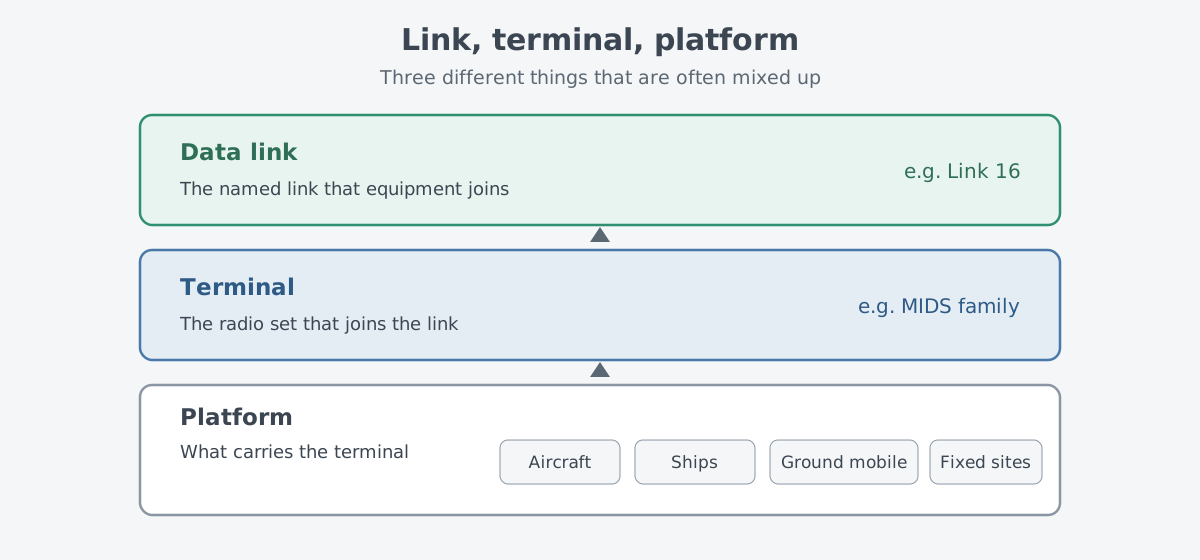
The MIDS Low Volume Terminal (LVT) program is an international cooperative development by France, Germany, Italy, Spain and the United States, with more than 25 years of cooperation behind it. MIDS JTRS is a U.S. Navy-funded variant of MIDS-LVT that uses multiple channels and is defined in software. In describing its mission, the MIDS program puts interoperability and security first and names joint, coalition and international warfighters as the people it serves. Since terminals built by five countries serve aircraft, ships, ground equipment and fixed sites, Link 16 shows many kinds of platforms from many countries joining one link.
When standards differ
When standards do not match, information can stall even inside one country and one service. CRS names interoperability between individual weapon systems, and between the military services, as one challenge the Department of Defense faces. Its example is the U.S. Air Force F-22 and F-35. The two fighters were developed with incompatible data link protocols (IFDL on the F-22, MADL on the F-35), and the record shows they could not share information with each other.
Each service designs the systems for command, control and communications around its own needs. Around the time of the report, the Navy's Aegis ballistic missile defense system could not pass its radar data to IBCS. The Integrated Battle Command System (IBCS) is an Army system that does a similar job. Aegis itself is explained in The Aegis combat system.
There have also been moves in the other direction. On the House side, Armed Services Committee members wrote in a clause calling for every tactical unmanned aerial vehicle in the services to carry the Tactical Common Data Link (TCDL). By the time of the 2012 CRS report, TCDL had become the services' standard communication tool.
Bigger network plans and open questions
There is also a larger plan to get past these walls: Joint All-Domain Command and Control (JADC2), a Defense Department concept. It aims to tie sensors from the Army, Navy, Air Force, Marine Corps and Space Force together in one network. Traditionally, each service built its own tactical network that did not work with those of the other services. The department has even compared the end state it wants to the ride-sharing service Uber.
There are many questions, too. Analysts quoted by CRS ask whether the technology is mature and whether it is affordable. They wonder whether a secure, reliable network could be fielded at all where electronic warfare is intense. They also ask who would hold decision authority across domains and whether it is right to reduce the human role in military decisions.
Data links and electronic warfare are hard to separate. In the CRS definition, electronic warfare covers operations that spot, eavesdrop on, jam or fool an opponent's radars, radio communications, data links and other electronics. It also covers protecting against the same moves by the other side. Read next to this definition, the JADC2 question about intense electronic warfare becomes clearer.
Where this meets lasers: a weapon must join the system
Laser weapons do not work alone either. A Navy information paper from October 2021, quoted by CRS, expects laser weapon systems to complement other weapons, sensors and the ship's whole combat system in complicated ways. For that reason, it says, a specific "combat value" is hard to assign to each platform's contribution. How to fit laser weapon systems into the overall combat system as they mature is also something the Navy keeps analyzing.
Integration inside a ship's combat system is not the same thing as a data link between pieces of equipment. Still, the question is similar. The Navy's wording, too, expects the laser to be used in a way that adds to other sensors and weapons. The parts that make up a laser weapon are laid out in A laser weapon is more than a laser.
What to read next
- Electronic warfare: the invisible contest: the contest over the radio waves that data links also use.
- Integrated air defense and sensor fusion: how shared information becomes one picture in air defense.
- A laser weapon is more than a laser: the system at a glance: the parts that make up a laser weapon.