If a swarm of drones arrives at once, how many interceptor missiles does a defender need? When the magazine runs dry, the defense stops. In October, at the Association of the U.S. Army's annual meeting (AUSA 2026), the defense company BAE Systems put forward two products as its answer to that problem.
One fires shells. The other fires no ammunition at all: it is a high-power microwave (HPM) system that sends out radio waves. This letter looks at what the company's press release says about the HPM and how far its sentences can be taken.
This letter in brief
- In an October 12 press release, BAE Systems said it unveiled the Multi-Domain Artillery Cannon System (MDACS) and the High Power Microwave (HPM) at AUSA 2026. The company called both "capability demonstrators."
- The company claimed the HPM is built from more than 99% commercial off-the-shelf parts, needs no conventional ammunition, and can keep defeating drone swarms as long as power is available.
- The company's product page adds technology readiness level 6 (TRL 6), outdoor testing and four deployment tiers.
- Power, effective range, size and weight, test conditions and numerical results, customers and schedule were not disclosed.
What was announced
The first source is BAE Systems' October 12 press release (Ref 115/2026). Its headline says the company unveiled next-generation directed energy and kinetic defense systems at AUSA.
The company presented the two products as "scalable, layered C-UAS options" for the U.S. Army. Both are meant to protect critical sites and maneuver forces against saturation drone attacks, and the company also claimed counter-missile capability for them.
The release gives this as the reason. Massed drone swarms, it says, have outpaced what magazine-limited kinetic systems can handle. That is the company's own assessment, and the release offers no numbers or examples to back it.
The HPM product page on the company website goes further than the release. It covers the system's technology readiness, outdoor testing and deployment tiers.
The U.S. defense outlet The Defense Post covered the news on October 16. It read the 99% off-the-shelf figure as a way to make the weapon easier and faster to produce.
What is publicly known
| Item | What the company's materials say |
|---|---|
| Venue | AUSA 2026 (release) |
| Stage words used | "Capability demonstrators" (release), technology readiness level 6, TRL 6 (product page) |
| Testing | Billions of pulses fired in outdoor range testing to achieve and record effects on targets (product page). No test conditions or numerical results |
| Deployment tiers | Four: fixed (grid power), towed (generator), maneuver (vehicle power), maritime (ship power plant). A modular array that can grow in power and size (product page) |
| Role of the HPM | The directed energy layer |
| Parts | More than 99% commercial off-the-shelf (COTS) components |
| Ammunition | Removes the logistics constraints of traditional ammunition |
| Company claim | Keeps defeating drone swarms as long as power is available |
| Paired system | MDACS: the kinetic layer, air transportable, firing the Hypervelocity Projectile (HVP) for air defense and Scorpio-XR against ground targets (release) |
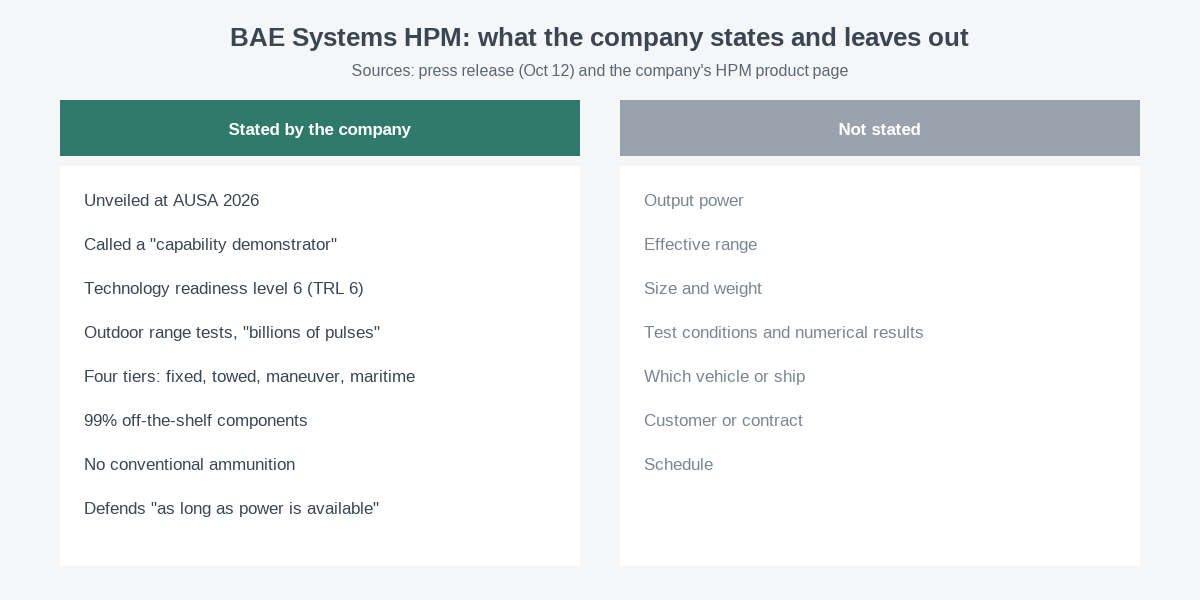
Two terms in the table tell you the stage: "demonstrator" in the release and "TRL 6" on the product page. The product page explains TRL 6 as the level at which a system has been demonstrated in a relevant operational environment.
Both are a different stage from a purchase contract or fielding. Nothing in the company's materials says that the U.S. Army has tested the demonstrator or plans to buy it.
The technology, explained
High-power microwaves are one branch of directed-energy weapons (DEW). Like lasers, they send energy to a target, but they use a different part of the spectrum and aim at a different thing. A laser focuses a narrow beam of light on one spot. A high-power microwave sends wider-spreading radio waves at the electronics inside a target.
Because the energy spreads, a high-power microwave can reach several targets at once. In return, it weakens sharply with distance, may not affect shielded equipment, and has to be used with care so that friendly electronics are not hit. The difference between the two branches is laid out in Lasers and high-power microwaves: two kinds of directed energy. The use against drone swarms is covered in Stopping Drone Swarms with High-Power Microwaves.
BAE's line "as long as there is power, there is defense" means the weapon fires on electricity, not ammunition. It is a comparison with guns and missiles, which have to be reloaded once the magazine is empty.
That does not mean it can fire forever. Not all the electricity fed into a directed-energy weapon becomes useful energy, and the rest becomes heat. So the equipment that supplies power and the equipment that removes heat both have to keep up.
The product page names a power source for each tier: the grid, a generator, vehicle power or a ship's power plant. How much power it draws and how it is cooled are not stated.
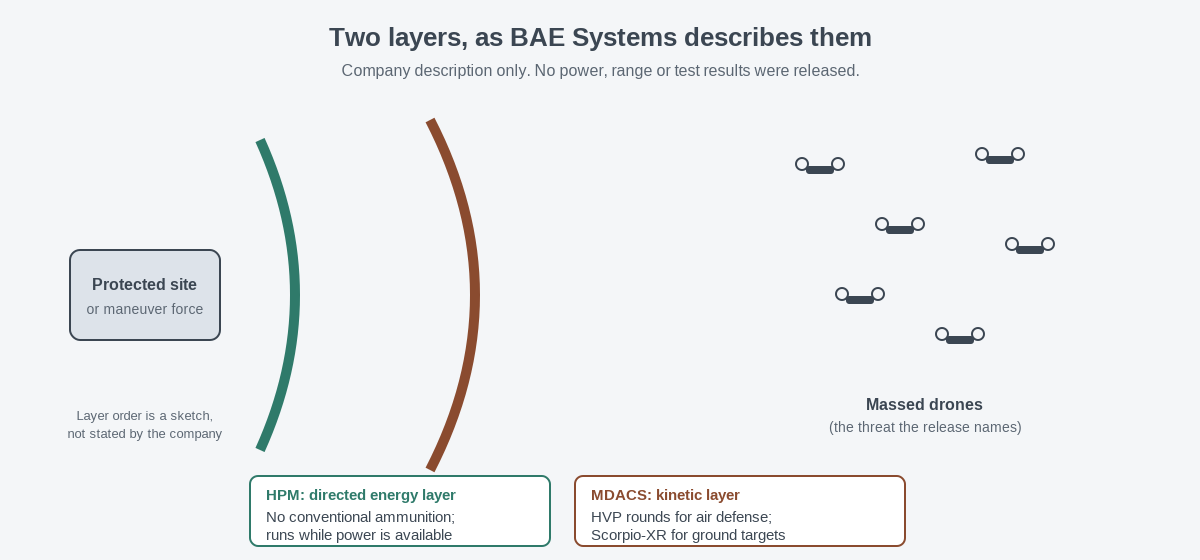
The phrase "layered defense" is worth a look too. The company calls MDACS the kinetic layer and HPM the directed energy layer. The general idea of stacking several tools is background in The Counter-Drone Chain: Detect, Identify, Track, Defeat and The cost of drone defense. The release does not say in what order the two layers work or how they are linked.
Limits and open questions
This news is the company's word from start to finish. Phrases such as "high-maturity" and "validated technical core" are the company's choice of words. The product page mentions billions of pulses fired on an outdoor range, but not what targets were used, at what distances or under what conditions, or what the results were. Nor do the company's materials say that the U.S. Army has confirmed those tests.
The numbers in the company's materials are TRL 6, the 99% parts figure and "billions" of pulses. The specifications that would describe performance are missing: power, effective range, the area covered at once, size and weight. The four deployment tiers also do not name a vehicle or ship. Since a high-power microwave's effect changes a great deal with distance, it is hard to judge performance without range information.
The 99% figure can also be read in more than one way. The company presented it as a benefit for logistics and the supply chain, while The Defense Post read it as easier, faster production. What sits in the remaining parts, under 1% by the release's count, and whether they include the key parts, is unknown.
Finally, the customer. The release says it offers options "to the U.S. Army," but it gives no contract or test schedule. To judge whether this demonstrator will lead to real equipment, government records such as a contract would need to come first.
What to read next
- Lasers and high-power microwaves: two kinds of directed energy: to first get clear on what this HPM shares with lasers and how it differs.
- Stopping Drone Swarms with High-Power Microwaves: to see the conditions attached to using high-power microwaves against drone swarms.
- The US Army E-HEL laser contract and the directed-energy pilot at US bases: to compare with directed-energy news the U.S. Army has backed with actual contracts and a pilot program.