In May 2026 the Royal Air Force announced that its Typhoon fighters, flying operations in the Middle East, now carried a new anti-drone weapon. It is called the Advanced Precision Kill Weapon System (APKWS). Trace it back, and you find a rocket that dates from the Cold War.
Why would a modern fighter jet reach for a rocket that is decades old? The answer is cost. Official US and UK documents now treat the use of expensive interceptor missiles against cheap drones as a problem, and defenders are looking for cheaper interceptors along several routes. This article reflects the situation as of October 2026.
Why expensive missiles became a problem
Military documents call a drone an unmanned aircraft system (UAS). The 2025 counter-drone report (R48477) from the Congressional Research Service (CRS) notes that some Members of Congress have worried about the cost of using conventional air defense interceptors against drones. It also cites media reports that the US military's stock of air defense interceptors has shrunk under operational demand.
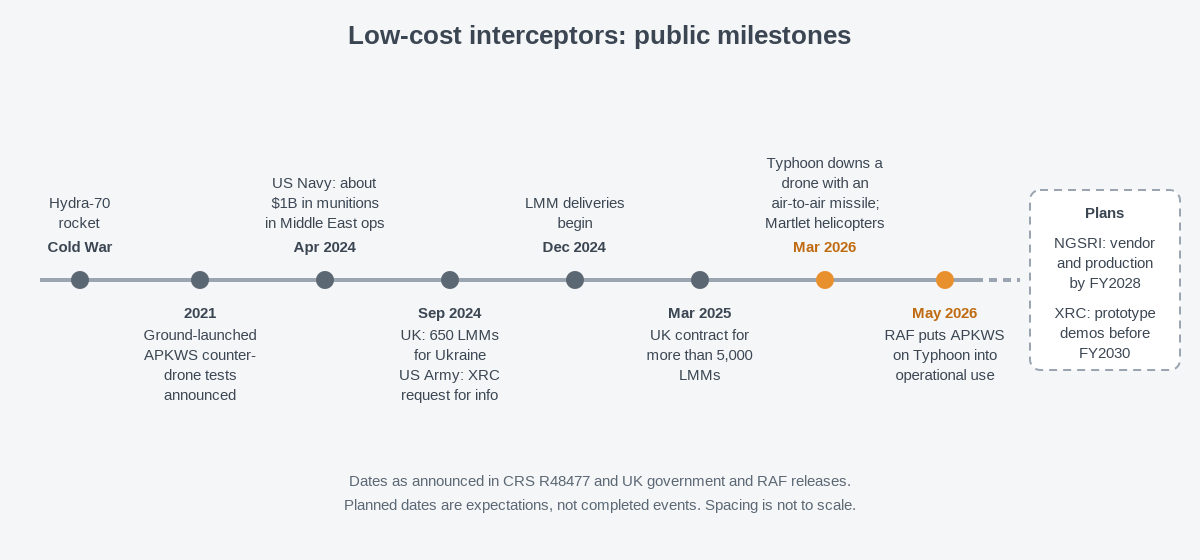
The worry was sharpest for the Navy. In the Red Sea, the Houthis kept up a fast pace of attacks on merchant ships with drones and cruise missiles. In April 2024, then-Navy Secretary Carlos Del Toro told Congress that Middle East operations had cost the Navy about $1 billion worth of munitions.
An article by an Army ammunition program office, posted on the Army's official site, puts it bluntly. Firing a missile worth several hundred thousand dollars at a hobby drone has a questionable cost-benefit ratio, and it leaves fewer missiles for more valuable threats. So low-cost kinetic effectors, it argues, must be part of the defense.
The Department of Defense has acknowledged the same problem. The fact sheet for its 2024 strategy lists one objective as "reducing the cost imbalance between unmanned systems and countermeasures." First on the department's list of options are new surface-to-air interceptors that may cost less. Guns, electronic warfare, directed energy and high-powered microwaves follow.
Comparing the price of a drone with the price of a missile has its critics, though. One commentator said that setting a Houthi drone against a US Navy SM-2 interceptor is too simple a comparison and can mislead. Another argued that the cost must also include the cargo ships being protected and the economic damage if the defense failed. That accounting is covered in detail in "The cost of drone defense".
Three ways to a cheaper interceptor
Put the public sources side by side, and there are three broad routes to a cheaper interceptor.
The first is to add guidance to a round that is already cheap. APKWS, which turns an unguided rocket into a precision-guided one, is the leading example.
The second is to repurpose missiles that are already in stock. According to CRS, the US military services have tried to turn older missiles, built to hit aircraft or ground targets, into counter-drone interceptors. Some experts have said this could cost less than conventional surface-to-air missiles. The Army has reportedly looked at using the Hellfire, an air-to-ground anti-tank missile, against drones.
The third is to build new interceptor missiles or to build more of them. The Army's new programs to follow the Stinger, and a UK contract that triples production of the Lightweight Multirole Missile, fall here.
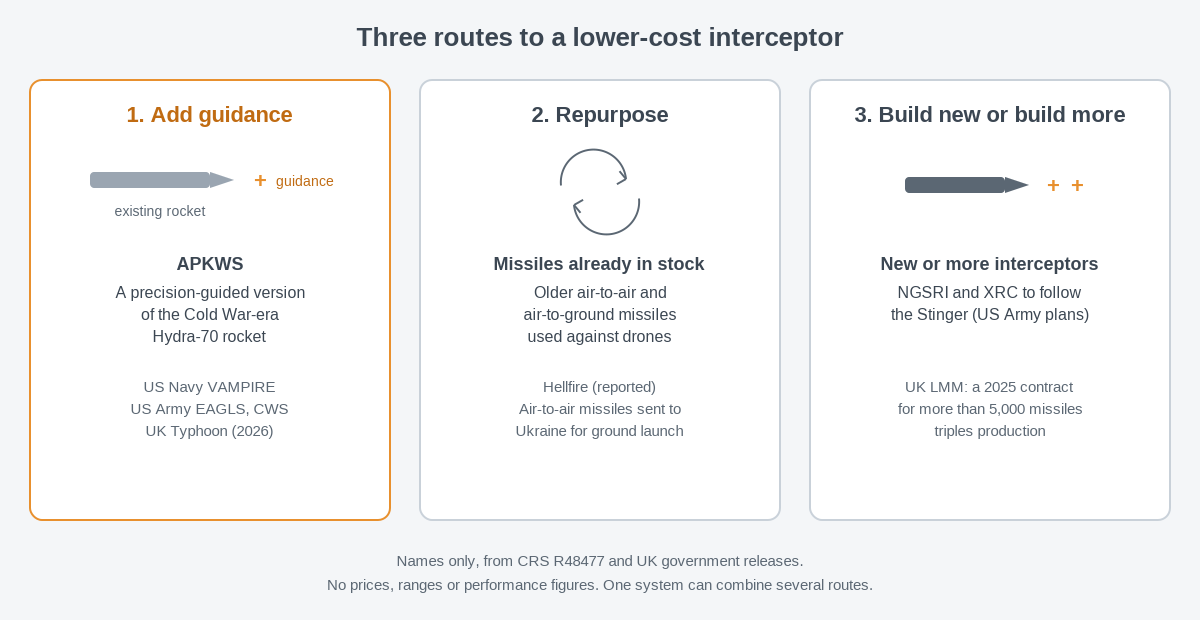
The three routes are not exclusive. One system can carry guided rockets, missiles and a gun together. The whole chain of finding, identifying and stopping a drone is laid out in "Counter-drone systems: why one device is not enough".
A Cold War rocket gets guidance
APKWS starts from the Hydra-70. A footnote in the CRS report introduces it as a 2.75-inch rocket from the Cold War. Aircraft first used it against targets on the ground, and it was later changed so that it could also be fired from the ground into the air.
APKWS is that rocket, changed into a precision-guided form. The RAF explains that APKWS uses a laser targeting system to turn unguided weapons into low-cost precision weapons. Some devices paint a spot of laser light on a target for another weapon to follow. Their principle is covered in "Laser Designators: Pointing Out a Target with Light".
Public sources also show the rocket moving into the drone role. In 2021, BAE Systems said it had started trials of APKWS fired from the ground to stop drones. By the time of the 2025 CRS report, APKWS was part of several counter-drone systems: VAMPIRE in the Navy, and EAGLS and the Containerized Weapon System (CWS) in the Army.
The name shows up in budgets too. In its fiscal year 2025 budget request, the Army asked for $59.6 million in research and development funding. The work includes the APKWS round and the Army's forward air defense command and control system (FAADC2). That figure covers several projects, not APKWS alone.
Instead of developing a new missile from scratch, the idea is to add a capability to a rocket that has been built in large numbers for years. The idea is a bit like giving an old bicycle new life by adding an electric drive.
The Middle East in 2026: guided rockets on fighter jets
According to a UK Ministry of Defence release on March 3, 2026, UK forces had downed several drones across the Middle East region during the day before. In one case, a Typhoon flying with the joint UK-Qatar squadron fired an air-to-air missile to bring down a one-way attack drone from Iran that was heading for Qatar.
In the same release, the UK government said a pair of Royal Navy Wildcat helicopters carrying Martlet missiles were also heading to the Eastern Mediterranean. The release called Martlet a "drone-busting" missile. Light missiles carried by helicopters, smaller than fighter jets, have also been called into the drone fight.
A fighter's air-to-air missile was built to fight aircraft. The Middle East passage of the UK's 2026 Defence Investment Plan addresses the cost question directly. It says Typhoons were quickly fitted with APKWS so they could stop drones for only part of what their current missiles cost. The same passage notes that a UK F-35B fought a drone in the air for the first time, over Jordan.
An RAF release on May 18, 2026 fills in more of the story. The RAF, the Ministry of Defence, and the companies QinetiQ and BAE Systems worked together to take the system from testing to operational use in under two months. Trials, including air-to-air engagements, were run by 41 Test and Evaluation Squadron, and 9 Squadron now operates it. The RAF says pilots can now take on drones for a small share of what traditional air-to-air missiles cost.
Neither release says exactly how large that share is. The price of a round has not been published, so the ratio cannot be worked out either.
Light missiles for Ukraine
The UK's Lightweight Multirole Missile (LMM) is an example of the third route, building more. On September 6, 2024, the UK government announced a £162 million contract to supply 650 LMMs to Ukraine. Thales makes the missiles at its Belfast factory, and they can be launched from many kinds of platform on land, at sea and in the air. Deliveries of that order began in December 2024.
A larger contract followed on March 2, 2025. Worth £1.6 billion, it covers more than 5,000 LMMs and triples LMM production at the factory.
Its first value is £1.16 billion, and about £500 million of further work may be added. A Ukrainian company will make the launchers and the command vehicles inside Ukraine. The money comes from a loan backed by UK Export Finance (UKEF).
The CRS report records a different strand as well: the UK gave Ukraine missiles designed for air combat so they could be fired from the ground at drones. That is an example of the second route, repurposing.
New interceptor programs and open questions
On the US side, the Army's portable surface-to-air missile, the Stinger, sits at the center of the story. The Army ran a service-life extension program to improve the Stinger's ability to intercept drones. It has also launched at least two programs aimed at replacing it.
One is the Next-Generation Short-Range Interceptor (NGSRI). It is a concept for a surface-to-air missile for Increment 3 of the Maneuver Short-Range Air Defense (M-SHORAD) vehicle. In 2023 the Army reportedly picked Lockheed Martin and Raytheon Technologies to build prototypes. The Army expects to pick a vendor and begin production by fiscal year 2028.
The other is the eXtended Range Counter-sUAS Missile (XRC), a concept for a surface-to-air missile to counter Group 2–3 drones. In a September 2024 request for information, the Army said it wanted a missile that fits the Stinger launcher and has more range than the Stinger. It expects prototype demonstrations to begin before fiscal year 2030. Both programs are still plans.
A lower price does not solve everything. Some analysts have argued that M-SHORAD Increment 1 is not a cost-effective answer to drones because its main anti-aircraft weapon is the Stinger. Army officials have likewise described the Coyote interceptor drone as effective against drones, though not necessarily cost-effective against cheap ones. That interceptor drone is the subject of a separate article in this series, "Using Drones to Catch Drones: Interceptor Drones."
Testing and evaluation are also unfinished. In 2023 congressional testimony, then-Air Force Secretary Frank Kendall said the Air Force leads the "low collateral effects kinetic interceptor evaluations" of the Joint Counter-small UAS Office (JCO).
Congress has asked questions too. The Senate Armed Services Committee told the Secretary of Defense to report by February 1, 2025. It wanted an assessment of today's cheap countermeasures, a faster fielding plan and the budget they would need. The House Armed Services Committee asked what the munitions spent in the Middle East had cost and how well they worked.
Even a cheap interceptor is still a round fired one at a time. A launcher can fire only what it carries, and once those rounds are gone they must be replaced. The number of engagements a vehicle or ship can make with the rounds on board is called depth of magazine. Alongside price, that depth and the rate of production are another yardstick for low-cost interceptors.
Where this meets lasers
Directed-energy weapons (DEW) are also on the Pentagon's list, alongside interceptors, guns and electronic warfare. Among these, the high-energy laser (HEL) works on a different cost logic from interceptors fired one round at a time. The CRS report also describes a plan to add a 50 kW laser for countering Group 1–3 drones in M-SHORAD Increment 2.
Guided rockets and lasers meet in another place too, because APKWS relies on a laser targeting system. One uses light to show the way; the other uses light itself to heat the target. How lasers, interceptor missiles and air defense guns divide the work by cost, weather and number of rounds continues in "Lasers, interceptor missiles and guns: how they share the work".
What to read next
- The cost of drone defense: splits cost into the price of a shot, the price of a system, and the program budget.
- Surface-to-air missiles: ground systems that guard the sky: how interceptor missiles are put together, from the basics.
- Laser Designators: Pointing Out a Target with Light: the principle and limits of pointing at a target with a laser.
- Articles in progress in this series: "The Return of the Anti-Aircraft Gun: Guns and Ammunition Against Drones," "Lasers Against Drones: From Iron Beam to National Prototypes," and "Layered Counter-Drone Defence: How the Layers Fit Together."