On 20 July 1969, Apollo 11 landed in the Sea of Tranquility. Before leaving, the astronauts set up a panel on a folding stand and aligned it toward Earth. The panel weighs 77 kg and holds 100 pieces of fused silica. It still returns laser light fired from Earth.
The Moon is about 385,000 km away. On the trip there and back, the beam grows to kilometers across, and only a few photons per pulse make it home. With those few photons, scientists measure the distance to the Moon to the millimeter. This article asks how wide the beam gets, where the light is lost, and what the surviving photons have revealed.
One hundred pieces of glass on the Moon
The panel has one job. It sends incoming light straight back the way it came. A reflector that does this is called a corner reflector. Each piece in the lunar panel has the shape of a corner cut from a glass cube, so scientists call it a corner cube.
Picture the corner of a room, where two walls and the floor meet at right angles. An ordinary mirror sends slanted light off in another direction.
A corner cube returns light toward its source, whatever direction it comes from. A real corner cube is not three mirrors glued together, though. It is a piece of shaped fused silica.
A 1994 NASA Goddard article describes the Apollo 11 panel as a 46 cm square aluminum plate holding 100 corner cubes, each 3.8 cm across. The panel is far too small to see from Earth.
It is not the only one. A 2020 NASA article counts five reflecting panels on the lunar surface. Apollo 14 left another 100-cube panel in 1971, and Apollo 15 left a 300-cube panel the same year. The Soviet robotic rovers Lunokhod 1 (1970) and Lunokhod 2 (1973) each carry a reflector with 14 cubes.
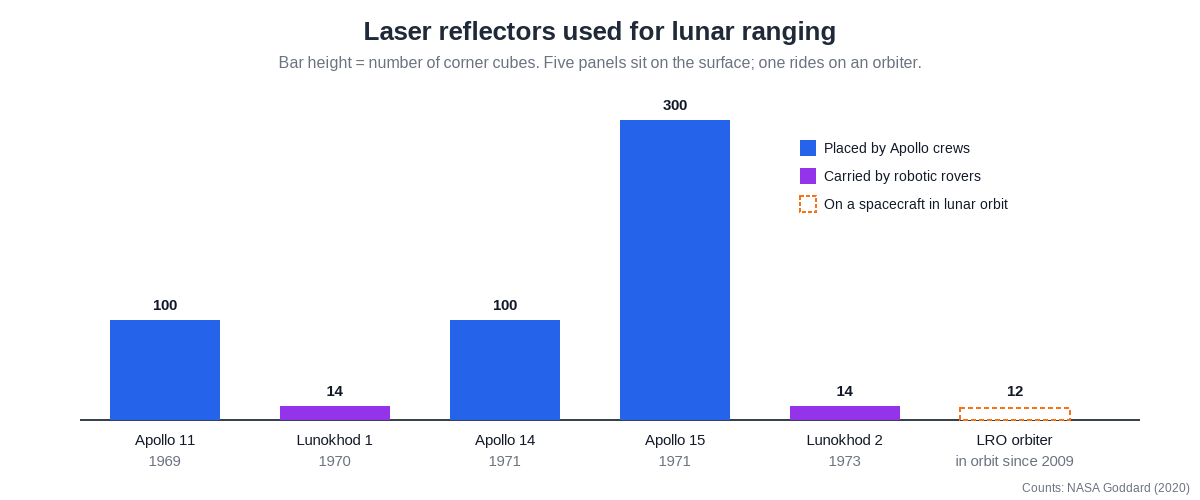
These reflectors are the one Apollo-era science experiment that is still running.
A round trip of 2.5 seconds
The method is the same round-trip timing described in Measuring with lasers: range finding and lidar basics. A pulsed laser fires short bursts of light through a telescope at a reflector. The time until the light returns, multiplied by the speed of light, gives the distance. On average the round trip takes about 2.5 seconds.
The time is not the same every day. The Earth–Moon distance ranges from 351,000 to 406,000 km, so the round trip ranges from 2.34 to 2.71 seconds. That is how APOLLO, the Apache Point Observatory Lunar Laser-ranging Operation in New Mexico, explains it.
The project began firing at the Moon in July 2005. Each of its pulses lasts 100 picoseconds, and light covers about an inch in that time.
The measurement has grown finer over the years. The 1994 NASA article gave an accuracy of about 3 cm. APOLLO's own page says 35 years of ranging had reached 2 cm precision; the project aimed to time each trip to a few picoseconds, about 1 mm of range. By 2020, distances were being worked out to less than a few millimeters.
How wide the beam is at the Moon
The beam goes in where the telescope's eyepiece would be and is widened to the size of the main mirror before it leaves for the Moon. Why a wide starting beam keeps its width longer is covered in Why a beam spreads. APOLLO uses a telescope with a 3.5 m main mirror as a giant laser pointer and as its signal receiver.
Even so, Earth's air blurs the beam. According to APOLLO, atmospheric turbulence adds roughly one arcsecond, at times more, of beam divergence. An arcsecond is 1/3600 of a degree. At the Moon's distance, that tiny angle becomes 1.8 km.
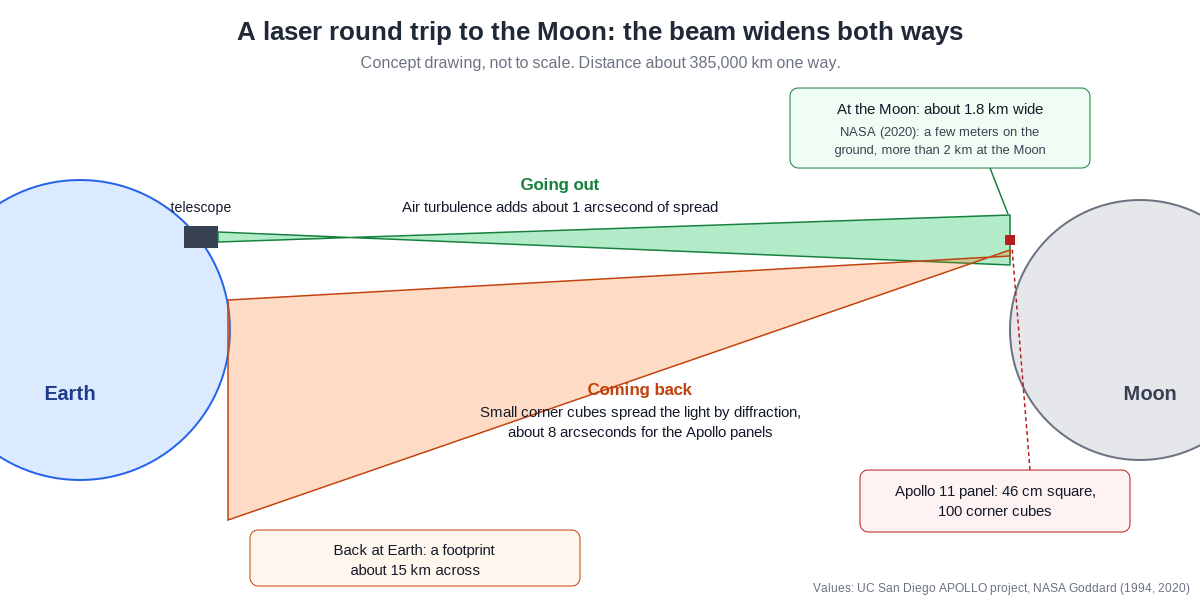
The sources give slightly different numbers. The 2020 NASA article first notes that the photons cross Earth's thick air twice and tend to be scattered along the way. It then says a beam that starts out a few meters across at the station can grow to more than 2 km at the lunar surface. The 1994 article put the width at the surface at roughly four miles (about 6.4 km).
Whichever figure you take, the beam is thousands of times wider than a 46 cm panel. Most of the light lands on bare lunar ground and is wasted.
Scientists have compared the aiming task to hitting a moving dime two miles away with a rifle. In practice, the beam is far wider than a dime and covers the whole panel. The hard part is not one lucky hit but keeping the beam on a panel that cannot be seen.
The returning light spreads even wider
Of all the light sent toward the Moon, roughly one part in 30 million actually strikes the reflector. A second round of spreading happens on the way back. Each corner cube is a small aperture, so the light leaving it must spread by diffraction.
For the Apollo panels this spread is around 8 arcseconds. By the time the returning light reaches Earth, its footprint is about 15 km across. A 3.5 m telescope collects only about one in 30 million of those photons. The light shrinks by tens of millions once on the way out and once on the way back.
The 2020 NASA article quotes somewhat different figures, which it calls estimates. A photon fired from Earth has a one-in-25-million chance of reaching the Apollo 11 reflector. A photon that does reach the Moon has an even lower chance, one in 250 million, of making it back. Both sources agree that a large loss happens on each leg of the trip.
Measuring with a handful of photons
Multiply the two odds and each photon has about a one-in-a-quadrillion chance of hitting the reflector and returning to the telescope. APOLLO puts about 3 × 10¹⁷ photons into every pulse. With other losses added, it expects 1–5 detected return photons per pulse. It fires 20 pulses each second.
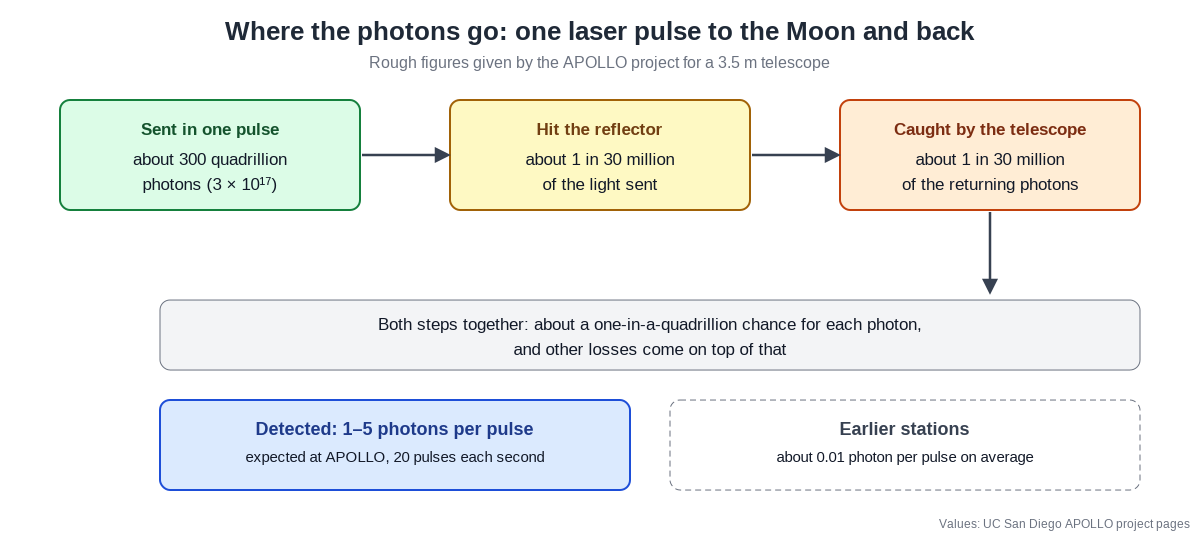
Older stations had it harder. Facilities before APOLLO averaged 0.01 photon per pulse, or one photon back for every 100 pulses. The 1994 NASA article also says that even in good viewing conditions, only one photon arrives every few seconds.
A single photon cannot give millimeter precision. The length of the pulse itself (about 2.5 cm) and the slight tilt of the reflector leave 30–50 mm of uncertainty per photon. Averaging N photons cuts the error by the square root of N. Getting down to 1 mm takes 900–2500 photons.
How do you pick those few photons out of bright moonlight? The answer lies in three things known in advance. The laser's color is known, so only that color reaches the detector. The reflector's position is known, so moonlight from everywhere else is blocked, and the return time is known, so the detector opens only around that moment.
Dimming panels and new attempts
After more than half a century on the lunar surface, the panels do not return light as well as they once did. The 2020 NASA article says some return only a tenth of the expected signal. One suspicion is that dust, kicked up by micrometeorite impacts, has settled on the mirrors, blocking light and heating them so they work less well. The dust question is still open.
There is also a clean target for comparison. One reason engineers put a reflector on the Lunar Reconnaissance Orbiter (LRO), in lunar orbit since 2009, was to test the surface panels against it. This reflector is a tenth the size of the Apollo 11 and 14 panels and has only 12 corner cubes. It also rides on a fast-moving spacecraft, which makes it harder to hit.
The first signal back from LRO came through a laser station in Grasse, France. The station fired pulses of infrared light, which passes through Earth's atmosphere better than the green visible light used in the past. Over a few dates in 2018 and 2019, tens of thousands of pulses brought back about 200 photons. How wavelength changes the way light crosses the air is covered in Why wavelength matters.
What half a century of ranging has shown
The best-known result is that the Moon is moving away. The gap between Earth and Moon grows by 3.8 cm each year. That is about the pace at which fingernails grow. Long records from several reflectors have also shown that the Moon has a fluid core.
The measurements also say something about Earth. The length of an Earth day varies by about a thousandth of a second over a year. The 1994 article names the atmosphere, tides and Earth's core as the causes.
For physicists, the measurement is a test bench for gravity. General relativity predicts that the lunar orbit differs from the Newtonian one at the level of several meters. Measuring the distance to the millimeter puts that prediction to a hard test. All of these results come from decades of collecting photons that arrived a few per pulse, or once every few seconds in earlier years.
The same physics in laser weapons
A lunar ranging laser and a laser weapon have entirely different goals. One gets a few photons back to time a trip; the other keeps light on one spot of a target for a long time. Still, the physics is shared: a beam widens with distance, and air blurs it.
Why a beam is launched wide is explained in Why a beam spreads. Correcting a beam against moving air is the subject of Adaptive optics: restoring a blurred beam. What a laser weapon is, and how it differs from the movies, is in What is a laser weapon?.
What to read next
- Why a beam spreads: divergence, focus and aperture: explains, with the beam waist and divergence, why the beam widened on its way to the Moon.
- Measuring with lasers: range finding and lidar basics: shows how round-trip timing is used on the ground and from satellites.
- May 16, 1960: Maiman's Ruby Laser: the story of the day laser light first switched on.