Hear "a Group 3 drone" or "a small drone" in the news, and it is hard to picture the size. A palm-sized quadcopter and a large aircraft that takes off from a runway are both called drones, which makes it harder still.
Behind these names sits a fixed chart. This article looks at how the U.S. Department of Defense (DoD) sorts drones into five groups and how to read that chart. It also asks why military and civil schemes sort by different things. Classes and rules change often, so this article reflects the situation as of October 2026.
Drone, UAV and UAS
First, the words. The DoD dictionary and joint doctrine JP 3-30 set out what an unmanned aircraft (UA, or UAV) is. It is an aircraft that carries no human operator and can fly with or without remote control. Add the equipment, network and people needed to control it, and you get an unmanned aircraft system (UAS).
One aircraft and the whole system that flies it are different things. Besides the aircraft, the system includes ground equipment, a network and people. These definitions have also changed over time, and they do not fully match those of other U.S. federal agencies.
The names have changed too. In the 1970s and 1980s, DoD commonly said remotely piloted vehicle (RPV), and the term unmanned aircraft later took its place. Today "drone" is everyday speech in the U.S. military for uncrewed aircraft in general, just as it is for the public. It is also the name for certain military types, such as aerial targets used in training.
From mission to weight and altitude
Weight was not the first yardstick. In 1988, the DoD UAV Joint Program Office published its first drone master plan, as Congress had directed. DoD then tried to bring each service's own way of sorting drones into one scheme. That early approach used the mission profile: close-range, medium-range, strategic and so on.
Over later versions, the focus moved to the aircraft itself. Physical and operating values, such as weight and airspeed, carried more weight. A 2007 proposal from what was then the Joint UAS Center of Excellence called for five groups in place of three classes. A year later, DoD took up a revised version.
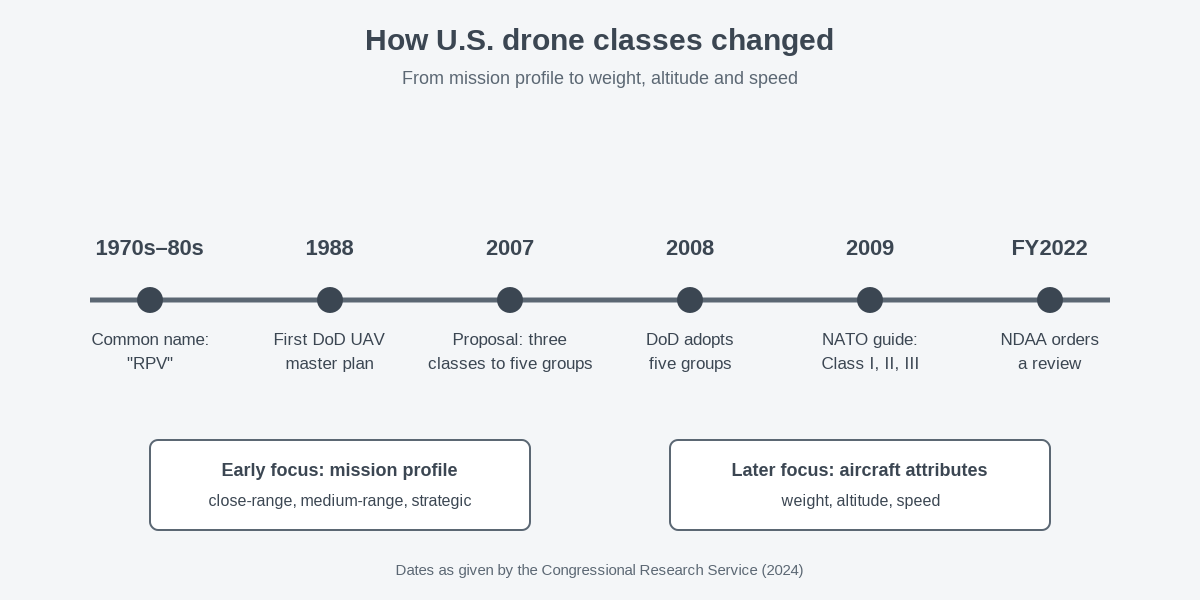
Why weight and altitude? The Congressional Research Service (CRS) explains that the attributes and dividing lines were chosen partly to line up with the Federal Aviation Administration (FAA). That makes it easier to fit military drones into U.S. airspace. One example is the Group 2 upper limit of 55 pounds, the same figure the FAA uses as the maximum takeoff weight of a small UAS (sUAS).
Mission names did not disappear, though. Even within its small drones, the U.S. Army plans short-range, medium-range and long-range reconnaissance UAS for platoons, companies and battalions. "One-way attack UAV" is also a mission name, for a drone built for a single-use mission with a built-in explosive warhead. DoD, however, seems to have no public definition of the term.
Reading the Group 1 to 5 chart
Today DoD still uses the five-group approach built in 2007–2008. It appears in JP 3-30 as the "UAS Categorization Chart." There are three yardsticks: speed, operating altitude and maximum gross takeoff weight.
A Penn State course table, which cites the U.S. Army Roadmap for UAS, gives the limits. Group 1 goes up to 20 pounds, normally flies below 1,200 feet above the ground and stays under 100 knots. Group 2 covers 21–55 pounds, below 3,500 feet and under 250 knots.
From Group 3, the weight range widens sharply. Group 3 is under 1,320 pounds, below 18,000 feet above mean sea level and under 250 knots. Groups 4 and 5 are both over 1,320 pounds with no upper speed limit. What splits them is whether they fly below or above 18,000 feet.
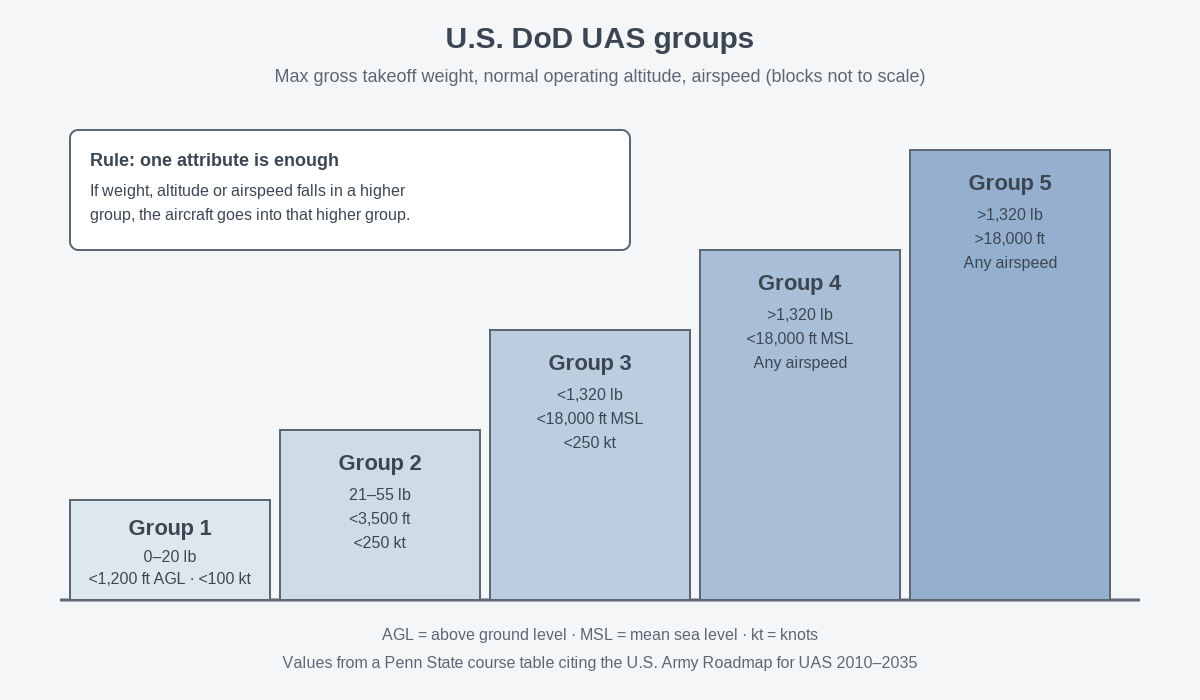
Notice that altitude has two reference points. Low-flying Group 1 is measured from the ground (above ground level, AGL). From Group 3 up, altitude is measured from mean sea level (MSL). For an aircraft flying over mountains, the two numbers can be far apart.
One rule matters most when reading the chart. If any one of weight, altitude or speed falls in a higher group, the aircraft goes into that higher group, whatever its other values are. A light aircraft that flies very fast cannot be placed in a low group by its weight alone.
"Small" does not always mean the same thing
"Small UAS" is one of the most common terms in the news, but it does not point to one range. In most DoD contexts, a small UAS weighs less than 55 pounds, which matches the definition in U.S. federal law. A CRS paper on the Army's small drones describes Groups 1 and 2 as aircraft under 55 pounds that stay at 3,500 feet above the ground or lower.
Counter-drone policy is the exception. DoD Directive 3800.01E made the Army the executive agent for countering small UAS. In that directive, a small UAS is any aircraft from Group 1 through Group 3, which means up to 1,320 pounds. So the same term can mean up to 55 pounds in one place and up to 1,320 pounds in another.
On the counter-drone side, Groups 4 and 5 are treated apart. A CRS counter-drone report says DoD expects defense against small UAS to need its own equipment, policy and doctrine. Groups 4 and 5, in DoD's view, are likely to stay with regular air and missile defense units and their systems. When a counter-drone story says "small," it helps to check which definition it uses.
NATO and civil rules
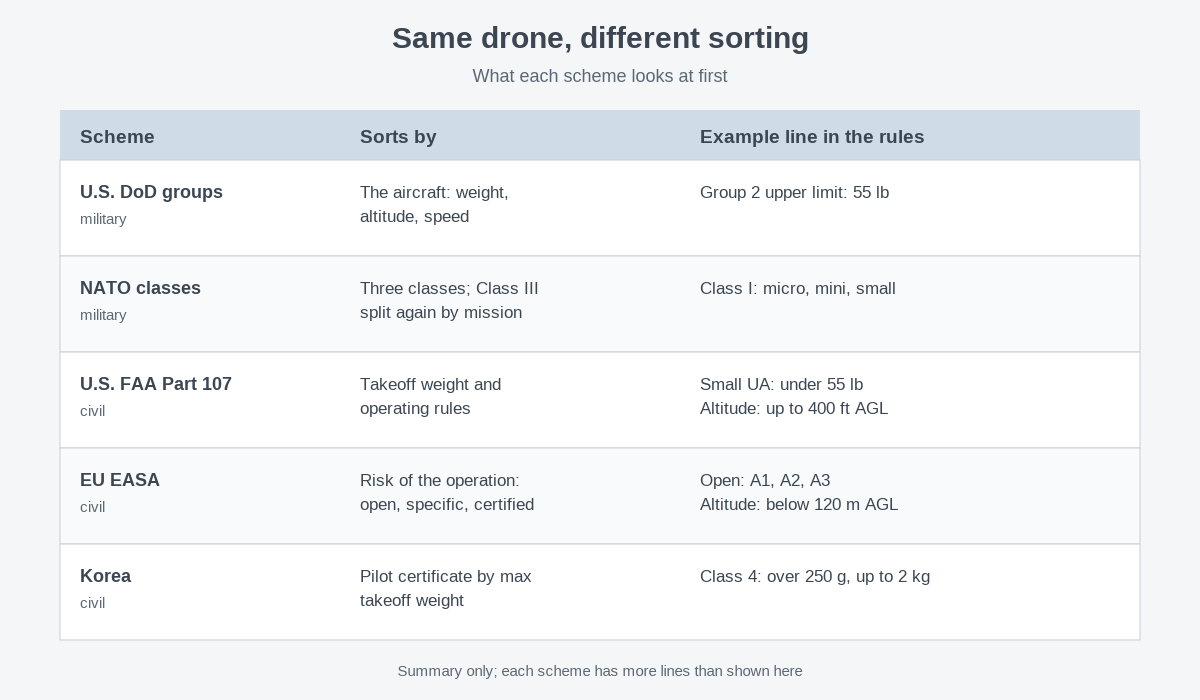
The U.S. five groups are not a world standard. The North Atlantic Treaty Organization (NATO) first presented its own guide in 2009. It sorts drones into Class I, II and III. Class I is split by size into micro, mini and small, and Class III is split again by the aircraft's mission.
Civil rules start from a different place. The U.S. rule 14 CFR Part 107 defines a small unmanned aircraft as one under 55 pounds at takeoff, counting everything on board or attached. As a general rule, such an aircraft must keep to 400 feet above the ground or lower. The military groups sort aircraft, while this rule sets who may fly them and under what conditions.
The European Union Aviation Safety Agency (EASA) looks first at the risk of the flight rather than the aircraft. A regulation in force since December 31, 2020 divides civil drone operations into three categories: open, specific and certified. The open category is low risk, so no operational authorization is needed before a flight. In the specific category, the operator must do a risk assessment and get authorization from the national authority.
The certified category covers cases where the risk is much higher. Certification of the operator and the drone, and a license for the remote pilot, are always required. Within the open category, flights are split by whether a drone may fly over people (A1), close to people (A2) or must stay far from people (A3). Flight altitude must stay below 120 m above the ground.
Korea divides pilot certificates by aircraft weight. Korea's Aviation Safety Act, in Article 125, requires a pilot certificate for anyone who flies an ultralight aircraft. A drone whose maximum takeoff weight is over 250 g but no more than 2 kg is in Class 4. By shape, there are four types: multicopter, helicopter, airplane and vertical takeoff and landing (VTOL) drones, the last one added in May 2025.
What the chart does not tell you
A group number leaves out a lot. DoD's classes contain no values that predict an aircraft's cost or service life. That is why DoD and the Air Force use a separate word, "attritable," for drones that are reusable but built cheaply enough that commanders can accept putting them at risk.
The classes themselves are debated. Some analysts argue that the groups say little about other useful traits, such as how automated an aircraft is. Others say Group 3 is too broad and that the groups do not match the schemes of America's allies and partners, which can cause confusion.
Still others praise the groups for being more flexible than other approaches. Congress ordered a review in Section 1073 of the National Defense Authorization Act (NDAA) for Fiscal Year 2022. It told DoD to look at the drone classes in JP 3-30 and report whether any changes are needed. Even one chart of weights and altitudes touches questions of airspace, policy and technology.
What to read next
- ISR drones: why endurance matters: see how the group chart shows up in the story of reconnaissance drones.
- MALE and HALE Drones: Aircraft That Stay Up for More Than a Day: names that come from altitude and endurance.
- FPV drones: flying through the drone's eyes: one way of flying a small drone.
- Loitering munitions: between missile and drone: what the label one-way attack drone points to.
- Counter-drone systems: why one device is not enough: how the tools for stopping small drones fit together, and where lasers come in.