Can a laser weapon fit inside a pod hung under an aircraft? The German Navy's ship laser is still in development, aimed at service in 2029, and the air is counted as an even harder place to work. The German arm of the European missile maker MBDA has now been given the job of testing that question.
In a November 2 press release, MBDA Deutschland said it had received a contract from the German armed forces procurement office (BAAINBw) to build an airborne laser demonstrator. Its stated goal is to lay the technical groundwork for future laser weapons on board aircraft. The laser demonstrators this company has made public so far have been ship systems, so the move to the air stands out.
This letter in brief
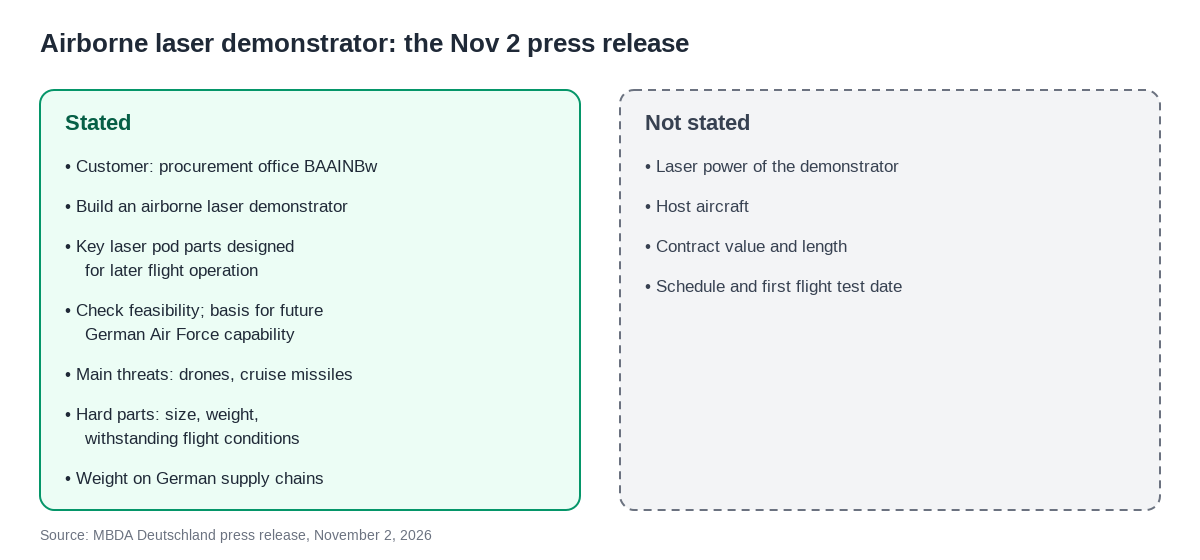
- MBDA Deutschland said on November 2 that it received a contract from the German procurement office for an airborne laser demonstrator. Under the contract, key parts of the laser pod are designed for later flight operation from the start.
- The company said the work will check whether an airborne laser weapon is feasible and lay a basis for future German Air Force capability. The main threats named are drones and cruise missiles.
- The press release does not give the laser power, the host aircraft, the contract value or a flight test schedule.
What was announced
The announcement is a single press release on MBDA Deutschland's website. Its title means "MBDA receives a contract for an airborne laser demonstrator from the Bundeswehr," and it carries a laser tag. The customer is BAAINBw, the office that buys equipment for the German armed forces.
The key word is "demonstrator." This is not a contract to buy a weapon but a step to build test hardware that shows whether a laser weapon can work in the air.
The company calls the core of that hardware a "laser pod." A pod usually means a container-shaped piece of equipment hung under an aircraft.
What is publicly known
| Item | What the press release states | Source |
|---|---|---|
| Announcement | November 2, MBDA Deutschland press release | MBDA Deutschland |
| Customer | German armed forces procurement office (BAAINBw) | MBDA Deutschland |
| What is built | An airborne laser demonstrator; key laser pod components designed for later flight operation | MBDA Deutschland |
| Purpose | Check the feasibility of an airborne laser weapon; lay a basis for future German Air Force capability | MBDA Deutschland |
| Main threats | Drones and cruise missiles | MBDA Deutschland |
| Hard parts | Size, weight and the ability to withstand flight conditions | MBDA Deutschland |
| Supply chain | Special emphasis on German suppliers and national system know-how | MBDA Deutschland |
| Background | Laser technology has been a strategic German R&D focus and a national key technology since 2019 | MBDA Deutschland |
The press release calls airborne laser development the "Königsdisziplin," or premier discipline, of laser weapon technology. It uses the word to say that specialists see it as an especially demanding task. The reason it gives is the extreme demand on size, weight and resistance to flight conditions.
The technology, explained: why aircraft are hard
A high-energy laser (HEL) weapon is more than the light source. It also needs power, cooling to remove the heat that did not become light, and a beam director that holds the beam on one spot of the target. How these parts fit together is covered in What is a laser weapon?.
A warship can put this whole set in one container on deck. A pod hung under an aircraft is a different case. Its volume and weight budget are much smaller, and the equipment has to withstand the conditions of flight as they come. That is the point MBDA makes when it names "size, weight and flight conditions" as the hard parts.
Heat is a large problem. A laser turns only part of its electric input into light, and the rest stays behind as heat. Inside a pod, even finding room for the cooling equipment is tight. Cooling and thermal management explains this problem in more detail.
Holding the beam on target comes with it. A laser weapon must heat one spot of the target for some time before damage occurs. When the shooter is an aircraft, both the shooter and the target are moving. Why this takes time is in Why lasers take time, and the aiming optics are in Beam director optics.
What is new
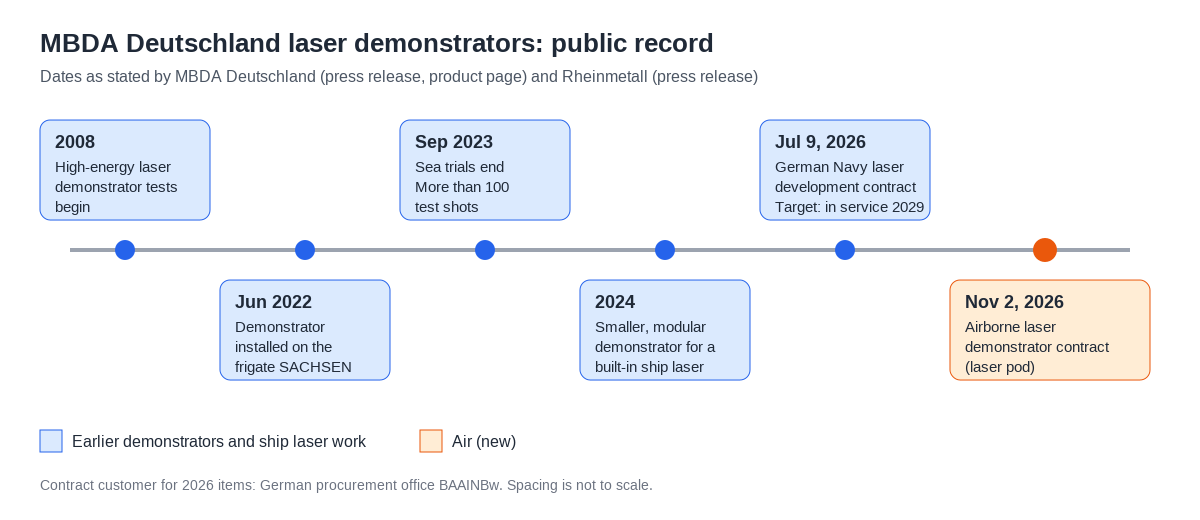
The laser demonstrator record that MBDA Deutschland has made public centers on ship lasers. According to the company's product page, it has tested several high-energy laser demonstrators since 2008. Its laser work puts weight on tracking, using active tracking with eye-safe illumination. Tracking is one part of acquisition, tracking and pointing (ATP).
The sea trials were done with Rheinmetall. The two companies' laser weapon demonstrator was installed on the frigate SACHSEN in June 2022, and the sea trials ended in September 2023. More than 100 test shots were fired in that time. In 2024, MBDA also built its own smaller, more modular demonstrator aimed at a laser built into the ship rather than housed in a container.
That line led to a contract on July 9 this year. According to Rheinmetall's press release, BAAINBw signed a German Navy high-energy laser weapon development contract with the two companies' working group, with an operational goal of 2029. Its value sits in the middle of the hundreds of millions of euros. At the WTD 91 test center, the demonstrator fired over 1,000 shots in over a year of trials.
The ship side was also covered in November letter No. 1. Less than four months after that contract, the same office has given the same company a demonstrator for the air. What changed is the setting and the stage: the ship laser has reached a development contract, while the airborne laser starts with a feasibility demonstrator.
Earlier attempts to fly lasers are covered in the 1983 Airborne Laser Lab and YAL-1.
Limits and open questions
No laser power is given for the demonstrator. The product page says MBDA demonstrators can handle more than 100 kW of output thanks to special mirror optics. That is a company statement about its demonstrators since 2008 in general, so it cannot be read as the power of this airborne demonstrator.
The host aircraft is not named. The contract value, its length and the date of a first flight are also missing. What the release does say stops at designing the key pod components for flight operation.
Everything here comes from the company. If the procurement office publishes its own account, the scope and schedule may become clearer. Until then, the public record is the company's description: test hardware to check whether an airborne laser against drones and cruise missiles is possible. How to avoid judging performance from a single power number is covered in How to read laser weapon news.
What to read next
- 2010: YAL-1, the 747 Laser Intercept Test and the End of the Program: to see where an earlier large-aircraft laser program stopped.
- Cooling and thermal management: where the heat that did not become light goes: to see why heat is a large problem for a laser in a pod.
- Lasers Against Drones: From Iron Beam to National Prototypes: to compare with counter-drone lasers on land and at sea.