In early June, a crane lifted an unusual piece of equipment onto the flight deck of the French aircraft carrier Charles de Gaulle while the ship was in port. It was a turret carrying cameras, a lidar and a laser. Four months later, in October, the French Navy's official magazine, Cols Bleus, ran a short piece about it.
The laser story is a single short section of that article. Within days, several outlets reported that France had tested a laser on its aircraft carrier. This letter separates what the official magazine actually says from what the media added, and shows where the two part ways.
This letter in brief
- Cols Bleus No. 3140 (October 2026) says that from June 4 to 8, while the Charles de Gaulle was in port, a team from a military air expertise center (CEAM) and a ground-based air defense squadron (EDSA) set up and trialed a counter-drone laser on its flight deck. Two outlets described it as an Air and Space Force team.
- What is public: the four hours the setup took, the equipment (a turret with cameras, a lidar and a laser, plus a cooling unit and a control console), and the test conditions (air transport, crane lifting and extreme weather).
- What is not public: the system's name, maker and power, and whether the beam was fired or any drone was hit.
What was announced
The first source is the "EXPÉRIMENTATIONS" feature in Cols Bleus No. 3140. It groups three "major innovations" tried during La Fayette 26, the carrier strike group's deployment. They are data and artificial intelligence, underwater gliders, and a counter-drone laser.
The laser section opens with the date and place. From June 4 to 8, during a port call of the Charles de Gaulle, a team set up a counter-drone laser on the ship's flight deck. Its members came from the military air expertise center (CEAM) at Mont-de-Marsan and the ground-based air defense squadron (EDSA) at Istres. The magazine does not say which service the two units belong to; the two outlets that picked up the story describe the team as French Air and Space Force.
The team leader, a non-commissioned officer, told the magazine that it was the first trial of this system aboard a navy ship. That line is an interview quote in the article, not a separate finding by the navy or the ministry.
Two outlets reported the story from this article. On October 26, the European defense outlet Defence Industry Europe ran it under a headline saying the test was "at sea." On October 27, the maritime outlet Baird Maritime reported that the equipment was set up while the ship was in port.
What is publicly known
The table holds only what the official magazine states.
| Item | What the magazine says |
|---|---|
| When and where | June 4 to 8, during a port call of the Charles de Gaulle, on the flight deck |
| Team | Personnel from CEAM (Mont-de-Marsan) and EDSA (Istres) |
| Setup time | Four hours |
| Equipment | A turret with cameras, a lidar and a laser, a cooling unit, and a control console |
| Test conditions | "Air transport, crane lifting and extreme climatic conditions" |
| Stated result | The laser's behavior was validated in operating conditions it had not faced before |
| Team leader's remark | The first trial of this system aboard a navy ship |
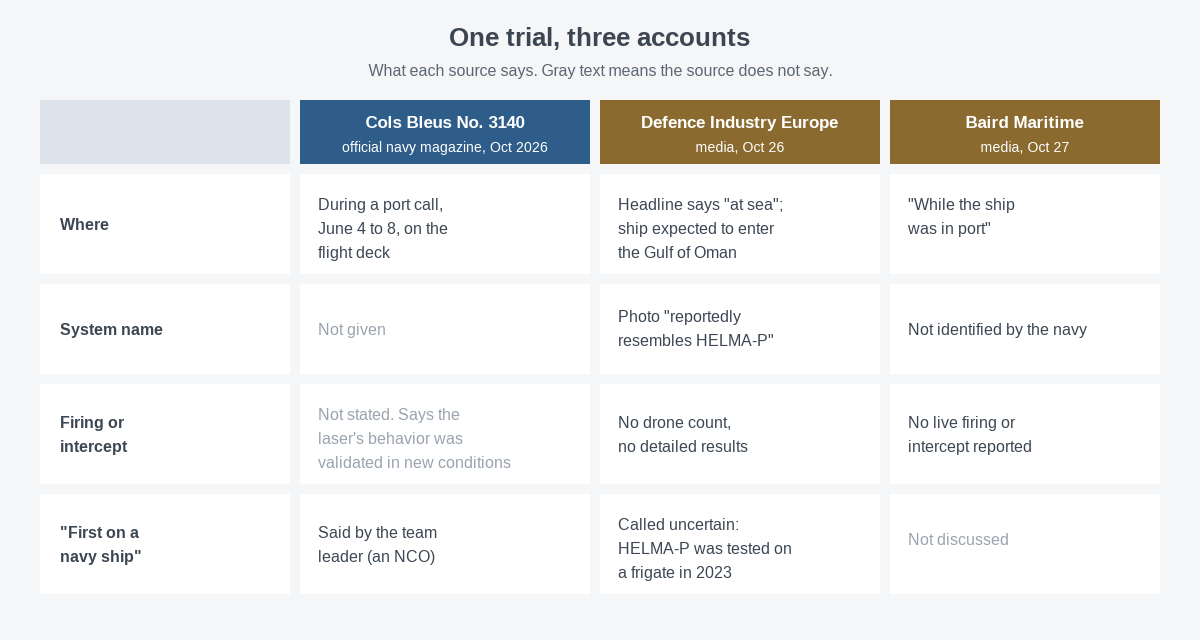
As a test result, the magazine gives the sentence saying the laser's behavior was validated. The "success" the team leader mentions is about teamwork and coordination under a tight schedule. It does not say how many drones flew or whether the beam was actually fired. Baird Maritime also noted that no live firing or drone intercept was reported.
The technology, explained
The magazine names three kinds of equipment. The first is the cameras and the lidar mounted on the turret. A lidar measures distance by sending out laser pulses and timing the light that comes back. The magazine does not say what each part does, but the turret carries sensors that act as eyes alongside the laser itself.
Stopping a drone runs in a sequence of detect, identify, track and defeat, as laid out in The Counter-Drone Chain: Detect, Identify, Track, Defeat. This article does not say which of these steps the trial covered.
The second is the cooling unit (groupe froid). Not all the electricity fed into a laser becomes light, and the rest turns into heat. That is why high-power lasers bring their own cooling. Why this heat is such a large problem is covered in Cooling and thermal management.
The third is the test conditions. Air transport and crane lifting are about moving and loading the equipment. Precision optics are sensitive to shaking, shock and temperature changes.
So flying the equipment in, hoisting it by crane and leaving it on a deck in extreme weather are tests in their own right. Protecting optics in places that shake is the subject of Vibration and shock.
It also stands out that the laser was not built into the ship. It was flown in, lifted aboard by crane and set up in four hours for a five-day trial.
The magazine does not say what was measured under these conditions or what standard was used to "validate" the laser. For general background on how air and moisture at sea affect a laser beam, see Strengths and limits of laser weapons.
What is new
This is not France's first counter-drone laser trial on a ship. On June 8, 2022, France's defense procurement agency (DGA) notified the L2AD counter-drone laser contract to the company CILAS. The contract buys an operational prototype that can identify, track and neutralize small and very small drones.
That prototype came from the HELMA-P demonstrator, which was evaluated in 2020 and 2021. The same contract included a study of adapting HELMA-P to a naval platform, with first feasibility tests at sea planned for that year. The DGA wrote that HELMA-P needs only light logistics because it uses no ammunition.
From June 12 to 14, 2023, the DGA, the navy and CILAS tested HELMA-P aboard the air defense frigate Forbin in the Mediterranean. The navy wrote that the tests open the way to further prototype development toward eventual integration on navy ships. Both announcements are also summarized in Laser weapon programs that have been made public.
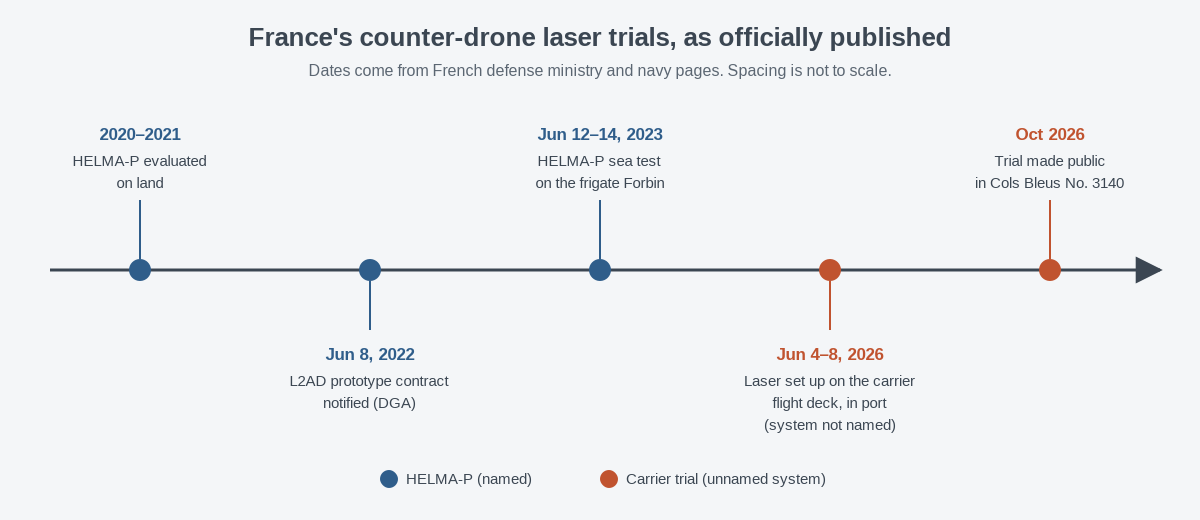
So what is new this time? One thing is the ship. In 2023 it was a frigate; this time it was the flight deck of an aircraft carrier.
The other is who set it up. The 2023 test was run by the DGA, the navy and the company, while the team in this article came from CEAM and EDSA. The two outlets reported those units as Air and Space Force units.
The team leader's "first trial aboard a navy ship" seems to clash with the 2023 Forbin test. Whether the two trials used the same system has not been made public, so the article alone cannot tell what that "first" is measured against.
Limits and open questions
The biggest gap is the system itself. The magazine does not give its name or maker. Defence Industry Europe reported that the equipment in the photos reportedly resembles HELMA-P, but the navy has not confirmed this. No power figure appears anywhere.
The second gap is the location. The official magazine says the trial took place during a port call (escale). Defence Industry Europe's headline says "at sea," and its text says the carrier was due to head into the Gulf of Oman while the trial ran. Baird Maritime, like the original, says the ship was in port.
The third gap is the result. In laser weapon news, "tested" and "intercepted" are different claims. This article gives no number of shots, no targets and no hits. How to read such reports is covered in How to read laser weapon news.
Finally, no separate press release on this trial from the navy or the DGA could be found. These sources also say nothing about whether France plans to fit a laser to its carrier for good.
What to read next
- Laser weapon programs that have been made public: to compare France's L2AD and Forbin tests with other countries' official announcements in one table.
- Lasers Against Drones: From Iron Beam to National Prototypes: for a wider look at how counter-drone lasers are built.
- Aircraft carriers: turning a ship into an airport: to see how the flight deck where this trial took place is normally used.