New duties on drones entering the United States began one minute after midnight, eastern time, on September 3, 2026. The presidential proclamation behind those duties does not stop at finished drones; it also puts separate duties on docking stations and certain parts. In the US government's view, even drones assembled in the United States carry critical parts made overseas.
A drone is small and light, but its parts come from far apart. The motors need rare-earth magnets, the batteries need lithium, graphite and cobalt, and the nose carries a camera. Each of these comes from a different country, mine or factory. So how many groups of parts does a drone break into, and which of them have governments singled out?
A mineral figure changes meaning with what it counts, so mining, production and imports have to be read apart. The rules and duties are as checked in October 2026.
Taking one drone apart
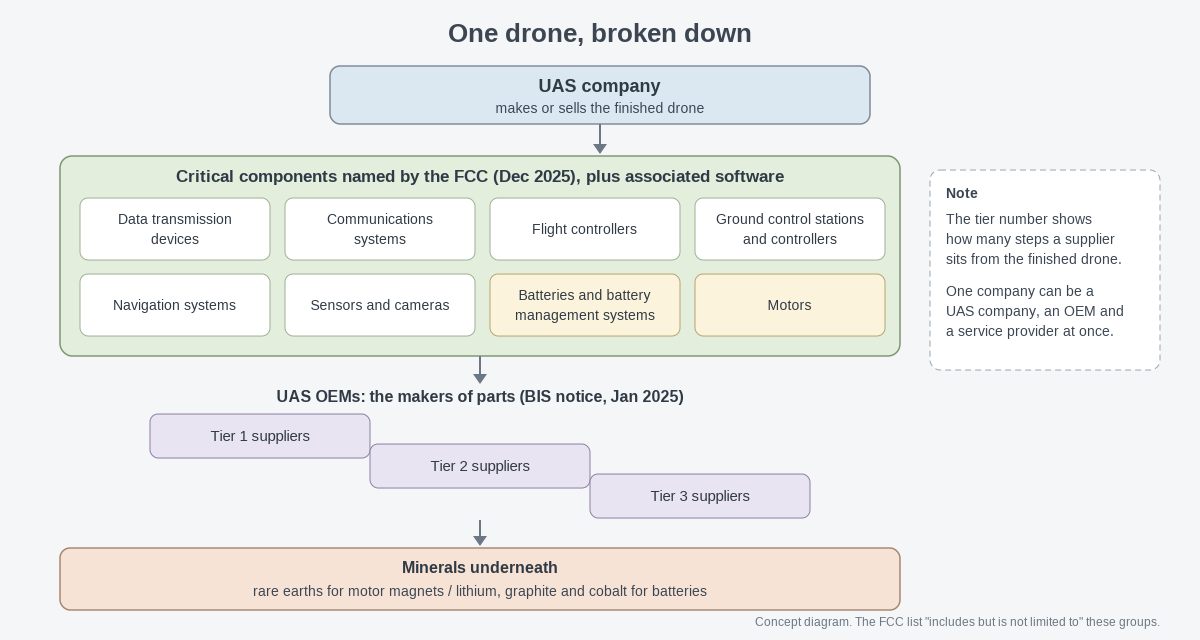
There is a government document that lists the parts of an unmanned aerial system (UAS) directly. It is the national security determination that the US Federal Communications Commission (FCC) published in a public notice on December 22, 2025. The determination says "UAS critical components" include at least eight groups, plus any associated software. They are data transmission devices, communications systems, flight controllers, ground control stations and UAS controllers, navigation systems, sensors and cameras, batteries and battery management systems, and motors.
The list opens with the words "includes but is not limited to." The parts that see, listen, talk and push come first, ahead of the flying body itself.
The companies that make these parts form layers. In an advance notice on January 3, 2025, the Commerce Department's Bureau of Industry and Security (BIS) called the makers or sellers of finished drones "UAS companies." It called the makers of parts "UAS OEMs," a group that includes tier 1, tier 2 and tier 3 suppliers.
In supply-chain language, the tier number says how many steps a supplier sits away from the finished product. The notice also cautions that one company, depending on its products, can be a UAS company, an OEM and a service provider all at once.
A list of parts was put out for comment. It included onboard computers that control flight, communications and flight control systems, ground control stations, operating and mission-planning software, intelligent battery power systems, data storage and AI software. It also carried a figure: products from China-based entities make up at least 75% of the US consumer drone market. That figure is an estimate taken from a 2021 industry analysis and press reports.
Motors and magnets: rare earths
Take the brushless DC motor as an example of a drone motor. It has a rotor with permanent magnets and a stator wound with wire. Current in the windings pushes and pulls on the magnets and turns the rotor.
Those magnets lead to rare earths. In the mineral summaries the US Geological Survey (USGS) released in February 2026, the estimated leading global use of rare earths was magnets. Inside the United States, catalysts were the leading use. The US government stockpile plan listed 450 t of neodymium-iron-boron magnet block among its fiscal year 2025 acquisition candidates.
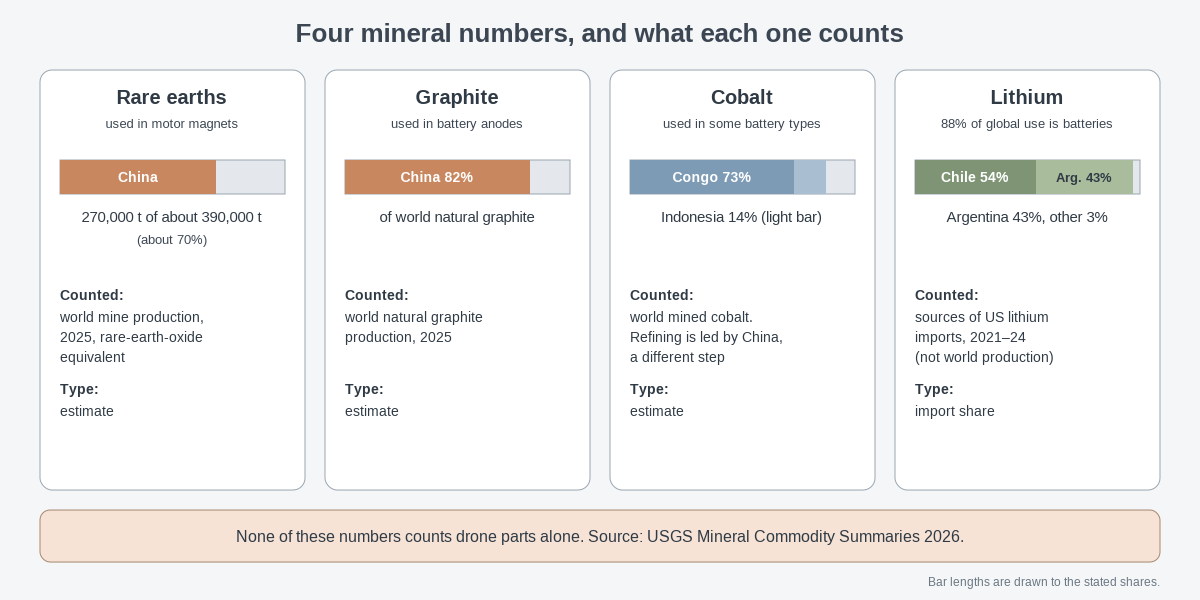
Digging rare earths out of the ground is concentrated in one country. The same summary estimates world mine production in 2025 at about 390,000 t of rare-earth-oxide equivalent, with China at 270,000 t. That works out to about 70%.
US mine production was 51,000 t. From 2021 to 2024, US imports of rare-earth compounds and metals came from China (71%), Malaysia (13%), Japan (5%) and Estonia (5%).
In 2025, government action was layered on top of this. In April, China added export controls on alloys, compounds, metals and oxides of samarium, gadolinium, terbium, dysprosium, lutetium, scandium and yttrium. In October it widened the controls to europium, holmium, erbium, thulium and ytterbium, and in November it suspended the October controls for one year. The April controls stayed in place, while China began issuing general export licenses to selected exporters.
Erbium, thulium and ytterbium on the October list are also the elements added to fiber lasers. The light each one gives off in a laser is covered in Rare-Earth Dopants: What Light Ytterbium, Erbium and Thulium Give.
Batteries: lithium, graphite and cobalt
Three minerals come up most often for batteries. An estimated 88% of global lithium use goes into batteries. From 2021 to 2024, US lithium imports came from Chile (54%) and Argentina (43%).
Graphite goes into the battery anode. China produced an estimated 82% of the world's natural graphite in 2025, and the United States relies fully on imports for natural graphite (net import reliance of 100%). In the first eight months of 2025, US imports of graphite battery anode material, natural and synthetic, came to 43,400 t, from China (55%), Indonesia (31%) and South Korea (14%).
For cobalt, the places that mine it and refine it differ. Congo (Kinshasa) accounts for an estimated 73% of world mined cobalt and Indonesia for 14%. China is the world's leading producer and consumer of refined cobalt, mainly for the lithium-ion battery industry. The cobalt content of lithium-ion batteries is falling, and in China cobalt-free batteries that use iron and phosphorus held a large share of the market.
How batteries shape a drone's flight time, and how they compare with engines, is covered in Drone Power: Batteries, Engines and Hybrids.
Cameras and thermal imagers
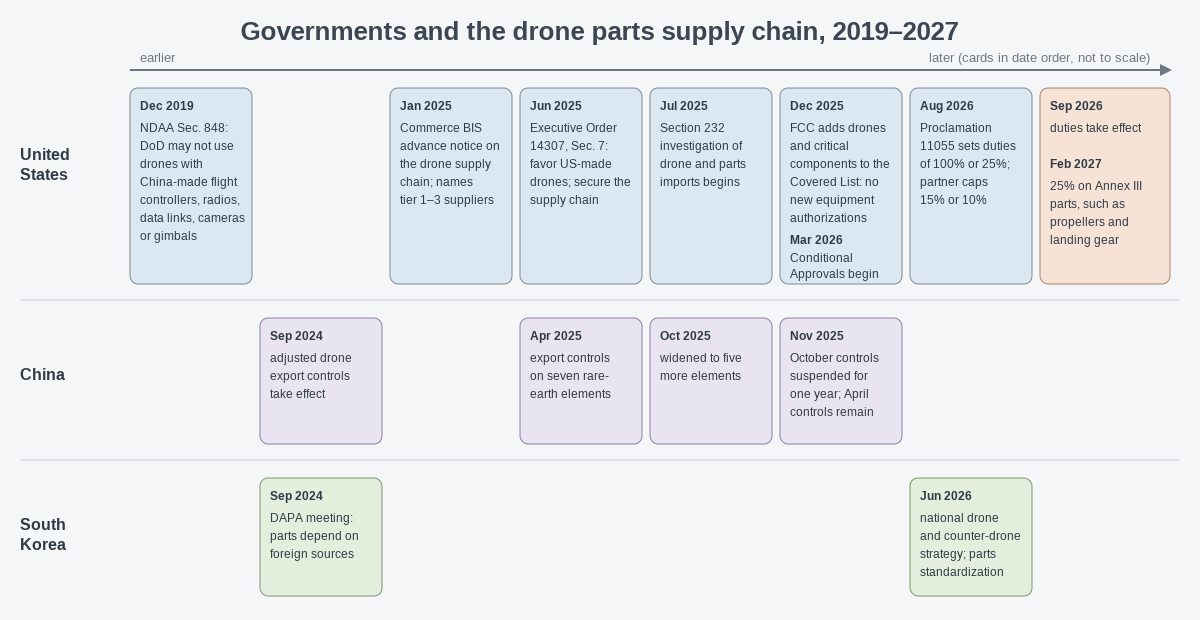
Cameras show up in the rules more than in the mineral tables. Section 848 of the US National Defense Authorization Act for Fiscal Year 2020 was approved on December 20, 2019. It bars the Defense Department from operating, or signing procurement contracts for, drones that use flight controllers, radios, data transmission devices, cameras or gimbals made in China. A gimbal is the rotating mount that holds a camera steady.
Cameras appear in China's rules too. According to a Xinhua report on July 31, 2024, China's commerce ministry adjusted its drone export controls. It changed how it controls key parts such as target-indicating lasers and infrared thermal imagers. It also brought high-precision inertial measurement unit (IMU) equipment under control and lifted temporary controls on certain consumer drones.
Even civilian drones outside the control list may not be exported for weapons-of-mass-destruction proliferation, terrorism or military purposes. These changes took effect on September 1, 2024.
What a target-indicating laser does is explained in Laser Designators: Pointing Out a Target with Light. How heat becomes an image is covered in Thermal Imaging Sights: Seeing Heat in the Dark.
The 2026 US proclamation also treats thermal imagers separately. Drones that carry a thermal imager fall in the highest duty band whatever their weight. In the annex, tariff lines marked "TI" cover only drones with thermal imaging.
The United States: rules that reach the parts
In the United States, the 2019 Defense procurement rule was followed by a string of measures from 2025. Section 7 of Executive Order 14307, signed on June 6, 2025, told all agencies to favor drones made in the United States as far as the law allows. It directed the Commerce Secretary to protect the US drone supply chain from foreign control or exploitation, including through proposed rules and investigations.
On July 1, 2025, the Commerce Secretary opened a Section 232 investigation under the Trade Expansion Act. It looks at how imports of drones and their parts affect national security. Comments were due by August 6. The questions included whether domestic production can meet domestic demand, and how far imports are concentrated among a few suppliers or countries, with the risks that brings.
On December 22, 2025, the FCC added drones and their critical components to its Covered List. The determination said that, to meet both peacetime and wartime demand, the US drone industry cannot rely on critical components produced abroad.
According to an FCC fact sheet from January 7, 2026, covered equipment cannot receive new equipment authorizations, so new devices cannot enter the US market. Models the FCC has already authorized can still be imported, sold and used. On the same day, the FCC also updated the list to exempt certain drones from the restrictions. From March 2026, some aircraft and parts that received a Conditional Approval from the Defense Department or the Department of Homeland Security also began to come off the Covered List.
"Produced in a foreign country" has nothing to do with a company's nationality. The FCC said the nationality of the company making the drone or part is not what decides the question. The test is where the item is made.
The duties came with Proclamation 11055, signed on August 13, 2026 and printed in the Federal Register on August 19. The Commerce Secretary had found that the United States depends too much on foreign drones and drone parts. Most commercial and industrial drones, even those made in the United States, include critical parts produced overseas. Many US manufacturers also lean heavily on foreign suppliers for motors, speed controllers, lithium-ion batteries and docking stations.
The rates depend on weight and equipment. From September 3, 2026, a 100% ad valorem duty applies to four groups. They are drones heavier than 25 kg at maximum take-off, drones that carry thermal imagers, docking stations and certain parts in Annex I. Drones of 25 kg or less face 25%.
Parts in Annex III face 25% from February 9, 2027. That annex includes propellers and rotors and their parts, and landing gear and its parts, when imported for use in drones. The proclamation says it delayed this duty by 180 days to encourage moving production into the United States.
Partner countries get a ceiling. Products of Japan, South Korea, Taiwan, Switzerland, Liechtenstein and EU member states face no more than 15%, and products of the United Kingdom no more than 10%. These rates apply only when importers certify that nearly all of the critical parts and technology come from the United States or those countries. The Commerce Secretary may approve plans from companies building new production sites in the United States, and each plan must commit to construction before January 20, 2029.
The FCC Covered List and the Section 232 duties sound alike but do different jobs. The Covered List shuts the door on equipment authorization for radio devices, while Section 232 puts a tax on goods at the border. Rules that block exports are a separate branch again, outlined in Export Controls: What ITAR and the Wassenaar Arrangement Restrict.
Moves in China and South Korea
China's 2024 drone export adjustment, described above, changed the standards on the parts side. The Xinhua report described it as an update to drone export controls that had already run for a year. The 2025 rare-earth controls did not target drones alone, but they touch the material in motor magnets.
In South Korea, the Defense Acquisition Program Administration (DAPA) has pointed to parts dependence more than once. A DAPA release on a September 10, 2024 meeting says the defense drone industry had long been flagged as exposed to supply-chain crises through its heavy reliance on foreign parts. Companies at the meeting said that high dependence on China for core parts such as engines and batteries could hit the supply chain hard if China restricted exports. The meeting discussed developing domestic parts and setting up standards and certification.
In 2026 a plan followed. On June 4, a task force led by the Office for Government Policy Coordination finalized the National Drone and Counter-Drone Transformation Strategy. It named the small scale of Korea's drone industry and its dependence on Chinese technology and parts as problems to fix. It plans to create about 2 trillion won of public demand for drones and counter-drone systems over five years.
Later that month, the government's policy news service reported two more plans. One is a Korean military certification system modeled on the Blue UAS concept, and the other is standardizing core parts such as batteries with other ministries.
What to check when reading the numbers
A mineral figure means very different things depending on what it counts. China's 270,000 t of rare earths is mine production, and the 82% for graphite is natural graphite production. The 73% for cobalt is Congo's share of mining, while China leads in refining. The Chile and Argentina figures for lithium are not world production but US import sources.
The 100% net import reliance for graphite needs its own reading. It means the United States meets its natural graphite needs with imports rather than domestic production. It does not mean the imports come from one country. Where the imports come from is a separate figure, like the anode-material import sources.
Check whether a number is an estimate. The world production figures in the USGS summaries carry the word "estimated" and are revised each year. The "at least 75%" in the BIS notice is not a government count but a figure quoted from an industry analysis.
Above all, none of these numbers counts drone parts alone. Rare-earth magnets also go into electric cars and wind turbines, and lithium goes into phones. Reading "about 70% of world rare-earth production is in China" as "70% of drone motors are made in China" goes beyond the source. Why the line between civilian and military parts is blurry is covered in Dual-Use Technology: When Civilian Tech Becomes Military Tech.
What to read next
- Drone Power: Batteries, Engines and Hybrids: how battery materials connect to flight time.
- Export Controls: What ITAR and the Wassenaar Arrangement Restrict: a different branch of rules from duties.
- Counter-drone systems: why one device is not enough: the other side, stopping drones once the parts come together.
- Motors, Propellers and ESCs: How a Multirotor Lifts: how motors actually lift the aircraft.
- US Restrictions on DJI: From the Entity List to the FCC: the FCC steps in this article, followed through one company's case.
- Blue UAS: The Drones the US Government Approves: the US list that Korea's planned certification takes as its model.
- Korea's Drone Industry: Military UAVs and Civil Makers: Korea's parts localization task in the context of the whole industry.