Standing still seems to take no effort. Yet if you close your eyes and stand on one foot, you will probably feel your ankle and calf making small corrections all the time. A robot that stands on two legs has to do that work with motors and computation.
A humanoid's walk can be split into two parts. One is the hardware that actually turns the joints: the actuators. The other is balance control, which decides where and when to step and how to shift the body so the robot does not fall.
What turns a robot's joints, and how does it move its feet without falling? The examples of what companies use today come from announcements made up to October 2026.
Actuators in place of muscles
An actuator is a device that takes energy, such as electricity or fluid pressure, and uses it to turn a joint or to push and pull. In a human body, that is the job of a muscle. The turning force at a joint is called torque.
The comparison stops there. A muscle produces force inside the body on its own. Most robot actuators instead attach a spinning motor to a transmission, such as gears or cables, to move the joint. The robot also has to carry the battery that drives those motors.
Everything a legged robot needs, from sensors and actuators to its power source, rides on its own body. For a long time that meant motors with too little power, and companies such as Boston Dynamics have since made big gains there.
It helps to know how many joints there are. Each leg of Unitree's H1 has three hip joints, one knee and one ankle, while the H1-2 has two ankle joints. Every joint needs an actuator to turn it.
From hydraulics to electric motors
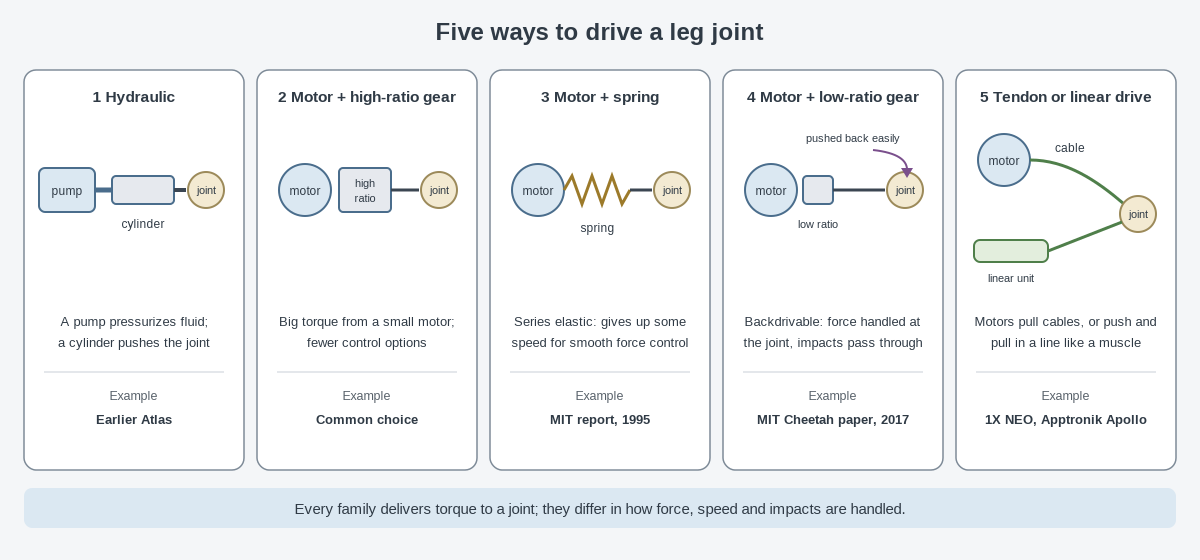
The Atlas seen in older videos ran on hydraulics. A pump puts fluid under pressure, and that pressure pushes cylinders that move the joints. In April 2024 Boston Dynamics retired the hydraulic Atlas and unveiled an electric one.
By the company's account, the electric version is stronger than earlier generations and has a wider range of motion. It has a human shape, but its joints are not limited to a human's range; the company wanted it to move in whatever way gets the job done most efficiently.
H1 offers an example of electric joints. Its joint motors are permanent magnet synchronous motors (PMSMs), a type built with low rotor inertia so they can spin fast. A motor usually runs through a high gear ratio to get the needed torque from a small package. The catch is that a high gear ratio narrows the range of control methods available.
There are also several ways to carry a motor's force to a joint. 1X's home robot NEO uses Tendon Drive, in which motors pull on cables, or tendons, that move the joints. The company says this drive makes gentle movements that are safe around people. Apptronik's Apollo runs on linear actuators designed to imitate how human muscles work.
Joints that can take a hit
Walking is a series of collisions between the feet and the ground. So is a stiffer joint always better?
A 1995 technical report from the MIT Artificial Intelligence Laboratory questioned that idea. Force-controlling actuators had been designed on the premise that "stiffer is better."
Those actuators responded fast, yet they tended to become unstable on contact, made noise and delivered little power for their size. The series elastic actuator described in the report puts an elastic element between the motor and the joint. It gives up a little speed of response in return for stable, quiet force control and protection from shock loads.
That sounds like bending your knees to soak up a landing. In reality the whole joint does not bend; an elastic element inside the actuator takes the shock first. The trade-off is extra parts, which make the device more complex and add inertia.
There is another route. A 2017 paper from MIT's research on Cheetah, a four-legged robot, proposed "proprioceptive actuation." Ordinary factory actuators struggle to give a running leg high torque density along with a way to cope with rough contact. This approach keeps the gear ratio low and controls force right at the joint, so the force where the foot meets the ground can be adjusted quickly.
The key property here is backdrivability. It describes how easily the transmission turns backward when something pushes on the end of the leg, instead of resisting. The more backdrivable the joint, the less damage an unexpected impact does.
To know the state of its own body, a robot also uses an inertial measurement unit (IMU), which measures tilt and acceleration, alongside its joint readings. NEO's spec sheet lists IMUs that measure velocity and acceleration for each link.
What keeps a robot from falling
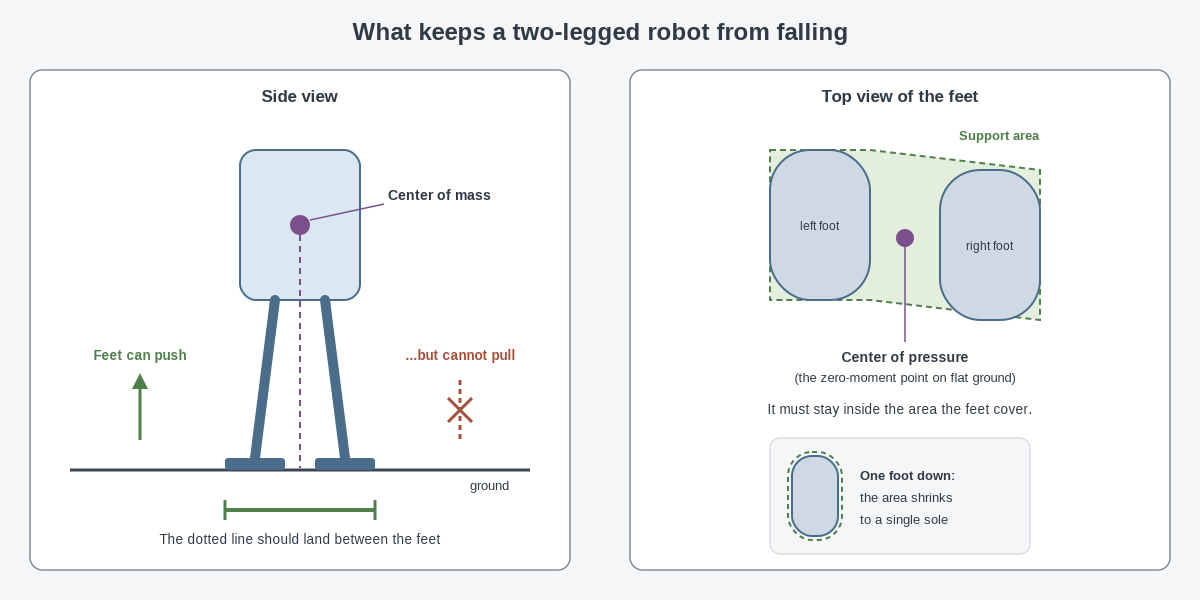
A standing object stays up only if its center of mass is above the area its feet support. When a robot stands on two feet, the area around both soles is called the support polygon. Take a simple walking model that rolls like a wheel with spokes but no rim. Even there, standing becomes unstable once the center of mass can no longer be inside that area.
Feet come with a major limit. They can press down on the ground, but they cannot pull on it. Sideways forces are limited to what friction allows. So however strong the motors are, they cannot pull the center of mass toward the ground faster than gravity.
The center of all the forces with which the soles press on the ground is called the center of pressure. It always lies inside the area formed by the points touching the ground. While walking, the robot spends moments on one foot, so this area keeps shrinking to a single sole and growing again.
Interestingly, some machines walk with no motors and no controller at all. A passive-dynamic walker, with well-matched body weight and leg length, shows that the basic motion of walking can come from the body's own mechanics. A humanoid adds motors and control to that so it can deal with flat floors, stairs and pushes.
The zero-moment point and footstep plans
Robots very often walk on flat or nearly flat ground. On such ground the center of pressure becomes the zero-moment point (ZMP). Imagine adding up all the outside forces on the robot as if they acted at one point. The ZMP is the point where the part of those forces that would twist the body becomes zero.
Because the center of pressure cannot leave the area under the feet, a planner shapes the body's motion so the ZMP stays inside the foot or feet on the ground.
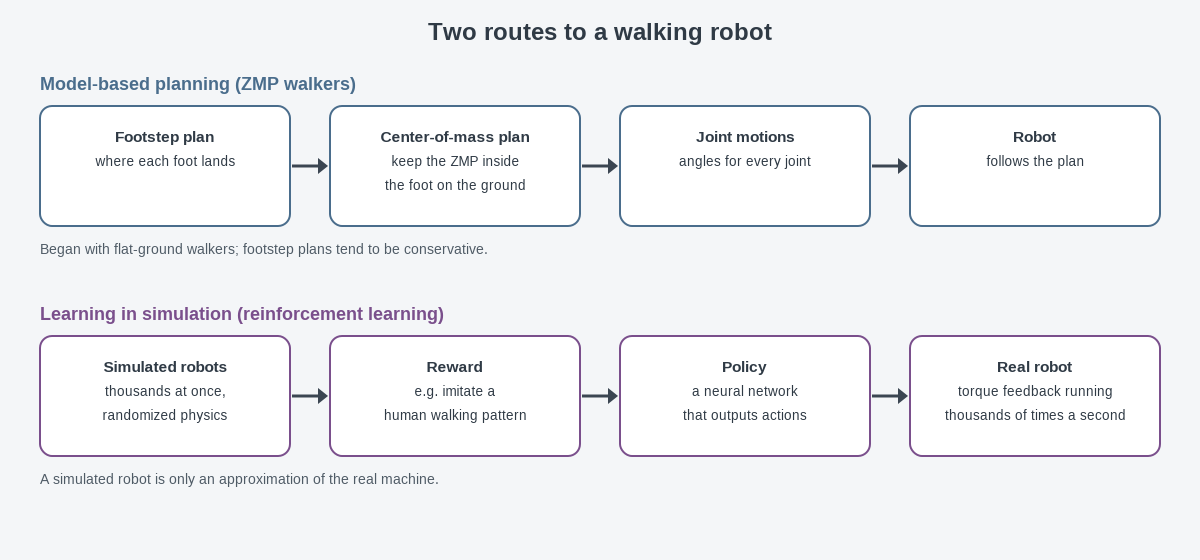
A common order has three steps. First decide where to place the feet. Next, plan how the center of mass will move. Finally, work out the motion of each joint that produces it.
This approach started with ZMP walkers such as Honda's ASIMO and focused on walking on flat ground. The author of the course notes writes that his team used an implementation of it in the DARPA Robotics Challenge. Even for a robot with dozens of joints, planning and control often rely on simple models like this.
Splitting the problem this way has a cost. Footstep plans do not reason about the robot's dynamics directly, so they tend to be conservative. The center-of-mass plan cannot fully capture limits such as how far a joint can bend or how much force it can produce.
Walking learned in simulation
Company announcements now often describe a different route. Reinforcement learning is a method in which a controller improves its behavior by trial and error, steering toward whatever earns a set reward. On March 25, 2025, Figure announced that it had used this method to teach Figure 02 to walk in simulation.
Inside the simulator, thousands of copies of Figure 02 walk at once, each with slightly different physical values. They pack years of practice into a few hours and face varied terrain, changes in how the actuators behave, and moments when a foot catches, slips or gets shoved. To make the walk look human, the robots were rewarded for imitating reference trajectories from human walking. The company says the robots ended up striking with the heel, pushing off with the toes and swinging their arms in time with their legs.
The problem is that a simulated robot is only an approximation of the real machine. Figure says it closed the gap in two ways.
In simulation, each robot's physical properties were randomized so the controller got used to many bodies, a technique called domain randomization. On the real robot, torque feedback running thousands of times a second corrects errors in the actuator model. The company said the learned walk moved to the real robot directly, without further tuning.
Boston Dynamics has also said it now pairs its long work on simulation and on predictive control based on models with machine learning, including reinforcement learning and computer vision. Testing in a virtual world first is similar to the idea of a digital twin. Examples from equipment development are in Digital twins: testing before building.
What is still hard
Controlling a walking robot calls for much faster response and much shorter delay than human motor control. Even so, the MIT course notes judge that robots still do worse than people in rough settings. Every time a foot touches down or lifts off, the forces change abruptly; having to control the body through contact is a big part of what makes walking hard.
Seeing was another problem. Figure's April 2026 post says its whole-body control model had until then used only information about its own body, such as joint states and torso motion. It walked well on flat ground but could not see what lay ahead, so stairs, ramps and uneven ground needed hand-set mode switches and human intervention.
Figure announced that the model now also uses what its cameras see, and that after training on thousands of randomly generated terrains it moved directly to real stairs. That is the company's report, and a simulation is still an approximation of reality. The distance between walking well on a flat lab floor and walking every day in factories, homes and rough ground outdoors is the distance humanoids are now trying to close.
What to read next
- A Map of Humanoid Robot Makers: Tesla, Figure, Boston Dynamics, Unitree and More: the companies that build these robots and the stage each has reached.
- Robot Foundation Models: Robots That Learn in Simulation: how far simulation learning goes beyond walking.
- Quadruped Robots in Defence: Patrol, Inspection and Bomb Disposal: where robots that walk on four legs are used.
- Drone Power: Batteries, Engines and Hybrids: another machine that has to carry its power source on board.