You cannot steer a rover on Mars with a joystick. Radio signals take time to travel between Earth and Mars. The team plans a day's worth of instructions and sends them, and the rover carries them out the next day. That is why NASA's Perseverance rover can find hazards on the path ahead and drive around them by itself.
So is this rover an autonomous robot, even though people still choose where it goes?
Questions like this rarely split cleanly into yes or no. A more useful question is where the human sits and which tasks they keep. Comparing the public level frameworks used for cars, aviation and drones helps find that place. The rules and proposals are as they stood in October 2026.
A dial, not a switch
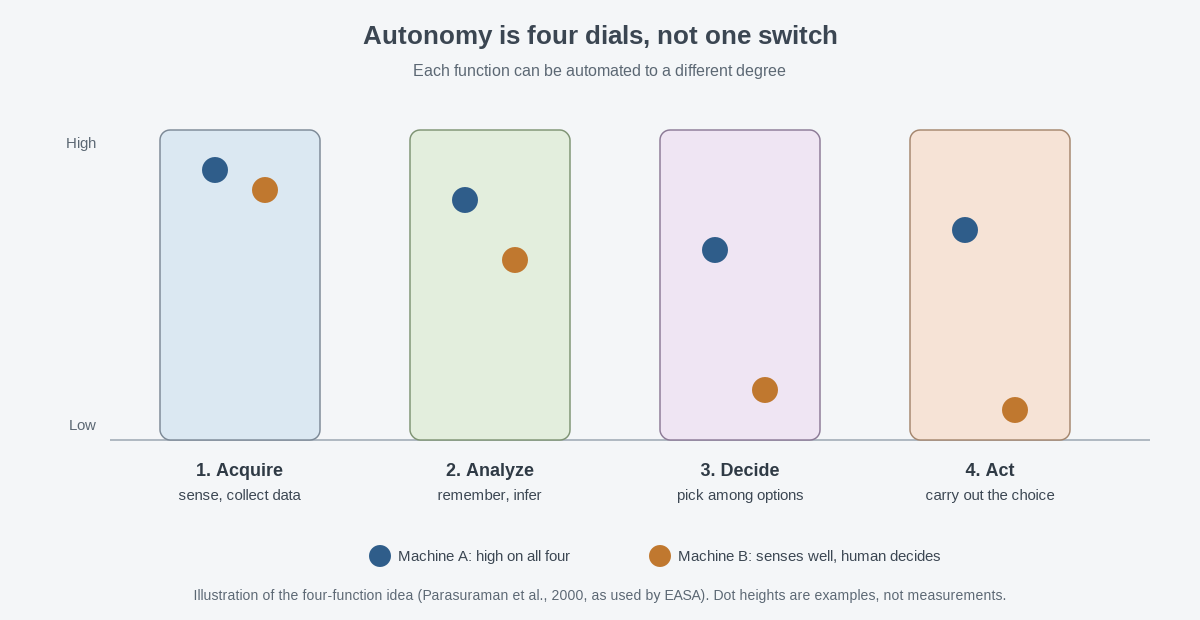
Thinking of autonomy as an on-off switch causes confusion. When the European Union Aviation Safety Agency (EASA) sorted AI into levels, it borrowed a framework from a 2000 paper by Parasuraman and colleagues on how people interact with automation. The idea is that four different kinds of functions can each be automated on their own.
The four functions are acquiring information, analyzing it, deciding and acting. Acquiring means sensing and recording inputs, and analyzing means remembering and drawing inferences. Deciding means picking one option out of several, and acting means actually carrying out that choice.
Think of a navigation app. It gathers the map and your position, weighs which roads are blocked, and offers a few routes. Yet you are still the one turning the wheel. The first two functions are highly automated, while acting is not.
In reality each dial has more than one notch. Every function has a range of steps, running from little automation to a lot. So "Is this drone autonomous?" is less precise than "Which functions does this drone handle by itself, and how far?"
Six levels from the car world
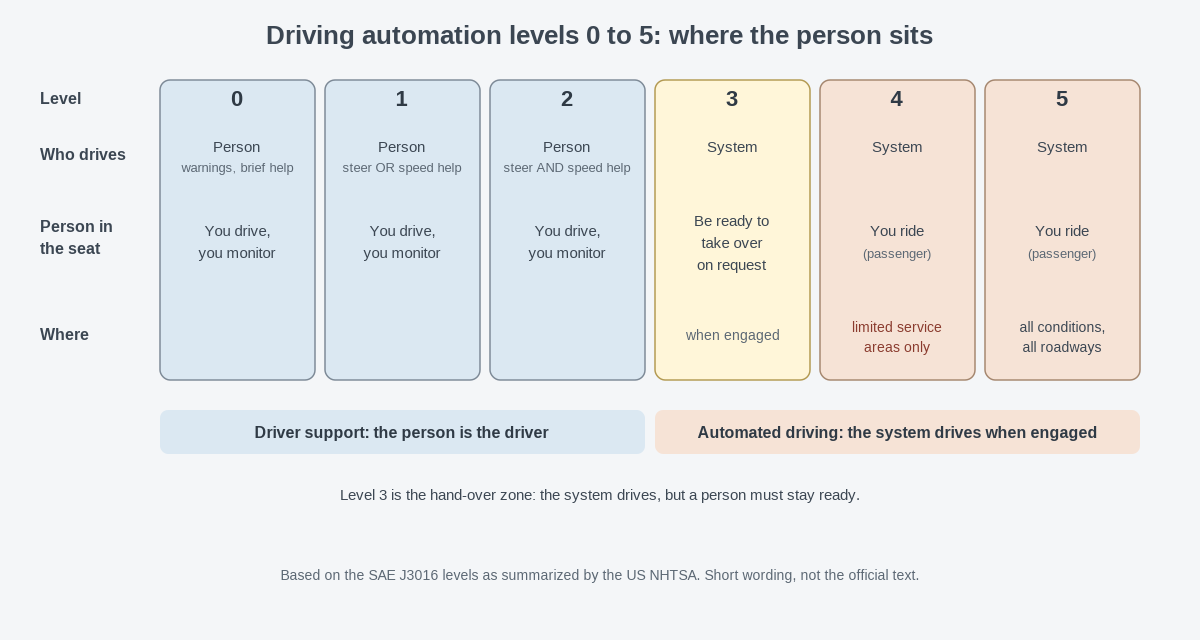
The best-known level framework comes from cars. SAE J3016 is a recommended practice from the engineering body SAE International, first issued in 2014. It splits driving automation into six levels, from Level 0 (no driving automation) to Level 5 (full driving automation). The 2021 version was written jointly with the International Organization for Standardization (ISO) and made free to read.
The changes in the 2021 version show where people had been getting confused. It drew a clearer line between Level 3 and Level 4. It added terms for two kinds of remote support, remote assistance and remote driving. It also gave Levels 1 and 2 the name "driver support systems."
The US National Highway Traffic Safety Administration (NHTSA) sums up the human's place with short slogans. At Levels 0 to 2, "you drive, you monitor." Whether the system gives warnings, helps with steering or speed, or helps with both, the driver is responsible for driving.
From Level 3, the one driving changes. At Level 3 the system drives, but the person must be able to take over when asked. At Level 4 the system drives within limited service areas and the person is a passenger. At Level 5 the system drives under all conditions on all roadways.
NHTSA stresses that even the highest level of driving automation that consumers can buy today needs the driver's full engagement and undivided attention. Following industry standards, NHTSA also avoids calling the higher levels "self-driving." That label describes a vehicle's state of operation rather than what it can do, and it is too easily confused with how drivers need to work with today's cars.
How aviation sorts AI
Aviation sorts AI into its own levels. On March 6, 2024, EASA released the second edition of its AI and machine learning concept paper. The broad frame has three levels. Level 1 assists the human, Level 2 is humans and AI working as a team, and Level 3 is advanced automation with more autonomy for the machine.
The dividing line is who decides and who acts. At Level 1 the end user makes decisions with help from the AI and carries out every action. At Level 2 the AI can pick and carry out actions automatically, but the user keeps full oversight and can overrule what the AI does whenever they choose. At Level 3 the AI gets full authority to decide and act, with the user monitoring remotely (3A) or not involved at all (3B).
The paper's table gives, in one column, the authority left to the user at each level. It is full at 1A, 1B and 2A, partial at 2B, limited and only upon alerting at 3A, and not applicable at 3B. When in doubt, an applicant should assume the higher level.
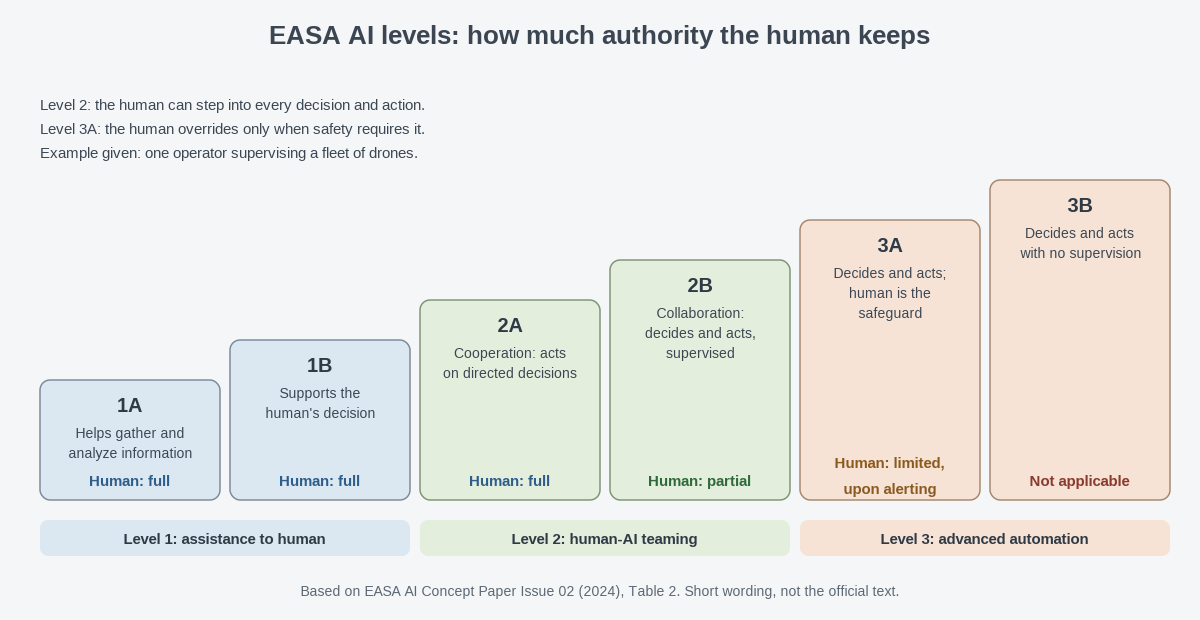
Drones appear at the boundary between 2B and 3A. A firm requirement for Level 2 is that the user can step in on anything the AI decides or does. At 3A, the user's power to override shrinks to cases where safety demands it. The paper's example is one operator watching over many drones who receives an alert and stops one of them.
The guidance in Issue 2 covers only 1A through 2B. Level 3 guidance is left for later, and it will need to look closely at how handing authority to AI affects the accountability scheme.
Drones: from watching pilot to supervisor
Today's basic US rule for flying small drones has a human eye built into it. Federal regulation 14 CFR 107.31 covers three people: the pilot in charge, any visual observer, and whoever is working the controls. They must keep the drone in sight for the entire flight, using nothing but glasses or contact lenses if they need them.
That way they know where it is and how it is flying. They can also watch for other aircraft or hazards and judge that it puts no one's life or property at risk.
On August 7, 2025, the US Federal Aviation Administration (FAA) published a proposed rule in the Federal Register that goes beyond this setup. It is a performance-based rule meant to make low-altitude drone flights beyond visual line of sight (BVLOS) routine for jobs such as package delivery, farming and surveying. It is still a proposal. On January 28, 2026, the comment period was reopened for two topics, electronic conspicuity and right-of-way.
Under this proposal, the human's place shifts. Instead of pilot certificates, each operating company would need an operations supervisor in charge of overall safety. It would also need flight coordinators who monitor flights and step in when needed. The supervisor covers the operation as a whole, and the coordinators look after individual aircraft.
Tasks a pilot in a traditional aircraft does by hand, such as navigation and steering clear of other aircraft, would be handed to technology and programming.
The proposal also takes on whether one person can handle several aircraft. Controlling many aircraft at once is something only drones make possible.
The proposal sets a ratio of one aircraft per flight coordinator, with exceptions for methods the FAA accepts. A coordinator could not take on more aircraft than they can manage in normal, abnormal and emergency conditions. An older table that rated drone autonomy by number, and the four operating modes in a NIST glossary, are covered in Drone autonomy: navigation is not the same as communication.
A Mars rover gets a day's instructions at a time
Back to the rover from the start. On July 1, 2021, NASA's Jet Propulsion Laboratory (JPL) described Perseverance's AutoNav system. It builds 3D maps of the ground ahead, spots hazards, and charts a way past obstacles without further instructions from controllers on Earth. It also has "thinking while driving," in which the rover works out its next autonomous drive while its wheels are turning.
With these upgrades, Perseverance might reach a top speed of 120 m per hour. At the time, the earlier rover Curiosity, with an older version of AutoNav, was covering about 20 m per hour.
People still stay in the loop. The rover team's work remains essential in planning and driving the route. The team studies satellite images to plan a path and sends instructions, and the rover carries them out the following day. The team also stays ready to step in when needed.
Here, autonomy did not appear in order to push people out. It appeared so the work could get done in a place where messages arrive late. The human sits in the planning room, not the driver's seat.
When the supervisor looks away
Moving a person into a "supervising" role can look like less work. In reality, supervising is work too. One crash investigated by the US National Transportation Safety Board (NTSB) shows how much it weighs.
On March 18, 2018, in Tempe, Arizona, a test vehicle run by an automated driving system still under development hit a woman. She was crossing the road on foot with a bicycle beside her, and she died. An operator was sitting in the driver's seat.
The system picked her up 5.6 seconds before the crash, yet it never recognized her as a pedestrian or worked out where she was going. By design, it did not use emergency braking and relied instead on the operator to intervene.
The inward-facing camera showed the operator looking away from the road for a long time, and she looked back at the road only about 1 second before impact. The probable cause NTSB found was that the operator, distracted by her personal cell phone, was not watching the road or how the automated system was behaving. The contributing factors include the testing company's lack of adequate ways to deal with operators' automation complacency.
When a level chart changes the human's box to "monitor" or "supervise," it also means that person has to stay alert the whole time. That is worth reading alongside EASA's requirement that at Level 2 the user must be able to step into every decision.
What the level charts leave out
First, the same level can mean very different things depending on where and what. The US National Institute of Standards and Technology (NIST) has a framework for unmanned systems called ALFUS. It looks at autonomy along three axes: mission complexity, environmental complexity and independence from humans. The fact that Level 4 driving is defined only within limited service areas also shows that a level means little without its setting.
Second, decisions to use weapons are handled by a different framework. US Department of Defense Directive 3000.09 does not cover platforms that carry no weapons, whether a person steers them remotely or they run on their own. For weapon systems with autonomous or semi-autonomous functions, it requires a design that lets commanders and operators apply "appropriate levels of human judgment over the use of force." More on this directive is in Autonomous weapons and human control.
Third, a label and real capability can differ. That is why, as seen above, NHTSA avoids the term "self-driving." When an ad says "autonomous," it is worth asking which functions the machine does by itself, how far, and what the person is supposed to be doing at that moment.
Fourth, the level charts themselves are still being written. EASA's Level 3 guidance has not been issued yet, and the US rule for drones flying beyond visual line of sight is still a proposal. As machines take on more, the way the human's place is described is changing too.
What to read next
- Drone autonomy: navigation is not the same as communication: a table that rated drone autonomy by number, and what happens when the link drops.
- Autonomous weapons and human control: where people sit in decisions to use weapons.
- The Debate over Military Physical AI: Company Policies and International Talks: what robot companies and international bodies have said about military use.
- Manned-unmanned teaming: when a pilot's wingman is a drone: people and machines flying as one team.
- Robot Foundation Models: Robots That Learn in Simulation: the training methods that let robots do more on their own.