In December 2018, one Wing Loong unmanned aerial system (UAS) was handed over for export. Xinhua reported it as the 100th Wing Loong system sold abroad. An aerodynamics academy in Beijing says it delivered its first Caihong drone to a foreign customer fifteen years earlier, in 2003.
These two names come up in almost any account of Chinese military drones. Wing Loong is built inside AVIC, an aircraft group. Caihong is built inside CASC, a space and missile group. Caihong means "rainbow," and English sources also call the family Rainbow.
Where did each family come from, and who counted the export numbers?
This article follows that path using the two companies' own profiles and a report by a commission set up by the US Congress. It also uses data from SIPRI, an institute that studies the arms industry. Statements by company staff that appeared in China Daily, a Chinese state-run English daily, are marked as such. This article reflects the situation as of October 2026.
Two state groups, two institutes
Wing Loong's parent is the Aviation Industry Corporation of China (AVIC). According to its company profile, AVIC was formed on 6 November 2008 by restructuring and merging two earlier aviation groups. It has more than 100 subsidiaries, 24 listed companies and over 400,000 employees.
Caihong's parent is the China Aerospace Science and Technology Corporation (CASC). It traces its roots to the Fifth Academy of the Ministry of National Defense, set up in 1956. The company in its current form was founded on 1 July 1999.
Its core business is space products such as launch vehicles, satellites and crewed spacecraft, along with strategic and tactical missile systems. From there the group expanded into drones, artillery rockets and guided bombs.
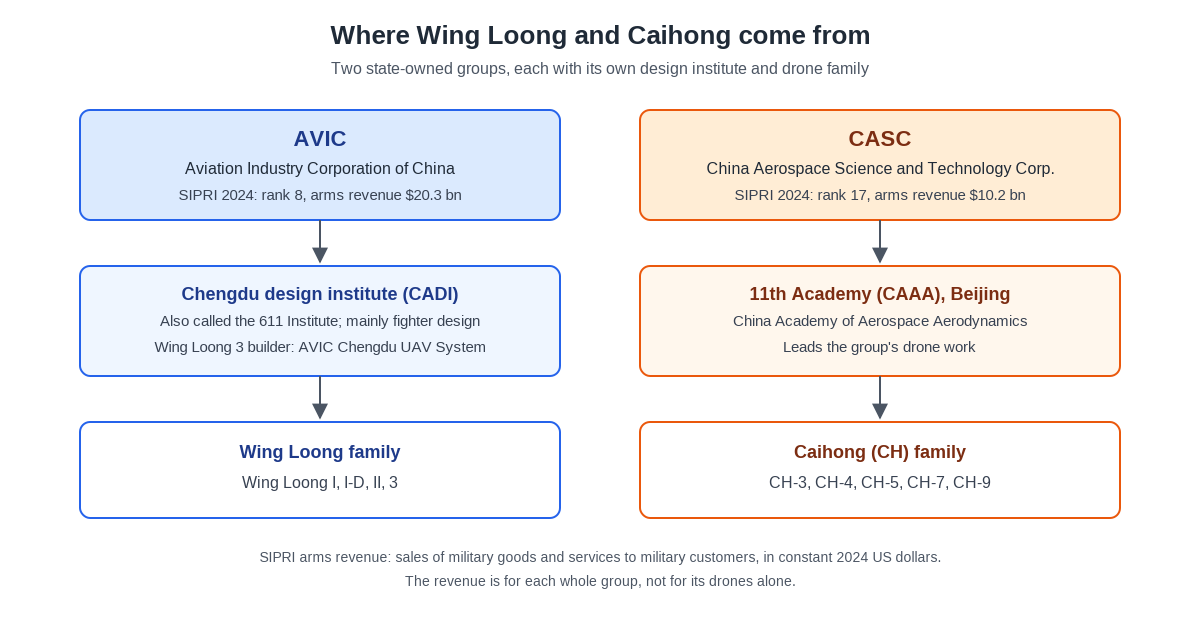
SIPRI's list of the world's 100 largest arms companies for 2024 gives a sense of scale. AVIC ranked 8th and remained China's largest arms producer, with arms revenue down 1.3% to $20.3 billion. SIPRI tied the drop to slower deliveries of military aircraft. CASC ranked 17th, with arms revenue down 16% to $10.2 billion.
Arms revenue here means money earned from selling military goods and services to military customers at home and abroad. It covers each whole group, not drones alone. The eight Chinese companies on the 2024 list together earned $88.3 billion in arms revenue, down 10%.
The two families start out in a similar way. No stand-alone drone company builds them. Each comes from an institute inside a large state-owned group: Wing Loong from a place that mainly designs fighter aircraft, and Caihong from an academy that works on aerodynamics.
Wing Loong: drones from a fighter design institute
Wing Loong was developed by the Chengdu Aircraft Design Institute (CADI) in Chengdu, Sichuan province. It is also known as the 611 Institute. A 2013 staff report by the U.S.-China Economic and Security Review Commission (USCC) places CADI inside the Chengdu Aircraft Industry Group, an AVIC subsidiary. Its main work is designing and researching advanced fighters.
CADI reportedly began developing a MALE drone called Yilong in the mid-2000s. In English this aircraft is the Wing Loong. Its first public display was at the 2012 Zhuhai Airshow. MALE stands for medium-altitude long-endurance, a class of drones that stay up for a long time at middle altitudes; the MALE and HALE drones article covers the class in detail.
The history below comes from AVIC's side, as reported by Xinhua and China Daily. AVIC began exporting the Wing Loong series in 2010.
In December 2018 it delivered its 100th system for export. Two days earlier, on a Sunday, a new model called the Wing Loong I-D made a 30-minute first flight. The I-D's fuselage is built entirely of composite material.
The Wing Loong II made its first flight on 27 February 2017. According to the company side, it had already received the largest drone system order in China's history before that flight. It was described as 11 m long, with a 20.5 m wingspan.
What was sold was not a single aircraft. A Wing Loong II system consists of the drone, a ground control station, mission payloads and a ground support system. This kind of package is what the term unmanned aerial system means.
Alongside comments from deputy chief designer Li Yidong, the article noted that medium and large drones must stay safe in flight even if the data link drops. In other words, the radio connection between the ground and the aircraft cannot be assumed to hold at all times.
In November 2022, the Wing Loong 3 was set to debut at the 14th China International Aviation and Aerospace Exhibition in Zhuhai. AVIC Chengdu Unmanned Aerial Vehicle System developed and built it, and it is 12.2 m long with a 24 m wingspan. At the time, the company said it was working to set up the capacity to mass-produce it.
The export channel is also inside the group. In the same article, CATIC (China National Aero-Technology Import and Export Corporation), an AVIC subsidiary, appears as China's biggest exporter of aviation defense products. AVIC has also built civilian models based on the Wing Loong 2 and Wing Loong 10 for emergency response, communication relay and weather forecasting.
Caihong: drones from an aerodynamics academy
Caihong is built by CASC's 11th Academy, the China Academy of Aerospace Aerodynamics (CAAA). It is based in Beijing and leads CASC's drone work. As the name suggests, it is an academy that works on aerodynamics.
In 2025 the academy gave China Daily this account of its background. It began research and development on the CH drones in 1999. The trigger was that its engineers saw that their experience in aerodynamics and missile design could also apply to unmanned aircraft. Its first delivery abroad came in 2003.
The American record starts at air shows. The USCC report says the CH-3 first appeared as a full-scale model at Airshow China in 2008, and a model of the CH-4 was shown at the 2012 show. But as of the 2013 report, how far the CH-3 and CH-4 had been developed was unclear. The report judged that no CASC drone had yet entered service with the Chinese military.
Around then, the company side also described itself as a newcomer. At Zhuhai in 2012, a CASC official said there were many similar, mature products on the world market, so the company had not yet made a big impact. He added that it would take time for its products to become known and accepted.
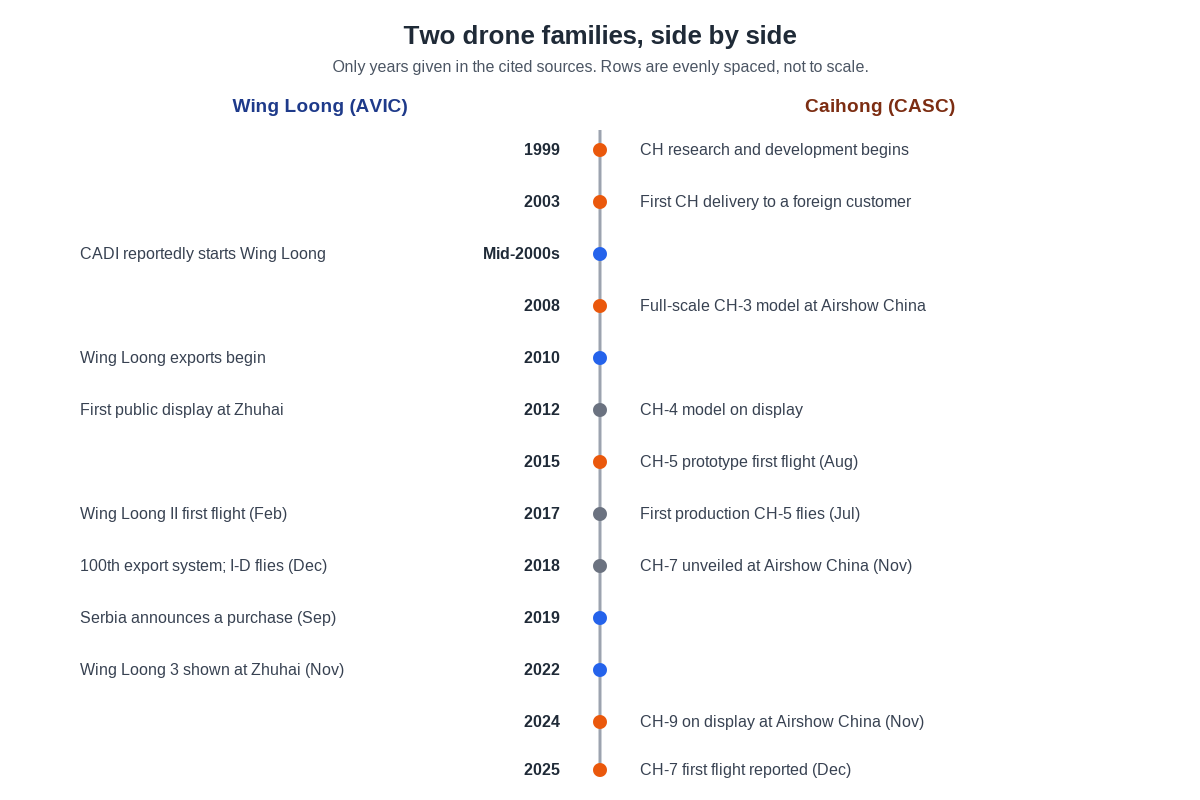
The CH-5 prototype first flew in August 2015. In July 2017, the first production CH-5 made its first flight at an airport in Hebei province, flying for over 20 minutes. The composite aircraft has a 21 m wingspan.
The CH-7 is a tailless flying-wing aircraft. It was unveiled at the 12th Airshow China in November 2018, and the exhibition material gave a wingspan of 27.3 m. In December 2025, the academy said the CH-7 had recently made its first flight in a province in northwestern China.
The first flight checked autonomous takeoff and landing, in-flight attitude control, communications, and remote control and tracking. In effect, it tested whether the aircraft could carry out its assigned moves by itself without a person flying every step. The academy said later tests will look at flight performance and the mission payloads.
The CH-9, which the academy promotes as its latest offering, was on display at the 15th Airshow China in November 2024. An academy executive said he was promoting the CH-9 to current and potential customers.
Who counted the exports
How many have been sold? There are three sets of numbers, each using a different yardstick: deliveries counted by a research institute, a think tank's analysis, and figures the companies give.
First is SIPRI's March 2019 data. SIPRI defines an unmanned combat aerial vehicle (UCAV) as a remotely controlled armed aircraft and counted how many were delivered. China delivered 10 to 2 countries in 2009–13 and 153 to 13 countries in 2014–18. Five of those countries were in the Middle East: Egypt, Iraq, Jordan, Saudi Arabia and the United Arab Emirates (UAE).
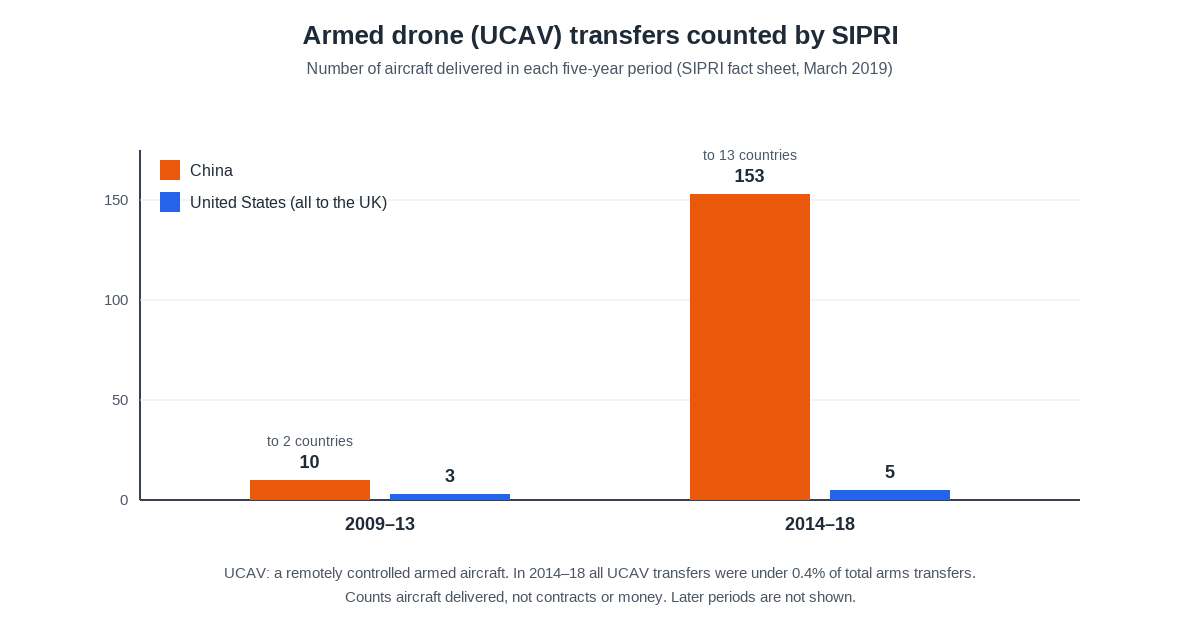
In the same two periods, the United States delivered 3 and 5 UCAVs, all of them to the United Kingdom. SIPRI wrote that China had become the primary exporter of UCAVs. Even so, all UCAV transfers together made up less than 0.4% of total arms transfers in 2014–18.
An analysis by the US think tank CSIS draws the lines a little differently. From 2008 to 2018, China sold 181 drones to 13 countries, and more than three-quarters of them were strike-capable types. Wing Loong accounted for 53.6% of those sales and Caihong for 35.4%. Over the same period, total drone exports including reconnaissance types were higher for the United States, at 292, and Israel, at 265.
The buyers slowly widened. CSIS notes that Serbia announced in September 2019 that it would buy nine Wing Loong drones, the first time a European country bought Chinese drones. In 2022, China Daily cited weapons observers as saying most Wing Loong users are in Africa and the Middle East, with Nigeria, Egypt and the UAE among them.
The company figures use yet another unit. In 2017, CAAA cited its own statistics to call itself the country's biggest exporter of military drones, counted by units sold abroad. By then, it said, CH drones had been sold to the militaries of more than 10 countries. In 2025, it said it had sold more than 200 medium and large combat drones to over 10 countries, more than 100 of them CH-4s.
In the same 2025 interview, academy executive Wang Zhaokui said the drones had earned about $2 billion. He also said the academy had handed over final assembly lines to two countries abroad, and that most orders in the past two years came from repeat customers. All of these figures come from the company side and have not been checked against the buyers' government records.
China and the export-control regimes
Countries cannot export drones entirely as they please. Groups of countries have set up multilateral export-control regimes, and the two main ones that cover drone exports are the Missile Technology Control Regime (MTCR) and the Wassenaar Arrangement. What each regime restricts is set out in the export controls article.
In the 2013 USCC report, the United States and Israel, then the world's top two drone exporters, appear as members of both regimes. China belonged to neither, and its stated position was that it "keeps contact and exchanges" with them. The report judged that China's big defense firms were not bound by the export limits that the leading drone exporters face.
The Congressional Research Service (CRS) report on the MTCR, in its September 2025 update, adds detail. China is not an MTCR partner, but in 1992 it agreed to follow the regime's guidelines. CRS wrote that press and nongovernmental expert reports name China and the UAE as exporters of MTCR Category I drones.
The buyers' side also shapes the numbers. SIPRI wrote that four of the ten largest arms importers in 2014–18, namely India, Australia, South Korea and Vietnam, will not buy Chinese arms for political reasons. That is worth keeping in mind when looking at which regions Chinese drone customers are in.
What to check when reading the claims
First, check what a country count bundles together. CAAA said it has sold combat drones to more than 10 countries. CASC's official site says products under three brands, CH, WS and FT, have been exported to over 30 countries and regions.
That description lists artillery rockets and guided bombs alongside drones as the group's business. So that number should not be read as a count for Caihong alone.
Second, aircraft counts also use different yardsticks. SIPRI's 153 are UCAVs actually delivered in 2014–18.
CSIS's 181 are all drone sales from 2008 to 2018. CAAA's "more than 200" is the number of medium and large combat drones the company side said it had sold, in a 2025 interview. The periods and the things counted differ, so adding or subtracting them gives a misleading result.
Third, consider the nature of the sources. Much of the history in this article is what company staff told state media.
The CH-5's chief designer said it is as good as the US MQ-9 Reaper. Such comparisons are the makers' own view, not independent data from tests under the same conditions.
Fourth, consider how old the numbers are. SIPRI's UCAV figures run to 2018, and so do the CSIS sales figures. Newer aircraft such as the Wing Loong 3, CH-7 and CH-9 have appeared since then, so describing today's market needs more recent data.
What to read next
- MALE and HALE drones: what class of drone the Wing Loong and Caihong belong to
- ISR drones: the jobs long-endurance drones do
- Export controls: what the MTCR and the Wassenaar Arrangement restrict
- Counter-drone systems: the technology on the defending side
- From the same series, "General Atomics: The Company Behind the Predator and Reaper Family", "Baykar: At the Center of Turkey's Drone Exports" and "Israel's Drone Industry: IAI and Elbit": drone companies in other countries