In 1979, an airplane powered only by a human crossed the English Channel. The company founded by Paul MacCready, who built that line of aircraft, now makes small reconnaissance drones and loitering munitions for the U.S. Army. Its name is AeroVironment, and it calls itself AV for short.
Two products explain why the company shows up so often in defense news. One is the Raven, a scout aircraft a soldier launches by throwing it. The other is the Switchblade, a loitering munition fired from a tube. Both are small airplanes that look alike, but they do different jobs.
This article follows how the company began, where U.S. military documents place its aircraft, and how a scout differs from a loitering munition, using public sources. What the company says about itself is kept apart from what government documents say. This article reflects the situation as of October 2026.
A company that began with a human-powered airplane
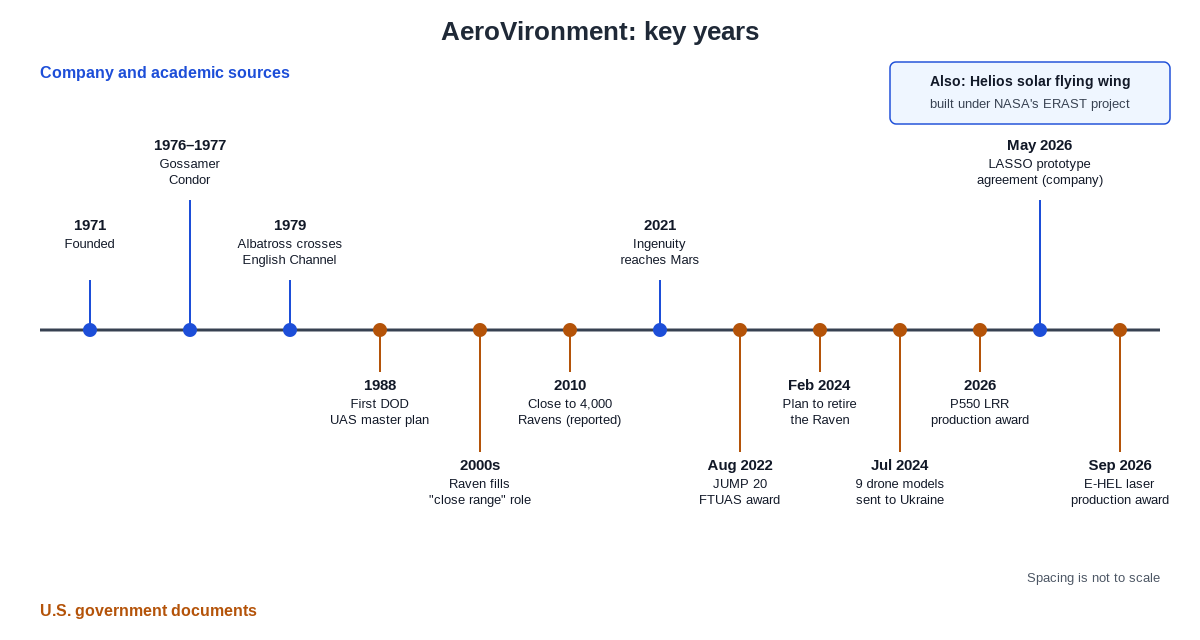
AeroVironment was founded in the summer of 1971. According to an oral history record at the Caltech Archives, Paul MacCready started it with his associates Peter Lissaman and Ivar Tombach. Its early work was not airplanes but weather studies, such as measuring wind profiles with acoustic radar.
What made the name widely known was human-powered flight. The Gossamer Condor came in 1976–1977, and in 1979 the Gossamer Albatross crossed the English Channel. After that, MacCready's interest turned to solar-powered flight.
Solar flight led to work with NASA. The Helios Prototype, a solar aircraft, was the largest and latest of a line of slow, ultralight flying wings. AeroVironment of Monrovia, California, developed it under NASA's ERAST project.
Today the headquarters is in Arlington, Virginia, and the company has a ground-vehicle headquarters in Ostfildern, Germany. The company profile at the end of its press releases shows a wide scope. The list it gives runs from autonomous systems and loitering munitions to counter-drone technology, space platforms, directed energy, and cyber and electronic warfare.
The Raven, a scout you throw by hand
The story of small scouts starts with a 1988 U.S. Department of Defense document. At the direction of Congress, DOD published its first "Master Plan" for uncrewed aircraft, and it called for a "close range" drone for lower-level tactical units. The aircraft had to be something the military could buy in large numbers at low cost.
From the 2000s on, the Raven largely filled that role. The Congressional Research Service (CRS) describes the Raven as a four-pound fixed-wing aircraft and says that by 2010 the Army had reportedly put nearly 4,000 of them in service. It was also taken up by the Marine Corps, the Air Force and Special Operations Command.
The U.S. military sorts drones by weight and altitude. Groups 1 and 2 cover small UAS (sUAS) lighter than 55 pounds that stay at 3,500 feet or lower above the ground. At four pounds, the Raven falls within that range.
The Army's own description from 2014 is short and concrete. The Raven is launched by hand, run by two soldiers and designed to fit in a rucksack. Operator training takes ten days, and no specific military specialty is required.
The cameras have changed over time. Around 2014, the Army was fielding two payloads on a gimbal in place of the older fixed cameras. Each one combines a color electro-optical (EO) sensor and an infrared (IR) sensor. On the same page, AeroVironment appears on the contractor list alongside other firms such as Lockheed Martin, and 11 countries are named as foreign buyers of the Raven.
The Raven had predecessors too. A 2012 CRS report says the Pointer, a short-range scout developed by AeroVironment, entered procurement in 1990. The Dragon Eye, a battery-powered backpack drone used by Marines at company level and below, was also the company's aircraft. That Marine Corps contract was later changed to buy the Raven instead.
The scouts that came after the Raven
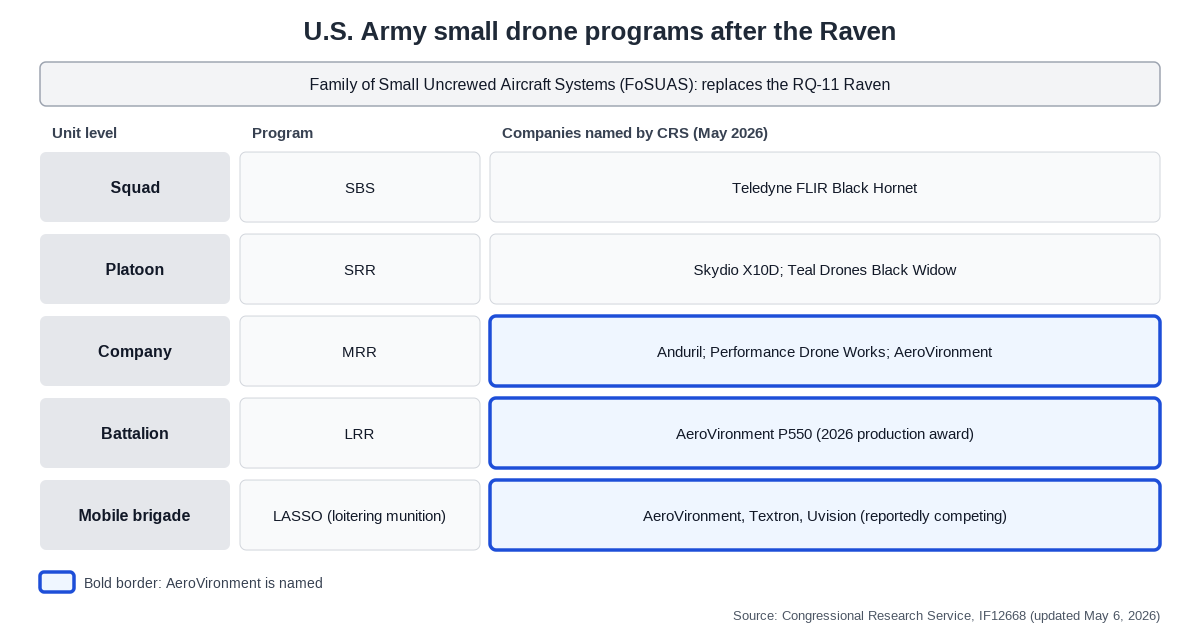
The Raven is now on its way out. In February 2024, the Army Secretary and Chief of Staff of that time announced plans to retire the RQ-11. The Army wants to fill the gap with the Family of Small Uncrewed Aircraft Systems (FoSUAS). The idea is to pick a separate aircraft for each level: squad, platoon, company and battalion.
In this new effort, AeroVironment is one supplier among several. Other companies' products were picked for the squad and platoon aircraft. For the company-level MRR, the company received contracts together with Anduril and Performance Drone Works. For the battalion-level LRR, its P550 received a production contract in 2026.
The company describes the P550 as an autonomous electric vertical takeoff and landing (VTOL) drone. It rises and lands in place without a runway. Earlier, on August 18, 2022, the Army signed an other-transaction agreement to buy one JUMP 20 system, the company's VTOL aircraft, under the first step of the FTUAS program. That step answered an urgent request from units to replace the long-serving RQ-7B Shadow.
The hand-launched line also includes the Puma. The company says the Puma 3 AE can be launched by hand, bungee or rail, and lands for recovery with an automatic maneuver called a deep stall. It flies for up to three hours, and the company says its waterproof airframe can land in fresh water or salt water.
Switchblade: an aircraft that does not come back
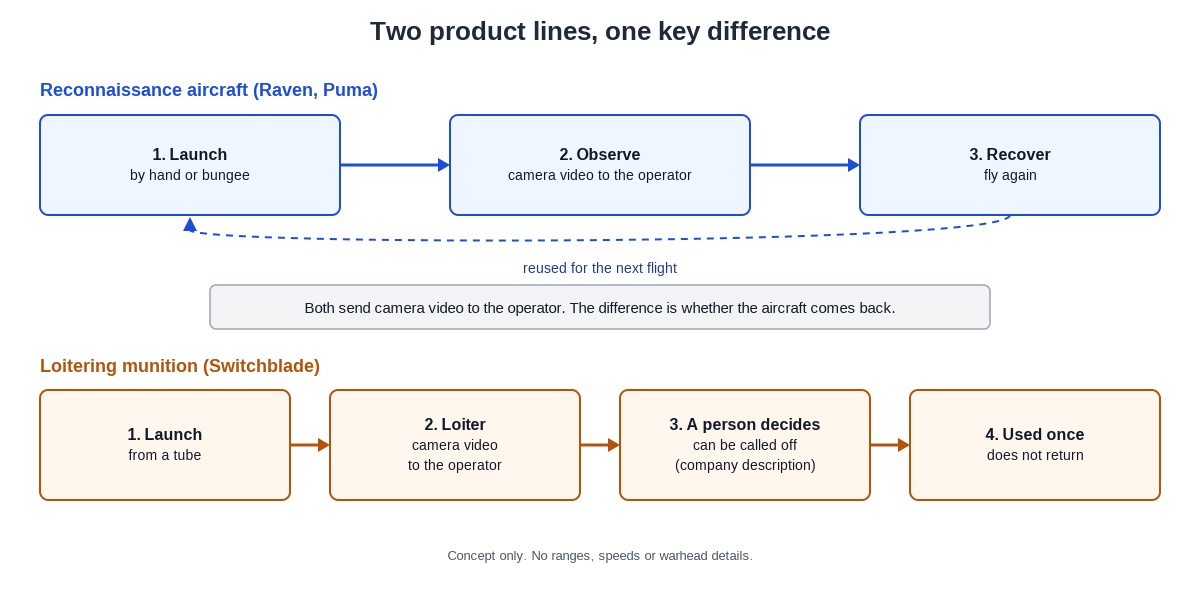
The Raven and the Puma come back after a scouting flight and fly again. The Switchblade does not. Aircraft like this are called loitering munitions, and CRS also uses the term one-way attack drone. In the CRS definition, these are expendable armed drones designed to explode on impact with a target.
The company's product page says the original Switchblade was built to launch from a simple tube that one person can set up in a few minutes. The company puts its weight at roughly 5 pounds, small enough for foot soldiers to carry with the rest of their gear. The larger Switchblade 600 ships in a tube that holds everything needed to launch, and it is presented as an aircraft for larger, harder targets.
The camera is what the two lines share. The Switchblade also sends live video from its EO and IR sensor to the operator during flight. The company says that while the aircraft stays aloft, there is time to call off the attack if the situation changes. That means a person watches the video and decides, as described on the company's product page.
CRS writes that the Army acquired limited numbers of these small one-way attack drones for special forces units in the mid-2010s. The CRS report does not name a product at that point. Why the line between scout drones and loitering munitions is blurry is covered in more detail in the loitering munition article.
The name in government documents
The Switchblade name also appears in DOD program documents. DOD officials confirmed that the Switchblade 600 was selected for the Replicator initiative. The CRS report on Replicator also lists Anduril's Altius-600 and Ghost-X and Performance Drone Works' C-100.
For LASSO, the Army's loitering munition program, the sources were written at different moments. A CRS report updated on May 6, 2026, said AeroVironment and Textron of the United States and Uvision of Israel were reportedly competing. Two days earlier, on May 4, the company announced it had received a LASSO prototype agreement for the Switchblade 400. The company's announcement also mentions a separate five-year, $990 million contract under the Lethal Unmanned Systems (LUS) requirement, awarded in August 2024.
The company's name also appears in the list of aid to Ukraine. A September 2024 CRS report says the United States had sent nine drone models to Ukraine by July 2024. They include the JUMP 20, an unarmed drone for gathering intelligence, and the Switchblade 300 and 600 as one-way attack drones, and the report's appendix table also lists the Puma.
Through August 2024, DOD contracts under the Ukraine Security Assistance Initiative (USAI) came to $90 million for the company and $576 million for Aevex Aerospace. In March 2024, the company's CEO said on an earnings call that the company had significantly increased its Switchblade production capacity.
From a Mars helicopter to lasers
The company's work does not stop at scouts and munitions. On the company's page, its MacCready Works team worked with NASA's Jet Propulsion Laboratory (JPL) to design and build Ingenuity, the Mars helicopter carried by the Perseverance rover. Ingenuity reached Mars in February 2021 and flew 72 times there. The principle of its coaxial rotors is in the helicopter rotors article.
The work reaches lasers too: on September 2, 2026, the U.S. Army announced a production agreement with AeroVironment of Albuquerque, New Mexico, for the E-HEL high-energy laser. No earlier Army contract had put a high-energy laser weapon into production. The company announced that dozens of LOCUST X3 laser weapon systems would be handed over in the coming years. A company that built small drones now also builds lasers meant to stop them.
Government documents note a challenge as well. CRS says some observers argue that the small drones the Army has bought remain too expensive compared with those on the commercial market. The remark is not aimed at one company, but it is a question every firm supplying small drones to the military faces.
What to read next
- Loitering munitions: between missile and drone: why aircraft like the Switchblade carry this name, and what the category means.
- ISR drones: why endurance matters: what intelligence, surveillance and reconnaissance (ISR), the job of the Raven and the Puma, involves.
- The US Army E-HEL laser contract and the directed-energy pilot at US bases: a closer look at the company's laser contract.
- How Drones Are Classified: Size, Altitude, Mission and Groups 1 to 5: the Group 1 and 2 limits that the Raven falls under.
- Anduril and Shield AI: New Defence Companies Built on Software: another company met in the same programs.