The element name ytterbium comes up often in articles on laser weapons. Stories about telecom networks bring up erbium, and stories about 2 µm lasers bring up thulium. All three are rare-earth elements mixed into the center of an optical fiber, and the choice of element changes the wavelength of the light that comes out.
Why does each element give a different light? This article starts with what rare earths are and how ions in glass amplify light. It then visits ytterbium, erbium, thulium and holmium in turn, follows the road from a 1961 glass rod to kilowatt fibers, and ends with the limits.
Elements that are rare mostly in name
The rare-earth elements are the 15 elements from lanthanum (atomic number 57) to lutetium (71). The USGS, the U.S. federal earth science agency, gives the group's official name as the lanthanoids, more often called the lanthanides. Yttrium (39) is usually counted with them, since it behaves much the same and turns up in the same deposits. Holmium, erbium, thulium and ytterbium, the elements in this article, all belong to the heavy rare earths, the run from terbium to lutetium.
Despite the name, most of them are not especially rare. They were identified as "earths" in the 18th and 19th centuries and got the name because they were scarce compared with other earths. Cerium, the most common one, is found in the crust in larger amounts than copper or lead.
What is rare is a deposit rich enough to mine. Some rare earths are used heavily in clean energy and defense technology. In a laser, a rare earth's job has to do with light, and it does that job with a very small number of ions.
How ions in glass amplify light
An optical fiber is first of all a path that carries light a long way. Put rare-earth ions into its fiber core, though, and the fiber stops being a passive carrier and becomes a gain medium that amplifies light. Adding these ions is called doping. A fiber made this way is the heart of a fiber laser and of a fiber amplifier.
To amplify light, an ion first has to take in energy. This step is called pumping, and it is usually done with light from a pump diode. Each active fiber works in a wavelength range set by the rare-earth ion inside it, and the pump light always has a shorter wavelength than the laser light.
Light with a shorter wavelength carries more energy per photon. The ion is lifted high by the pump light, then comes back down while giving off laser light with less energy. The part it does not bring back down, the pump energy minus the laser energy, is called the quantum defect, and that part is left behind as heat.
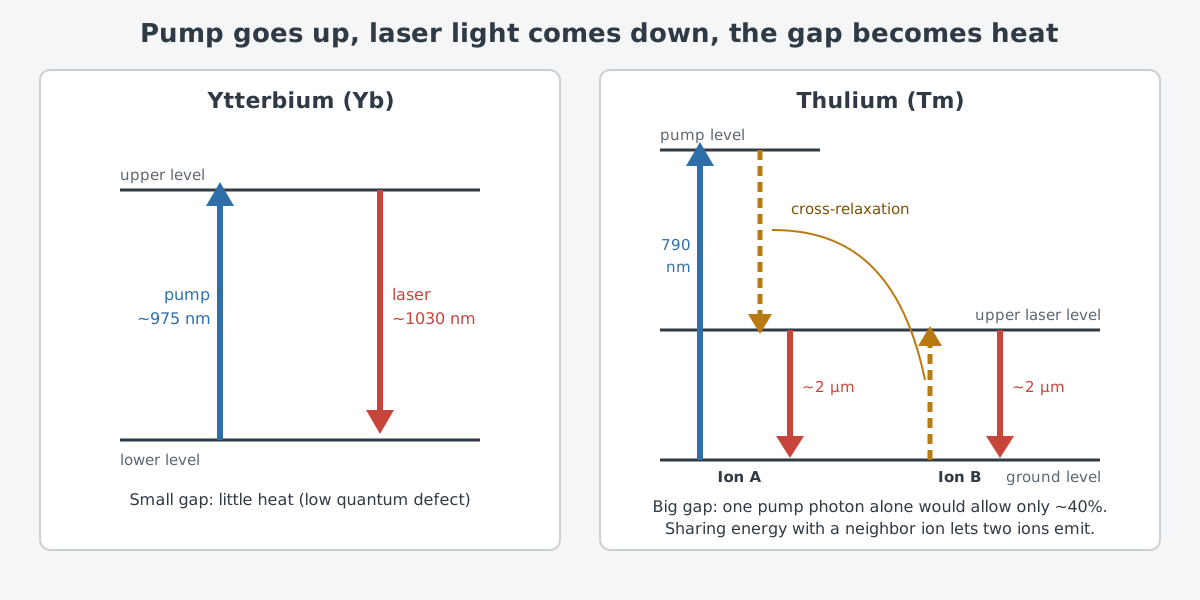
Think of stairs. Carry a box up to the fifth floor and set it down on the fourth, and one floor's worth of effort is spent with nothing to show for it. The difference in a laser is that the spent share does not vanish; it piles up inside the glass as heat. That is why heating drops as the pump energy gets closer to the laser energy.
Ions in glass also differ from ions in a crystal. Doped silica fiber absorbs and emits over very wide spectra, much wider than a crystal does. The trade-off is that glass can dissolve only a limited amount of rare earth, so a fiber's doping level is lower than in many crystals.
Fibers make up for this with length. In a comparison given in Coherent's webinar slides, a crystal is a few centimeters long while a fiber is around 10 m. Here the ability to coil a long, thin strand of glass pays off.
Ytterbium: the workhorse near 1 µm
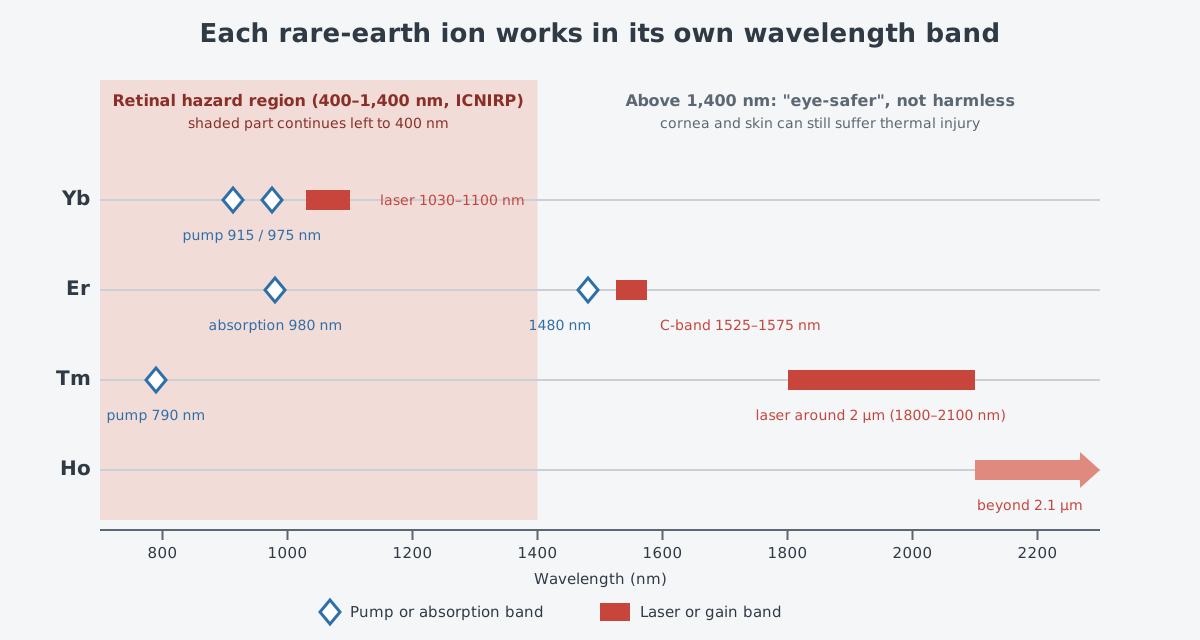
Ytterbium-doped fiber (YDF) works near 1 µm. It lases and amplifies between 1030 and 1100 nm. Where it lands in that span depends on how many ions sit high in energy compared with how many sit low, and pumping examples are 915 nm and 975 nm.
Why sources list slightly different wavelength values was shown in a table in "What is a fiber laser? Growing light inside a thin glass fiber".
Ytterbium became the main choice for high power for good reasons. The energy gap between pump light and laser light, the quantum defect, is very small. An excited ion also rarely absorbs a second photon or passes its energy upward in the wrong direction, a process called upconversion.
Keller's textbook on ultrafast lasers says gain materials like this are very well suited to high average power. It also notes that ytterbium solid-state lasers now reach higher pulse energy and average power than any other diode-pumped solid-state laser. Unlike neodymium lasers, ytterbium lasers are classed as three-level lasers.
Fiber lasers that cut and weld sheet metal also pick ytterbium as their gain medium. Telecom amplifiers use erbium today, but for much higher power, ytterbium does better.
The fiber shape helps too. Coherent's material explains that a fiber laser is efficient enough to get by on less diode pumping than most solid-state lasers. Its heat load is also spread along the fiber. The view that ytterbium fibers and parts became standardized and cheaper over the previous ten years is also the company's, from 2013.
The element shows up on defense parts lists as well. Exail offers ytterbium-doped fiber for 1 µm as a directed energy laser component, for building kW-class optical amplifiers. Where such fibers sit in a laser weapon can be traced along the parts chain in "Following One Laser Weapon: From Chip to Effector".
Erbium: the 1.5 µm of telecom networks
Erbium works in the 1.5 µm band. Thanks to several closely spaced levels, it amplifies light from 1525 to 1575 nm, a span called the C-band. Fiber loss is low there, which is why optical communication uses it. Erbium's energy levels have strong absorption bands at 980 nm and 1480 nm.
Before the erbium-doped fiber amplifier (EDFA), things were awkward. When an optical signal had faded after tens of kilometers of glass, it had to be turned into an electrical signal, boosted, then turned back into light. The erbium amplifier did away with that by boosting light as light.
The University of Southampton's Optoelectronics Research Centre (ORC) describes its 1987 paper as announcing the first practical optical amplifier. That let many signals travel hundreds of miles with no electronic conversion. The IEEE milestone gives a similar account: fiber amplifiers for the 1.5 µm telecom band made possible today's broadband networks that cross continents and run under the sea.
Erbium has its burdens too. It is basically a three-level laser, so it needs a lot of pump power. Ytterbium can also help erbium. In Er:Yb glass, ytterbium acts as a sensitizer that takes in the pump light and hands energy to erbium, and erbium provides the gain in the 1.5 µm region.
Thulium and holmium: toward 2 µm
Thulium fiber lasers give light near 2 µm. In Coherent's material, a chart of tuning results for a thulium fiber laser has a horizontal axis running from 1800 to 2100 nm. Around 2013, when that material came out, thulium fiber was pumped at 790 nm.
Pumping at 790 nm to get 2 µm light means a wide wavelength gap. If one pump photon could make only one laser photon, the quantum limit would be about 40%. Compared with ytterbium, a much larger share is left as heat.
Thulium closes this gap by sharing with a neighbor. One ion lifted high by the pump light drops to the upper laser level and, on the way, lifts a neighboring ion from the ground up to that same level. This is called cross-relaxation, and it happens more readily when the thulium concentration is high and the ions sit close together. Coherent explains that this lets 790 nm pumping beat the quantum limit, reaching typically around 60% as of its 2013 material.
Output kept pace. Thulium fiber pumped at 790 nm reached 1 kW. Holmium goes further out, and experiments show it working better than thulium beyond 2.1 µm. Pumping it directly at a wavelength holmium absorbs is presented as promising for large power scaling.
The interest in 1.5 µm and 2 µm also has to do with the eye. Coherent's material says some uses call for "eye-safer" wavelengths above 1400 nm, which made these two bands important, and lists medical, sensing, materials processing, and military and defense uses. Exail writes that high-energy lasers just below 2 µm are used for infrared countermeasures aimed at a threat (DIRCM) and for directed energy lasers. It adds that they still cost more than 1 µm or 1.5 µm lasers.
"Safer" should not be read as "harmless." The ICNIRP, the international body that sets exposure limits for non-ionizing radiation, treats 400 to 1,400 nm as the retinal hazard region. Beyond 1,400 nm, its guidelines say, heat damage occurs in the cornea and skin. The light may not reach the retina but can still hurt the eye and skin, and "Laser safety: classes and how to read eyewear labels" explains classes and eyewear.
From 1961 to kilowatts
The story begins with a glass rod more than a fiber. In 1961, at American Optical in Southbridge, Massachusetts, Elias Snitzer and colleagues built the first fiber laser anywhere and got it running. That same year Snitzer reported laser action from Nd³⁺ ions in barium crown glass, the first glass solid-state laser. Three years later, in 1964, the same group showed the first fiber amplifier.
The road to telecom amplifiers opened in the 1980s. In 1985 a paper appeared on making low-loss fibers that contain rare-earth ions, and in 1987 two separate groups published papers on erbium-doped fiber amplifiers working at 1.54 µm. The IEEE milestone says innovations by Payne and others led to fiber amplifiers for the 1.5 µm telecom band, and the milestone was dedicated in Southbridge in October 2012.
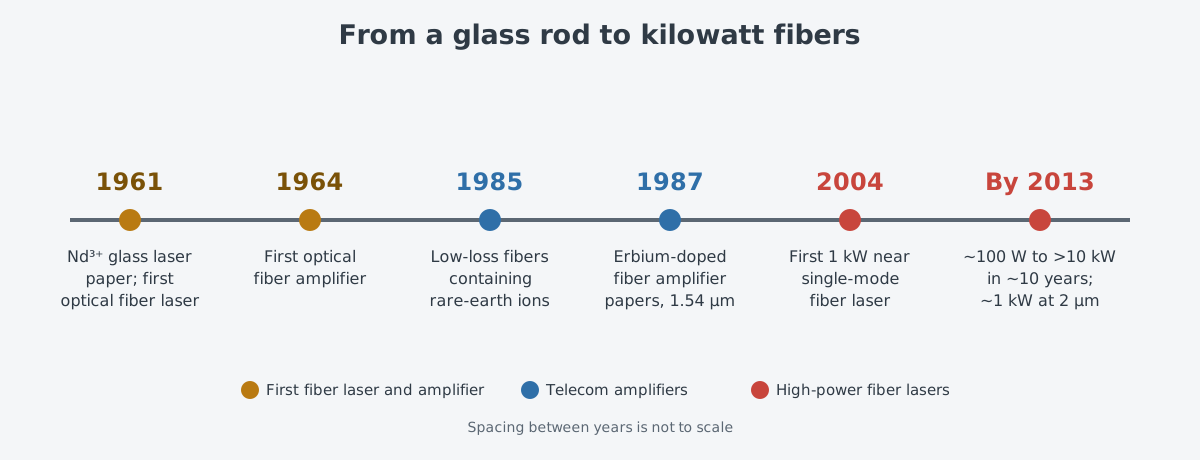
High power picked up speed in the 2000s. The first 1 kW near single-mode fiber laser was demonstrated at the ORC in 2004. Coherent's 2013 summary says near single-mode fiber laser output grew from about 100 W to over 10 kW in about ten years. Output at the eye-safer wavelengths had followed, reaching about 1 kW at 2 µm.
Fiber lasers today produce multikilowatt beams that cut and weld everything from plastics to metals. The ORC, which makes fiber for research, lists ytterbium, neodymium, erbium, erbium with ytterbium, thulium and holmium together among its active dopants.
Limits and trade-offs
Each element gives something and takes something.
- Glass dissolves only so much. Little rare earth fits into glass, so the doping level is lower than in a crystal. That is why fibers get long.
- Three-level lasers need a lot of pump power. Ytterbium and erbium are classed as three-level lasers, and erbium is described as needing a lot of pump power for that reason.
- The quantum defect turns into heat. Ytterbium's share is small but not zero. Thulium's share is large, so it relies on cross-relaxation, which requires a higher concentration. What heat does to a fiber continues in "Limits of a single fiber (2): heat and mode instability".
- Longer wavelengths still cost more. A 2 µm laser still costs more than a 1 µm or 1.5 µm one.
- "Eye-safer" does not mean safe. Ytterbium's 1030–1100 nm lies inside the retinal hazard region, and light past 1,400 nm can still harm the cornea and skin.
The path pump light takes into the fiber is in "Double-clad fibers and how pump light gets in". The part that supplies a different pump wavelength for each element is in "Pump diodes: the part that turns electricity into light".
Further reading
- "Fiber Bragg gratings (FBG): mirrors written inside a fiber": how mirrors written at both ends of a doped fiber form a laser cavity.
- "Pump diodes: the part that turns electricity into light": the semiconductor parts that make pump light matched to ytterbium, erbium and thulium.
- "Laser safety: classes and how to read eyewear labels": how to read the eye hazard of each wavelength through classes and eyewear.