Some drones are small battery aircraft launched by hand. Others are large uncrewed aircraft that take off from a runway. The small ones often run on swapped battery packs, while the large ones carry fuel and can stay up for more than 20 hours. Size is not the only difference; the power that turns the propeller comes from different places.
This article sorts drone power into its main paths. They are batteries, fuel-burning engines, hybrids that mix the two, fuel cells that make electricity from fuel, and power from sunlight or a cable. One question ties them together: how much energy can 1 kg hold?
What turns the propeller
Most drones, or unmanned aerial systems (UAS), fly on propellers. A propeller makes thrust by moving a large mass of air a little faster, and that thrust overcomes the drag holding the aircraft back. The Wright brothers' 1903 airplane worked the same way: the engine's crankshaft turned two propellers.
Two kinds of machines turn propellers. One is an electric motor and the other is an engine that burns fuel. Both start from chemical energy. A mix of gasoline and oxygen holds chemical energy until an engine turns it into mechanical energy, and a battery also stores its energy as chemical potential.
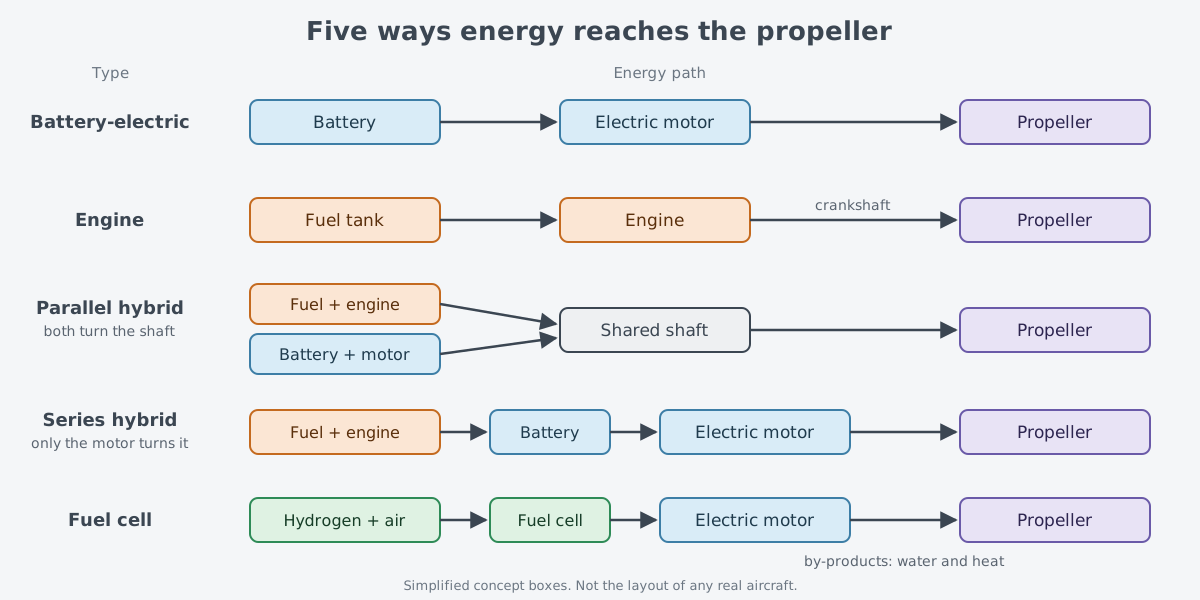
The figure above shows how the paths split. A battery feeds a motor, and fuel feeds an engine. A hybrid links the two, and a fuel cell turns fuel straight into electricity for a motor.
Batteries: chemical energy straight to electricity
Open a battery and you find two terminals. They are the cathode and the anode, and a chemical material called the electrolyte fills the space between them. Connect a motor, and electrons flow through the outside circuit while charged ions cross the electrolyte at the same time. In a rechargeable battery both flows can go either way, so charging runs them in reverse.
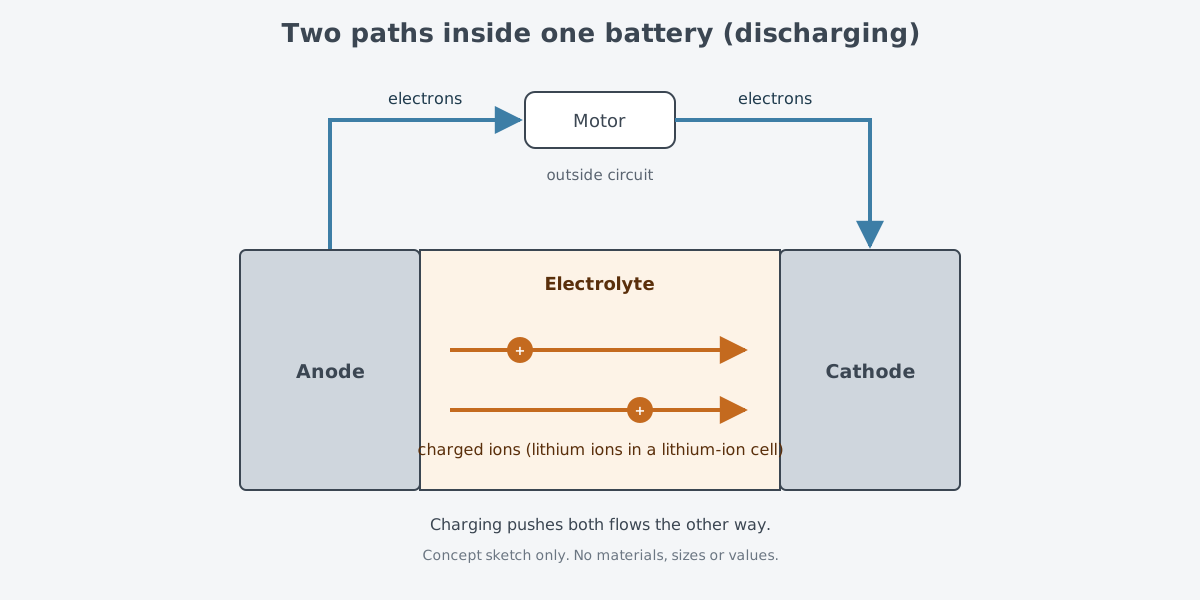
The battery most drones carry is the lithium-ion type. It is one of the most widely used rechargeable batteries and shows up in many portable electronic devices. Charge flows as lithium ions move between the two electrodes, and one cell gives about 3.7 V under typical conditions.
The textbook gives four reasons for its popularity. It can deliver a large current and weighs less than comparable batteries of other kinds. Its voltage stays nearly constant during discharge, and it loses charge only slowly in storage.
The limits are real too. Charging and discharging never reverse completely. Over time those small mismatches alter what the battery materials are made of and how they are built, which can reduce performance and safety. Batteries with lithium metal anodes could be smaller and lighter, but they cannot be recharged as many times and raise safety concerns.
For the military, these limits turn into numbers. In 2020 an Army Research Laboratory (ARL) program manager described a future fleet of hundreds or even thousands of drones flying together. With current battery technology, he said, each one has only roughly 26 minutes to fly its mission and get home before the battery runs out. The research he led looks at ways for small battery drones to fly back to unmanned ground vehicles on their own and recharge.
At the other end is a 2026 U.S. Army article about a demonstration. In it, a battery-powered Group 1 small unmanned aircraft system (sUAS) stayed up for 8 hours 41 minutes 43 seconds, breaking a world endurance record. The two numbers come from different years, different aircraft and different goals, so they do not belong on the same scale. Read together, they show only how widely battery flight times spread across aircraft and conditions.
Engines: burning fuel to turn a shaft
A fuel engine runs on a four-beat cycle. NASA Glenn Research Center walks through it with the Wright brothers' engine. First the piston pulls back and draws in fuel and air (intake). Then the piston moves in and squeezes that mixture into a smaller space (compression).
At the end of compression a spark lights the mixture. High-pressure gas pushes the piston out (the power stroke), and the force passes to the crankshaft, where the piston's straight-line motion becomes rotation. Last, the spent gas is pushed out to make room for the next ignition (exhaust).
Propellers are very efficient, and almost any kind of engine can turn one. Light general aviation planes use internal combustion engines like this, while a turboprop spins its propeller with a gas turbine core. Large military drones use both kinds; NASA's research aircraft Ikhana, an MQ-9 Predator B, was built for long flights at medium altitude and flies on a turboprop. Some of its science flights lasted more than 20 hours.
The U.S. Army's MQ-1C Gray Eagle uses a heavy fuel engine (HFE). The Army gives four reasons: better performance, better fuel economy, one fuel shared across the battlefield, and longer engine life. It also notes that the engine runs on either jet or diesel fuel.
The idea of a common fuel goes back to the late 1980s, when the U.S. Department of Defense issued its "Single Fuel Forward" policy. It called for one kerosene-based fuel, JP-8, to ease the large logistics load of handling and hauling many fuels in the field. In 2012 the Army Research Laboratory was studying engines that would let ground vehicles, generators and small drones all run on the same fuel. A drone's power source is tied to how a whole military moves fuel, not just to one aircraft.
The energy-per-kilogram wall
So why do large drones carry fuel instead of batteries? Comparing the energy packed into 1 kg explains much of it. This value is called specific energy, and it is written as the number of watt-hours (Wh) that 1 kg can hold.
A 2024 NASA study put the best current batteries at about 250 Wh/kg at the pack level. That is 48 times lower than conventional Jet A aviation fuel. The study starts from a simple consequence: switching a powertrain to electricity makes the energy storage heavier, which cuts payload and range.
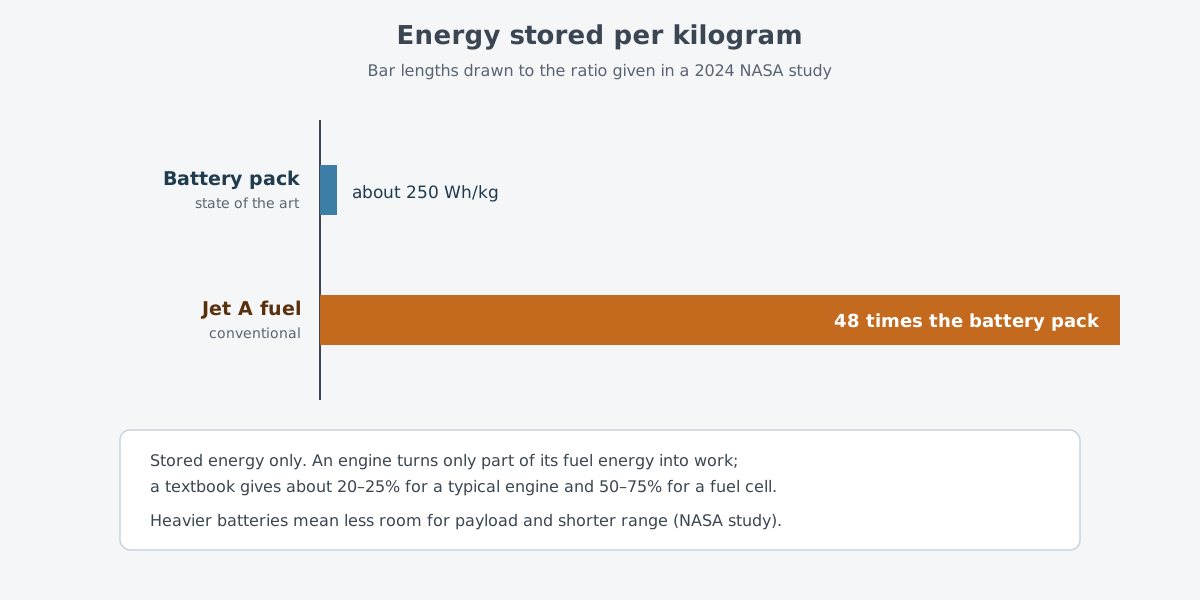
That factor of 48 compares stored energy only. An engine cannot turn all of the energy in its fuel into work. For the same chemical reaction, the textbook gives about 20–25% efficiency for a typical engine and about 50–75% for a fuel cell. To compare what actually reaches the propeller, these efficiencies have to come into the picture as well.
Weight is also where drone design begins. A heavier power source leaves less room for sensors or cargo. In weapon systems this whole set of trade-offs is called size, weight and power, or SWaP.
Hybrids and fuel cells
What if a drone used an engine and a battery together? That is the idea behind a hybrid; the U.S. Department of Energy describes a hybrid electric car as having two sources of drive. One is a combustion engine, and the other is at least one electric motor running on battery energy. The battery in such a car is charged by regenerative braking and by the engine.
There are two ways to connect the parts. In a parallel hybrid, the most common design, the engine and the motor are both linked mechanically to the wheels, and both drive them directly. In a series hybrid, only the electric motor turns the wheels. Help from the motor can allow a smaller engine.
These descriptions are about cars, but the same idea can be applied to aircraft. The 2024 NASA study modeled a C-130H cargo aircraft given a parallel hybrid electric drive. For larger drones, the 2020 Army article mentioned basic research on tiny fuel-property sensors for future hybrid electric drives that can burn more than one fuel. Both are research, not fielded systems.
A fuel cell takes yet another path, using the chemical energy of a fuel such as hydrogen to make electricity efficiently. Fuel and an oxidant are fed in without a break. So it behaves like a battery that never goes flat and never needs a charge, producing power and heat while the fuel supply lasts. Run on hydrogen, it gives off nothing but electricity, water and heat.
A battery is like a filled water bottle, and a fuel cell is more like a faucet hooked to a water tank. The real thing differs. A fuel cell makes electricity only while fuel flows in, so the fuel still has to be carried, and the weight problem does not go away. For how submarines handle a similar problem underwater without air, see Diesel-Electric, AIP and Nuclear Submarines.
Power from sunlight and from a cable
Some paths use neither fuel nor a battery as the main source. One is sunlight. NASA's solar-powered Helios Prototype flew on 14 brushless direct-current electric motors spread across its wing. Its first test flights in 1999 ran on lithium battery packs, and in 2000 the whole upper surface of the wing was covered with over 62,000 solar cells.
What happens after sunset? Enough NiCad or lithium rechargeable batteries to fly through a whole night would have been too heavy to meet the altitude or endurance goals. So the team chose proton-exchange membrane fuel cells instead, which join oxygen and hydrogen to make electric power, heat and water. The energy-per-kilogram wall shaped the design here as well.
NASA's mishap investigation report describes the long-endurance setup. By day, solar cells were to run the motors and onboard systems; by night, an adapted off-the-shelf hydrogen–air fuel cell would take over, with batteries as backup. The aircraft took off on 26 June 2003 at the Pacific Missile Range Facility, a U.S. Navy site on Kauai, Hawaii. On that flight it met turbulence, and high dynamic pressure then broke the leading-edge structure on the outer wing sections.
The other path is a cable, which the U.S. Army assessed in 2026 with tethered drones (Te-UAS). Ordinary drones depend on onboard power and need battery swaps. A tethered drone instead gets steady power, and passes data, through its cable, so it can stay airborne. The assessment feeds the Army's decision on whether to make the technology an official program.
Where this meets lasers: where the electricity comes from
Drones are not alone in facing this question: a vehicle-mounted laser weapon also depends on where its electricity comes from and how much is available. A 2022 U.S. Army article quoted a developer of a vehicle laser prototype. The vehicle's thermal and power system gets rid of heat and recharges the batteries, he explained, and the laser fires off those batteries. He added that if there is fuel in the tank to recharge the batteries, the system is ready.
Fuel refills the battery, and the battery's electricity does the work. That looks a lot like the series hybrid in the earlier figure. Lasers add one more question: how much of the electricity put in becomes light, a measure called wall-plug efficiency.
What to read next
- Power and Efficiency: why generators, batteries and fuel keep showing up together in laser weapons.
- ISR Drones: what staying aloft for a long time connects to.
- FPV Drones: another side of small battery drones.
- Weight and Platforms: how weight limits the equipment a platform can carry.