Before a lab ships one of its lasers to a university in another country, there is a question that comes ahead of the shipping label. Is that item on a national export control list? The lists hold more than guns and missiles. Lasers, sensors and computers with civilian uses take up places on them too.
When a news story mentions "ITAR rules" or "the Wassenaar Arrangement," what is it talking about? The answer lies in two U.S. regulations and a set of lists that many countries use together. This article walks through what each system covers, the history behind it, and how far it reaches. It draws on the regulations themselves, a report by the Congressional Research Service (CRS) and the official Wassenaar Arrangement website.
Weapons and dual-use items: two tracks
The United States restricts a wide range of exports. They include defense articles, defense services, dual-use goods and technology, and some nuclear materials and technology. Items that could help build nuclear, chemical or biological weapons, or the systems that carry them, are covered too. The 2021 CRS report adds that exports to countries under U.S. economic sanctions, for example Cuba, Iran and Syria, are also restricted.
The key term is dual-use. It covers goods, software and technology with uses in both civilian and military life. The U.S. rules also count uses linked to terrorism and weapons of mass destruction, and they bring purely civilian items within reach as well.
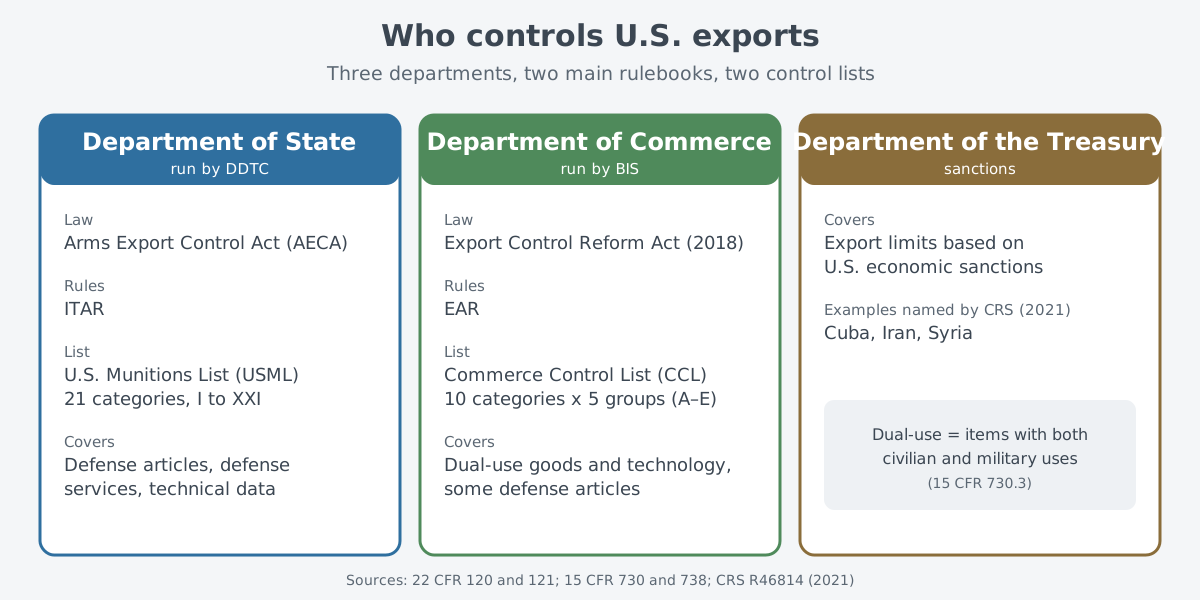
Several departments share the work. The State Department regulates munitions exports and issues their licenses. The Department of Commerce handles dual-use goods and technology plus some defense articles, and the Department of the Treasury handles export limits that come from sanctions.
The State Department's rules are the International Traffic in Arms Regulations (ITAR). The rules issued by the Commerce Department's Bureau of Industry and Security (BIS) are the Export Administration Regulations (EAR).
A system built by war and the Cold War
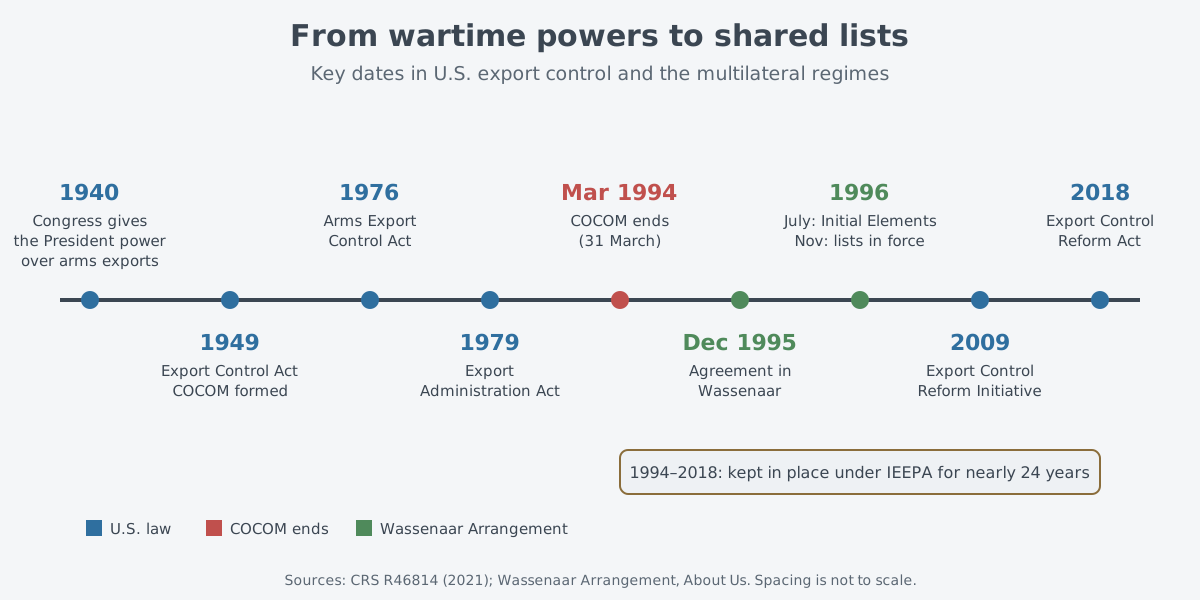
Modern U.S. export control began in 1940. That year, Congress gave the President power to control exports of military equipment and munitions. Once the United States entered World War II, that power grew to cover civilian goods.
The Cold War set the framework. In 1949, Congress passed the Export Control Act. In the same year, a consultative group set up by the United States and its main European allies gave rise to the Coordinating Committee on Multilateral Export Controls (COCOM). COCOM coordinated limits on exports to the Soviet Union and Eastern Europe, and in 1952 a separate China Committee (CHINCOM) was formed for the People's Republic of China.
Arms exports followed their own path. A 1976 law changed the Foreign Military Sales Act of 1968 and turned it into the Arms Export Control Act (AECA). The AECA gives the President the legal authority to control exports of defense articles and services. On the dual-use side, the Export Administration Act of 1979 (EAA 1979) is the basis of today's EAR.
Controls kept running even when the law lapsed. From 1994 until the Export Control Reform Act (ECRA) passed in 2018, nearly 24 years, the U.S. system was kept in place under the International Emergency Economic Powers Act (IEEPA). Unlike the laws before it, ECRA has no end date.
When the Cold War ended, COCOM closed too. According to the Wassenaar Arrangement website, COCOM was dissolved on 31 March 1994. The Wassenaar Arrangement took its place.
ITAR: the U.S. Munitions List
At the center of ITAR is the U.S. Munitions List (USML). It lists the items the Secretary of State designates for export and temporary import control, and the State Department sets it with the agreement of the Defense Department. The Directorate of Defense Trade Controls (DDTC), part of the State Department's Bureau of Political-Military Affairs, runs the rules.
The list has 21 categories, from Category I, firearms, to Category XXI. A category usually starts with end items, then lists major systems and equipment, then parts and accessories, and finally the technical data and defense services tied to that category. Entries marked with an asterisk count as Significant Military Equipment (SME).
Licensing works differently from some Commerce dual-use controls. Nearly every USML item needs a license to be exported. The CRS report explains that the license requirement depends on what the item is, not on its end use or end user. Any firm that makes, exports or brokers USML items must register with DDTC and pay a fee every year, even in a year with no exports.
Even one part carries a tag. A USML item stays controlled after it is built into another product that is not on the list, unless the rules say otherwise.
Reexports show a big difference too. The EAR require a reexport license for most items when controlled U.S. content is over 25%. ITAR, by contrast, requires DDTC approval for any end product with U.S. defense articles inside, whatever the share.
Large deals must also go to Congress. Under Section 36(b) of the AECA, deals such as major defense equipment worth $14 million or more need formal notice to Congress 30 days before the final steps. For NATO members, Japan, Australia and New Zealand, the notice period is 15 days. In general, the executive branch can go ahead unless Congress passes a law to block or change the deal.
Oversight continues after the goods leave. Exports under ITAR face end-use monitoring through the State Department's Blue Lantern program. Staff at U.S. embassies carry out checks before a license and checks after shipment for direct commercial sales (DCS). For each violation, the AECA sets a criminal fine of up to $1 million, a prison term of up to 20 years, or both.
Not only goods but information: what "export" means
Under ITAR, an export is more than goods crossing a border. Besides shipping or sending a defense article abroad, giving technical data to a foreign person inside the United States also counts. This is called a deemed export. Performing a defense service for a foreign person counts too, whether it happens at home or abroad.
The reach of a deemed export is broad. Releasing technical data to a foreign person inside the United States counts as an export to every country where that person holds or has held citizenship or permanent residency.
So what counts as technical data? The rules define it as information needed to design, develop, produce, manufacture, assemble, operate, repair, test, maintain or modify defense articles. General science, math and engineering principles that schools and universities commonly teach are not included, and neither is information in the public domain. Basic marketing information about function or purpose and general descriptions of a system are left out as well.
The definition draws a line between textbook principles and the information needed to build and handle a specific weapon. Think of a general recipe in a cookbook versus the secret recipe of one restaurant. In practice the line is not that tidy. A separate section defines what "public domain" means, and it has to be read alongside this one.
The Wassenaar Arrangement: shared lists
If only one country restricts an item, the same item can still leave from somewhere else. The Wassenaar Arrangement is a framework in which many countries agree to use the same lists. In The Hague on 16 November 1993, representatives of the 17 COCOM members agreed to end COCOM and set up a new multilateral arrangement. The agreement to found it came on 19 December 1995 in Wassenaar, a town on the edge of The Hague, and the arrangement takes its name from that town.
It began operating in 1996. The July Plenary that year adopted its basic document, the Initial Elements, and the new lists and the exchange of information took effect on 1 November.
South Korea is a founding member. At the first Plenary in Vienna in April 1996, it joined as a founding member along with Argentina and Romania, making 33 founding members in all. Today there are 42 Participating States.
The aim is to raise transparency and responsibility when conventional weapons and dual-use items change hands, and so to prevent buildups that threaten stability. Keeping such items away from terrorists is another goal. The Wassenaar Arrangement says it is not aimed at any single country or bloc.
There are two lists. The Munitions List divides items built specifically for military use into 22 main entries. The List of Dual-Use Goods and Technologies is organized into categories such as materials, electronics, computers, telecommunications, navigation and aerospace. The current lists include the changes agreed at the December 2025 Plenary.
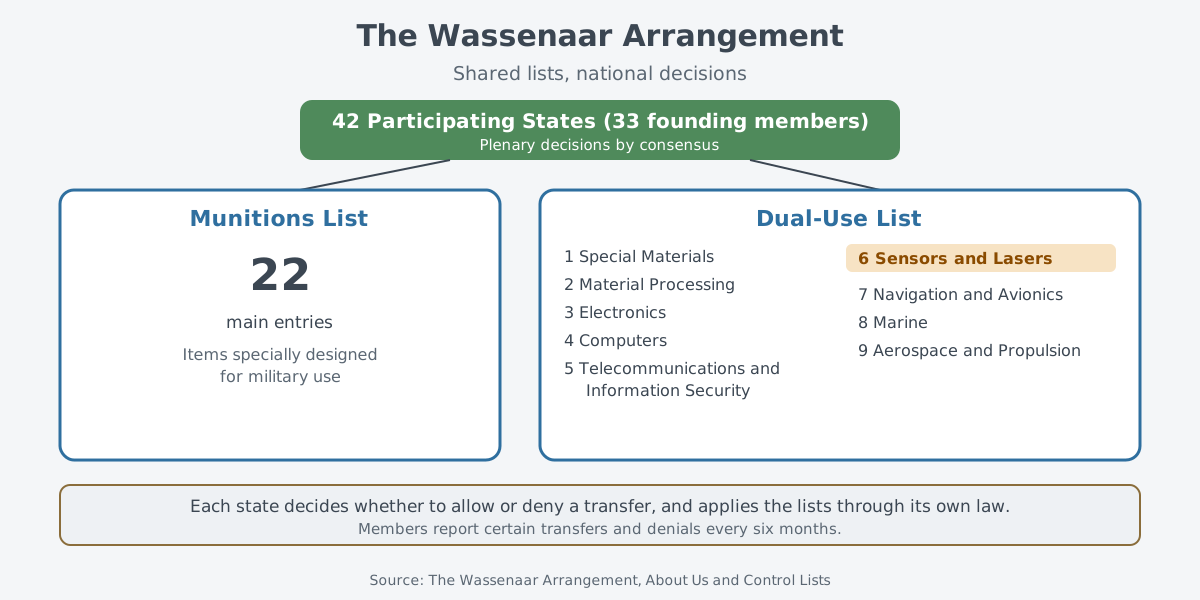
Each country makes its own decisions. Only the member state itself can decide whether to allow or deny a transfer. Members control listed items through their own national laws, so start dates and actual practice differ from country to country. All Plenary decisions are made by consensus, and members report every six months on arms transfers and on transfers and denials of some dual-use items to places outside the arrangement.
How is this different from COCOM? The CRS report describes Wassenaar as a voluntary regime, approved in 1996 as the successor to COCOM. It is more loosely built than COCOM, members cannot block one another's deals, and it has no enforcement mechanism.
Wassenaar is not the only regime. CRS names four major regimes: the Australia Group, the Missile Technology Control Regime (MTCR), the Nuclear Suppliers Group (NSG) and Wassenaar itself. The Australia Group covers chemical and biological items, the MTCR covers missiles, the NSG covers nuclear items, and Wassenaar covers conventional arms and dual-use items. On the U.S. Munitions List, entries ending in (MT) are items on the MTCR Annex.
Limits and debates
Export control is always caught between two goals. CRS sums up the balance between national security and export competitiveness as a problem that both Congress and the executive branch have wrestled with for decades. If the same technology can be bought abroad, controls may not work and may only hurt U.S. firms. Since 1969, Congress has therefore told the government to ask whether an item is available abroad when deciding whether to control it.
The lists have also been reworked. In 2009, President Obama launched the Export Control Reform Initiative (ECRI), a full review of the export control system. In that process, parts and components judged not sensitive were taken off the USML and moved to the Commerce list.
Not every export needs a license. In its section on the scope of the EAR, CRS reports that in 2019 only 0.4% of all U.S. exports, worth $6.3 billion, needed an export license. The weight of the controls falls on a few narrow groups of items rather than on most trade.
Where this meets lasers: lasers on the lists
Lasers appear on all three lists. USML Category XII covers fire control, laser, imaging and guidance equipment, and Category XVIII covers directed-energy weapons (DEW). Category XVIII names systems that use non-acoustic techniques such as lasers (both continuous wave and pulsed), particle beams and high-power radio frequency.
The dual-use side has a laser slot as well. The Commerce Control List (CCL) has 10 categories, and Category 6 is "Lasers and Sensors." Each category has the same five groups: equipment and components, test and production equipment, materials, software and technology, and each item has an Export Control Classification Number (ECCN). Category 6 of the Wassenaar dual-use list is "Sensors and Lasers."
When a laser weapon story mentions export control, it helps to ask which list it means first. Whether the story is about a weapon system or a laser device that industry also uses decides which department and which rules apply. For the parts of a laser weapon beyond the laser itself, see A laser weapon is more than a laser: the system at a glance.
What to read next
- A map of Korean defense technology: how Korean weapon systems move through institutions to production and export.
- Eye safety and international rules: the protocol on blinding laser weapons: another set of international rules around laser weapons.
- How Weapons Are Bought: The Defense Acquisition Process: how a country buys its weapons.