One drone type with a 12 m wingspan has entered the forces of more than thirty countries. That is the export record the company reports for the Bayraktar TB2. The company behind it is Baykar, based in Türkiye.
Baykar started out making car parts. Today it is a drone maker that earns most of its revenue from exports. How did one company end up at the center of a country's drone exports?
This article lays out the company's history and press releases next to two other kinds of source. One is the announcements of defense ministries that bought the aircraft. The other is data from SIPRI, a research institute that studies the arms industry.
Each time a number appears, it also asks who measured what. This article reflects the situation as of October 2026.
From a car-parts workshop to a drone maker
The story begins with Baykar Makina, founded in 1986. According to the company history, it began producing automotive machine parts that same year. The company describes itself as an engineering firm from the car industry that took to the skies.
The history page dates the start of drone research and development to 2000. The company's press releases put the same starting point in 2003. Even the company's own sources differ slightly on the year.
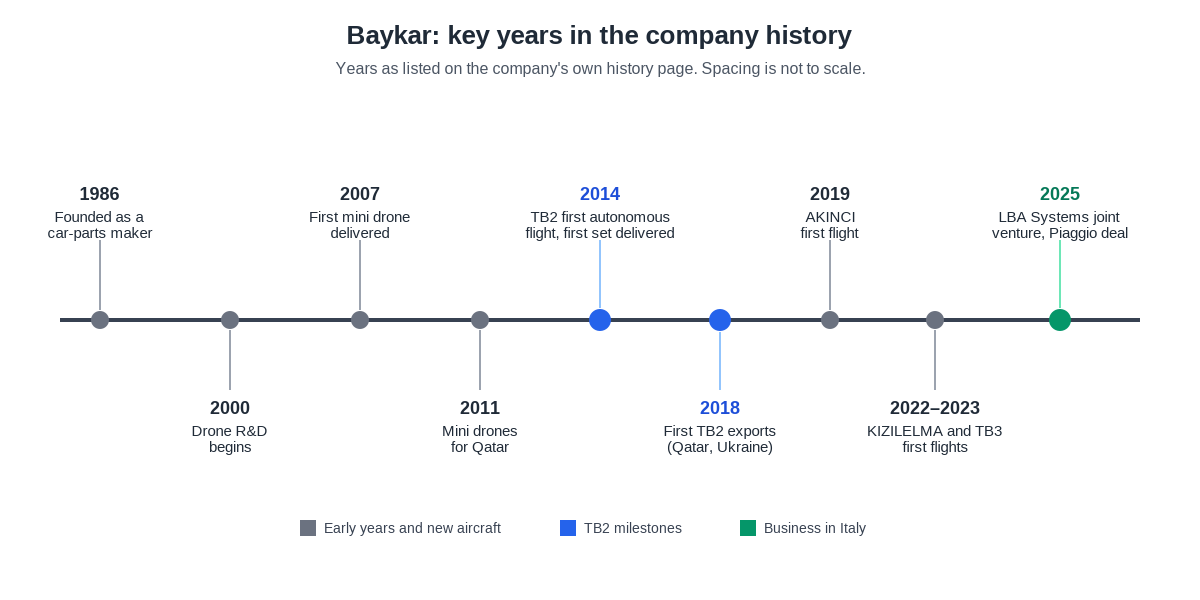
In 2004 Baykar ran its first autonomous flight test with its own electronics and software. In such a flight the aircraft carries out the task a person gives it on its own. It delivered its first small drone, the Bayraktar Mini UAV, in 2007, and in 2011 it built mini drones for Qatar's armed forces. That is the first foreign customer named in the history.
A drone here means more than the aircraft. What a military buys is an unmanned aerial system (UAS): the aircraft plus a ground control station and a data link. The contracts later in this article buy that whole bundle.
The company puts forward one more number. Its "About" page gives a localization rate of 93%. That is the company's own figure, and the page does not say how it was counted.
The TB2 at the heart of exports
The TB2 made its first fully autonomous flight test in 2014, and the first set was delivered that year. In 2015 the Turkish National Police also placed an order.
Poland's defense ministry, a buyer, describes the TB2 as a MALE (medium-altitude long-endurance) tactical drone. It can fly surveillance and reconnaissance (ISR) work as well as combat missions.
The drone is 6.5 m long with a 12 m wingspan and can fly for up to 27 hours. Its avionics let it taxi, take off, fly and land entirely on its own. To see what the MALE class means, read the article on MALE and HALE drones.
Exports began in 2018. The first export went to Qatar that year, and the TB2 was also exported to Ukraine in the same year. Exports to Azerbaijan followed in 2020, and a contract with Poland was signed in 2021. The war that took place in the year Azerbaijan brought in the TB2 is covered in the 2020 Nagorno-Karabakh War.
Production numbers appear in the history as well. The 500th TB2 rolled off the line in 2023. In 2024 the TB2 fleet passed 1 million flight hours, and the first TB2 ever deployed was retired.
Export figures the company reports
Every number in this section comes from Baykar's own press releases. Export revenue was $661 million in 2021, $1.2 billion in 2022, $1.8 billion in 2023, $1.8 billion in 2024 and $2.2 billion in 2025. Total revenue in 2025 was $2.5 billion, and 88% of it came from exports.
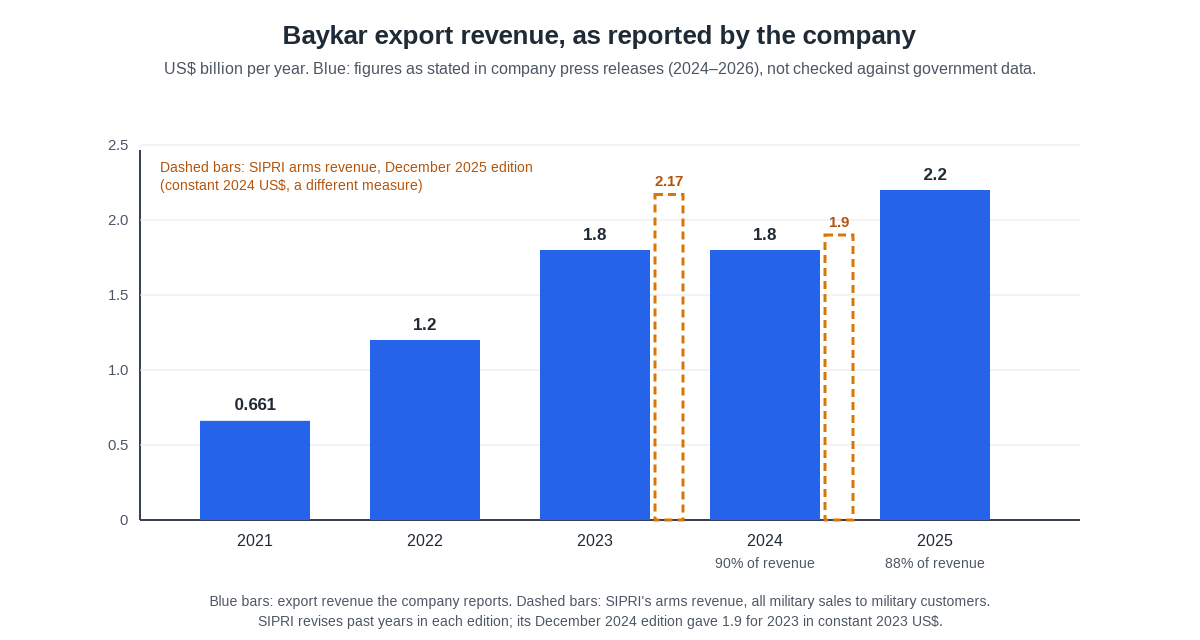
The shares make the reliance on exports even clearer. In 2024, 90% of revenue came from exports. Counting all revenue since drone R&D began in 2003, the export share is 83%. The releases also state that all projects have been funded from the company's own resources.
The releases also give Baykar's place inside Türkiye. Baykar alone produced one-third of the defense and aerospace sector's exports in 2023 and one-quarter in 2024. In 2023 it became the first defense and aerospace firm to rank among the country's top ten exporters across all sectors, on the list of the Turkish Exporters Assembly (TIM).
A January 2026 release cites data from a conference that the Defense Industry Agency (SSB) hosted. It says Baykar ranked second among Türkiye's defense exporters. The company points to SSB and TIM data as the basis for these ranks and shares. The government agencies' own company-by-company figures are not published alongside the releases.
Contracts as the buyers describe them
Some numbers come from outside the company. When a government buys weapons, it often announces what it bought and for how much. The defense ministries of Poland and Croatia are two examples.
Poland's defense ministry announced a contract for four TB2 sets on 24 May 2021. Each set holds six armed drones, for 24 in total, and one set cost about $67 million. The first set was formally handed over on 28 October 2022 at the 12th Unmanned Aircraft Base, and that first batch included 6 drones and 3 mobile control stations. The whole order was to be completed by the end of 2024.
Croatia's defense ministry announced its contract on 21 November 2024. The signers were Ivan Anušić, deputy prime minister and defense minister, and Baykar's chief executive, Haluk Bayraktar. It covers six armed drones for EUR 67.01 million before VAT, with the system due in operational use by the end of September 2025.
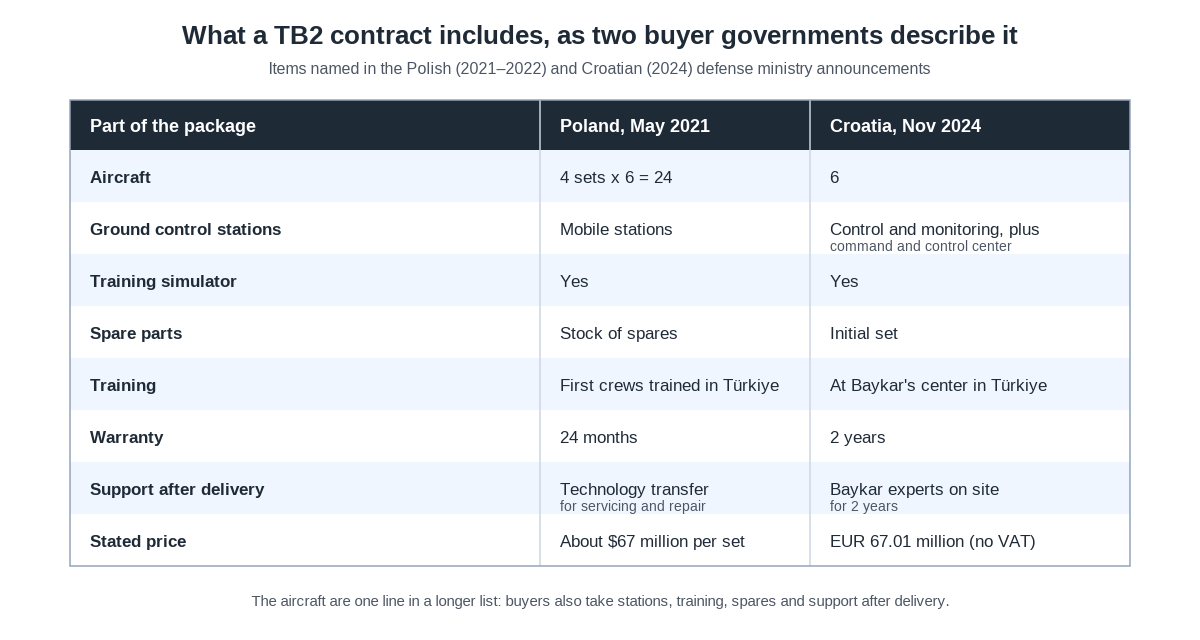
Put the two announcements side by side and a pattern appears. These are not contracts for aircraft alone. The Polish contract includes, among other items, mobile control stations, SAR radars, simulators, spare parts, a 24-month warranty, and training and logistics packages. It also includes a technology transfer that allows servicing and repair of engines, ground control stations and cameras.
The Croatian list is just as long, starting with a command and control center, a simulator for training and stations to control and watch the drones. Ground data stations, a first stock of spare parts and a two-year warranty are on the list too. Baykar technical experts stay in Croatia for two years, and training takes place at Baykar's training center in Türkiye. Poland's first instructors and system users also trained in Türkiye.
So an export does not end on the day the aircraft is handed over. The buyer trains people, receives parts and gets support from the company during the warranty period. Croatia's defense ministry wrote that the system can also serve border surveillance and firefighting, and the minister said it is used in 37 countries.
New aircraft and a move into Italy
The aircraft after the TB2 appear in the history in turn. The AKINCI first flew in 2019 and was first delivered in 2021. The KIZILELMA first flew in 2022 and the TB3 in 2023. Also in 2023, Baykar signed an export agreement with Saudi Arabia.
In 2025 the business spread into Italy. On 16 June 2025, at the Paris Air Show, Leonardo announced a joint venture with Baykar for unmanned technologies. It is called LBA Systems, each company holds 50%, and its legal and operational headquarters are in Italy. The two companies had signed a memorandum of understanding in Rome in early March that year.
The joint venture is to design, develop, build and maintain unmanned aerial systems. Baykar focuses on designing and developing the unmanned platforms. Leonardo provides electronic systems and payloads, manned-unmanned teaming (MUM-T) and swarming capabilities, and certification work. The idea of drones flying beside crewed aircraft connects to Collaborative Combat Aircraft, and swarms are covered in drone swarms.
On 30 June that year, Baykar announced that it had completed its acquisition of the Italian aviation firm Piaggio Aerospace.
In the company's account, Italy's Ministry of Enterprises and Made in Italy started the deal on 27 December 2024. It closed with "Golden Power" approval from the Prime Minister's Office.
The company's plans include building more P.180 Avanti EVO aircraft and making AKINCI and TB2 drones at Piaggio's sites. They also include a European center for aircraft and engine maintenance. All of these are plans the company has announced.
What to check when reading the numbers
SIPRI offers a yardstick from outside the company. Each year SIPRI ranks the world's top 100 arms-producing and military services companies. In the 2023 data, published in December 2024, Baykar ranked 69th, up from 79th the year before. Its arms revenue rose 25% to $1.9 billion, and around 90% of that came from exports.
In the 2024 data, published in December 2025, Baykar ranked 73rd. Its 2024 arms revenue was $1.9 billion, down 12% from the year before, and about 95% came from exports. According to SIPRI, the two years of fast growth before this drop came mostly from unusually strong Ukrainian demand for the TB2. That demand rose in the early stages of Ukraine's full-scale war with Russia.
Even the numbers for the same year change from one edition to the next. Each year SIPRI revises its past data with new information and restates it in constant dollars of the latest year, which remove the effect of inflation. So the 2024 edition lists Baykar's 2023 rank as 66th and its 2023 arms revenue as $2.17 billion (in constant 2024 dollars). The earlier edition gave 69th and $1.9 billion (in constant 2023 dollars).
The rank the company gives is different again. Its own June 2024 press release puts it 76th on the SIPRI list, without saying which year's list.
The company reports $1.8 billion in exports for both 2023 and 2024. Over the same two years, SIPRI's arms revenue fell 12%.
The two numbers measure different things. SIPRI counts as arms revenue everything earned by selling military goods and services to armed forces, while the company's figure is what it earned from exports. These two sources alone cannot tell us why one stayed flat while the other fell. Read them knowing they are not on the same scale.
In its 2023 data, SIPRI writes that the war in Ukraine saw wide use of Baykar's armed drones. It adds that the company sold them to Ukraine directly, and also to other countries that passed them on to Ukraine. For the Turkish arms industry as a whole, SIPRI notes a long-standing aim of self-reliance in arms production. In 2023, it says, growth came mainly from rising demand at home and from more exports, which were often tied to the Ukraine war.
Country counts also change with the date and the counting method. In June 2024 the company said it had export contracts with 34 countries. In February 2025 it said it had delivered to 35 countries, in June 2025 it gave 36 countries, and in January 2026 it gave contracts with 37 countries.
"Countries with contracts" and "countries with deliveries" are different numbers. The Croatian minister's "used in 37 countries" is yet another way of putting it. When you pass such a number on, say when it was counted and what it counts, or it loses its meaning.
What to read next
- MALE and HALE Drones: what the MALE class that includes the TB2 means
- The 2020 Nagorno-Karabakh War: a record of the war that drew attention to the TB2
- Collaborative Combat Aircraft: plans for drones that fly beside crewed jets
- Counter-drone systems: the technology on the defending side
- From the same series, "DJI: The Company That Built the Civil Drone Market" and "General Atomics: The Company Behind the Predator and Reaper Family": stories of drone makers in other countries