A soldier on night watch looks out over an open field. The moon has set, and clouds hide even the stars. Yet on the screen of a thermal imager, a deer standing in the middle of the field glows brightly. With no light at all, what is the device picking up?
The answer is heat. Warm objects give off infrared, a kind of light the eye cannot see, and a thermal sight collects that light and turns it into a picture. This article follows the idea behind it, the two families of detectors, and the path from the crude night scopes of the 1940s to the thermal sights of today.
Two ways to see at night
Night viewing devices come in two main kinds. One is the image intensifier, which makes faint light brighter. The other is the thermal imager, which sees the heat an object gives off. Both get called "night vision," but they work with different light.
The image intensifier goes back to the image converter tubes of World War II. These tubes responded only to light out to about 1.3 µm, so they could not see the light objects give off on their own.
In principle they could brighten starlight. In practice they were so insensitive that they almost always needed a hidden infrared light source, such as a searchlight fitted with a filter that blocked visible light. Their main use was in rifle and sniper scopes.
Modern image intensifiers are small enough to fit in goggles and can see by reflected ambient light without any extra lamp. They still need some light to amplify, though. In the 1970s era, image intensifiers needed ambient light and clear air, and in overcast skies, smoke or dust they were effectively blind.
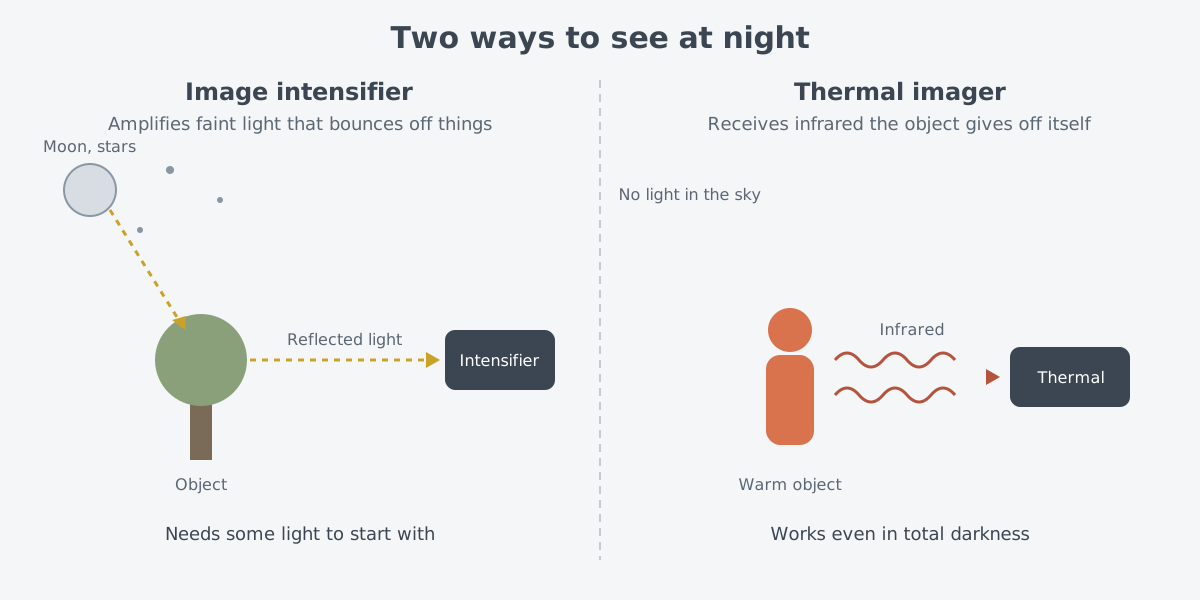
Thermal imaging starts from a different place. It does not wait for light to bounce off an object. It collects the infrared the object sends out by itself, so a picture appears even when the sky is completely dark.
Everything gives off heat as light
Infrared belongs to the electromagnetic spectrum. People cannot see it with their eyes, yet the body can sense it as warmth.
In 1800, William Herschel spread visible light out into its colors and placed a thermometer in each one. Just past the red end, where no color showed at all, the reading was even warmer. Light the eye could not see was sitting there.
Very hot objects, such as a fire, also give off visible light. Objects that are not that hot, such as people, give off only infrared. The eye misses that light, but instruments that sense infrared can show warm things like people and animals on a screen.
Infrared has its own bands. The usual split is near, mid and far infrared, and Earth scientists give the name thermal infrared to the stretch between 8 and 15 µm. How the color of light relates to its wavelength is covered in Light basics: waves, wavelength, frequency and photons.
For thermal imaging, a temperature difference matters more than the temperature itself. The long-wave infrared (LWIR) band, 8–12 µm, gives the strongest signal when an object and what lies behind it differ by a set amount in temperature. That is why this band is so wanted for looking at objects on the ground and for ground combat.
Detectors that turn heat into a picture
The part that receives the infrared is the detector. The history of thermal imaging has moved with the arrival of usable detectors. Detectors fall into two main families.
The first family is the photon detector. It turns incoming particles of light straight into an electrical signal. The trouble is that long-wave infrared photons carry little energy. The dark current made by the detector's own heat, and the noise that comes with it, are also low in energy, so signal and noise mix easily.
So photon detectors are chilled hard. The first practical long-wave detector material, mercury-doped germanium (Hg:Ge), needed chilling to 30 K, which took bulky, heavy and costly multistage coolers. Things improved in 1959, when the benefits of mercury cadmium telluride (HgCdTe, MCT) came to light at Britain's Royal Radar Establishment. Its lower dark current let it detect long-wave infrared at 80 K, which made the coolers much smaller, lighter and cheaper.
The second family is the thermal detector. Instead of counting particles of light, it measures how much it warms up when infrared lands on it. Think of a plate covered with a great many tiny thermometers. In reality, nobody reads a scale; the device senses each tiny temperature change and builds a picture from it.
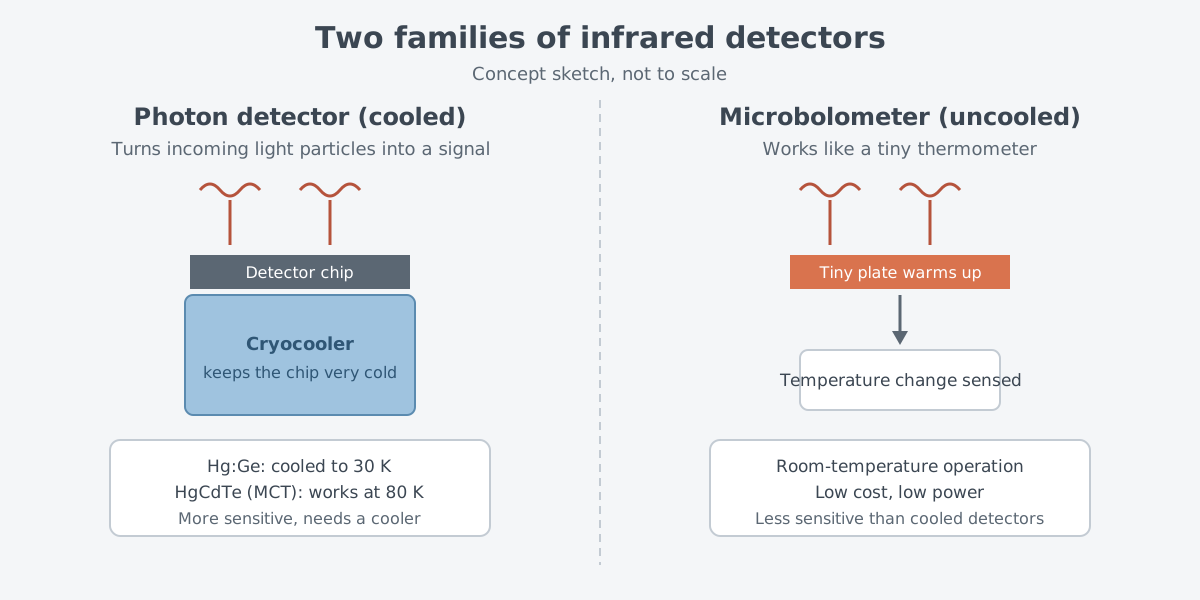
The best-known thermal detector is the microbolometer. In 1994, Honeywell received a patent for a vanadium oxide (VOx) microbolometer design that grew out of a government effort, the High-Density Array Development (HIDAD) program. Many other American aerospace firms, and a few foreign countries, later got licenses to it, all under tight export controls.
As a rule, thermal detectors fall well short of cooled photon detectors in sensitivity. Packed in large numbers on one array, though, they become sensitive enough for night viewers that help drivers, for rifle scopes and for missile seekers. Low cost, low power use and room-temperature operation make them very attractive.
From detector to sight: a short history
Heat-seeing devices did not start out as sights. In the 1960s, during the Vietnam War, early systems were infrared mappers that scanned the ground one line at a time from an aircraft and recorded the result on film. They worked very well for reconnaissance but were of little use for direct fire support.
Soon came systems that could be pointed and could show a live picture. These are called forward-looking infrared (FLIR). The name has a story behind it. Adding a vertical scan mirror let the detectors sweep in two directions, so a device that had only looked down could now look ahead.
Around the turn from the 1960s to the 1970s, parts were standardized to cut cost and improve reliability. Every service had to use shared "common module" parts that Texas Instruments led the way on, built with the Army in charge, and the result was called first generation. As mass production brought prices down sharply, infrared systems spread in the 1970s onto tanks, armored personnel carriers, aircraft and ships alike. This was when the Army's motto became "we own the night."
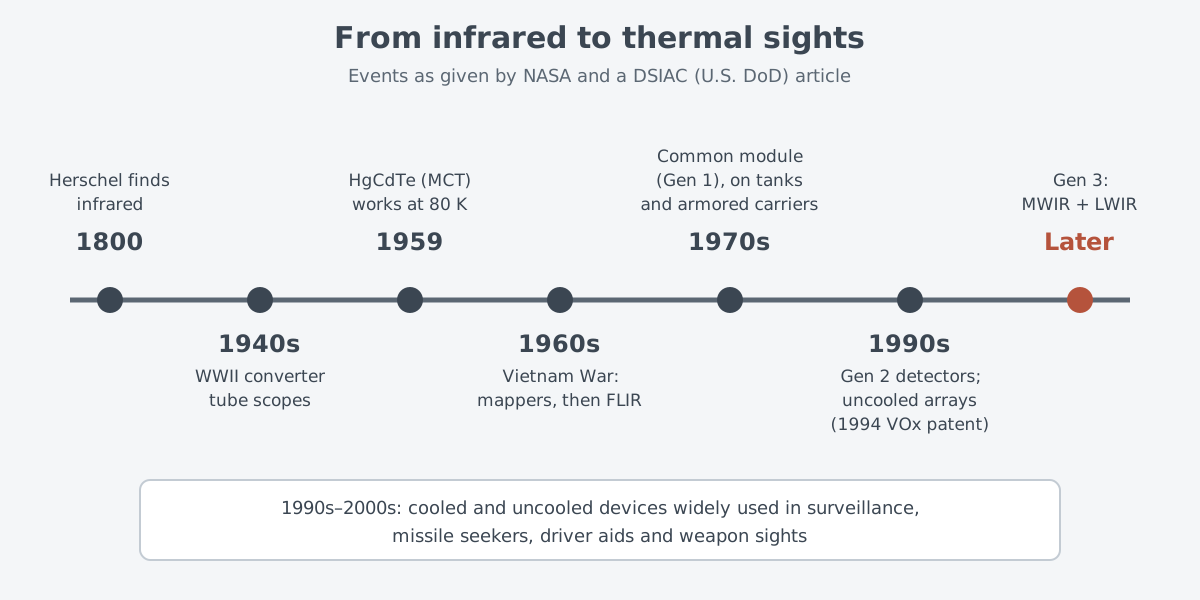
The next step came from electronics. Devices invented in the late 1960s, such as CCDs and CMOS switches, opened a new path. A readout integrated circuit (ROIC) placed right behind the detectors could now gather the signals of many detectors together, so each detector no longer needed its own wire and amplifier. This line of work led to the second-generation detectors of the 1990s.
Also in the 1990s, thermal detectors that run at room temperature reached maturity as flat arrays, and interest grew on both the military and civilian sides. In the 1990s and 2000s, cooled and uncooled devices came into wide use in surveillance gear, missile seekers, aids for drivers and sights on weapons. Later, Army needs led to third-generation sensors that see both mid-wave infrared (MWIR) and long-wave infrared. A third-generation detector stacks mid-wave material behind long-wave material so the two bands share the same spot.
Today the U.S. Army's FWS-I is mainly a thermal sight that mounts on a weapon. A helmet goggle that blends thermal and intensified images on one display, the Enhanced Night Vision Goggle (ENVG), has also appeared. It lays the thermal picture over the green image of the image intensifier. The Army says the goggle's thermal feature lets it work in any lighting, by day or by night, and see through smoke, fog and dust.
What thermal imaging can and cannot do easily
The biggest strength of thermal imaging is that it needs no light. It made it possible to see through the dark of night and across a smoke-covered battlefield. Heat-seeing devices have also been used away from the battlefield. In 1970, the Royal Navy used the first shipboard thermal imager to fight fires at sea.
The hard parts are just as clear. Long-wave infrared is one of the most difficult bands for detectors, and a sensitive photon detector has to travel with a cooler. Choosing an uncooled thermal detector instead makes the device lighter and cheaper but less sensitive. Choosing a device means weighing one against the other.
Cost is an old problem too. Third-generation devices that see both mid-wave and long-wave infrared are expensive, mostly because few detectors come out of production usable and the optics are complicated. Meanwhile, as off-the-shelf microbolometers become easy to buy, infrared technology is spreading around the world. Those commercial imagers fall below advanced technology in both resolution and sensitivity.
Where this meets lasers: the same infrared
Infrared comes up often in laser weapon stories too. Which wavelengths pass well through air, and how invisible light is divided up, are the same questions in laser articles. That story continues in Why wavelength matters: visible and invisible light and Light through air: absorption, scattering, turbulence, thermal blooming.
There is also a trend toward joining thermal imaging and lasers in one system. Aircraft and ships have begun using hybrid systems of this kind. They find targets with passive infrared imaging and examine them in detail with LADAR, an active device that forms images with a laser. The word LADAR combines "laser" and "radar."
In principle, LADAR can form images at much shorter wavelengths than thermal imaging, such as 1.54–1.57 µm. An article from DSIAC, an information analysis center of the U.S. Defense Department, notes that this choice of wavelengths is eye-safe.
A thermal imager is a passive sensor that only receives, much like the infrared search and track sensors that look for aircraft. The side of the story about finding small dots in the sky is in Infrared search and track: seeing aircraft without emitting.
What to read next
- Infrared search and track: seeing aircraft without emitting: a sensor that uses the same infrared to find aircraft in the sky.
- Why wavelength matters: visible and invisible light: sorting light, infrared included, by wavelength.
- "Night Vision: Image Intensifiers That Amplify Starlight": the other kind of night device, the one that amplifies light.