"Pick up the cup and put it on the table." Type that into a chatbot and it will explain how to grip the handle and how slowly to lift. The cup still does not move. The chatbot has no eyes to see the cup and no hand to hold it.
Physical AI is the name for efforts to fill that gap. It is artificial intelligence that sees the world through cameras and sensors, decides what to do, and moves real objects with motors. In 2025 the term showed up both in a US chipmaker's product launch and in a press release from Korea's industry ministry.
What changes when AI gets a body, and what does that body learn from? How do you tell a robot in a video from a robot you can actually buy? The company and government announcements here run up to October 2026.
AI that leaves the screen
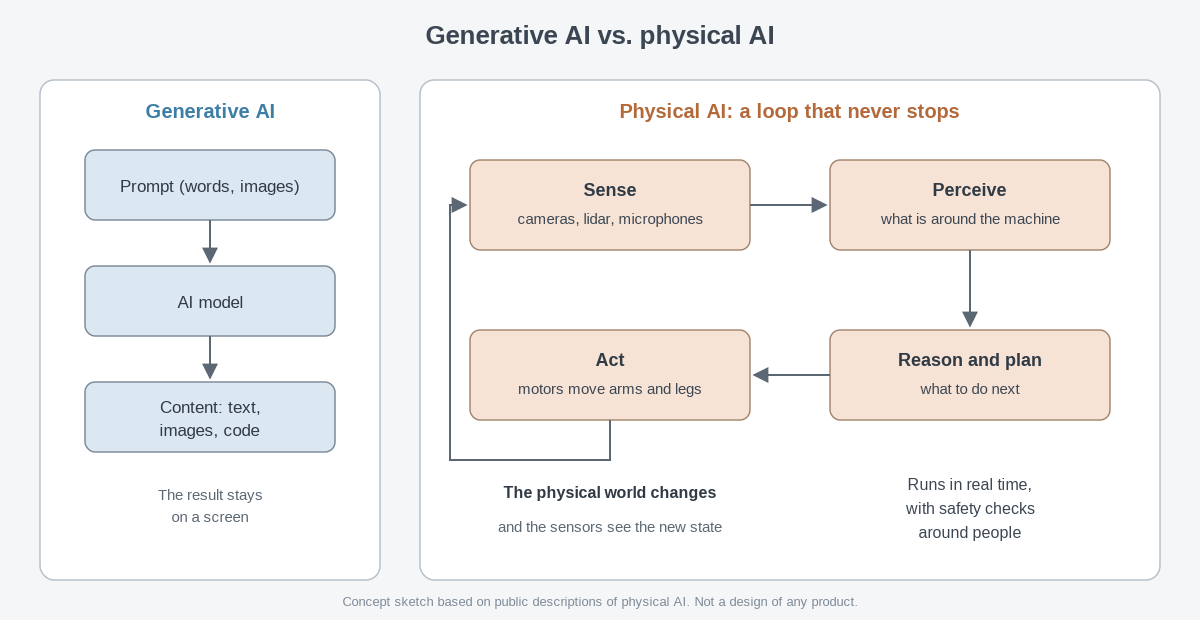
NVIDIA's glossary describes physical AI as what lets autonomous machines, from factory robots to robotaxis, sense and understand their surroundings and carry out complex tasks there. A definition agreed by researchers or governments is hard to find, so the term follows that wording here. The glossary also separates it from generative AI, which makes things like text, pictures and code. Physical AI instead helps a machine notice, think through and move within its real surroundings.
The difference comes from where the result lands. If a writing AI produces a sentence you dislike, you ask it to try again. A machine with a body has to account for the distance and direction between objects, conditions that keep changing, and the rules of the physical world.
When Google DeepMind released robot models in March 2025, it described the same problem in other words. AI models' abilities had mostly stayed in the digital realm. To be useful in the physical world, they need "embodied" reasoning, a humanlike ability to grasp their surroundings and respond to them, and they need to act safely. The phrase "with a body" in this article's title means the same thing.
The loop of sensing, deciding and moving
Picture catching a ball. Your eyes track it, you judge where it will land, you reach out, and you correct your hand if you are off. Physical AI runs a similar loop.
What comes in are camera images and video, spoken words, and data from various sensors. The machine uses these to perceive its surroundings, reasons about what to do, makes a plan and acts. The action changes the world, and the changed world comes back in through the sensors.
This loop has to run in real time. When development is split into stages, processing sensor data and deciding on the spot gets a stage of its own. A writing AI can be a little slow without harm, but a moving machine has to decide as fast as its surroundings change.
The ball analogy has a limit. A person who learned to catch a baseball can quickly handle a ball they have never seen, but for robots that kind of transfer is a big open problem. That is why generality, the ability to adapt to new situations, sits at the top of the wish list for robot AI.
Models that turn words into actions
If you need to drive a nail and have no hammer, you might pick up a rock. In experiments, a robot model called RT-2, announced in 2023, chose the rock for this kind of question. That result came when the model was prompted to reason in several steps.
The idea behind RT-2 is simple. It writes the robot arm's movements as text tokens and mixes them into the training data just as if they were ordinary words. A model that learned from web text and images can then produce robot actions much as it writes a sentence. Models of this kind are called vision-language-action (VLA) models.
RT-2 was published at the 2023 Conference on Robot Learning (CoRL) and was evaluated in 6,000 trials. Robot data is not as easy to gather as web text. For its robot demonstrations, RT-2 drew on data that 13 robots gathered in an office kitchen across 17 months.
Gemini Robotics, announced on March 12, 2025, follows the same line. It is a VLA model that adds "physical actions" as a new output to Google's Gemini 2.0 model so that it can control robots directly. Google DeepMind named three qualities robot AI needs: generality for new situations, interactivity for quick reactions to commands or changes, and dexterity with hands and fingers.
The model was trained mainly on data from ALOHA 2, a two-armed robot. The company said it can also be adapted to more complex bodies, such as Apptronik's Apollo humanoid. The aim is to move the same brain between bodies of different shapes.
Practicing in a virtual world first
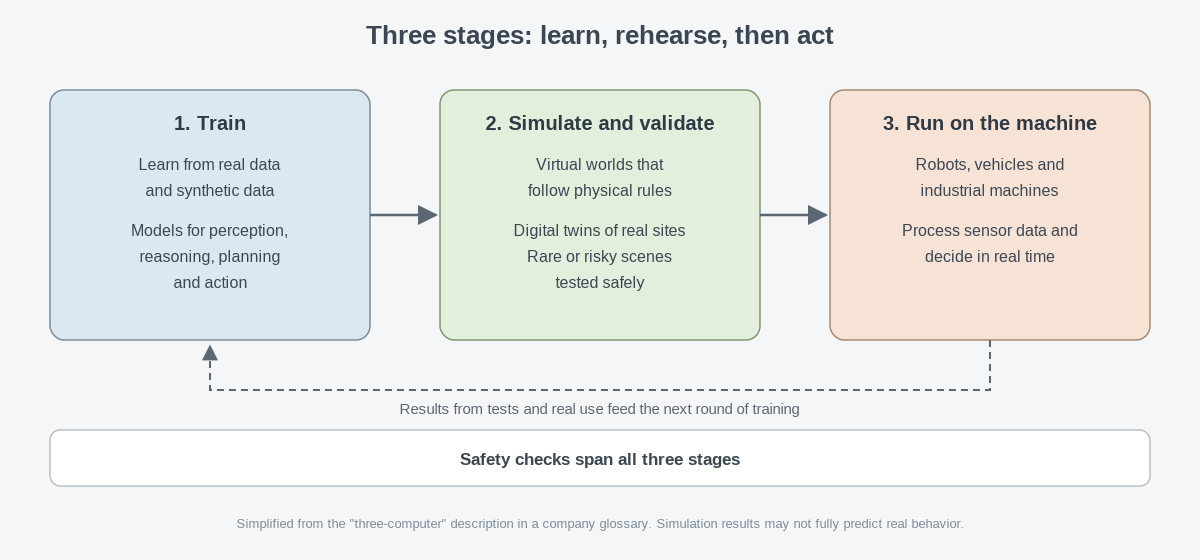
If a robot had to fall over thousands of times to learn not to fall, neither the robot nor the things around it would survive in good shape. Gathering varied data in the real world can take a long time, cost a lot and sometimes be dangerous. That is why physical AI development uses virtual worlds first.
Development can be split into three stages. Teams train models on real and synthetic data, test and validate them in virtual environments that follow physical rules, and then run the trained models on real machines. Safety checks span all three stages.
In a virtual environment, a robot can practice through reinforcement learning and imitation learning. Digital twins, which represent real machines and spaces inside a computer, are also used at this stage. How digital twins are used in equipment development is covered in Digital twins: testing before building.
On January 6, 2025, NVIDIA announced a platform called Cosmos at CES. It bundles generative "world foundation models" and is meant to produce large amounts of realistic, physics-based synthetic data for training and evaluating robot and self-driving models. The company said the models would come under an open model license.
In the same announcement, NVIDIA wrote that physical AI models are expensive to build and demand a lot of data and testing in the real world. CEO Jensen Huang said, "The ChatGPT moment for robotics is coming." This is a company leader's forecast while presenting a product, so it does not tell us when that moment will arrive.
Announced, demonstrated, on sale
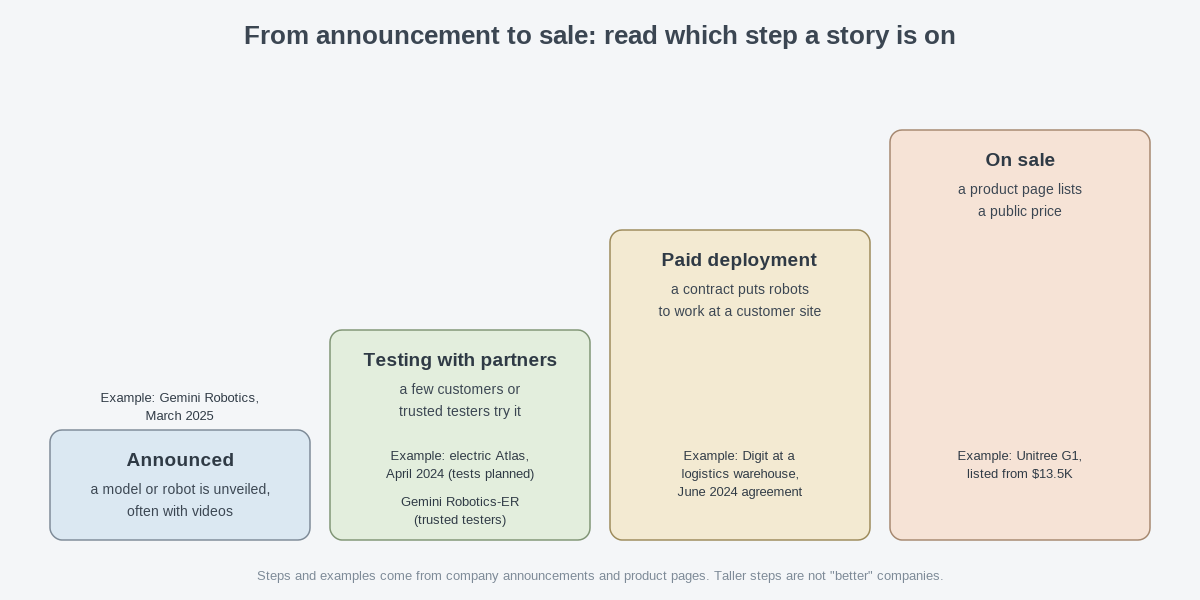
The most confusing part of physical AI news is the stage. A robot may move impressively in a video. You still have to check whether it is a launch demo, a trial with a few customers, a paid deployment, or a product anyone can buy.
Gemini Robotics, described above, is at the announcement stage. Google DeepMind said it is building next-generation humanoids with Apptronik. It has also let a few outside companies, among them Agile Robots, Agility Robotics, Boston Dynamics and Enchanted Tools, try Gemini Robotics-ER, a model focused on spatial understanding.
Hold three humanoids up to this yardstick and the stages split apart. The electric Atlas that Boston Dynamics unveiled in April 2024 came with an unveiling and a plan for several years of tests. Agility Robotics announced in June 2024 a multi-year agreement with the logistics company GXO to begin deploying its Digit. Unitree of China lists its G1 "from $13.5K" on the product page, so it is a product you can buy.
What each of the three companies has said is followed company by company in A Map of Humanoid Robot Makers: Tesla, Figure, Boston Dynamics, Unitree and More.
What is still hard
The first problem is data. Google DeepMind explains that to match models trained on web-scale data, robots would have to gather their own data across all kinds of objects, places, jobs and situations. The idea that scarce and uneven data is a central obstacle to robot learning also appears in a quote from Agility's chief technology officer in the Cosmos announcement.
The second is the gap between virtual and real. Data from the real world can leave out unusual conditions, and a model that does well in simulation is not guaranteed to behave the same way once deployed. That is why simulation results need a separate step of checking against tests on real hardware, with the differences fixed before a robot goes to work.
The third is safety. Keeping robots and nearby people physically safe has long been a basic concern in robotics. Classic safety measures include avoiding collisions, limiting the size of contact forces, and keeping mobile robots from falling over. A mistake by an AI on a screen stays on the screen, but a mistake by an AI with a body can reach a person.
Bringing robots into a workplace also takes more than the robot. Boston Dynamics wrote that putting many autonomous mobile robots to work also calls for computer systems, staff who accept the robots, network links, work routines, safety rules and operating procedures.
Defense and Korea
Military interest in human-shaped robots began before the term physical AI spread. The DARPA Robotics Challenge (DRC), run by the US Defense Advanced Research Projects Agency, was a competition to push human-supervised robot technology for disaster response. Its goal was ground robots that can do complex tasks in dangerous, degraded environments built for people.
The finals took place in Pomona, California, on June 5–6, 2015, and the KAIST team's DRC-Hubo took first place. The key phrase of the challenge was "supervised autonomy." DARPA explains that better supervised autonomy lets robots work even when communications are slow or keep dropping. The program has ended.
As robots make more decisions on their own, it matters more where a human decides what. That question, as it applies to weapons, is the subject of Autonomous weapons and human control.
The Korean government has also moved. On April 10, 2025, the Ministry of Trade, Industry and Energy held a launch ceremony for the "K-Humanoid Alliance," and about 40 organizations, including companies and universities, signed an agreement. More than 1 trillion won of investment is expected by 2030 as a result, according to the government.
The press release says many AI experts expect the era of physical AI to arrive soon after generative AI. One of the alliance's plans is a shared robot AI foundation model for robot makers by 2028. Another is a set of virtual simulators based on video and touch data, with the goal of a "Korean Cosmos." Both were plans announced at the launch.
What to read next
- A Map of Humanoid Robot Makers: Tesla, Figure, Boston Dynamics, Unitree and More: widens the companies in this article into a single map.
- How Humanoids Walk: Actuators and Balance Control: looks at the "act" box of the loop, where the body actually moves.
- Robot Foundation Models: Robots That Learn in Simulation: goes deeper into VLA models and learning in virtual worlds.
- Drone autonomy: navigation is not the same as communication: a useful comparison with how drones find their own way.
- The Debate over Military Physical AI: Company Policies and International Talks: the debate over robots used by militaries.