Among the signals a phone map app uses to find your position are signals from GPS satellites that the U.S. Space Force runs. The internet that carries this page also has its roots in a research network built for a defense research agency. Technology made for the military now sits inside things people hold every day.
The road also runs the other way. The military often adopts technology that companies built for the market. Goods and technology that can serve both civilian and military purposes are called "dual-use." This article looks at the official meaning of the term, two real cases of technology crossing over, and why countries keep separate lists for such items.
What "dual-use" means
The U.S. Export Administration Regulations (EAR) call an item dual-use when it has civilian uses and can also serve military ends, terrorism, or weapons of mass destruction (WMD) programs. The European Commission puts it in a similar way: goods, software, and technology count as dual-use if they can serve civilian purposes as well as military ones.
Two words stand out: "software" and "technology." Dual-use does not only mean machines you can touch. Programs and know-how count too.
The line is not always neat. The EAR also reach items that are entirely civilian, as well as some military-only items that still do not need weapons-level control. "Dual-use" is less a label stuck on an object and more a way of saying that one object can sit in two places.
From military to civilian: the roots of the internet
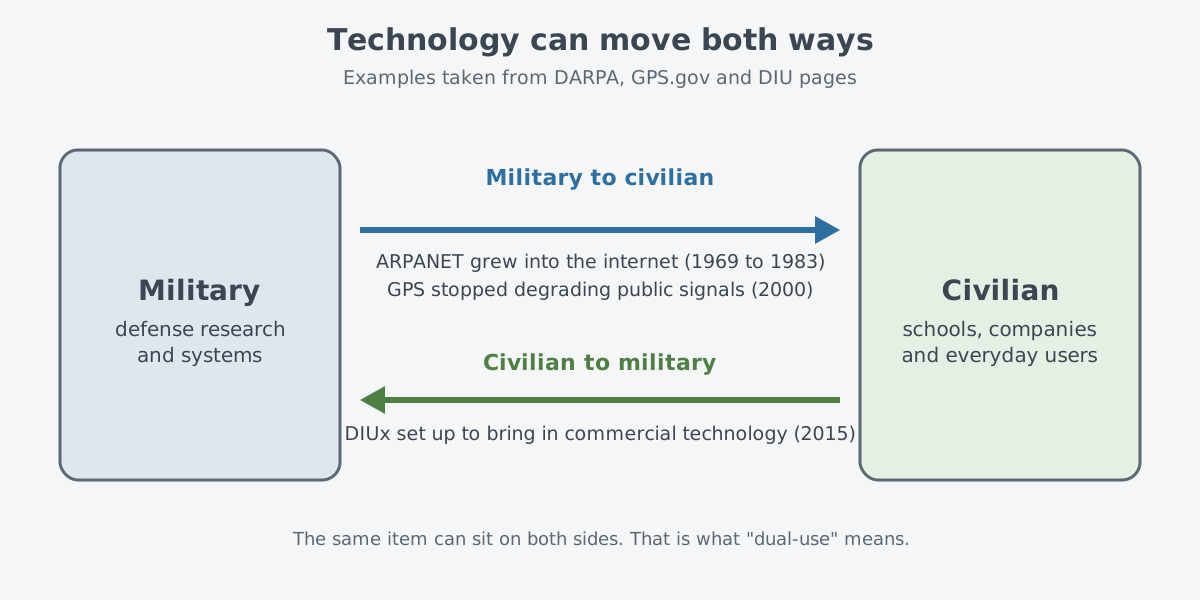
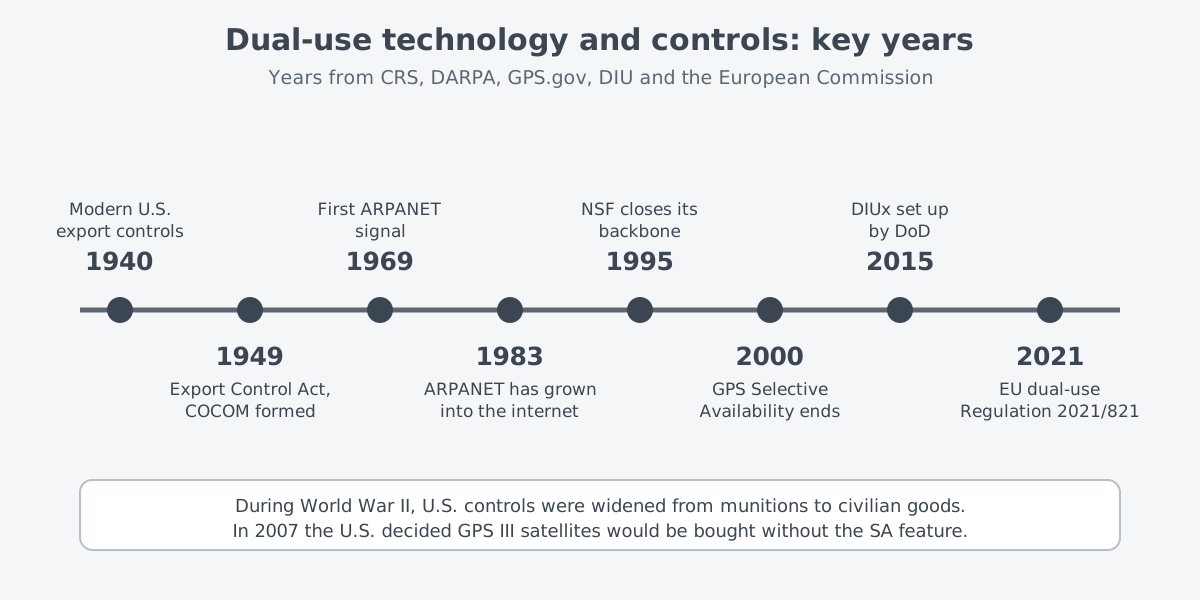
DARPA says today’s internet grew from work the agency started in the 1960s. At the time it was called the Advanced Research Projects Agency (ARPA), and that work became the ARPANET. The ARPANET started with four computer nodes. On October 29, 1969, a computer at UCLA sent the network’s first message to a computer at the Stanford Research Institute (SRI).
One early goal was secure communication and information sharing between research sites far apart. As more computers joined, a problem appeared.
If the network worked like an old telephone system, one failed node could bring the whole network down. Packet switching came out of that challenge. Data is split into small packets that find their own way through the network and are put back together at the destination.
Different computers did not speak the same language, so a common set of rules was also needed. That became TCP/IP, first implemented at Stanford in 1975. By January 1983, enough networks had linked up that the ARPANET had grown into the internet.
The move to civilian use came in steps. The network first opened to the academic community, and the National Science Foundation (NSF) set up NSFnet in 1985. In 1988 the Federal Networking Council allowed the MCI Mail service to be linked in, which ended the rule that kept commercial electronic messages off the government backbone. Commercial internet services then grew fast, and in 1995 the NSF closed the backbone it had run for this purpose.
Then the story turned back to the military. In the mid-1990s, DARPA tried to build secure, dependable battlefield communications on this technology. But a battlefield network, unlike the civilian internet, could not count on fixed equipment like cell towers or server farms. Technology from the same roots faces different problems in different places.
From military to civilian: GPS for everyone
GPS.gov calls the Global Positioning System "a U.S.-owned utility." It gives users position, navigation, and timing information, known as PNT.
GPS is one kind of global navigation satellite system (GNSS). It has three parts: the space segment with the satellites, the control segment on the ground, and the user segment, which is the receiver in your hand. The U.S. Space Force builds and runs the satellites and the ground control network. The baseline constellation has 24 working satellites.
Before civilians could rely on a military-run system, there was a hurdle. For national security reasons, the United States once deliberately degraded the accuracy of public GPS signals. This was called Selective Availability (SA).
President Bill Clinton ordered an end to SA, and the U.S. government stopped using it in May 2000. The goal was to make GPS serve civilian and business users around the world better. In September 2007, it announced that the next generation of satellites, GPS III, would be bought without the SA feature. That step made the 2000 policy decision permanent.
The GPS case shows one side of dual-use clearly. A single system run by the military came to serve civil and commercial users around the world. How satellite and inertial navigation work together is covered in Inertial and satellite navigation.
From civilian to military: commercial tech moves faster
Now the other direction. In August 2015, under Secretary of Defense Ash Carter, the Defense Department set up a unit called DIUx. Today it is called DIU. The first reason its website gives is that private-sector technology was moving ahead faster than defense R&D.
DIU names two more problems. Traditional acquisition methods are too slow, and the barriers for first-time and small businesses to enter the defense market are too high. With the internet and GPS, the military led and civilians followed. Here the order is reversed: the military opens its doors to catch up with the commercial world.
Put the two directions side by side and it becomes clear why dual-use draws steady attention. Wherever a technology starts, it tends to end up on both sides, and that raises the question of where it flows.
The lists that followed: dual-use controls
Rules for handling dual-use items also have a long history. According to a Congressional Research Service (CRS) report, modern U.S. export controls began in 1940, when Congress gave the President power to control exports of military equipment and munitions. After the United States entered World War II, Congress widened that power to include civilian goods.
In 1949, Congress passed the Export Control Act. A committee called COCOM, formed the same year, coordinated, among Western countries, limits on exports headed for the Soviet Union and the countries of Eastern Europe.
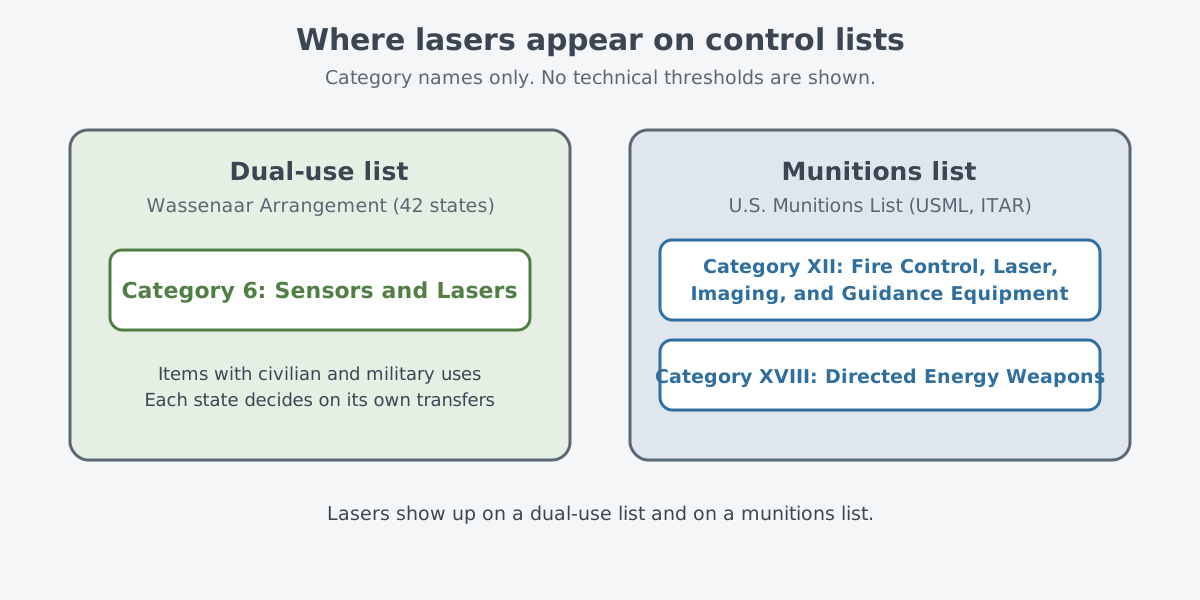
Today many countries share lists. The Wassenaar Arrangement is a multilateral regime that deals with the transfer of conventional weapons and of dual-use goods and technology. It has 42 participating states, and the Republic of Korea is a founding member.
The arrangement says it does not target any country, and each participating state decides for itself whether to allow a transfer. Under Regulation (EU) 2021/821, the EU oversees exports of dual-use items, along with their transit, brokering, and related technical help, and it keeps one shared EU list of these items.
Controls have limits. CRS describes balancing national security and export competitiveness as a complex problem that lawmakers and the executive branch have struggled with for decades. If the same item is available from foreign sources, controls may not work, and they may put a country's own firms at a disadvantage. How the U.S. system is organized is covered in a separate article in this series, "Export Controls: What ITAR and the Wassenaar Arrangement Restrict."
Where this meets lasers: factory lasers, listed lasers
Lasers are another example of dual-use. In factories they are tools for cutting, joining, and marking metal. Those uses are described in Where industrial lasers are used. Systems that use lasers as weapons are also being studied.
Lasers have places on both kinds of control list. The Wassenaar dual-use list has Category 6, "Sensors and Lasers." On the U.S. side, the munitions list (USML) has Category XII, "Fire Control, Laser, Imaging, and Guidance Equipment," and Category XVIII, "Directed Energy Weapons" (DEW).
When a news story mentions "exporting laser technology," it helps to first ask whether the laser is factory equipment or part of a weapon system. What the term laser weapon refers to is covered in What is a laser weapon?.
What to read next
- Turning points in military technology: moments when military technology changed sharply.
- Where industrial lasers are used: cutting, welding, marking, cleaning: the civilian side of lasers.
- Inertial and satellite navigation: knowing where you are: how satellite navigation such as GPS is used by the military and civilians.