Picture a US military unit that wants to buy a small reconnaissance drone. A shop has plenty to choose from. The defense department, though, works under conditions set by law, so the unit first has to ask where the aircraft was made and where its radio and camera came from. If every unit did that research on its own, it would take a long time.
Blue UAS is a list of drones and parts that have already been through that kind of check. It was created by the Defense Innovation Unit (DIU) as the department's first vetted list of drones, and it holds commercial drones that have gone through security and performance assessments.
By 2026, though, the same list was being used to decide radio equipment approvals outside the defense department. How did a list of drones the military may buy end up there? What follows reflects the situation as of October 2026.
Why a list was needed: Section 848
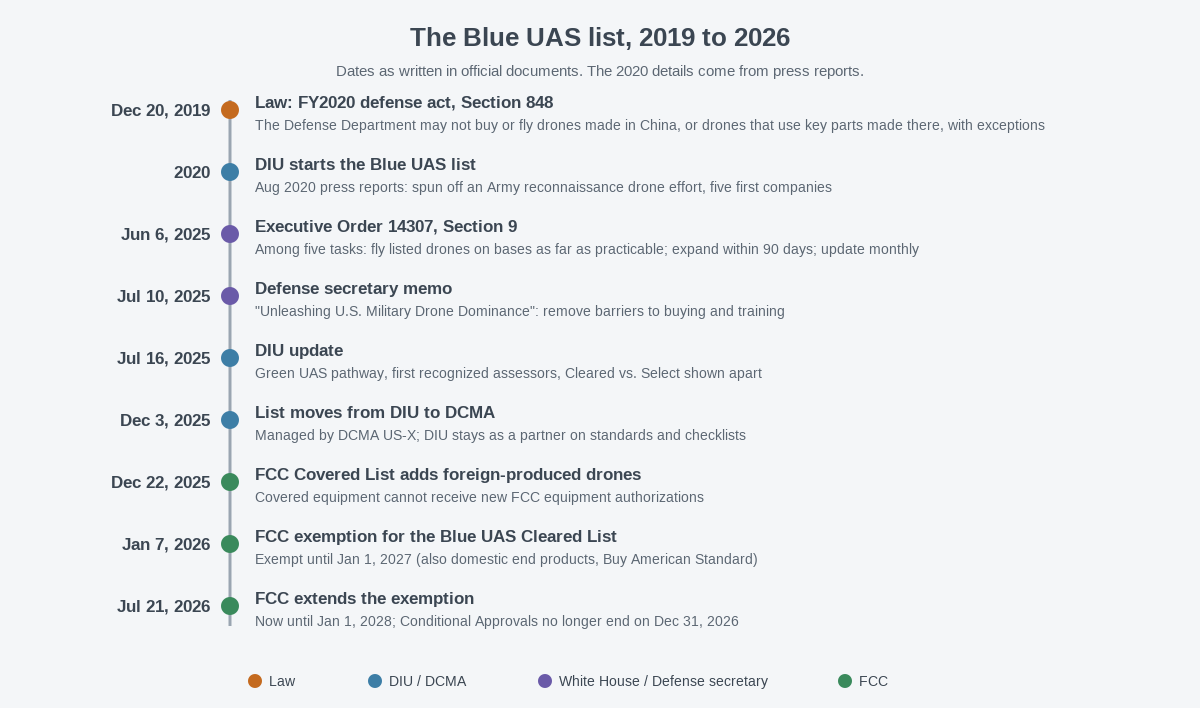
It starts with one section of law: Section 848 of the National Defense Authorization Act (NDAA) for Fiscal Year 2020, signed on December 20, 2019. Under it, the Secretary of Defense is barred from operating an unmanned aerial system (UAS) made in China or by an entity based there. Signing or renewing a contract to buy one is also barred.
The section looks past the airframe. The same ban applies when the cameras, gimbals, radios, flight controllers or data transmission devices come from such a source. It also applies when the ground control system or operating software was developed there, or when the network connection or data storage is located there.
Purposes the law names separately, such as surrogate testing and training for counter-UAS work, and intelligence, electronic warfare and information warfare operations with their testing, analysis and training, are exempt. Beyond that, the Secretary of Defense can waive the ban case by case by certifying in writing to the congressional defense committees that it is required in the national interest.
Checking down to the parts makes the job much larger. A drone sold by a US company can still fail the test because of one camera inside it. The Blue UAS list gathers aircraft that have already been through those checks in one place.
The 2020 start: a spin-off of an Army reconnaissance drone
The Blue UAS list began in 2020. In a 2025 announcement, DIU looked back on a launch "five years ago."
Press coverage from the time shows what the start looked like. A Defense News report from August 20, 2020, gives the first name as Blue sUAS. The effort grew out of the Army's Short Range Reconnaissance (SRR) program, which was developing a quadcopter that fits in a rucksack.
The drones were built to comply with Section 848, and configurations came from five companies: Altavian, Parrot, Skydio, Teal and Vantage Robotics. They were planned to be on the General Services Administration (GSA) schedule from September 2020.
The "s" in the name stands for small unmanned aircraft system (sUAS). Official defense and FCC documents now use the name Blue UAS.
The list has three parts
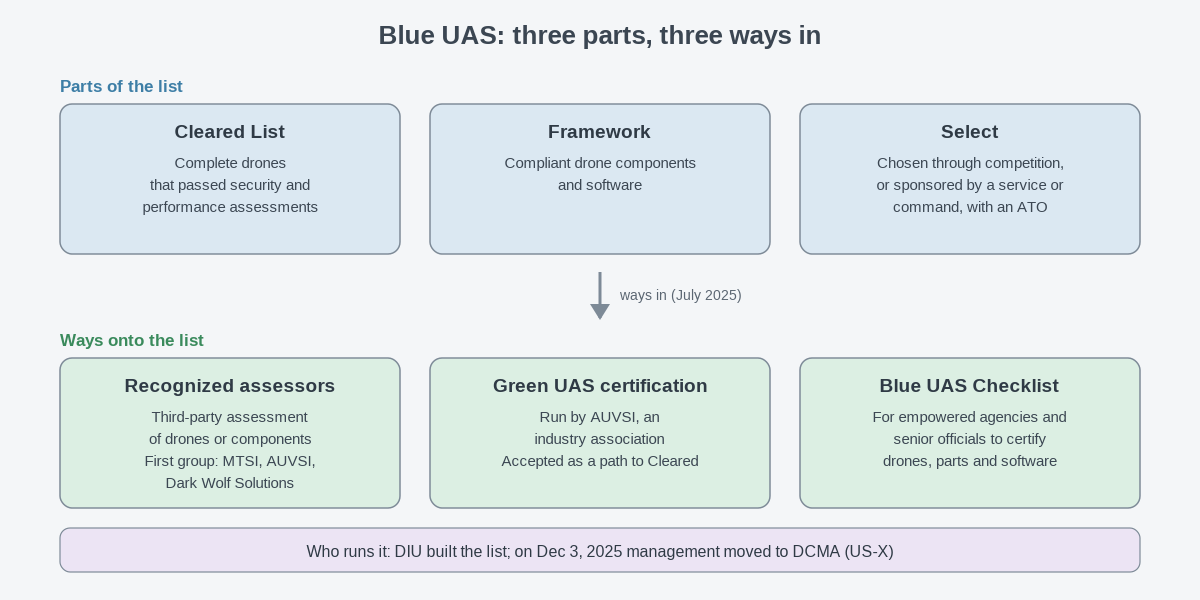
It is easy to think of Blue UAS as one table, but it has separate parts. The first is the Blue UAS Cleared List, which holds complete aircraft. The second is the Framework, a list of compliant drone components and software.
The "Blue UAS list" named in the National Security Determination that the defense department sent to the FCC means these two lists combined. A July 2026 notice from the Federal Communications Commission (FCC) spells this out and uses the name "Blue UAS Cleared List" for both.
The third part is Blue UAS Select. These are aircraft chosen through competition, or sponsored by a military service or combatant command and given an authority to operate (ATO). Since a July 2025 website update, "Cleared" and "Select" appear separately.
How a system gets on the list
DIU built the list and ran it. On July 16, 2025, it announced wider paths onto the list.
One path runs through Recognized Assessors. These are organizations that give third-party assessments of aircraft or components. The first group was MTSI, Dark Wolf Solutions and AUVSI, and they were to be ready to take systems for assessment by September 2025.
Another path is Green UAS certification. It is run by AUVSI, an industry association for uncrewed systems, and now counts as an authorized path to Cleared status. From the day of the announcement, aircraft that had completed Green UAS certification were to be added to the Cleared List.
The third path is a Blue UAS Checklist, which DIU was finishing together with the office of the Deputy Secretary of Defense. With it, empowered agencies, general and flag officers and senior executives would be able to certify aircraft, components and software. The checklist was due by August 1, 2025.
2025: an executive order, a defense memo, and the move to DCMA
Executive Order 14307, "Unleashing American Drone Dominance," came out on June 6, 2025. Section 9 gave the Secretary of Defense five tasks, and three of them are about the Blue UAS list.
First, make sure every aircraft on the Blue UAS list can fly at all military installations and ranges without an exception to policy. That was to happen as soon as possible and to the fullest extent practicable. Second, within 90 days, expand the list to cover all drones and critical components that comply with Section 848, to the fullest extent practicable. Third, update the list every month.
The other two are about Section 848 itself. Drones made by US companies that comply with Section 848 were to be bought ahead of drones from all other companies, to the maximum extent practicable. Exemptions and waivers to Section 848 were to be used only when absolutely necessary for the mission. Compliance with Section 848 was also not to hold back the rapid adoption of drone technology.
A month later, on July 10, a memo from the defense secretary titled "Unleashing U.S. Military Drone Dominance" followed. Its goal was to remove barriers to buying and training with new drone technology. The July 16 announcement covered above was DIU's response to that memo and the executive order.
On December 3, the list changed hands. DIU passed the Cleared List and related assets to the Defense Contract Management Agency (DCMA), ahead of the original January 1 deadline. Management left DIU's Mountain View, California, headquarters for US-X, a new DCMA command in Palmdale. DIU stays on as a partner that helps set standards and revise checklists, and DCMA runs and grows the list.
DIU tied the handover to the secretary's goal of "small UAS domain dominance" by the end of 2027. The plan is to turn the list from a certification scheme to a marketplace where service members can buy trusted drone technology quickly. By then, 81 companies had been processed onto the list, and as of November 19, 2025, it held more than 39 certified systems and 165 components.
The FCC Covered List and the Blue UAS exemption
Blue UAS started as a buying list inside the defense department. From late 2025, it also began to matter for rules outside the military.
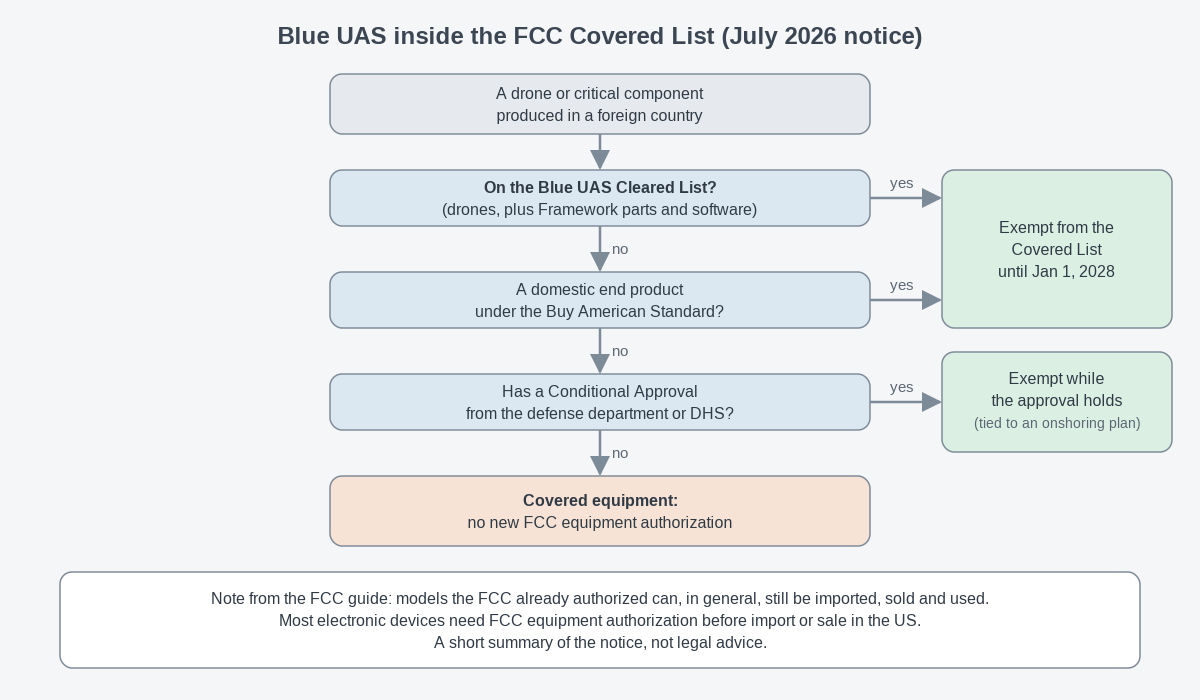
The FCC acted on December 22, 2025, adding uncrewed aircraft systems and critical components produced in foreign countries to its Covered List. Equipment on that list cannot receive new equipment authorizations, so new devices cannot enter the US market. Most electronic devices need that authorization before they are imported or sold in the United States. Drones and parts the FCC had already authorized can, in general, still be imported, sold and used.
On January 7, 2026, the FCC added an exemption based on a new defense department determination. Two kinds of items were judged not to pose such risks until January 1, 2027. One is anything on the Blue UAS Cleared List; the other is anything that counts as a "domestic end product" under the Buy American Standard. A US-made drone with foreign parts is not covered either, as long as it meets the Buy American Standard or the Blue UAS Cleared List.
A notice on July 21, 2026, extended the exemption to January 1, 2028. The new determination ends on that date and replaces the one from January.
The list is not the only way out. The same notice says the FCC has also, since March 2026, exempted specific devices that hold a Conditional Approval from the defense or homeland security department.
The July determination states that these approvals do not end on December 31, 2026. Instead, they hold for as long as the applicant follows the onshoring plan in its application, that is, its plan to move production into the United States. If it does not, the approval ends and the device goes back on the Covered List.
So the Blue UAS Cleared List has become one of the tests that decide whether a foreign-produced drone can still get a new authorization. The Buy American Standard and individual Conditional Approvals are the other two.
Use outside the military, and the limits
The military is not the only user. The Department of Homeland Security runs SAVER, a program that assesses equipment for emergency responders. Its Blue UAS material says the defense department's list may help responder agencies with buying. First responders fly drones for search and rescue, for fighting fires and for reconstructing incidents afterward, among other jobs.
It also helps to know what the list does and does not say. In the homeland security material's words, Blue UAS aircraft have been "vetted to be compliant with DoD policy." That is not a ranking of which aircraft suits which mission best.
The list keeps changing. The executive order called for monthly updates, and the FCC exemption carries an end date. To know whether a given aircraft is on the list today, check DCMA's list at the time.
Where this meets lasers: lists of trusted parts
Section 848 reached down to parts such as cameras and radios, and trust in a weapon system likewise starts with its parts. Blue UAS also lists complete aircraft separately from components and software.
A laser weapon is likewise built in layers, from a semiconductor chip through amplifiers and a light source to the effector. How those layers connect is the subject of Following One Laser Weapon: From Chip to Effector.
What to read next
- US Restrictions on DJI: From the Entity List to the FCC: the same FCC action, seen from the regulation side.
- A Map of Civil Drone Makers: Autel, Skydio, Parrot, Teal and More: drone companies beyond the list.
- Export Controls: What ITAR and the Wassenaar Arrangement Restrict: the permit systems for goods that cross borders.
- Counter-drone systems: why one device is not enough: how drone defenses are put together.