Put a CD, a DVD and a Blu-ray Disc side by side on a desk, and all three are the same size: 120 mm across. Open the standards and compare the numbers, though, and the differences show. The wavelength of the reading light gets shorter, from 780 nm to 650 nm to 405 nm. The numerical aperture (NA) of the lens that gathers the light grows, from 0.45 to 0.60 to 0.85.
Why did the color of the light have to change to fit more on a disc of the same size? The answer is diffraction: even a lens cannot squeeze light into an infinitely small point. A single ratio of two numbers explains most of the gap between the three discs.
The three discs in numbers
The values below come from the CD-ROM standard (ECMA-130), the read-only DVD standard (ECMA-267) and sources on Blu-ray. The Blu-ray capacity is the value written in the specification list of the Blu-ray Disc Association (BDA).
| Item | CD | DVD | Blu-ray |
|---|---|---|---|
| Diameter | 120 mm | 120 mm | 120 mm |
| Reading wavelength | 780 nm | 650 nm | 405 nm |
| Lens numerical aperture | 0.45 | 0.60 | 0.85 |
| Track pitch | 1.6 µm | 0.74 µm | (not in the sources used here) |
| Substrate thickness | 1.2 mm | 0.6 mm | (not in the sources used here) |
| Capacity | (no single value in the standard) | 4.7 GB, one side and one layer | 25/50 GB in the specification list |
The human eye usually senses wavelengths from 380 to 700 nm. At 780 nm, CD light sits outside that range in the near infrared. The 650 nm DVD light is toward the red end, and 405 nm is close to the violet end. The articles "Why wavelength matters" and "The wavelength map" cover wavelength and color in more detail.
The name Blu-ray comes from the color of the light. A 2003 paper on recording media in the Japanese Journal of Applied Physics describes the Blu-ray format this way. It pairs a 405 nm blue laser diode with a lens of NA 0.85.
A smaller spot means more data
An optical disc stores data in tiny pits pressed into an otherwise flat reflective layer. The lengths of the pits and the gaps between them carry the information. The pits line up along a spiral track that runs from the inside of the disc outward. The CD standard sets the spacing of this spiral at 1.6 µm, and the DVD standard sets it at 0.74 µm.
A drive focuses laser light through a lens onto one spot on the track and reads the pits there. If the spot is much wider than the track pitch, it lights up several tracks at once. So before the tracks can sit closer and the pits can get shorter, the spot has to shrink.
Picture reading a book line by line with a flashlight. The narrower the beam, the tighter the line spacing you can follow. Real light differs here: a flashlight beam seems able to get as narrow as you like, but no light can be focused below a certain size.
Diffraction: a lens cannot make a point
Light is a wave, so it bends and spreads a little at the edges of any opening it passes. This is diffraction. Diffraction limits how fine a detail any optical system with a lens or mirror can separate.
Light passing a round opening forms a pattern: a bright central disk, then dark and bright rings in turn. For a circular opening of diameter D, the first dark ring appears at this angle.
θ = 1.22 λ / D
Here λ is the wavelength of the light and D is the diameter of the opening. A shorter wavelength or a larger opening makes the angle smaller.
The same happens when a lens focuses light. Ray diagrams draw the focus as a point with no size, but such a point would need infinite intensity, so it cannot exist. Because of diffraction, the focus becomes a small region with a width and a spread of intensity. "Interference and diffraction" explains the patterns themselves.
Numerical aperture: the width of the light cone
Light converging from a lens to its focus forms a cone. If α is half the cone angle, the numerical aperture of the lens is NA = n sin α. Here n is the refractive index of the material between the lens and the focus, close to 1 for air.
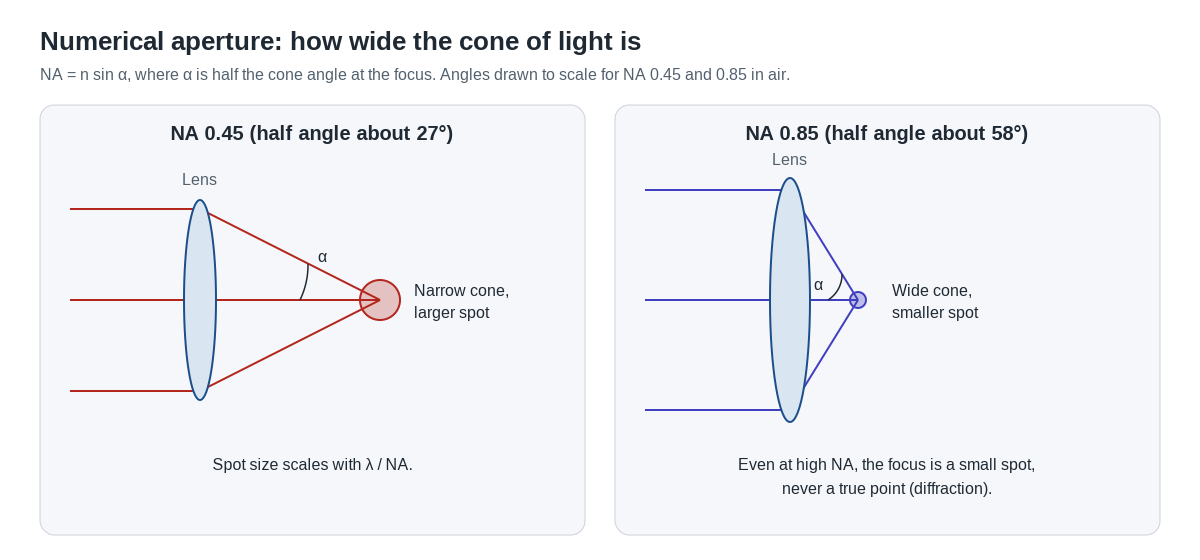
An NA of 0.45 matches a half angle of about 27°, and 0.85 matches about 58°. A wider cone gathers light from a wider range of angles, and the focal spot gets smaller. Even so, no NA turns the spot into a true point.
In optics, the closest distance a lens can separate is often written as x = 0.61 λ/NA. The message of the formula is simple. A shorter wavelength λ or a larger NA shrinks the size scale of the spot.
The three discs on one ruler
Now put the three discs into the formula. The value 0.61 λ/NA comes to about 1.06 µm for CD, about 0.66 µm for DVD and about 0.29 µm for Blu-ray. These are not measured spot diameters in real drives. They form a diffraction scale for comparing the three discs on the same ruler.
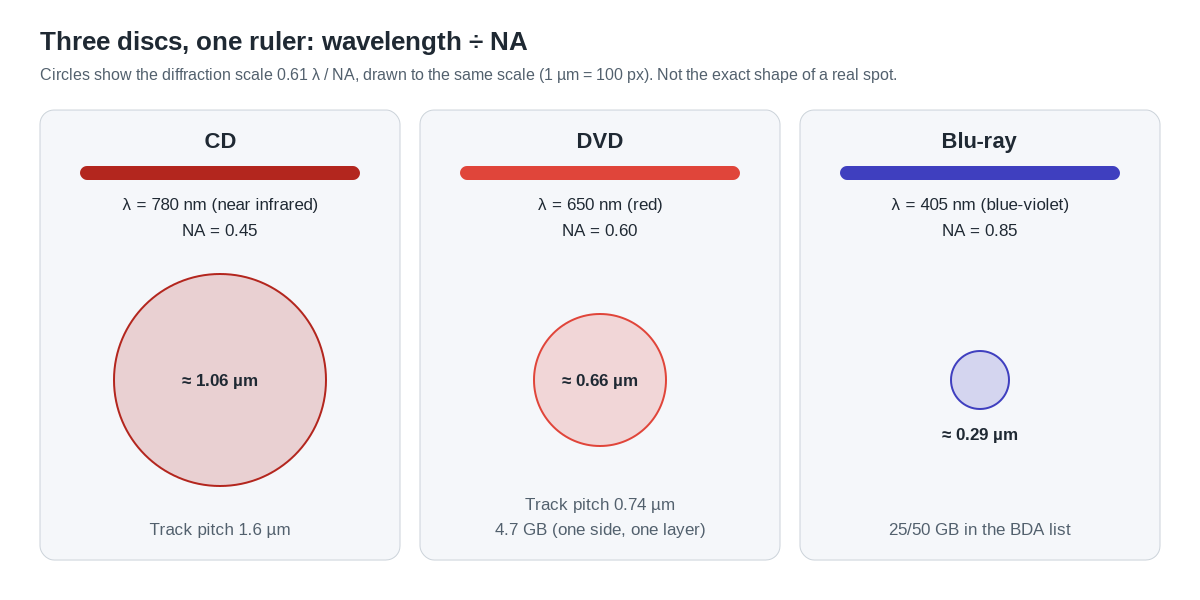
On this scale, the spot shrank to about one 3.6th of its size from CD to Blu-ray. By area, that is about one 13th. Even between DVD and Blu-ray, the gap is about 2.3 times in length and about 5 times in area.
The CD and DVD track pitches follow the same trend. While the diffraction scale fell from 1.06 µm to 0.66 µm, the track pitch narrowed from 1.6 µm to 0.74 µm. On both discs, the track pitch is set a little wider than the diffraction scale.
Capacity does not depend on spot size alone, though. Within the same DVD standard, one side with one layer holds 4.7 GB. Stacking two layers or using both sides gives 8.5 GB, 9.4 GB or 17.0 GB. The capacity column in the Blu-ray specification list also shows 25 GB and 50 GB side by side.
What changing the color required
The idea of a shorter wavelength is simple, but a product needs a small light source that emits it. The path that led CD and DVD drives to red-region semiconductor lasers continues in "1962: Four Labs, One Month, and the First Laser Diodes". Blu-ray uses a blue laser diode that emits at 405 nm as its light source.
The lens changed too. An NA of 0.85 means a wide cone with a half angle of about 58°, so the lens has to gather light over that large an angle. Changing wavelength and numerical aperture together is what separates the three generations.
The same ruler at long range
The same diffraction formula is not limited to the micrometer world inside a disc. When a laser beam travels a long distance, diffraction spreading can become large. In experiments that bounce laser light off the Moon to measure its distance, a telescope expands the beam to make D large, which keeps the spreading angle small.
A disc uses a short wavelength and a large NA to make the spot small. Over long distances, a large aperture keeps a beam from spreading as much. Both rest on the same λ/D relation. It is also linked to why the beam director of a laser weapon sends out a widened beam.
What to read next
- "Why a beam spreads: divergence, focus and aperture": beam waist and Rayleigh length give a closer look at diffraction spreading.
- "Beam director optics: lenses, mirrors, coatings and a large aperture": why laser weapons use a large aperture.
- "A laser to the Moon: measuring the lunar distance with Apollo reflectors": how wide a beam gets on its way to the Moon.