The laser diode, or LD, at work inside fiber-optic links and printers was not the invention of one person or one lab. In autumn 1962, four US labs each reached the same result within about a month.
On November 1 that year, The New York Times ran a story headlined "Two Concerns Make Same Discovery." The same day, Robert Hall's group at the GE research lab published in Physical Review Letters, and an IBM group published in Applied Physics Letters. Both reported laser light from a current run through the semiconductor gallium arsenide.
There were not two competitors but four, and the trigger was reports at meetings that summer. In 2024, the Institute of Electrical and Electronics Engineers (IEEE) honored the work as a milestone in technology history.
Summer 1962: a report of "nearly 100%"
The groundwork was the transistor of 1948. Knowledge of semiconductor materials grew quickly after the transistor arrived. Several corporate and government labs gained the people and technology needed to try a semiconductor laser.
The spark was a report at conferences in summer 1962. It said gallium arsenide could turn close to 100% of the electrical energy fed into it into light. Several research groups that heard the news were ready to turn that light into a laser right away.
Hall at GE was one of them. A GE article says that in 1962 he learned of studies on the invisible infrared glow of gallium arsenide and saw a way to turn it into a semiconductor laser.
Four labs, about one month
The four sites named by the IEEE milestone are two GE sites (Schenectady and Syracuse), IBM's Watson research lab and MIT's Lincoln Laboratory. In autumn 1962, within roughly a month, the first semiconductor lasers worked at all four, each on its own.
- GE Schenectady: Hall's group published "Coherent Light Emission From GaAs Junctions" in Physical Review Letters, volume 9, page 366, on November 1, 1962.
- IBM: Marshall Nathan's group published "Stimulated Emission of Radiation from GaAs p-n Junctions" in Applied Physics Letters, volume 1, page 62, the same day.
- MIT Lincoln Laboratory: The lab built its first gallium arsenide diode laser in October 1962, with the paper in Applied Physics Letters, volume 1, page 91. That year it also used the technology to send a television signal.
- GE Syracuse: Nick Holonyak Jr. and S. F. Bevacqua reported a semiconductor laser that gave off visible light in Applied Physics Letters on December 1, 1962.
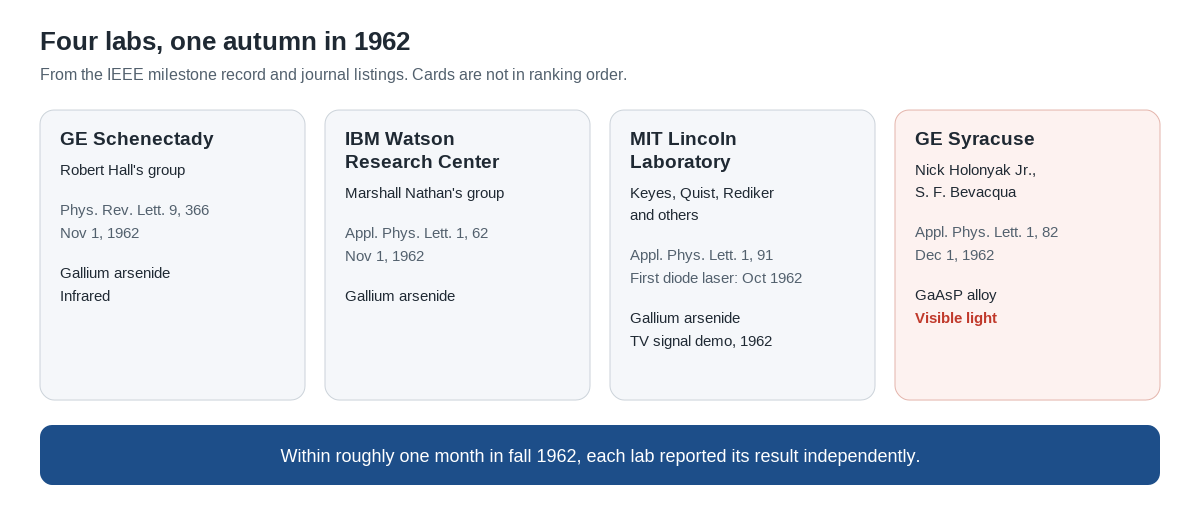
So who was first? GE writes that Hall's team beat IBM by two weeks. The IEEE milestone does not rank them and records that the four reported "independently." The same knowledge had reached several places at the same time.
What changed: three parts in one piece
Think back to the 1960 ruby laser. The ruby crystal that amplified light, the flash lamp that fed it energy and the mirrors at each end that bounced the light were assembled as separate pieces. That story is in May 16, 1960: Maiman's Ruby Laser. Every laser from 1960 to 1962 had to be built this way, from several separate parts.
A semiconductor was different. It turns electrical energy straight into light, so one device does the jobs of both the gain medium and the pumping. The structure that guides light and the mirrors of the optical resonator could be made inside the semiconductor as well. Today the device is called a laser diode.
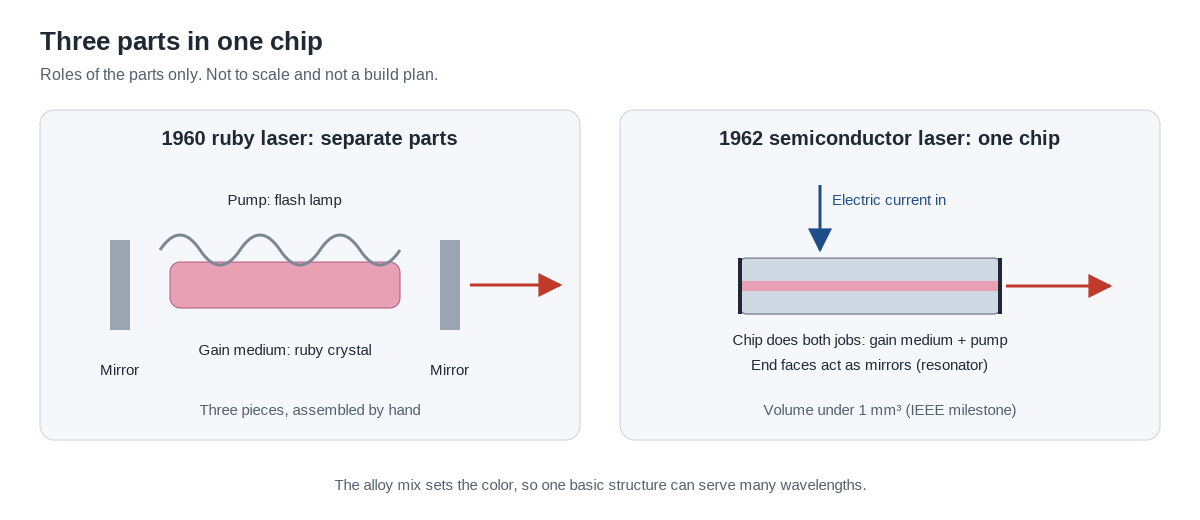
Its size was different too. The IEEE milestone describes the semiconductor laser as smaller than a grain of rice and says it typically takes up less than 1 mm³. With every function packed into a tiny volume, it was well suited to mass production. Changing the mix of the semiconductor alloy also changed the color, or wavelength, of the light.
It was not hugely useful from day one, though. The first semiconductor lasers were comparatively feeble and became today's technology only after decades of innovation. Lincoln Laboratory's first laser sat on a transistor mount that was standard at the time. The active layer, waveguide and end faces inside the chip are covered in Inside a Laser Diode Chip: Active Layer, Waveguide and Facets.
Holonyak and visible light
Among the four, the GE Syracuse result had a different color. Hall started from the invisible infrared of gallium arsenide, while Holonyak used an alloy of gallium arsenide mixed with phosphorus to produce visible light. The paper title even includes the word "(visible)."
The GE article credits Holonyak with the first visible LED, also from late 1962, and says he built on Hall's work by demonstrating a red semiconductor laser. The National Inventors Hall of Fame says his research led to the technology behind the red lasers in CD and DVD players.
Being able to pick the color through the alloy mix became a major strength of semiconductor lasers. They now come in wavelengths from ultraviolet to long-wave infrared and terahertz.
Where the rice-grain device went
Semiconductor lasers now serve optical communications, such as undersea cables between continents and data-center links. They also run CDs and DVDs, laser pointers and printers, industrial cutting and welding, and medical imaging (OCT). The IEEE milestone says their greatest impact has perhaps been in communications.
The four groups of 1962 knocked on the same door from different places. Beyond that door, chips smaller than a grain of rice came to send light through undersea cables between continents.
What to read next
- Inside a Laser Diode Chip: Active Layer, Waveguide and Facets: what the 1962 chip has become today
- The three parts of a laser: gain medium, pump and resonator: the three parts that went inside the semiconductor chip
- 1964: Nd:YAG and CO2, Two Industrial Workhorses from Bell Labs: two lasers that came out of Bell Labs two years later