Imagine glass that loses 99% of the light after only 20 m. That was optical fiber around 1966.
That year, a telecom laboratory in Harlow, England, put one number on the glass fiber. At least 1% of the light sent in should still be there after 1 km. In decibels (dB), that is 20 dB/km.
The fibers of the day came nowhere close. Yet four years later, in 1970, the American glass company Corning made a fiber that beat the target.
What was eating the light, and what changed in those four years? How glass traps light is covered in How optical fibers guide light. This article follows a different question: how much of that trapped light fades inside the glass, and how that loss came down.
Counting loss in decibels
The fading of light in a fiber is called attenuation. It is usually given in decibels per kilometer. The decibel scale turns multiplication into addition. A loss of 10 dB leaves one tenth of the light; a loss of 20 dB leaves one hundredth.
The scale is handy because losses simply add up with length. A fiber that loses 20 dB in 1 km loses 40 dB in 2 km, leaving one ten-thousandth. With plain fractions you would multiply again and again; with decibels you just add.
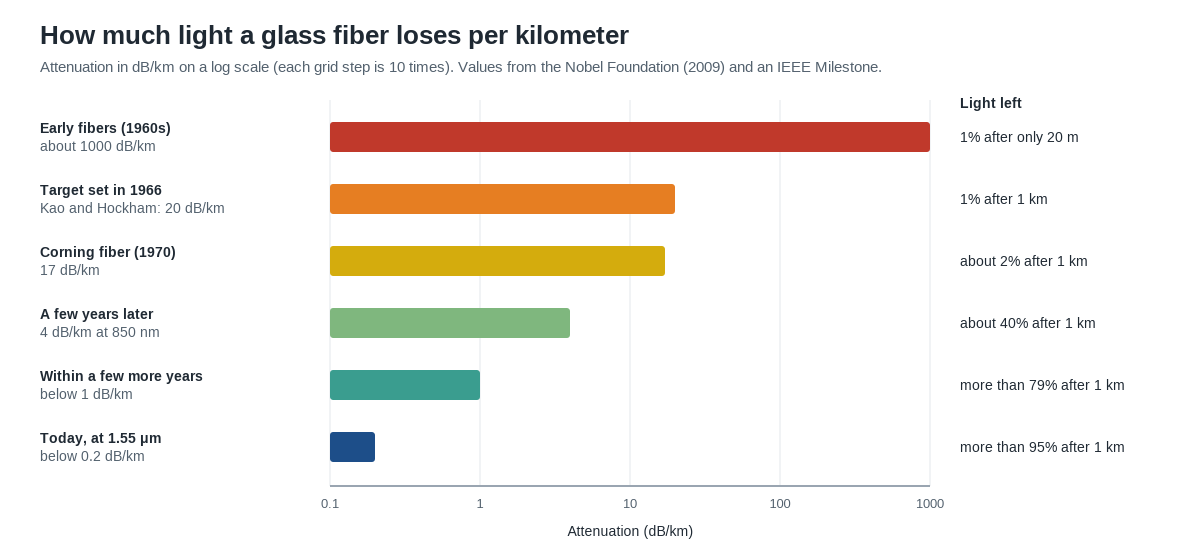
Early fibers in the 1960s typically lost 1000 dB/km. Twenty meters is 0.02 km, so the loss is 20 dB and only 1% of the light remains. That is the arithmetic behind the Nobel Foundation's "1% after 20 m."
The 1966 finding: the glass, not the flaws
Charles Kao studied glass fibers with his young colleague George Hockham at STL (Standard Telecommunication Laboratories) in Harlow. They looked beyond the shape of the light's path and also weighed the properties of the glass itself. Kao presented their conclusions in London in January 1966, and the paper appeared that June in the Proceedings of the IEE.
The key result went like this. In a dielectric such as glass, loss comes mostly from absorption and scattering. Those two alone predicted only a few dB/km. The losses actually measured were far higher.
Impurities, especially iron ions, made up the gap. The main problem was not flaws in the fiber strand but the glass itself. Losses from bending and waveguide imperfections were also checked and found to be small.
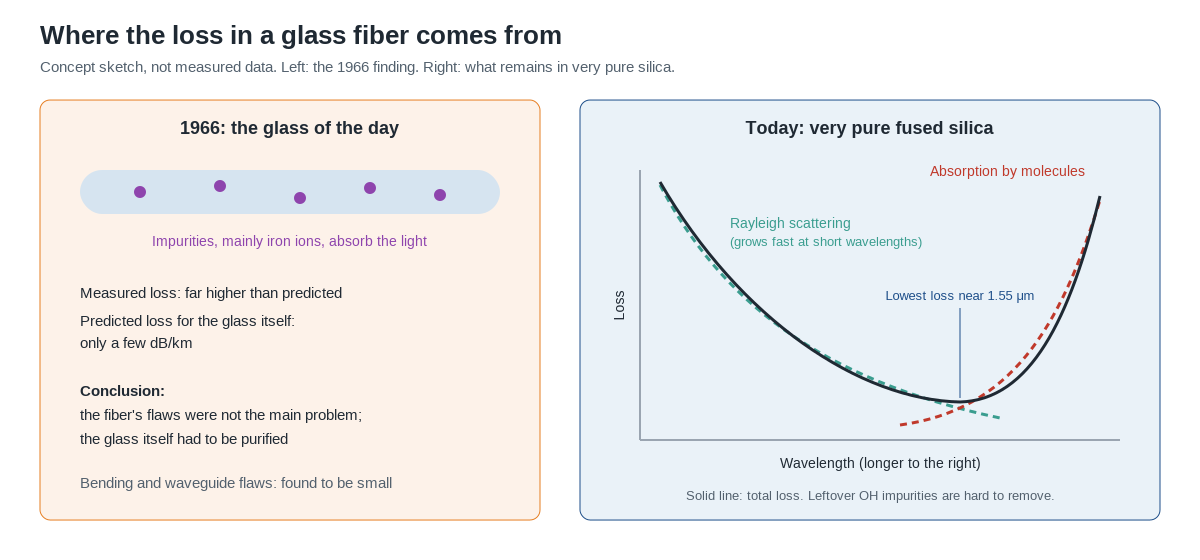
Picture a long pipe full of muddy water. However smooth you make the pipe, the mud keeps light from reaching the far end. A real fiber is different. Its impurities are not visible grains but ions such as iron mixed into the glass, and they absorb the light rather than block it.
In September of the same year, Werts at CSF in France published a paper with similar conclusions. Kao and new coworkers then measured the attenuation of glass at many wavelengths. They showed that fused silica (SiO₂) had the purity optical communication needed.
Why 20 dB/km?
The number 20 did not come from the glass. According to the Nobel Foundation's scientific background, the threshold was based on the laser power and detector sensitivity available at the time, and it was judged to be within reach. In other words, it was set by how strong the light sent in was and how faint a light the receiver could still notice.
Kao and Hockham also named single-mode fiber (SMF) as the best medium for transmission. With many modes, losses grow and pulses spread out in time. In the mid-1960s, people from the British Post Office came to Corning with a design of their own: a single-mode fiber with about 20 dB/km of attenuation.
The numbers show why the goal looked so far away. An IEEE Milestone record puts the best bulk optical glass of the day at about 1,000 dB/km. The loss in decibels per kilometer had to fall by a factor of 50.
1970: 17 dB/km
Kao had picked the right material, but it was hard to work with. Fused silica melts at almost 2,000 °C. Most laboratories first tried drawing fibers from other kinds of glass, with little success.
At Corning Glass Works, Robert Maurer, Peter Schultz and Donald Keck made a fiber with 17 dB/km of attenuation in 1970. The Nobel Foundation's scientific background lists a team of Kapron, Keck, Schultz and Zimar, led by Maurer. They used a chemical method called chemical vapor deposition (CVD). The core had titanium added, and the cladding was pure fused silica.
The aim was to bring the refractive indices of core and cladding very close together. The result was published that year in Applied Physics Letters, volume 17. The Nobel Foundation's popular article gives 1971 as the year a 1 km long fiber was made.
At 17 dB/km, about 2% of the light is left after 1 km. That beats the 1966 threshold by only a little in decibels, but it doubles the fraction left. Recall that 3 dB is roughly one half, and the numbers fit.
Down the ladder: 4, 1, 0.2 dB/km
17 dB/km was only the start. A few years later the Corning team switched from titanium to germanium and reached 4 dB/km at a wavelength of 850 nm. That leaves about 40% after 1 km.
At Bell Laboratories, MacChesney and coworkers developed a modified CVD method that made efficient fiber production possible. Within a few years, attenuation fell below 1 dB/km. Today it is below 0.2 dB/km at a wavelength of 1.55 μm.
Read 0.2 dB/km the other way around. It takes 100 km to reach 20 dB, the point where only 1% remains. What a 1960s fiber lost in 20 m now takes 100 km, a distance 5,000 times longer.
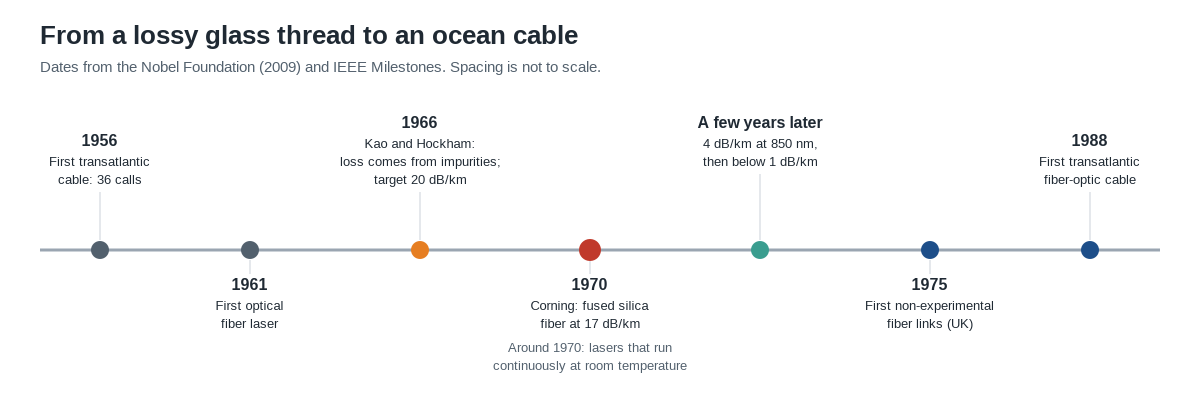
Communication changed along this ladder. The first non-experimental fiber links went into service in the UK in 1975, and the US and Japan soon followed. The first transatlantic cable of 1956 carried 36 phone calls at once; in 1988 the first transatlantic fiber-optic cable was laid.
The light sources grew up too. Around 1970, more practical lasers appeared that could run continuously at room temperature. The semiconductor laser behind them is the subject of The 1962 semiconductor laser.
What is left: scattering and absorption
What remains once almost all the impurities are gone? Even very pure silica has a floor of loss. At short wavelengths, Rayleigh scattering raises the loss. At long wavelengths, absorption by molecules does.
Rayleigh scattering goes as the inverse fourth power of wavelength. Halve the wavelength, and scattering grows 16 times. Stretch the wavelength too far, and the glass molecules start to absorb infrared (IR) light. The wavelengths used for communication sit in the valley between the two curves.
So the working wavelength shifted over the years: first 870 nm, then 1.3 μm, and at last 1.55 μm, the low point of the loss curve. Leftover OH (hydroxyl) impurities in the glass are still hard to remove. Long-distance links now use single-mode fiber almost exclusively.
Low loss is still not zero. The first systems used closely spaced electronic repeaters to make up for what remained. Most of those repeaters have since been replaced by optical amplifiers, especially erbium-doped fiber amplifiers; that story continues in The 1987 erbium fiber amplifier.
From phone line to laser
The fiber laser was born before the low-loss fiber. In 1961, Elias Snitzer and colleagues built and ran the world's first optical fiber laser. Three years later they showed the first optical fiber amplifier. This record is kept as an IEEE Milestone.
Fiber lasers later became factory tools, with multi-kilowatt beams that cut and weld everything from plastics to metals. Why they spread in factories is covered in Why fiber lasers spread.
Half of the 2009 Nobel Prize in Physics went to Kao for his work on sending light through fibers for optical communication. The three Corning scientists were inducted into the Inventors Hall of Fame and received the National Medal of Technology.
What to read next
- How optical fibers guide light: core and cladding, total internal reflection, and what single-mode means
- The 1987 erbium fiber amplifier: the next step, making up the remaining loss while the signal stays light
- What is a fiber laser?: how a laser grows light inside the same kind of glass strand