Throw two stones a little apart into a still pond, and two rings of ripples spread out until they meet. Where crest meets crest, the water rises higher, and where crest meets trough, the two cancel. Light is a wave too, so something similar happens. When overlapping light adds up or cancels out, that is interference.
Light does one more thing because it is a wave. After passing a small opening, it spreads out beyond it. That is diffraction. The two effects look separate, but they can show up together in a single experiment.
Light basics treated light as a wave. This article looks at what happens when those waves overlap and spread. It starts from one question. When light overlaps, what actually adds up?
When waves overlap: the superposition principle
In linear optics, the wave equation is linear. That is why the superposition principle holds. Where two waves overlap, the field is the sum of the two fields, and that sum is itself a valid wave.
E = E₁ + E₂
Here E₁ and E₂ are the fields of the two overlapping beams, and E is the field after they overlap. The point that is easy to miss is that the fields add. The intensity of light does not, in general, simply add the same way.
Intensities also simply add when the two beams do not meet the conditions for interference. If the polarization of one beam is perpendicular to the other, or if the two beams are fully incoherent, their intensities just add.
The pond picture breaks down here. In light, what rises and falls is not the height of water but the electromagnetic field. And adding the fields does not mean the intensities add as they are.
Constructive and destructive interference
The timing of a wave's rise and fall is called its phase. When two waves are in step, crest arriving with crest, they reinforce each other and the intensity grows. That is constructive interference. When they are out of step and the crest of one meets the trough of the other, they cancel and the intensity drops; this is destructive interference.
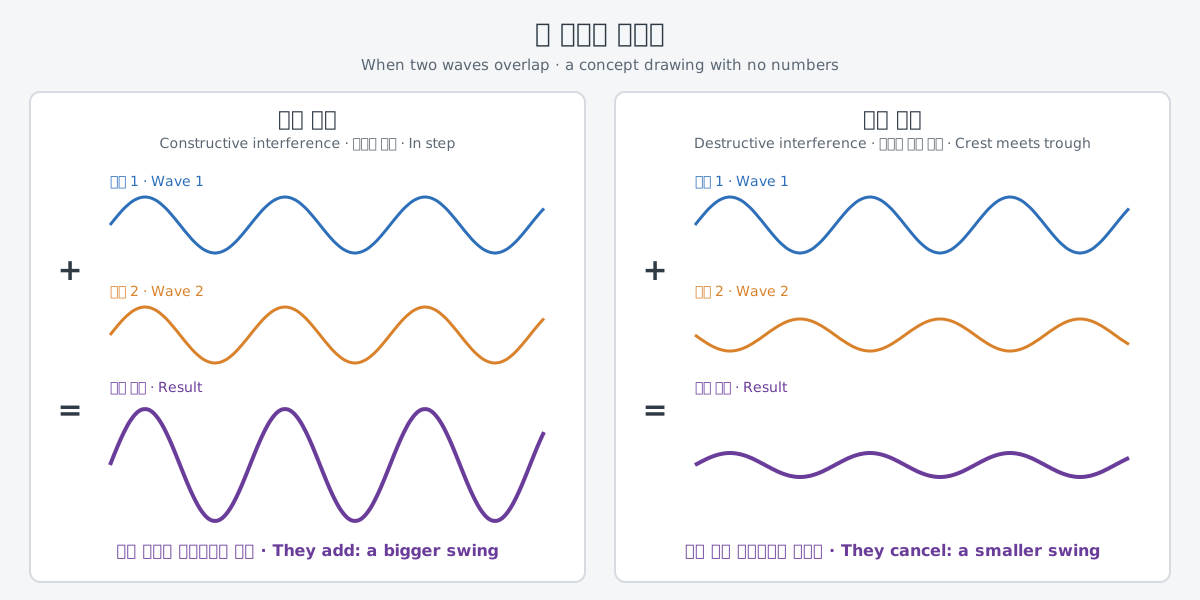
The same thing happens inside a laser pulse. A pulse is one of the short bursts of light described in Continuous-wave and pulsed lasers, and a single pulse is made of many wavelength components. If those components are in phase and interfere constructively, the result is a high-intensity pulse; if they are out of phase and interfere destructively, the pulse has a lower intensity.
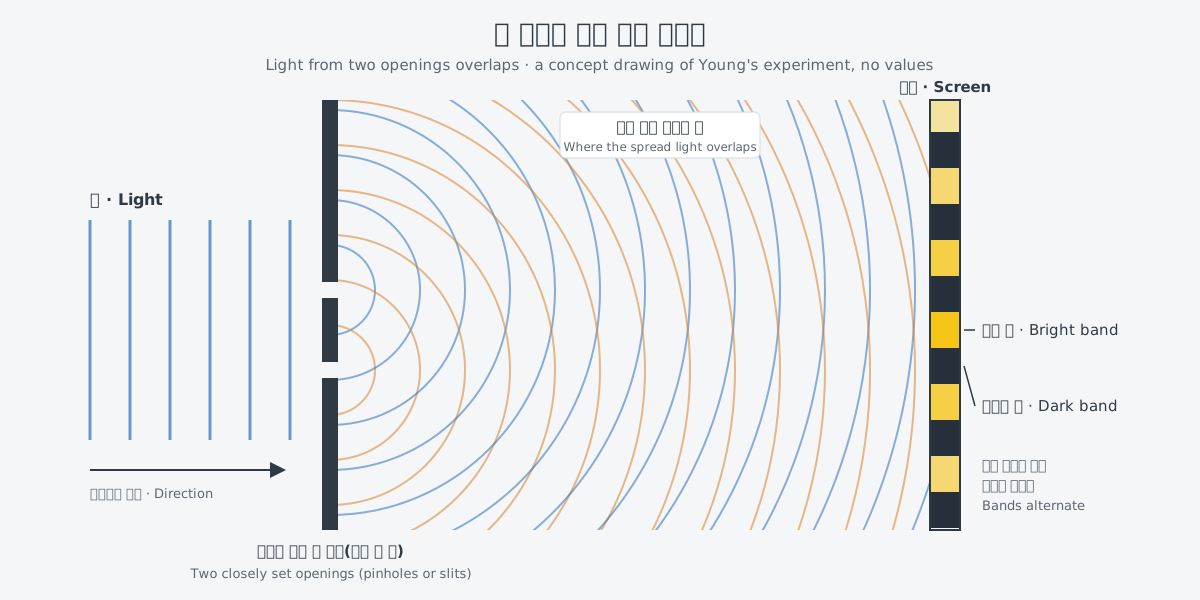
A widely known experiment that showed light interference is Young's experiment. An optics timeline from Florida State University and the National High Magnetic Field Laboratory places it in 1801. Light passed through two closely set pinholes, spread out over a screen and overlapped, and bright and dark bands alternated where it overlapped. The fringes formed when light from a single source was split into two beams and then recombined.
The Whipple Museum of the History of Science at the University of Cambridge presents this work as a series of experiments from 1801 to 1803. Today a version with two slits, the "double slit," is a common classroom demonstration, and its result is commonly accepted as proof that light has wave-like properties.
At the time, the dominant view was the particle theory, which saw light as a stream of particles leaving a source. The idea that light is a wave had been suggested in the 17th century, but these experiments added new evidence for it. The same wave theory was also used to explain the colors of thin films such as soap bubbles.
Even so, the work was largely ignored for more than a decade. Interest in the wave theory came back only after an explanation of diffraction in terms of waves appeared around 1816. Today light is understood to have the properties of both waves and particles, as explained by quantum mechanics. This is the wave–particle duality from Light basics.
When interference shows: coherence
The word coherence first came up in What is a laser?. That article called light coherent when its waves rise and fall in step. Seen from the side of interference, coherence is tied to whether two components of light can interfere stably.
The opposite case has already come up: two fully incoherent beams, whose intensities simply add. So if one beam is split in two, one half is delayed a little, and the two halves overlap again, how long can the delay be and still give interference? The quantity that speaks to this question is the coherence time.
The coherence time is the approximate time difference up to which two components of a laser field can stably interfere. If the delay is within the coherence time, the two components can interfere stably.
This value is typically measured with an optical interferometer. One arm of the interferometer adds a time difference, and the output is the sum of the original field and the delayed field. The definition of coherence time is somewhat arbitrary, so different sources define it in slightly different ways.
Coherence time is also tied to the linewidth from "What is a laser?" A narrow linewidth means a long coherence time. The exact relation between the two, however, depends on the shape of the spectral line.
Diffraction: light spreading out past a narrow opening
In Young's experiment, the light that passed the two openings spread out and overlapped. This spreading of light is diffraction. Huygens' principle is a tool for picturing it.
Huygens' principle treats each point of an advancing wavefront as the center of a fresh disturbance. Each point acts like a tiny point source that sends out a round secondary wave, and these secondary waves all interfere constructively to form the next wavefront.
Now picture a straight wavefront reaching a wall with a narrow opening. Only a small piece of the wavefront gets through. Seen through Huygens' principle, the secondary waves from the points of that piece spread out in arcs beyond the opening.
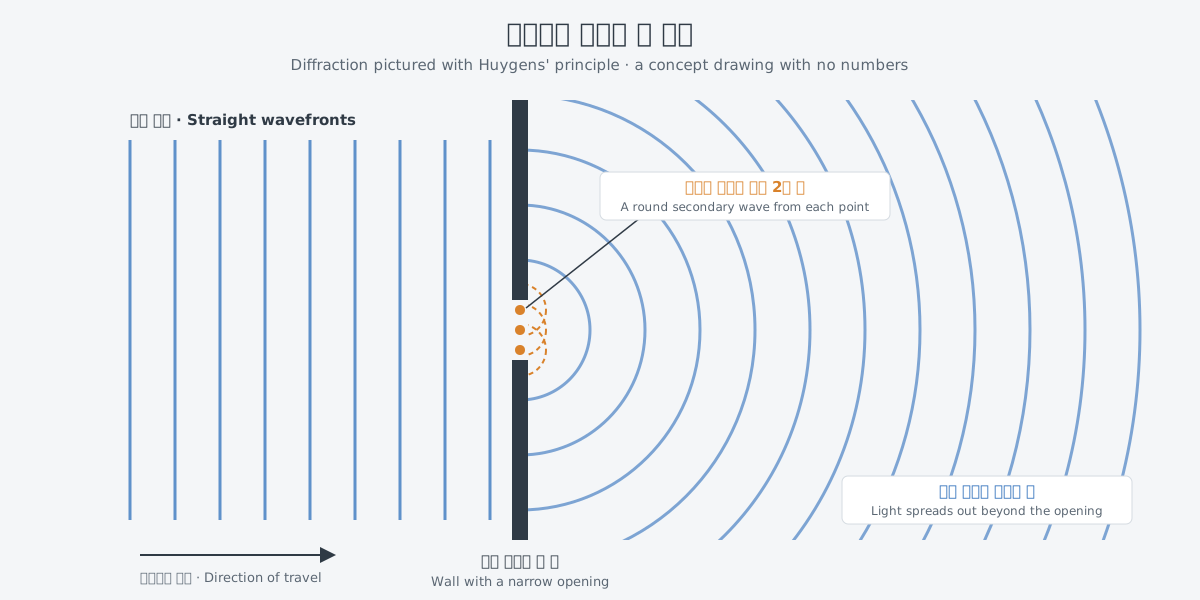
In Young's experiment, diffraction and interference appeared together. Light spread out from each of the two openings and overlapped in front of the screen, and bands formed where it overlapped. Those bands were interference.
The diffraction grating: diffraction and interference together
A diffraction grating is an optical element with many grating lines. Take a reflection grating as an example: just as in Huygens' principle, each grating line sends out secondary waves. The first-order diffracted light comes from constructive interference of the secondary waves from different grating lines. The name says diffraction, but diffraction and interference work together.
A diffraction grating sends each wavelength in a different direction. This property is called angular dispersion. The long-wavelength component, red light, is diffracted more strongly than the short-wavelength component, blue light.
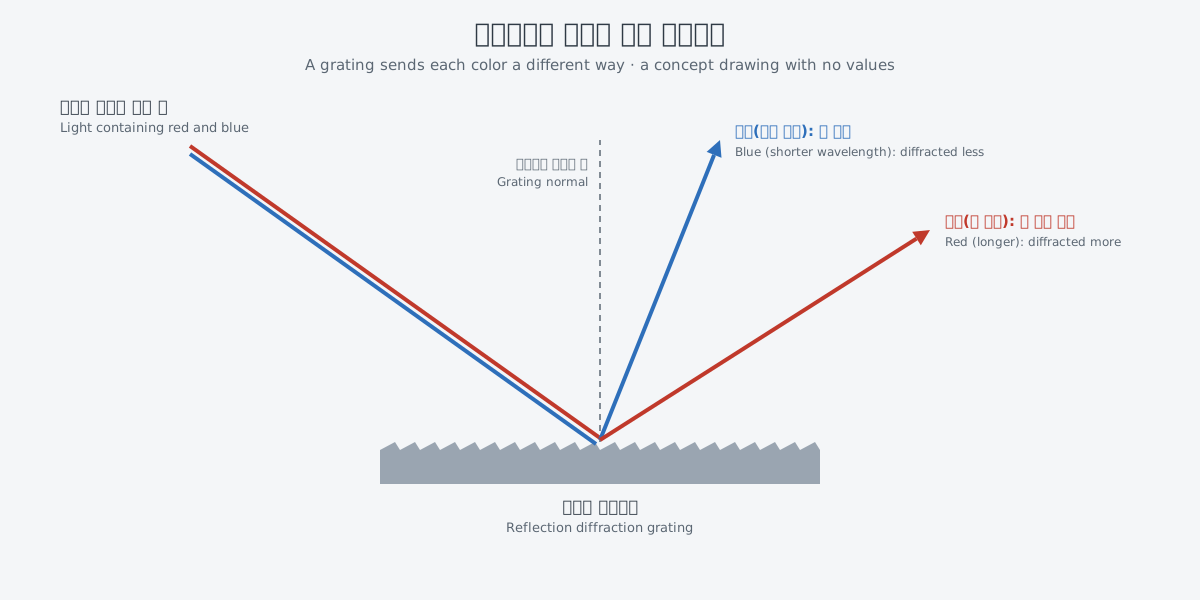
In the opening scene of Light basics, a prism also split white light into colors. Gratings and prisms are both elements that create angular dispersion, and in them the spectral components travel in different directions. In the ultrafast-laser textbook, this property comes up in the description of devices that compress pulses.
Where these two effects appear in laser articles
Interference and diffraction turn up often in other articles on this site.
| Effect | Where it shows up in laser articles |
|---|---|
| Interference | Some mirrors that use interference effects (such as dispersive mirrors) and interferometers, measuring coherence time, coherent beam combining that gathers many beams into one |
| Diffraction | Splitting colors with a diffraction grating, the way a beam spreads as it travels |
Some elements used to undo the broadening of a pulse that has passed through material also rely on interference. Dispersive mirrors and the Gires–Tournois interferometer are examples, and both use interference effects that depend strongly on wavelength.
A Gires–Tournois interferometer is a reflector that does not absorb light, and it has two reflecting surfaces. Many beams interfere between the two surfaces, so the phase of the reflected light shifts differently for each wavelength.
The article on coherent beam combining starts from the superposition principle in this article. The way a laser beam spreads as it travels is also linked to diffraction. How much it spreads, and what sets that amount, continue in "Why a beam spreads."
What to read next
- "Why a beam spreads: divergence, focus and aperture": follows how diffraction connects to the spreading of a beam.
- "Mirrors, lenses and coatings: optics for strong light": looks at layered mirrors and coatings.
- "Coherent beam combining: the principle, from published reviews": explains how many beams are gathered into one, building on superposition and coherence.