The red dot of a laser pointer, the invisible light from the tip of a TV remote, the body heat seen by a thermal camera, the microwaves inside an oven. All four are the same kind of electromagnetic wave. What differs is the wavelength, the length of one ripple.
Change the wavelength and the job changes. Some light can be seen, some passes through the air, and some shakes water molecules. Spread the ten-million-fold range from 100 nm to 1 m across one map, and each use turns out to have its own seat.
How to read the map: a logarithmic scale
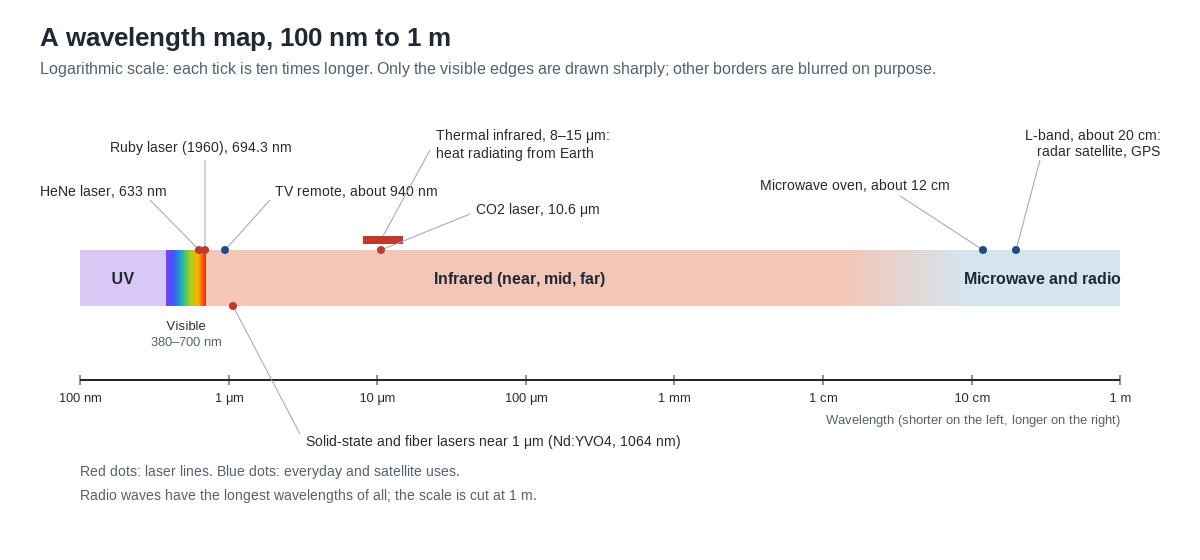
On the horizontal axis, each step makes the wavelength ten times longer. From 100 nm to 1 m is a factor of ten million, which no ordinary scale could fit on one page. That is why visible light shows up as a narrow strip, about the width of a fingertip on the map.
Read the borders with care. The two ends of visible light are fixed numbers. Borders between the invisible bands, drawn by use and technology, vary a little from source to source. The map blurs those borders on purpose.
The narrow visible strip, 380–700 nm
The human eye typically detects wavelengths from 380 to 700 nm. Violet sits at the short end, around 380 nm, and red at the long end, around 700 nm. A prism splits light into a rainbow because each color has a different wavelength.
A few points from laser history sit inside this strip. Maiman's first laser in 1960 used ruby and gave red light at 6943 Å, or 694.3 nm. The red line of the helium-neon laser, long a lab workhorse, is at 633 nm. NIST, the U.S. standards institute, reports that the international Consultative Committee for Length backed adding this 633 nm laser to the list of standards used to realize the meter.
Shorter than violet: ultraviolet
Light with shorter wavelengths than visible light is ultraviolet. It fills the left end of the map, yet not much of it reaches the ground. The atmosphere blocks a large share.
NASA explains that UV-C, the most harmful kind, is almost completely absorbed by the atmosphere, and about 95% of UV-B is absorbed by ozone. So astronomers who want to study high-energy ultraviolet use data from satellites orbiting above the atmosphere.
Longer than red: infrared
Light with longer wavelengths than red is infrared (IR). NASA divides it into near, mid and far infrared. Infrared also takes up the widest stretch of the map.
Near infrared, right next to visible light, shows up in daily life. A typical TV remote uses infrared at around 940 nm. The eye cannot see it, but some digital and phone cameras pick it up.
Just past the remote, near 1 μm, sit solid-state and fiber lasers. The laser altimeter on the ICESat-2 Earth-observing satellite takes 1064 nm light from an Nd:YVO4 crystal laser and turns it into 532 nm green light with a second-harmonic generator. On the fiber side, ytterbium (Yb)-doped fiber is the one for 1 μm. Exail, a photonics company, lists Yb-doped fiber for 1 μm and Tm- and Ho-doped fiber for 2 μm among its directed energy laser parts.
A little further along is the region of heat. According to NASA, 8–15 μm is best for studying the heat radiating from Earth, so Earth scientists call it thermal infrared. This is how thermal devices see objects even on a dark night, a story continued in Thermal Imaging Sights: Seeing Heat in the Dark.
A laser used in weapon experiments sits here too. The carbon dioxide laser carried by the U.S. Air Force's Airborne Laser Lab in 1975–1984 had a wavelength of 10.6 μm, right in the middle of the thermal infrared band.
Centimeters: microwaves and radio
At the right end of the map, wavelengths are counted in centimeters and meters. A microwave oven uses microwaves about 12 cm long to spin water and fat molecules in food. Some radar satellites use wavelengths of about 20 cm, called L-band, and the microwaves used by a car's GPS receiver are also L-band.
A big advantage of microwaves is that weather bothers them less. Medium-length C-band microwaves see the ground through cloud, dust, smoke, snow and rainfall. That is why microwaves are widely used for satellite communication and for observing Earth from space. How radar bands differ is covered in the article on radar L, S and X bands.
Longer still are radio waves, whose wavelengths are the longest anywhere in the spectrum. Turning a radio dial means choosing the wavelength, or frequency, you want to hear.
What the air lets through
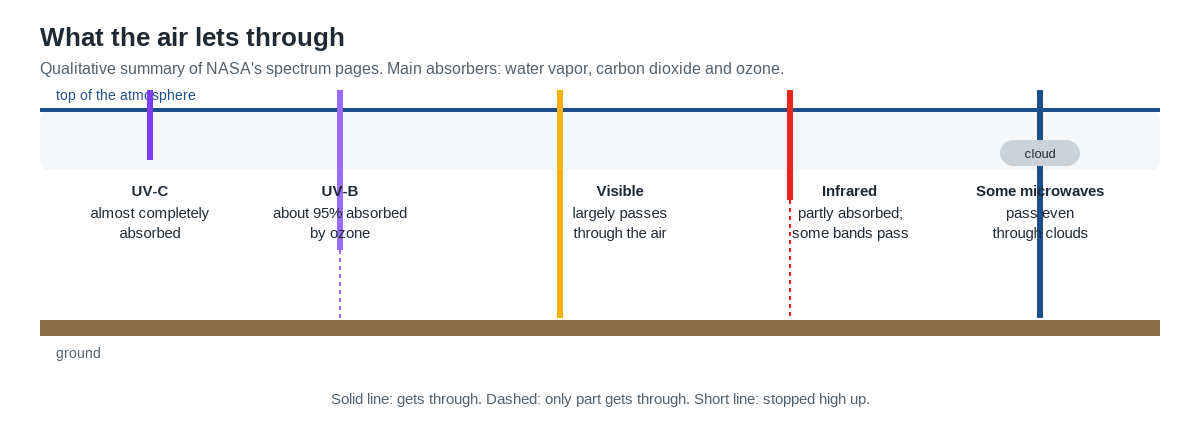
Light of different wavelengths passes through the air to different degrees. A few gases in the air do most of the reflecting and absorbing, above all water vapor, carbon dioxide and ozone. Visible light largely gets through, and some microwaves even pass through clouds.
The wavelength regions that pass through the air well are called "atmospheric windows." The picture of a window is a fair start. The real difference is that there is not one open window but several passable regions scattered along the wavelength axis.
One more thing to see on the map
This is a map of uses. Even at the same wavelength, a different power or a different way of using the light changes the safety story. Wavelength and eye safety are covered in Why wavelength matters: visible and invisible light.
Further reading
- Light basics: waves, wavelength, frequency and photons: how wavelength and frequency connect
- Why wavelength matters: visible and invisible light: wavelength and eye safety
- Military Lidar: Mapping Terrain and Objects with Lasers: an example of a laser wavelength used as a sensor