A Roman fleet lies at anchor off Syracuse. Archimedes tilts a kind of mirror toward the sun, gathers its light into one beam, and sends the flame onto the ships until the whole fleet burns. That is the outline of the story as the Byzantine historian of the 1100s Zonaras tells it.
Tzetzes, writing in the same century in his verse work, the Chiliades, adds detail. A hexagonal mirror and small four-sided mirrors moved by hinges gather the noon sun and turn ships to ash beyond a bowshot. Did any of this happen? Here the record, a 2005 test by an MIT class, and the physics of focusing sunlight with mirrors are set side by side.
Accounts of the siege mention no mirror
The siege of Syracuse took place in 212 BC. Among the ancient histories of the siege, the accounts of Polybius, Livy and Plutarch survive in public English translations. In all three, Archimedes is plainly the man who gave the Romans trouble.
What he used were machines. Engines that could throw to long range struck ships while they were still far off, and lighter missiles rained on ships that came closer. A large beam reached out from the wall with a chain and an iron claw at its end. It gripped a ship by the prow, lifted it, and let it fall.
There is no mirror anywhere. The word "mirror" does not appear even once in the English translations of these siege passages. Plutarch even notes that Archimedes would not leave behind any treatise on his machines.
When the mirror story shows up
Zonaras and Tzetzes, who tell the mirror story, both lived in the 1100s. That is more than 1,300 years after 212 BC. Zonaras served as secretary to the emperor Alexios I. For early Roman history his main source was the Roman historian Cassius Dio.
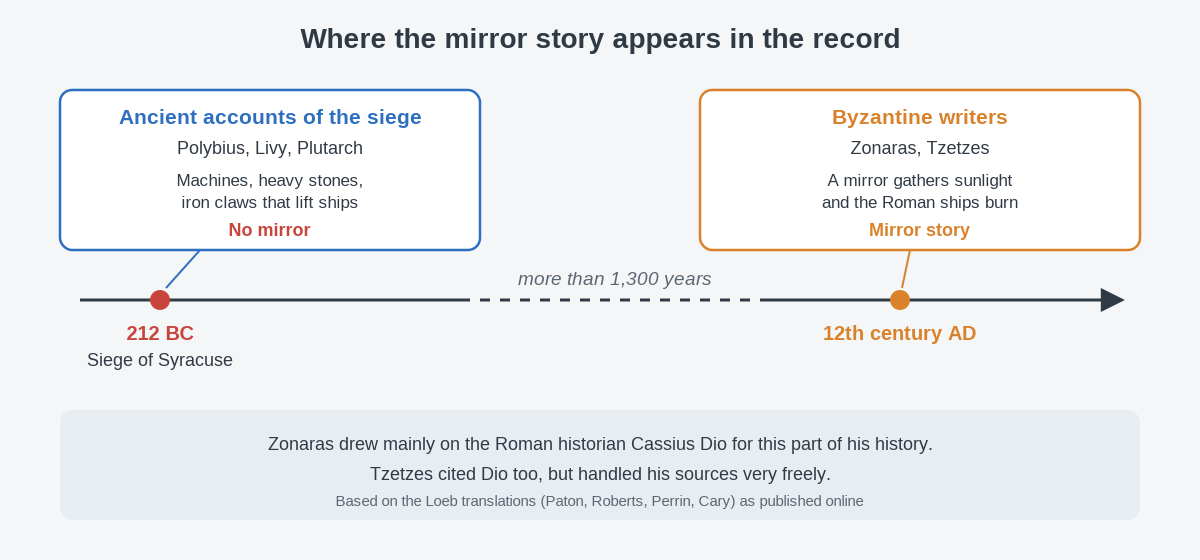
So the mirror story may already have been in Dio's book. The public English edition of Dio also takes this passage from Zonaras's summary.
Tzetzes cited Dio as well. But Earnest Cary, Dio's English translator, notes that Tzetzes handled his material very freely. It is hard to tell how much of his poem comes from Dio.
The record therefore runs in two lines. The ancient histories of the siege describe machines, and the mirror appears much later, in a summary and a poem. That alone does not prove the story false. It does make it hard to say that the old record bears witness to a mirror.
Two tries by an MIT class
In the fall of 2005, MIT's product engineering class 2.009 decided to test the story. The goal was not to rule on the myth. The class only wanted to see whether it was at least possible in a simple way. Given a five-minute challenge, about 95% of 80 students judged it infeasible.
Pictures of Archimedes often show one large parabolic mirror. The class team judged that many flat mirrors, each aimed by hand, would be faster and more practical.
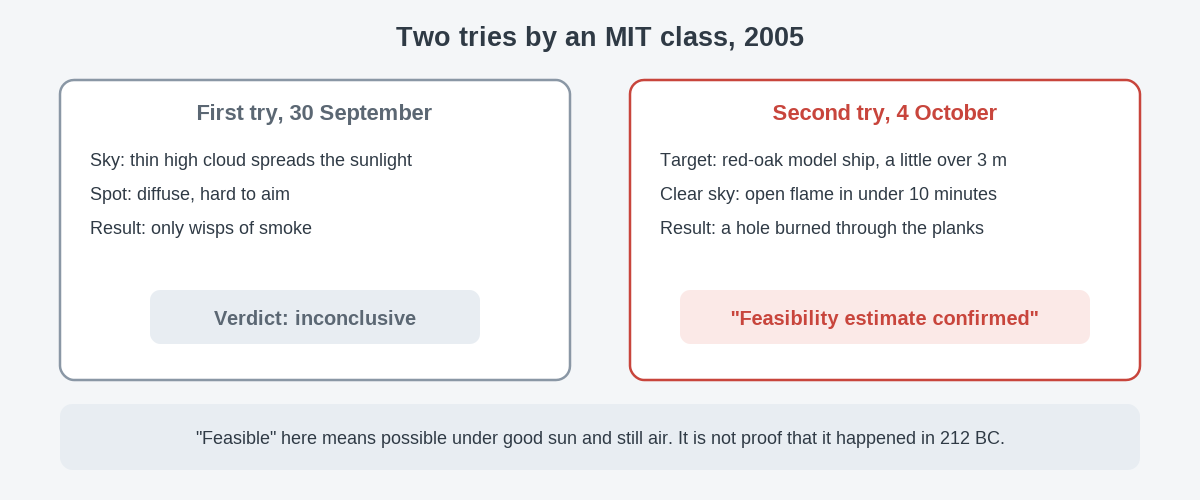
Weather spoiled the first try on 30 September. A thin layer of high cloud spread the sunlight, so each mirror cast a blurry patch that was hard to aim. Only wisps of smoke appeared, and the verdict was "inconclusive."
The second try on 4 October used a model ship a little over 10 feet (about 3 m) long, planked with red oak. When the sun came out between clouds, the smoke grew heavy. Carbon in the wood was burning, so the surface was at least 750 °F (about 400 °C).
Gases released from the wood then flashed into flame at roughly 1100 °F (about 590 °C). An open, lasting flame appeared less than 10 minutes after the sky cleared, and the short burn left a hole through the planks.
"Possible" is not "it happened"
The class summed up its result as "Feasibility estimate confirmed." The instructor's FAQ page narrows the meaning: the rough calculation was borne out by the test, and the myth is at least possible.
It is not a claim that Archimedes actually did it. Asked whether it really happened, the FAQ answers that the team is not made up of historians and cannot say.
A later test with the TV program MythBusters gave a weaker result. According to the same FAQ, the wood did ignite after three passes, but no large flame broke out. The instructor understood that the boat had been underwater for some weeks before the test and puts the result down to how little of the wood was dry.
So the experiment shows this much: with good sun and weather and a dry wooden target, mirrors can start a fire. Whether it happened at Syracuse in 212 BC remains a question for the record.
What limits a mirror full of sunlight
A flat mirror does not gather light; it only turns it. Yet in the test, the bright patch from a single mirror grew wider with distance. The reason is that the sun is not a point. It is a disk about 0.5° wide in the sky.
Light from opposite edges of the disk leaves the mirror in slightly different directions, so the reflected bundle spreads by the same amount.
Aim many mirrors at one spot, and their widened patches overlap on the target. The power of light falling on each unit of area is called intensity. The better the patches overlap, the more the intensity on the target grows with the number of mirrors, and the faster the target heats.
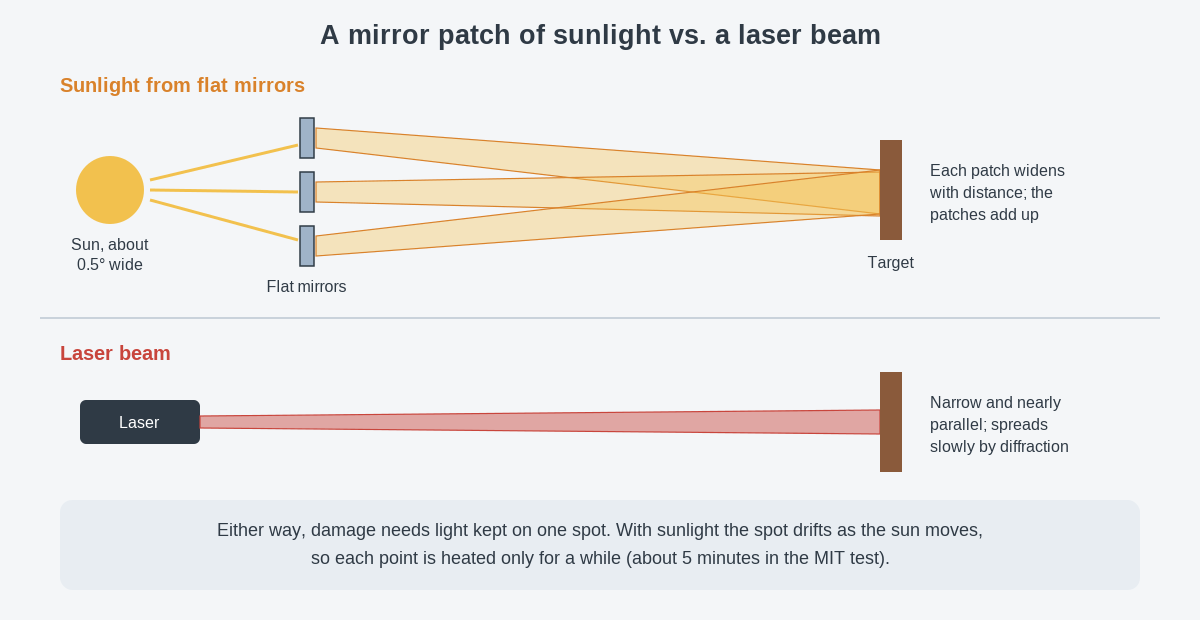
Time matters too. Once the mirrors are aimed and left alone, the sun keeps moving across the sky, and the bright spot creeps across the target. In the MIT test each point on the ship was heated for about 5 minutes.
If the wood did not reach ignition temperature in that window, the chance was gone. Heating it faster takes more power.
Weather cuts into that power right away. Even thin cloud spread the sunlight enough to change the outcome. Wind cools the heated surface, which lowers the highest temperature it reaches and stretches the time needed. Starting a fire with mirrors is simple in principle but very sensitive to conditions.
Mirrors and lasers: what carries over
To burn something with light, you have to hold enough intensity on one spot for long enough. On that point, mirrors and lasers are the same. It is the same physics that keeps a laser weapon from destroying a target the instant it fires: the beam has to stay on one spot for some time. That time on one spot is called dwell time.
The difference lies in where the light starts. Sunlight arrives from a disk 0.5° wide, so a flat mirror cannot stop the reflected bundle from spreading. A laser sends out a narrow, nearly parallel beam. That is why a laser pointer can put a small dot on a distant wall.
That does not mean a laser beam never spreads. A laser beam also widens slowly with distance because of diffraction. The difference is that diffraction, not the width of the sun, sets the floor on spreading. Gathering light onto one spot and holding it there is still the central task for lasers as well.
What to read next
- What is a laser weapon? Film versus reality: what a laser weapon actually does, which is to heat one spot.
- Why a laser weapon does not finish "the instant it fires": dwell time, and the range, air and jitter that stretch it.
- Why a beam spreads: divergence, focus and aperture: how much a laser beam spreads by diffraction, in numbers.
- A Feel for Power: From a Light Bulb to a Power Plant, W, kW, MW and GW: how big optical power really is.