Switch on an electric stove coil and for the first few seconds nothing seems to change. Hold a hand near it and you only feel warmth. Then the coil turns a dull dark red, and with more heat it becomes bright orange. Iron in a forge and the filament of an incandescent bulb follow the same path.
Why do the colors come in that order? And during those first few seconds, before any red appears, was the coil really giving off no light at all? The answer to both questions is blackbody radiation, and it is also the reason a thermal camera can find a person in the dark.
Why heating changes the color
Every piece of matter warmer than absolute zero sends out energy over a range of wavelengths. A desk in a room, the sea in winter and the palm of your hand all do it. Most of that light is simply infrared (IR), which the eye cannot see.
Temperature moves the center of gravity of this light. The hotter an object is, the shorter its peak wavelength, the wavelength where most of its energy is concentrated. Atoms and electrons shake faster, so more of the light comes out at short wavelengths.
NASA's Earth Observatory shows the difference with three bulbs. A burned-out bulb at room temperature, 27 °C (300 K), gives off no visible light. A heat lamp at 677 °C (950 K) puts most of its energy into thermal infrared and only a little into red light. An incandescent bulb at 2223 °C (2500 K) glows orange-yellow, yet only 10% of its energy is visible light and the rest is heat.
The stove coil is no different. It was glowing from the first second. Its peak sat deep in the infrared, so none of that light reached your eyes as color.
The blackbody: an object that swallows all light
To turn this into a law, physicists needed a reference object. That object is the blackbody. A blackbody absorbs every bit of light that falls on it and neither reflects nor transmits any.
An object that absorbs light well also emits light well. This link is called Kirchhoff's law. A body that absorbs everything therefore becomes the fullest and most even emitter a given temperature allows.
The trouble was that no such object exists in nature. The 1911 Nobel Prize presentation speech pointed out that even soot and platinum black reflect some of the light that hits them. In 1895 Wilhelm Wien and Lummer found a way around this. If a hollow box with evenly heated walls has a small hole, the light coming out of that hole behaves like light from a perfect blackbody.
Light that enters the hole bounces from wall to wall and is absorbed before it can find its way out. It is a bit like a room that looks dark through a window on a bright day. A real blackbody hole is far smaller and its walls are held at one temperature, so the light it gives off follows only the temperature, not the wall material.
The peak moves to shorter wavelengths: Wien's law
Measure blackbody light wavelength by wavelength and you get a curve shaped like a hill. In 1886 Langley used his spectrobolometer on several heat sources. He showed that the radiation is strongest at one wavelength and that this peak shifts toward shorter waves as the temperature rises.
In 1893 Wien wrote this shift as a very simple rule. Multiply the peak wavelength by the temperature and you always get the same number. This is Wien's displacement law.
λ_max = b / T
Here λ_max is the peak wavelength, T is the absolute temperature in kelvins, and b is Wien's displacement constant. In the constants table published by the U.S. National Institute of Standards and Technology (NIST), b is 2.897 771 955 × 10⁻³ m·K, an exact value with no uncertainty.
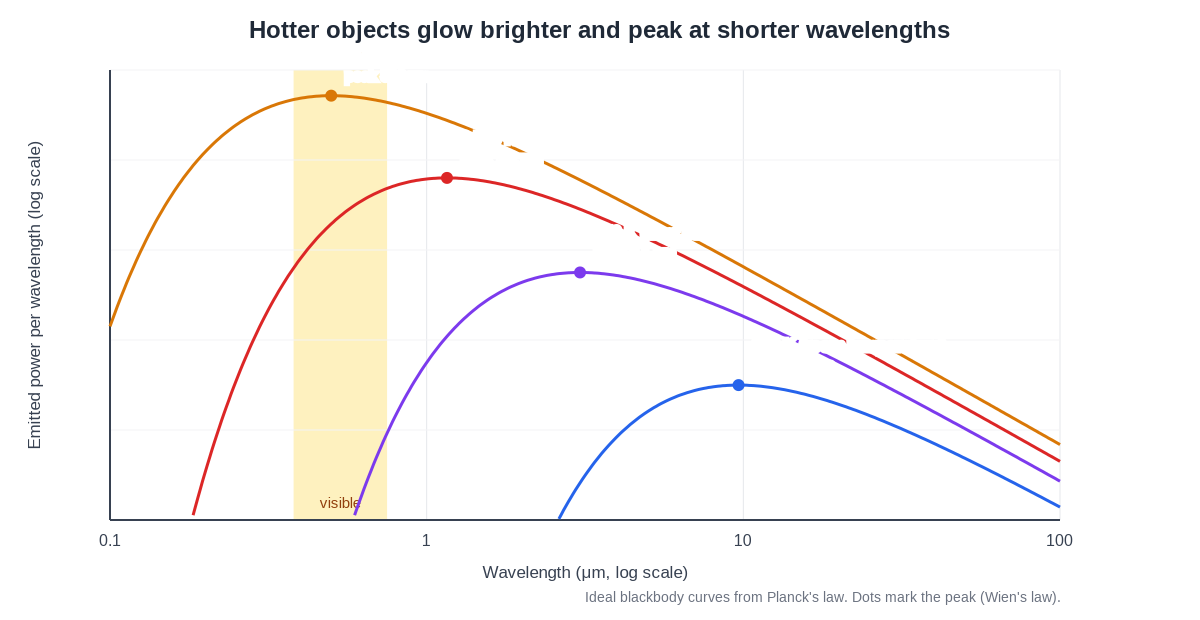
Using this constant on the temperatures above gives the following. All values assume an ideal blackbody.
| Temperature | Example | Calculated peak wavelength | Where the peak sits |
|---|---|---|---|
| 5,800 K | Surface of the Sun | about 500 nm | visible |
| 2,500 K | Lit incandescent bulb | about 1.2 µm | near infrared |
| 950 K | Heat lamp | about 3.1 µm | infrared |
| 300 K | Objects at room temperature | about 9.7 µm | long-wave infrared |
| 253 K | Earth seen from space (-20 °C) | about 11.4 µm | long-wave infrared |
NASA gives the Sun's surface temperature as about 5,800 K, and most of the energy the Sun sends out is visible and near-infrared light. The calculated peak of 500 nm, close to green, fits that picture. An incandescent bulb still has its peak in the infrared, so its visible light comes only from part of the left slope of the curve. That is why only 10% of its output is visible.
The law also works in reverse. Lummer and Pringsheim showed that bodies that are not blackbodies also follow the displacement law, only with a different value for the constant. Finding the wavelength of strongest light therefore gives the temperature of a distant object within fairly narrow limits. Light sources, the Sun and some stars were measured this way.
Twice the temperature, sixteen times the glow
Look at the curves again and you see more than a moving peak. A hotter curve sits above a cooler one at every wavelength. When the temperature rises, the total amount of light grows very quickly.
Total radiated heat climbs with the absolute temperature raised to the fourth power. This is the Stefan-Boltzmann law, and Lummer confirmed it by experiment with Pringsheim and Kurlbaum, using the blackbody apparatus. NASA's Earth Observatory explains that if the temperature doubles, the radiated energy rises by 2 to the fourth power, a factor of 16.
The constant in this law is the Stefan-Boltzmann constant from the NIST table, 5.670 374 419 × 10⁻⁸ W m⁻² K⁻⁴. With it, 1 m² of an ideal blackbody surface at 300 K sends out about 460 W as infrared. Real objects are not perfect blackbodies, so they give off less.
Room-temperature objects glow that much, yet a room at night is dark. Almost all of that light is infrared. The objects around them are trading similar amounts back and forth.
Planck and the missing piece
Knowing where the peak sits and how much light there is in total still left one thing open. How exactly is the light shared out among wavelengths? In other words, what is the shape of the curve itself? The 1911 presentation speech called Wien's displacement law "half the answer".
Wien's radiation law of 1894 matched experiments at short wavelengths. Lord Rayleigh's law matched only at long wavelengths. Following the laws known at the time all the way led to an absurd result, with radiation at high frequencies growing without limit.
In 1900 Max Planck closed that gap. He proposed that light must come out in packets of set energy, called quanta. The new constant that fixes this energy is Planck's constant, and the packets lead to what is now called the photon, the particle of light.
The quantum idea also explains the hill shape. Shorter-wavelength light comes in larger packets of energy, which an object's heat has trouble supplying. As the temperature rises, there is room to make larger packets, and the peak is pushed toward shorter wavelengths.
Wien won the 1911 Nobel Prize in Physics for his discoveries on the laws that govern heat radiation. Planck was named the 1918 Nobel laureate in physics for discovering energy quanta and received the prize one year later, in 1919.
Why thermal cameras look at 8–12 µm
Now back to thermal cameras. People, objects in a room, the ground and trees are mostly near room temperature. As the table shows, a 300 K blackbody peaks at about 9.7 µm. The world at room temperature glows brightest in the long-wave infrared.
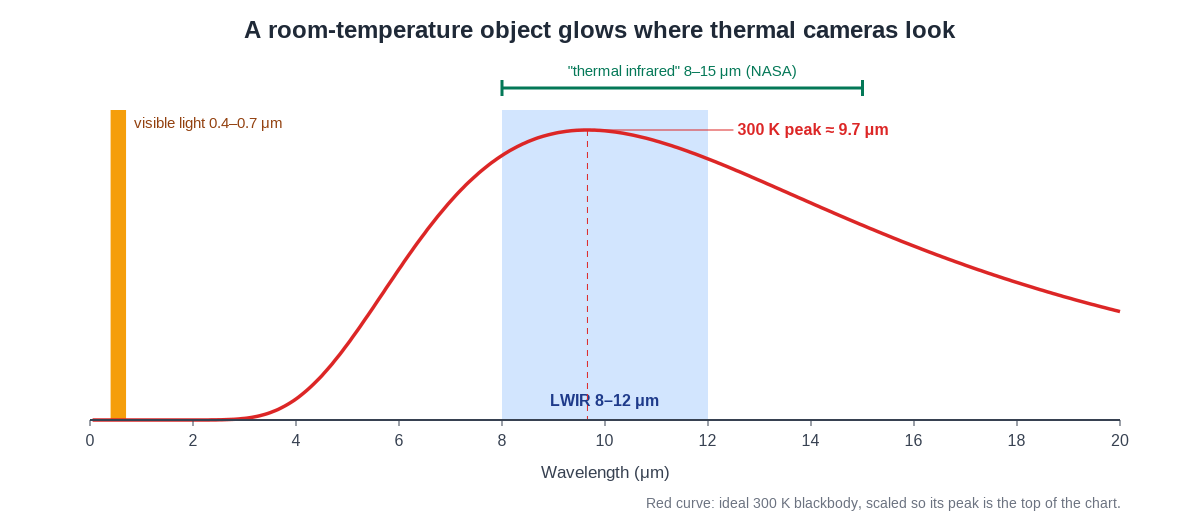
NASA explains that Earth scientists call the region from 8 to 15 µm thermal infrared. The air matters too. Water vapor, carbon dioxide, ozone and other gases in the air absorb some wavelengths and let others pass. Bands with little absorption are called atmospheric windows, and most remote sensing instruments work in one or more of them.
Where the peak and a window overlap is the long-wave infrared (LWIR) band, 8–12 µm. The Defense Systems Information Analysis Center (DSIAC) serves the U.S. Defense Department. An article on infrared history in its journal says this band yields the strongest signal when an object and its background differ by a set amount of temperature. That is why it is so wanted for looking at objects on the ground.
There is a price. Longer wavelengths mean less energy per photon, so a detector also picks up noise made by its own heat. The same article calls this band one of the hardest for detectors to work in.
Detector cooling and the history of the equipment are covered in Thermal Imaging Sights: Seeing Heat in the Dark. Sensors that find aircraft by their heat are covered in Infrared search and track: seeing aircraft without emitting.
How laser light differs
A blackbody curve is a broad hill. The light of an incandescent bulb runs from near the ultraviolet far into the infrared, and only the temperature decides where the peak goes. As the U.S. Food and Drug Administration (FDA) puts it, ordinary sources such as the Sun or a bulb send out waves of many lengths in all directions.
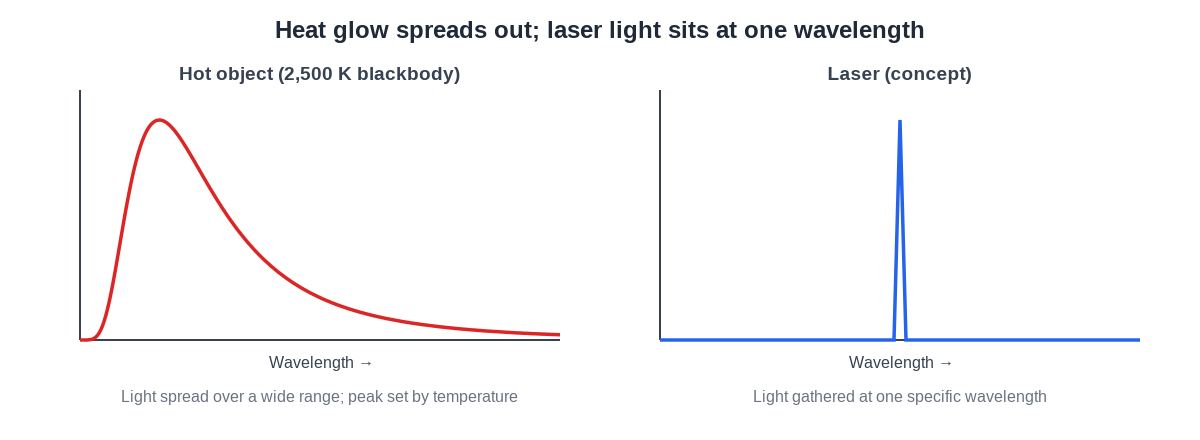
A laser starts from a different place. It does not get light by heating something. It picks out light from a transition between set energy levels and amplifies only that. Laser light is therefore gathered at one specific wavelength, and the material that makes the light, not the temperature, sets that wavelength.
This difference matters in two ways to anyone who works with lasers. First, laser light does not spread over a wide range of wavelengths like bulb light; it is gathered at the one wavelength that is wanted.
Second, laser equipment still gets hot. Energy that is not turned into the beam becomes heat, and that heat gives off infrared by the same blackbody rules described here. How uses split up by wavelength continues in The Wavelength Map: From Ultraviolet to Radio, Which Light Is Used Where.
What to read next
- Thermal Imaging Sights: Seeing Heat in the Dark: the equipment that turns this long-wave infrared into a picture.
- The Wavelength Map: From Ultraviolet to Radio, Which Light Is Used Where: visible light to infrared, laid out on one map.
- What is a laser? How it differs from a light bulb: the difference between bulb light and laser light from the start.