The S and the E in the word LASER came from a theory, long before any device. Albert Einstein, working in Berlin since 1914, turned away from general relativity in 1916. He began asking how matter and light, trading energy back and forth, settle at the same temperature, a state called thermal equilibrium.
The answer led him to stimulated emission. The idea is that light passing an atom that is already excited can make the atom give off one more identical piece of light. Those two words supply the S and the E.
The first laser came 43 years later, in 1960. What bridged the gap was an obstacle called absorption and the microwave research that followed the war.
Three ways light meets an atom
An atom can only sit at fixed energy steps, called levels. Light carries energy in small packets called photons. To absorption, which was already well known, Einstein added two kinds of emission as its partners.
The first is absorption. An atom absorbs only a photon of the right wavelength. The photon is used up, and the atom climbs to a higher level.
The second is spontaneous emission. An atom alone in an upper level drops down and gives off a photon even when nothing touches it. When it happens and which way the photon goes are random. Most of the light from ordinary sources is emitted this way.
The third, the key to the laser, is stimulated emission. When a photon of the right wavelength passes an atom in the upper level, the atom releases its own photon early. The new photon travels in the same direction, at the same frequency and in the same phase as the first. One photon goes in and two come out.
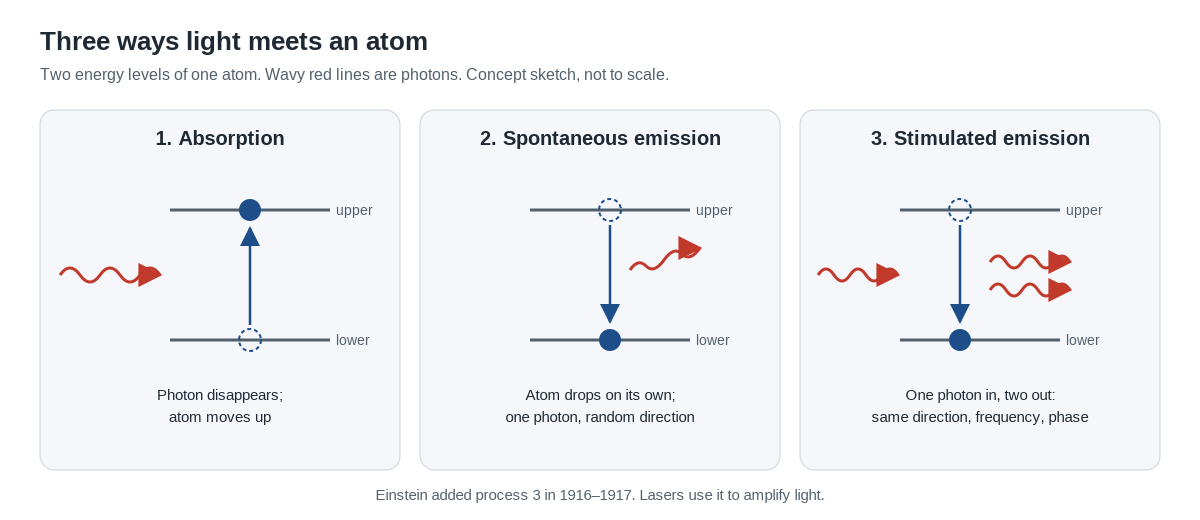
A choir gives a feel for it. Singers stand ready, one voice starts a note, and the singer next to it joins in on the same note and the same beat. Real atoms do not listen and choose like people. Whether an atom joins in is a matter of chance, and an atom in the lower level, not ready to sing, simply absorbs the photon instead.
A partner found in Planck's formula
Einstein did not see this in an experiment. The 1964 Nobel Prize in Physics ceremony speech explains that he found it through a theoretical analysis of Planck's radiation formula. Absorption, he concluded, must come with a partner process in which incoming light prompts atoms to give off light of the same kind.
The laser exhibit of the American Institute of Physics (AIP) dates the start of the idea to 1916. That year he wrote on the quantum theory of radiation (Quantentheorie der Strahlung), deriving the momentum that light quanta carry. His 1917 paper under that same title is where stimulated emission is explained.
The same ceremony speech notes that this process held a possible way to amplify light. If light can call up more light, weak light could in principle be built up into strong light. For a long time, though, that possibility stayed on paper.
As a side note, Einstein's 1921 Nobel Prize was not for stimulated emission but for discovering the law of the photoelectric effect. He received it a year later, in 1922.
Why it slept for almost 40 years
The main reason was absorption. In ordinary matter, far more atoms sit in the lower level. When light goes in, absorption outnumbers stimulated emission by a wide margin, so the light weakens instead of growing. The Nobel Foundation explains that stimulated emission was long seen as a purely theoretical idea that could never be put to work or even observed for this reason.
The tools were missing too. According to the AIP exhibit, engineers had little idea how to handle atoms, and for decades the concept looked like a theoretical curiosity with no practical use. The same exhibit says that by the 1930s the optical techniques and the theory needed for a laser already existed, but nothing pushed them together.
Around 1950, the push arrived from a direction few expected. Leftover World War II radar gear was rebuilt to make microwaves, and microwave spectroscopy, which uses those waves to set atoms and molecules vibrating, spread through physics labs. The American Physical Society (APS) newsletter likewise places the first practical interest in the idea in the 1940s and 1950s.
To amplify, the upper floor must be more crowded
Building up light through stimulated emission needs one condition. Stimulated emission has to outnumber absorption, and for that, more atoms must sit in the upper level than in the lower one. This state is called a population inversion.
A population inversion is an unstable state that does not arise on its own. In terms of a building, people have to climb the stairs until the upper floor is more crowded than the ground floor. In real atoms, the stay upstairs is short and atoms sent up soon come back down. That is why pumping, which keeps feeding energy in to refill the upper level, is needed.
The 1964 ceremony speech calls this the essential step in inventing the maser and the laser: creating a population inversion under conditions where stimulated emission can be used for amplification. The three parts of a laser, the gain medium, the pump and the resonator, all exist to create and hold that condition.
Through the maser to the laser
The first result came not in light but in microwaves. According to the Nobel Foundation, the first maser papers came from two independent efforts. One came from Charles Townes and his group at Columbia University, the other from Nikolay Basov and Aleksandr Prokhorov at the Lebedev Institute in Moscow. That story is told in 1954: The Maser Came First.
In 1958, Arthur Schawlow and Townes analyzed how the maser principle might work for light, and two years later the first laser ran. The path continues in Schawlow and Townes, 1958: The Optical Maser Paper That Proposed the Laser and May 16, 1960: Maiman's Ruby Laser.
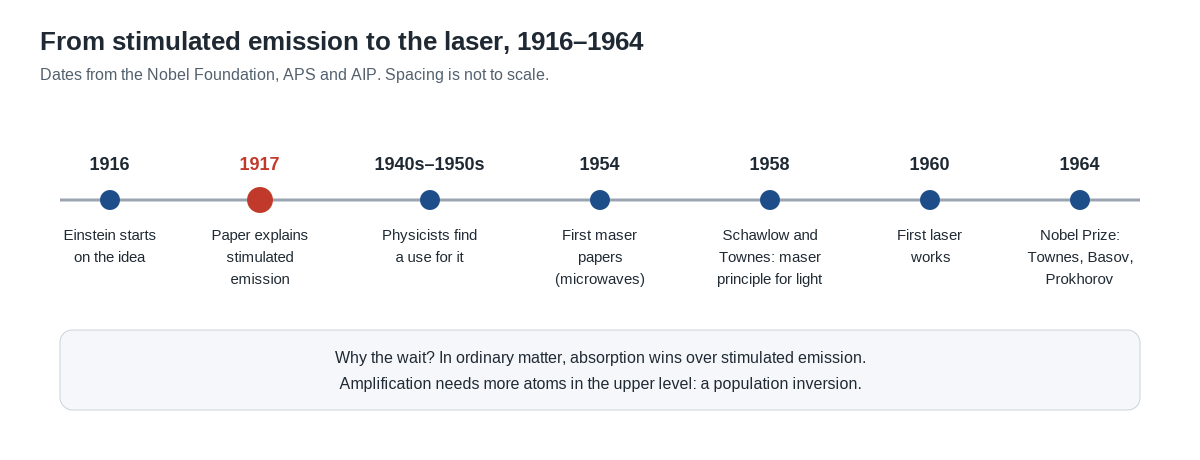
The 1964 Nobel Prize in Physics went half to Townes and half jointly to Basov and Prokhorov. The citation was for fundamental work in quantum electronics that led to oscillators and amplifiers built on the maser-laser principle. Early on, the ceremony speech names stimulated emission, introduced in 1917, as the key.
What 1917 left in today's laser light
Stimulated emission is also why laser light travels in one straight direction and has such a pure color. Each new photon matches the first in direction, frequency and phase, so huge numbers of photons line up into coherent light. How that differs from a light bulb is explained in What is a laser? How it differs from a light bulb.
Stimulated emission alone does not make a laser, of course. A pump to create the population inversion and mirrors to send the light back and forth are needed too. That setup is shown in The three parts of a laser: gain medium, pump and resonator.
The 1917 paper was not a blueprint for a device. It was pure theory about how light and matter reach balance. After waiting 43 years for the first laser, that theory led to lasers that cut steel in factories, to optical communications and to laser eye surgery.
What to read next
- 1954: The Maser Came First: the first device to put stimulated emission to work
- The three parts of a laser: gain medium, pump and resonator: the three parts that create and hold a population inversion
- Late 1960: The Helium-Neon Laser and the First Continuous Beam: the day laser light first came out without a break