Say laser, and most people picture a beam that keeps shining for as long as it is switched on. The first laser, in May 1960, was not like that. It gave off only pulses, like a camera flash.
An unbroken laser beam first appeared that December at Bell Labs in Murray Hill, New Jersey. It came not from a crystal but from a glass tube filled with helium and neon, and the secret lay in how the two gases split the work.
Flashing light and unbroken light
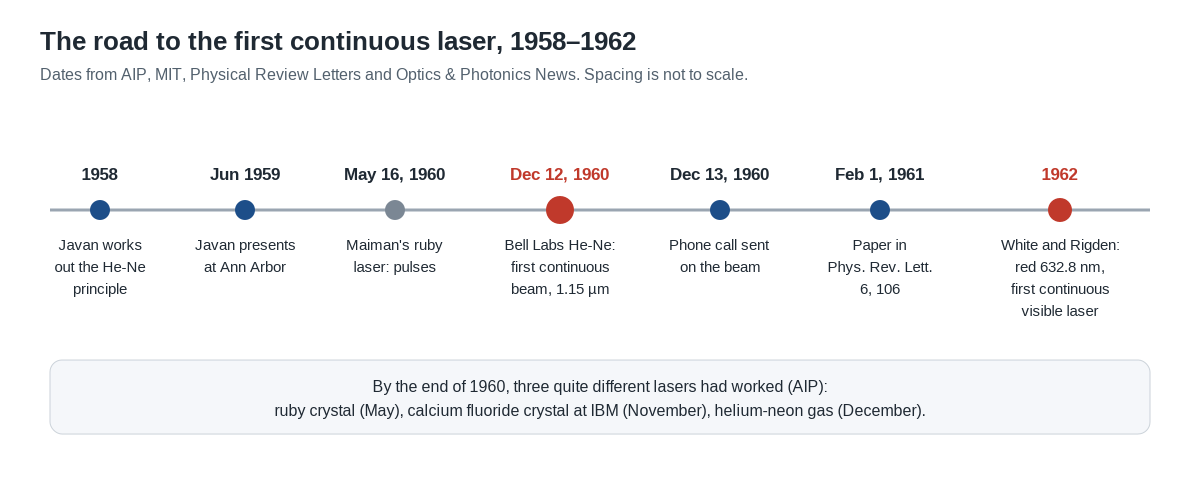
Maiman realized that the light source used to excite the ruby did not need to shine all the time. A photographic flash lamp was enough, and what he saw on May 16, 1960, were pulses of red light. That story is in May 16, 1960: Maiman's Ruby Laser.
Ali Javan at Bell Labs was after a different kind of light: a continuous-wave laser, or CW laser, whose output does not stop. Bell Labs had a reason to care. Alan White, who worked there, later recalled that a continuous source of coherent light able to carry a wide bandwidth was exactly what the Bell telephone system needed.
How continuous and pulsed lasers differ is covered separately in Continuous-wave and pulsed lasers.
Helium and neon split the work
Javan had been a student of Charles Townes. He shared Townes's liking for a simple medium, a gas. He settled on helium and neon, mixed together inside a long tube of glass. He worked out the operating principle of the idea in 1958.
The sequence goes like this. An electric current through the gas in the tube creates a discharge, and helium atoms pick up energy first. When an excited helium atom bumps into a neon atom, that energy passes to the neon. As neon atoms pile up in the upper level, a population inversion forms, and neon gives off laser light as it drops back down.
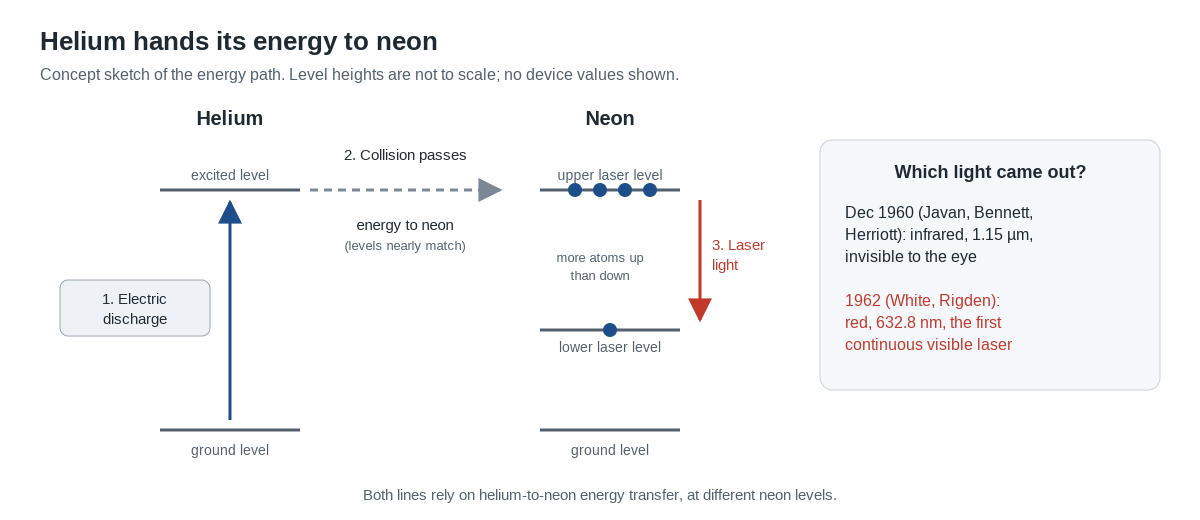
In a relay race, helium would be the first runner and neon the one who crosses the finish line. In reality, no baton changes hands. Because the energy helium carries closely matches the energy neon can take in, a collision passes it over easily.
Not everyone believed in it at first. In a later interview, Javan said many people remained unconvinced even after he was sure helium-neon was the best choice. They thought gas discharges were too chaotic to control. Indeed, the first attempts produced no laser action.
December 12, 1960: an invisible first light
Javan kept to his original path with Donald Herriott and William Bennett. On December 12, 1960, a snowstorm closed Bell Labs early.
At 4:20 that afternoon, Javan, still in the lab, checked his watch. It was the moment a gas laser first sent out an unbroken beam of infrared light. It was the first gas laser.
That first light could not be seen. In White's account, the three ran a radio-frequency discharge through helium and neon at low pressure, which flipped the populations of two neon levels. The result was amplification and laser oscillation at 1.15 µm in the infrared, a wavelength nearly twice that of red light.
What the eye could see was the glow of the discharge. Looking back on the first gas laser, Javan said the color of the discharge was "a beautiful pink color." The signal on an oscilloscope screen showed that the laser worked.
The next day, December 13, Javan and his Bell Labs colleagues sent a telephone call over the laser beam. MIT describes it as the first time a laser beam carried a telephone conversation.
The paper, and the three lasers of 1960
The result appeared on February 1, 1961, in Physical Review Letters, volume 6, page 106. Its title was "Population Inversion and Continuous Optical Maser Oscillation in a Gas Discharge Containing a He-Ne Mixture." At the time, people at Bell Labs still called the laser an "optical maser."
Earlier, in June 1959, Javan presented a paper at the Ann Arbor optical pumping conference at the University of Michigan. Gordon Gould gave a separate paper in the same session, which Schawlow chaired.
Before 1960 was over, lasers of three very different kinds had worked. They were the ruby laser in May, IBM's calcium fluoride crystal laser in November and the helium-neon laser in December. In the year of the first laser, two crystals and one gas opened the door together.
Red 632.8 nm came in 1962
The red beam people now link with helium-neon lasers came in 1962. Alan White and Dane Rigden at Bell Labs built the first continuous visible helium-neon laser.
The clue was in a spectrum. In pure neon, 632.8 nm was a weak red line, but adding helium made it 50 times stronger or more at the same discharge current. The two traced the cause to a helium level lying very close to a neon level. It was the same kind of energy transfer that had produced the 1.15 µm infrared laser.
Helium-neon lasers do not have just one color. A Boston University laser safety resource lists lines at 543, 594, 612 and 633 nm, and a table from the laser maker Newport gives the main wavelength as 632.8 nm. The figure 633 nm is 632.8 nm rounded.
What the first continuous-light laser left behind
Helium-neon lasers went to work in interferometry, holography and barcode scanning. Semiconductor lasers have since taken over many of these jobs, but a beam that never breaks and runs straight is what opened them up. The full family of laser types is laid out in Laser types at a glance: gas, solid-state, fiber, semiconductor.
Javan moved to MIT in 1961 and carried on with laser research there. The National Inventors Hall of Fame credits him with the helium-neon laser, built on the gas laser principle he conceived at Bell Labs. It inducted him in 2006.
The Hall of Fame says this gas laser made holography practical and found use in checkout barcode scanners. A pink glass tube on a snowy afternoon became the starting point for many jobs that measure and record with light.
What to read next
- May 16, 1960: Maiman's Ruby Laser: the first laser, which lit up in flashes earlier the same year
- Continuous-wave and pulsed lasers: the difference between unbroken and flashing light
- 1962: Four Labs, One Month, and the First Laser Diodes: how four labs succeeded almost at once two years later