Picture a car joining a highway. On the ramp the driver presses the pedal hard, and once the car reaches the desired speed, the driver eases off and holds that speed. Some missiles split their thrust in a similar way. The first, hard push is called the boost phase, and the gentler, longer push that follows is called the sustain phase.
In practice the comparison breaks down quickly. A driver chooses the force moment by moment, but a solid rocket motor usually burns in a pattern set in advance once it is lit. So why split the thrust in two at all?
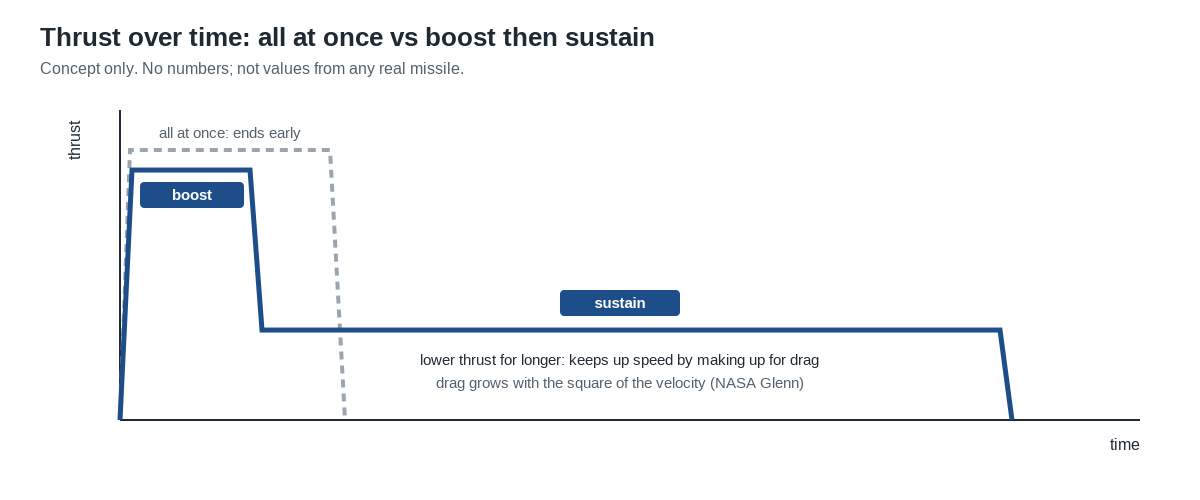
Two phases with names: boost and sustain
Boost and sustain name two periods within one flight that use thrust differently. Boost is the phase of high thrust at the start; sustain is the phase that keeps the flight going afterward.
The U.S. Army's LANCE surface-to-surface missile is a good example. According to the Redstone Arsenal history pages, LANCE left the launcher on a high-thrust booster. When the booster shut off, a sustainer took over. An accelerometer controlled that sustainer so that its thrust exactly matched the missile's drag.
Why split it? Air pushes back harder at speed
The key is drag. Drag depends on air density and on the square of the velocity. With everything else equal, doubling the speed makes drag four times larger.
So the faster a missile flies, the harder the air holds it back. If the motor shuts off early, the missile spends the rest of its flight losing speed to drag.
The sustain phase makes up for that loss. That is why the LANCE sustainer was set to match drag. The Army history credits this with a flight path that could be predicted and was almost free of errors from changing air.
Twice inside one case: the dual-thrust motor
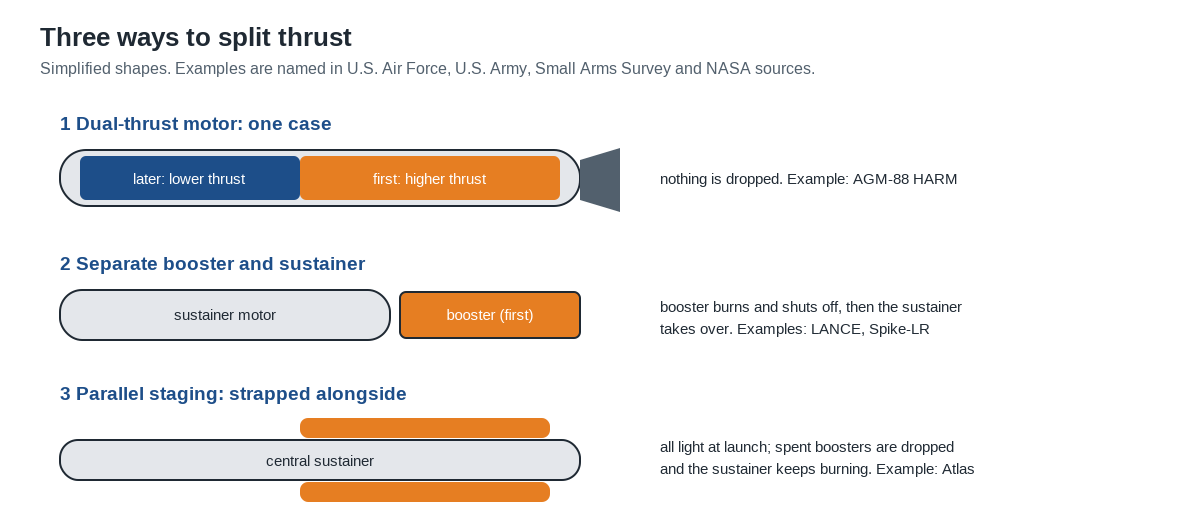
One way to split thrust is to have a single motor deliver two levels of thrust. A motor like this is called a dual-thrust rocket motor.
The thrust pattern is set by the surface that burns. A hole bored through the cylinder of propellant serves as the combustion chamber, and burning happens on the propellant surface. How much exhaust gas comes out is tied to how large the burning surface is, and designers use different hole shapes to control how thrust changes over time.
A public example is the U.S. Air Force's AGM-88 HARM anti-radiation missile. According to the Air Force fact sheet, its solid-propellant motor is a dual-thrust type that produces little smoke.
Separate booster and sustainer
Sometimes the booster and the sustainer are two separate motors. LANCE was built this way, and a Small Arms Survey report on anti-tank guided weapons lists the Spike-LR rocket engines as a launch booster and a sustainer.
The same names appear in rocket history. According to a NASA history of reentry, the Atlas carried three engines. A single sustainer sat in the center, and a booster engine was attached on each side. The boosters were designed to drop away at a set time during the climb, because their thrust no longer made up for their own weight and drag.
How this differs from multistage rockets
This is easy to confuse with multistage rockets. NASA Glenn explains that most of a rocket's weight is propellant. As it burns, nearly empty tanks and structure make up a growing share of the weight, so most launchers discard part of the vehicle. That is staging.
Staging comes in two forms. In serial staging, the first stage burns out and shuts down, then the second stage separates and lights. In parallel staging, several small first stages are attached around a central sustainer rocket, all engines light at launch, and the spent ones are dropped while the sustainer keeps burning. Atlas is closer to the parallel kind.
The difference lies in what gets thrown away. Staging exists to drop empty weight. Boost and sustain exist to change the size of the thrust over time. A dual-thrust motor changes thrust inside one case without dropping anything, while Atlas did both at once.
What a shorter flight time changes
The thrust pattern changes how long a missile takes to reach its target. The TOW anti-tank missile is guided by command to line of sight, so the gunner has to keep tracking the target until the missile hits. In 2012 Raytheon announced that, with a new launch, boost, sustain propulsion system, a TOW flew more than 7 km and reached the 4 km point in much less time.
The company said this cuts the time the gunner has to spend tracking a target. It is the manufacturer's claim, but it shows how the way thrust is split can change even the gunner's job.
Further reading
- Multistage Rockets: Why Rockets Come in Stages: staging to drop empty weight
- Solid and liquid rockets: what the fuel form changes: how solid and liquid motors differ
- Specific Impulse: How Rocket Engine Efficiency Is Compared: how long a propellant can push
- Anti-tank guided missiles: rockets versus guided missiles: the weapon family TOW and Spike belong to