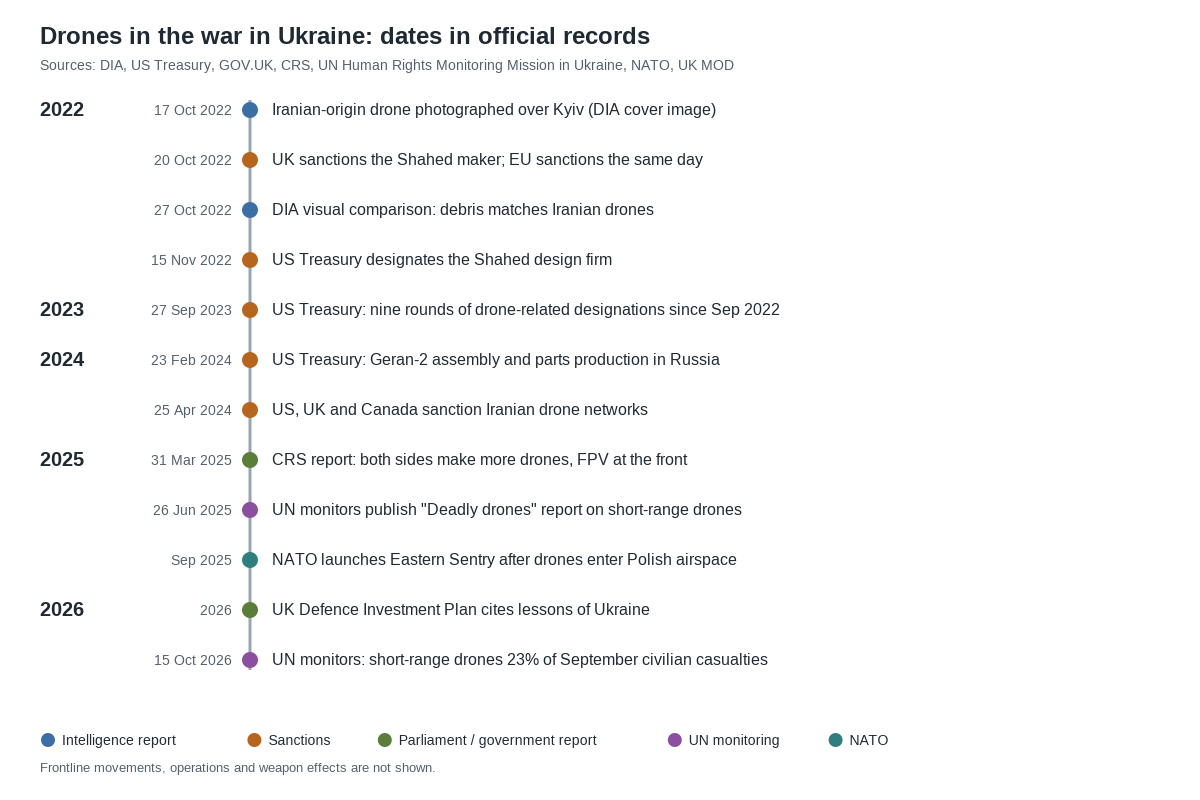
On October 17, 2022, during an attack on Kyiv, an Iranian-origin drone was photographed flying over the Ukrainian capital. The photo became the cover of a report by the US Defense Intelligence Agency (DIA), built on information up to October 27. Follow the drone story of this war by date, and one moment like this leads to the next in the official record.
This article collects those dates. It lines up drone-related events from 2022 onward that carry a date in an official document. The documents include intelligence reports, sanctions announcements, congressional reports, records of the UN monitoring mission and statements by NATO.
The war is still going on, so this article does not judge how well either side's drones worked on the battlefield. The major dates of the war as a whole are in the Russia-Ukraine war timeline. This article reflects the situation as of October 2026.
Autumn 2022: Iranian-origin drones over Kyiv
The DIA report is titled "Iranian UAVs in Ukraine: A Visual Comparison." A UAV is the flying part of an unmanned aerial system (UAS). The report sets drones used by Russian forces in Ukraine side by side with Iranian drones used to attack US and partner interests in the Middle East.
Its finding is short. Photos of debris and parts from Ukraine matched systems shown at military expos and similar venues in the Middle East. The DIA wrote that this analysis confirms Russia is using several kinds of lethal Iranian drones in the war.
What did it compare? One example is the wing stabilizer. Shahed-136 wing stabilizers recovered in Ukraine had the same size, shape and markings as those seen or recovered in the Middle East.
The report also gives pairs of names. Iran's Shahed-136 was renamed Geran-2 in Russia, and the Shahed-131 became the Geran-1. How several aircraft come to share one name is covered in the Shahed series.
Dates left in sanctions announcements
Sanctions announcements make good material for a timeline. One page says who was named, when and why.
On October 20, 2022, the UK government placed an asset freeze on Shahed Aviation Industries, which it described as the Iranian maker of the Shahed drones. The UK judged that the actions of Iran and Russia violate UN Security Council Resolution 2231. According to the US Treasury, the EU decided on the same day to sanction three Iranian military leaders and the Shahed Aviation Industries Research Center.
The United States designated that research center on November 15, 2022. The Treasury's Office of Foreign Assets Control (OFAC) described it as the firm responsible for designing and producing the Shahed-series drones used by Russian forces in Ukraine. An announcement on September 27, 2023, gave a count. From September 2022 to that point, OFAC had issued nine rounds of designations aimed at Iran's drone program.
In 2024 a production site appears in the documents. A Treasury announcement on February 23 said Russia's Alabuga special economic zone has a deal with the Russian military under which it puts together Geran-2 drones shipped from Iran. It added that the zone is building up the capability to make many parts of these Iranian-designed drones inside Russia. The same announcement noted that such one-way attack drones are also known as "kamikaze drones."
On April 25, the United States announced sanctions while the UK and Canada imposed their own at the same time. The Treasury said one company under Iran's defense ministry plays a key role in designing, making and selling thousands of drones. Many of them were ultimately sent to Russia for use in the war against Ukraine. The announcement also included the judgment that the Russian military has used such drones on Ukraine's critical infrastructure and on civilian targets.
A sanctions announcement records the judgment of the government that issued it. These documents do not show how the governments of Iran and Russia view those judgments.
Ukraine's fundraising and support programs
Records from the Ukrainian government look different. The shape of a program shows up before any date does.
UNITED24, the government's official fundraising site, hosts a project called the Army of Drones. Three bodies run it together: the General Staff of the Armed Forces, the State Special Communications Service and the Ministry of Digital Transformation. It buys drones regularly at the military's request and includes a pilot training course. The site says more than 1,400 drones were bought in the project's first 3 months, and that it now focuses on targeted fundraisers set by military requests.
Brave1 is a government initiative to develop defense technology, run by the Innovation Development Fund. It began as a grant program for defense startups. So far it has issued more than 750 grants, worth 3.7 billion hryvnias in all.
As of October 2026, when this article was written, the Brave1 cluster has 2,500 companies, and more than 500 of them make drones. Neither site gives the date its program started.
Small drones multiply
On March 31, 2025, the Congressional Research Service (CRS) issued a report on US Department of Defense counter-drone programs. Its introduction sums up this war in a single sentence. Russia and Ukraine have both reportedly turned out more and more drones for the battlefield. They have also given front-line forces first-person view (FPV) one-way attack drones carrying explosives, to add to artillery shells and conventional missiles.
That sentence carries the word "reportedly," and it gives no production figures. Just before it comes a sentence saying drones similar to the Shahed series have been used in Russia's strikes on Ukrainian cities and energy infrastructure. How an FPV drone is flown is explained in FPV drones.
Ukraine's drones also show up as a point of comparison in US debate. A CRS product updated on May 6, 2026, mentions a claim by some observers. In their view, the small drones bought by the US Army are still too expensive compared with those on the commercial market and those used in Ukraine. This is a claim by some observers, as CRS presents it, not a finding by the Army.
Civilian harm in the UN record
The UN Human Rights Monitoring Mission in Ukraine (HRMMU) counts civilian deaths and injuries it has verified. On June 26, 2025, the mission published "Deadly drones," a report on short-range drones alone. It looks at frontline areas from February 24, 2022, to April 30, 2025.
The report's summary says military forces use short-range drones more and more because of better technology and higher production. It adds that these drones are now among the main causes of civilian deaths and injuries in Ukraine.
Figures for a single month appear in the September report, published on October 15, 2026. In September, the mission recorded at least 328 civilians killed and 2,105 injured. Long-range weapons, meaning missiles and drones together, were the leading cause at 53% of casualties (165 killed, 1,119 injured).
Short-range drones came second at 23% (87 killed, 475 injured). In the mission's categories, drones fall into two places. Drones that come from far away are grouped with missiles as long-range weapons, so the 23% is the share of short-range drones only, not of all drones.
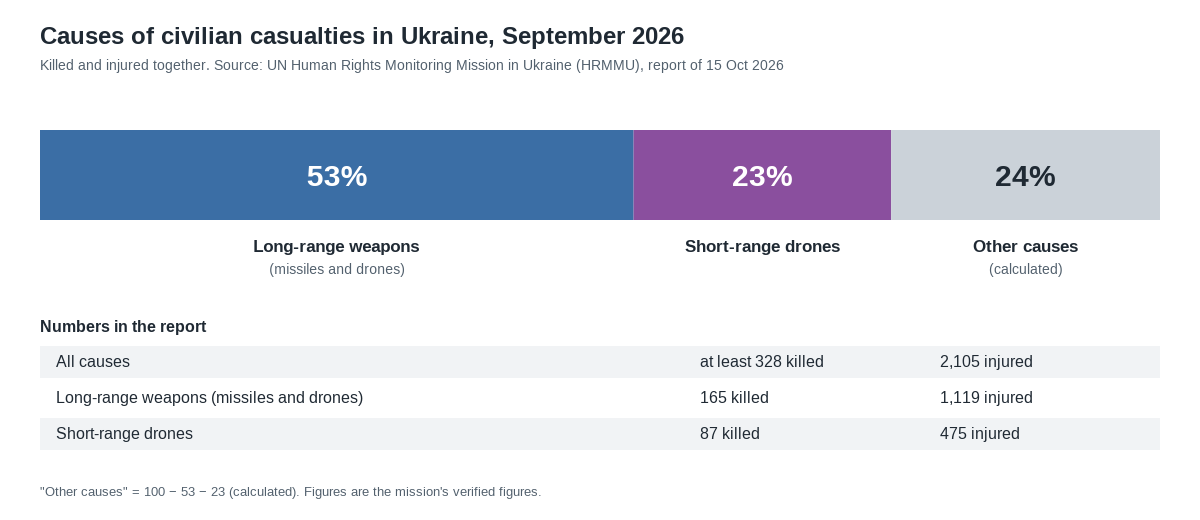
Each of these numbers is a death or an injury the mission has verified. The remaining 24% in the chart is found by subtracting the report's two shares from 100.
Defending, and beyond the border
Help from other countries in defending against drones also entered the record. According to the 2025 CRS report, the United States provided Stinger surface-to-air missiles to strengthen Ukraine's air defenses against Russian aircraft, cruise missiles and drones. The UK sent air-to-air missiles to Ukraine to be launched from the ground as interceptors against drones. Why drone defense is built in several layers is covered in counter-drone systems.
In September 2025, something happened outside Ukraine's borders. NATO launched Eastern Sentry after Russian drones violated Polish airspace, a violation NATO calls unprecedented. It is a military activity that brings in assets from many Allies, from traditional capabilities to new technologies such as anti-drone systems.
Some government documents also write this war down as a lesson. In its 2026 Defence Investment Plan, the UK government said it will spend more than £5 billion on advanced uncrewed systems for the remainder of this parliament. The plan ties this spending to learning the lessons of Ukraine. It set aside £210 million to give the Army, Navy and RAF one-way attack drones.
Where this meets lasers: reading statements by date
Every event in this timeline is someone's statement. Intelligence agencies compare photos of debris, sanctions authorities write down company names and dates, and the UN mission counts verified casualties. Even about the same war, what a document holds depends on which body wrote it.
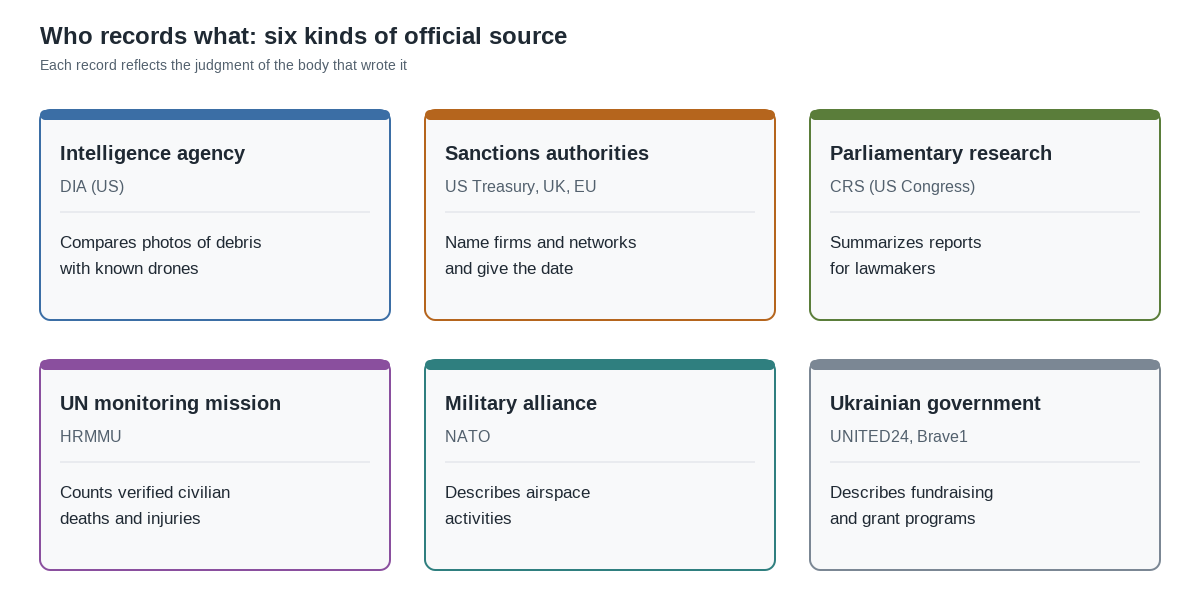
News about laser weapons can be read with the same eye. Check first who made the announcement, whether it describes a demonstration or an actual deployment, and what date its numbers refer to, and the weight of the story changes. That way of reading is laid out in how to read laser weapon news.
What to read next
- The Shahed series: same name, different drones: how the names Shahed and Geran split.
- FPV drones: flying through the drone's eyes: what first-person view flying is.
- Counter-drone systems: why one device is not enough: why the means of stopping drones come in layers.
- The Russia-Ukraine War: A Timeline from Public Records Since 2022: the major dates beyond drones, from UN records.
- The Bayraktar TB2 in the Early War in Ukraine: What the Record Shows: drones early in the war, from public records.