Picture an aircraft that takes off and is still in the sky at the same hour the next day. Nobody sits in the cockpit. The pilot is in a ground control station far away. Long-endurance drones used by militaries and science agencies work like this.
Two names describe these drones: MALE and HALE. This article starts with what the names mean. It then looks at why such aircraft have long, slender wings, what thin air high up changes, and what keeps a distant pilot connected. Along the way it follows Helios, a test aircraft that flew into the stratosphere on sunlight alone, through its record and its loss.
Two things in the name: altitude and time
MALE stands for medium-altitude long-endurance, and HALE for high-altitude long-endurance. Both names say how high and how long at once.
A 2012 report by the Congressional Research Service (CRS) calls Predator a medium-altitude, long-endurance system, and its successor, the MQ-9 Reaper, a long-endurance aircraft that spans medium to high altitude. On the high side, Global Hawk is described as a high-altitude surveillance aircraft. NASA also calls its own Global Hawks "high-altitude long-endurance aircraft."
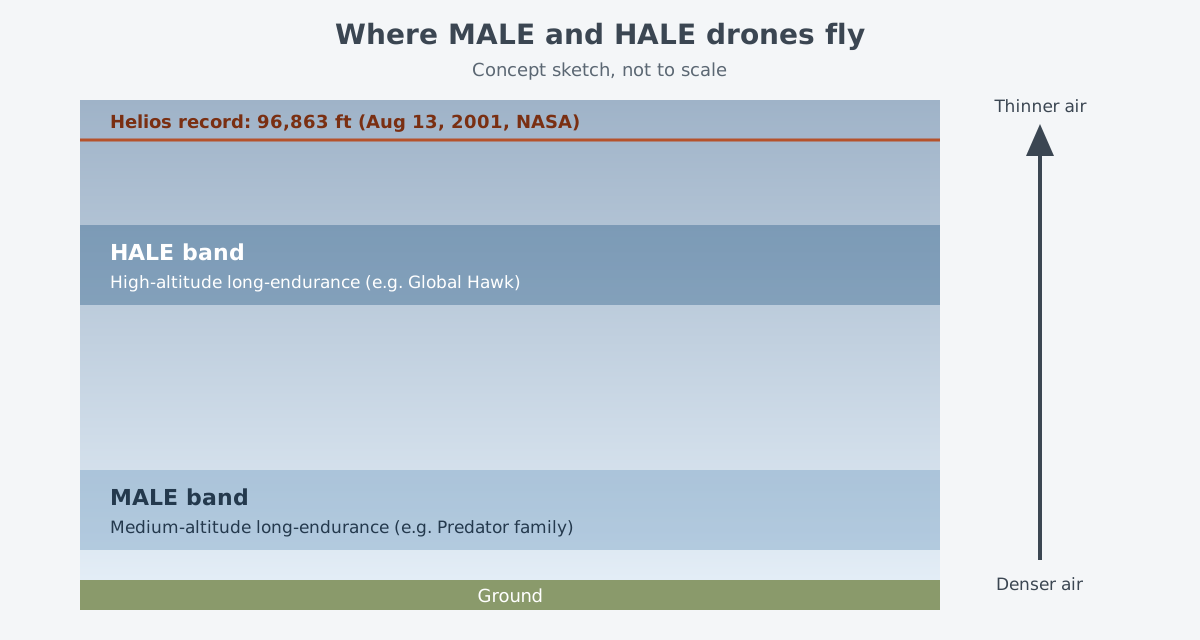
Official military classes look a little different. The U.S. Department of Defense sorts each unmanned aircraft system (UAS) into Groups 1 to 5, using maximum takeoff weight, operating altitude and speed. The North Atlantic Treaty Organization (NATO) first released its classification guide in 2009. It splits drones into Class I, II and III, and divides Class III again by mission.
The defense table labels each box with a number instead of a name. MALE and HALE sit apart from those numbers and describe, in words, how high and how long an aircraft flies.
The word "medium altitude" also appears in the name of a South Korean drone. In 2026, the Defense Acquisition Program Administration (DAPA) showed the first production medium-altitude reconnaissance UAV (MUAV). The English name in the press release is Medium altitude Unmanned Aerial Vehicle. It carries the altitude only; "long endurance" is not part of it.
The letters in front of the name tell a story too. Predator started out as the RQ-1B, a reconnaissance drone. In 2001 it gained the ability to carry weapons as a secondary role, and the U.S. Air Force renamed it MQ-1, a multi-mission drone. R stands for reconnaissance, and M for several missions.
Staying up longer means longer wings
Seen from above, a long-endurance drone has unusually long, thin wings. Predator, too, has long, slender wings and a tail shaped like an upside-down V. There is a physical reason for this shape.
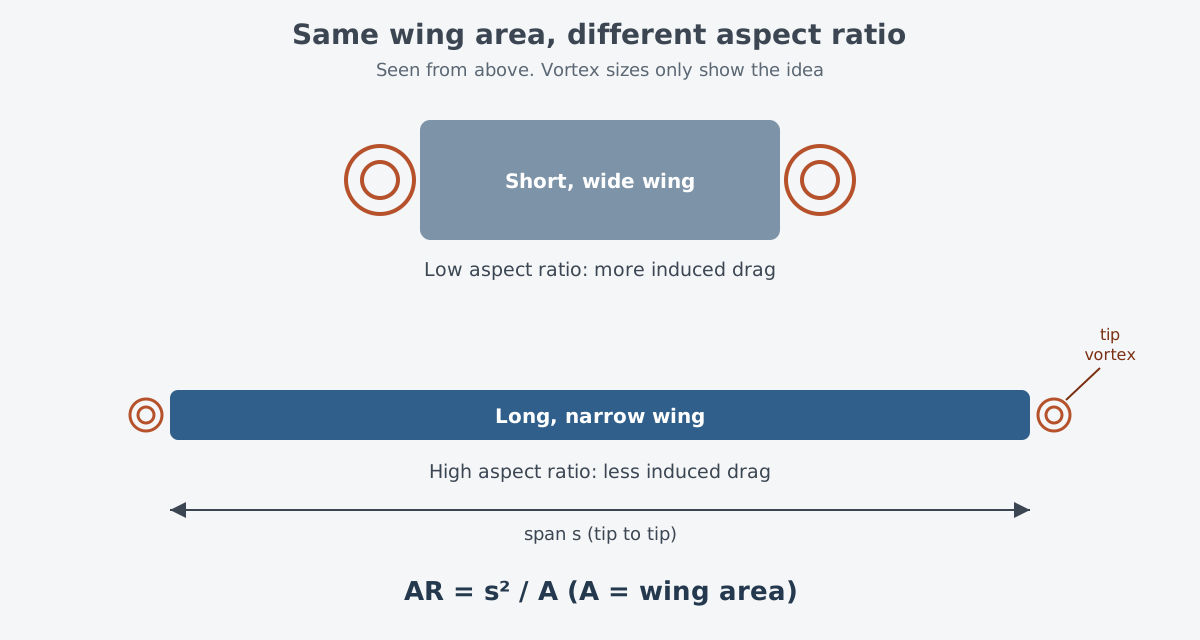
When a wing makes lift, the air pushes less on its top surface than on its underside. At the wing tips, air spills from the high-pressure side underneath to the low-pressure side on top and forms swirling vortices. These vortices add one more force that pulls the wing backward, called induced drag. Because it appears only on wings that make lift, and its size depends on that lift, it is also known as drag due to lift.
The key to cutting induced drag is the aspect ratio (AR). It is the square of the wingspan s, tip to tip, divided by the wing area A. The bigger the number, the longer and thinner the wing.
AR = s² / A
According to NASA Glenn Research Center's beginner's guide to aeronautics, a wing with a high aspect ratio has less induced drag than a low-aspect-ratio wing of the same area. In other words, a long, narrow wing does better than a short, wide one. Raising the aspect ratio cuts drag, improves the ratio of lift to drag, and flattens the glide. That is why high-performance gliders have such long wings.
The Helios prototype took long wings to an extreme. Its wingspan was 247 feet, longer than the wings of a Boeing 747 or a C-5 transport. When the earlier Centurion was turned into Helios, the longer wing gave more room for solar cells and improved its aerodynamic efficiency. As a result, Helios could fly higher and longer, and carry more, than the smaller aircraft.
Long, light wings come at a price. Wings like these bend easily. The Helios accident, later in this article, shows why that matters.
The higher you go, the thinner the air
People often say the air is thin on a high mountain. The higher you climb, the less air is left above you, so the pressure drops. Air density depends on temperature and pressure, and it falls as altitude rises. The aerodynamic forces on a wing depend directly on that density.
Lift moves with density too. In NASA's lift equation, lift is the lift coefficient times the air density, times half the speed squared, times the wing area. If density falls by half and nothing else changes, lift falls by half as well.
This relationship shows that when the air thins and density drops, an aircraft can keep the same lift with a bigger wing area or a higher speed. This hints at why high-altitude aircraft carry large wings. In a real aircraft, wing shape, angle, and how sticky and compressible the air is all play a part too, so this single line is not the whole story.
Thin air also makes cooling harder. The Helios team added radiator plates to cool the electronics at high altitude, because the thin air there carries so little heat away. A job the air does for free near the ground needs its own hardware up high.
The long leash: satellite links
A line of sight (LOS) is a straight, clear path between the sender and the receiver. Because the Earth is curved, once an aircraft goes past the horizon, there is no longer a straight path to an antenna on the ground. A drone that stays far from its base for a long time needs another route.
That route is satellite communications (SATCOM). Thanks to its satellite link, Predator can be flown beyond line of sight. A Predator-family system has four aircraft, one ground control station and one primary satellite link. The aircraft takes off and lands like a normal airplane, but a pilot on the ground flies it with a joystick.
On the high-altitude side, Global Hawk was first designed to need very little human input. It was meant to be an autonomous drone that took off, flew and landed on preset inputs alone. In practice, Air Force operators found that remote operators had to step in often (CRS, 2012). That is why even an aircraft that flies itself still needs a link to the ground.
Among the sensors a long-staying aircraft carries, synthetic aperture radar (SAR) lets it see through bad weather. The range of sensors, and the Earth-observation flights NASA made with Global Hawk from 2010 to 2017, are covered in ISR drones.
Wings that fly on sunlight: Helios, its record and its loss
Could an aircraft fly for days on sunlight, with no fuel on board? NASA tested that question with real aircraft in its Environmental Research Aircraft and Sensor Technology (ERAST) project. The largest of them was the Helios prototype. It was a slow, ultralight flying wing, built to stay in the stratosphere for Earth science or as a communications relay.
Helios made its first checkout flight on September 8, 1999, and in 2000 over 65,000 solar cells were fitted to the top of its wing. The project had two goals. One was to climb to 100,000 feet in 2001 and hold level flight there on a one-day flight. The other was to stay above 50,000 feet for four days or more in 2003, storing spare daytime electricity in fuel cells for use after dark.
Helios came close to the first goal. On August 13, 2001, off Kauai, Hawaii, it climbed to 96,863 feet (29,531.4 m), a world altitude record for an aircraft without rocket power. NASA hoped that, with other system reliability improvements, production versions could fly for months as "atmospheric satellites."
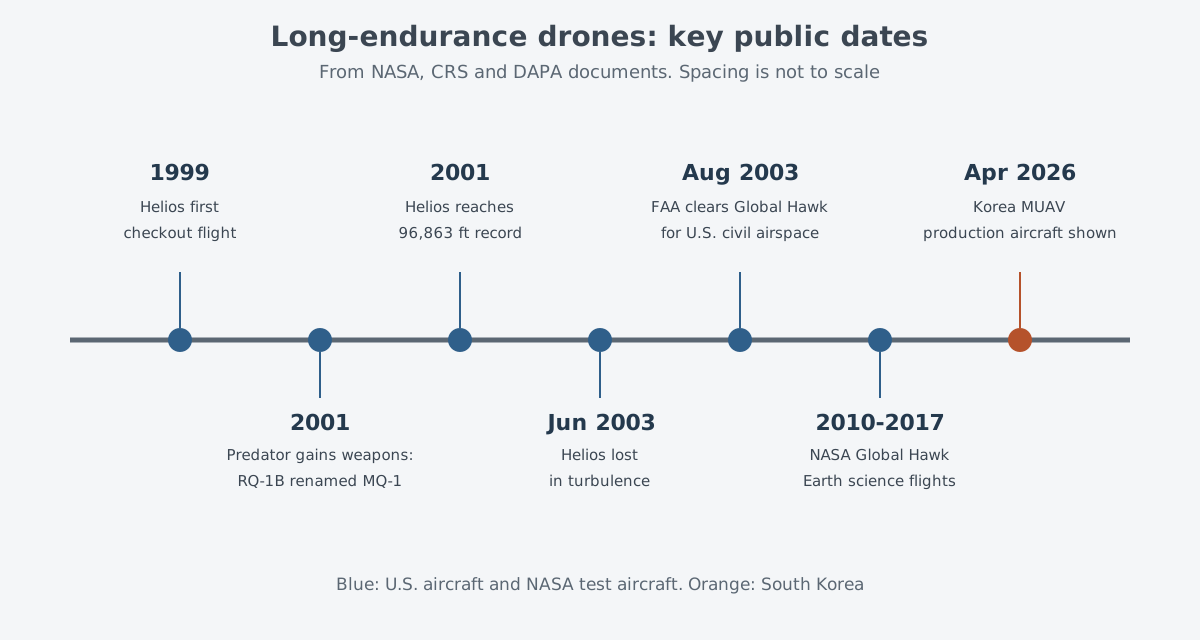
The second goal ended in an accident. According to NASA's mishap investigation report, on June 26, 2003, the version rebuilt for long flights (HP03-2) took off from Kauai and hit turbulence roughly half an hour after takeoff. Both wing tips bent sharply upward and stayed that way, the aircraft became unstable, and it fell into the ocean and broke apart. Nobody was hurt, and no other property was damaged.
One root cause the board named was the analysis methods. There was no adequate way to judge how changes to the aircraft's layout would affect it, so the risk was misjudged. As a result, the team chose to fly a version that was very sensitive to disturbances. The board said aircraft like this could open the stratosphere to many government and commercial uses, but it also found them far more complex than they look.
The homework of cost and reliability
Aircraft that fly high and long are expensive. The 2012 CRS report says defense officials and members of Congress grew worried about Global Hawk's rising cost. That cost led to Nunn-McCurdy breaches in April 2005 and April 2011. In May 2011, the Pentagon's operational test office judged the RQ-4B Block 30 "not operationally suitable" because of low aircraft reliability.
Sharing the sky is another task. Drones used to fly mainly in military-controlled airspace in support of combat operations. In August 2003, the Federal Aviation Administration (FAA) cleared Global Hawk to fly in U.S. civil airspace.
Wings are not the only way to stay up. Around 2012, large defense companies were competing to build unmanned blimps that might float for months at 70,000 feet. Lighter-than-air craft have a drawback, though: they are less maneuverable and slower than drones like Global Hawk.
Where this meets lasers
A high-altitude drone has to send a lot of data back to the ground. The 2012 CRS report mentions plans to add hyperspectral sensors to Global Hawk and to fit laser communications so it could send more information. That means optical communications: sending data with laser light instead of radio waves.
The benefits and limits of linking by light, and the problem of a drone losing its control link, are covered in Resilient military communications. Why laser light weakens and scatters on its way through air is explained in Light through air.
What to read next
- ISR drones: why endurance matters: how staying aloft ties into surveillance, and what ISR means.
- Resilient military communications: systems built to survive a lost link: layering communication paths so they hold up when a link drops, and laser communications.
- Light through air: absorption, scattering, turbulence, thermal blooming: four things that happen to laser light in the air.