The story of accurate guns starts with rifling. Cut spiral grooves inside a barrel to spin the bullet, and it holds its attitude like a top and flies straight. Yet look down the bore of most of today's main battle tank guns and the inside is smooth. Why throw away the very feature that brought accuracy?
The reason is that the rounds tanks fire have changed. Long, thin metal rods and rounds that form metal jets do not welcome fast spin. A round can stay stable in two ways, and the choice between them decided the shape of the bore.
Like a top, like an arrow: two kinds of stability
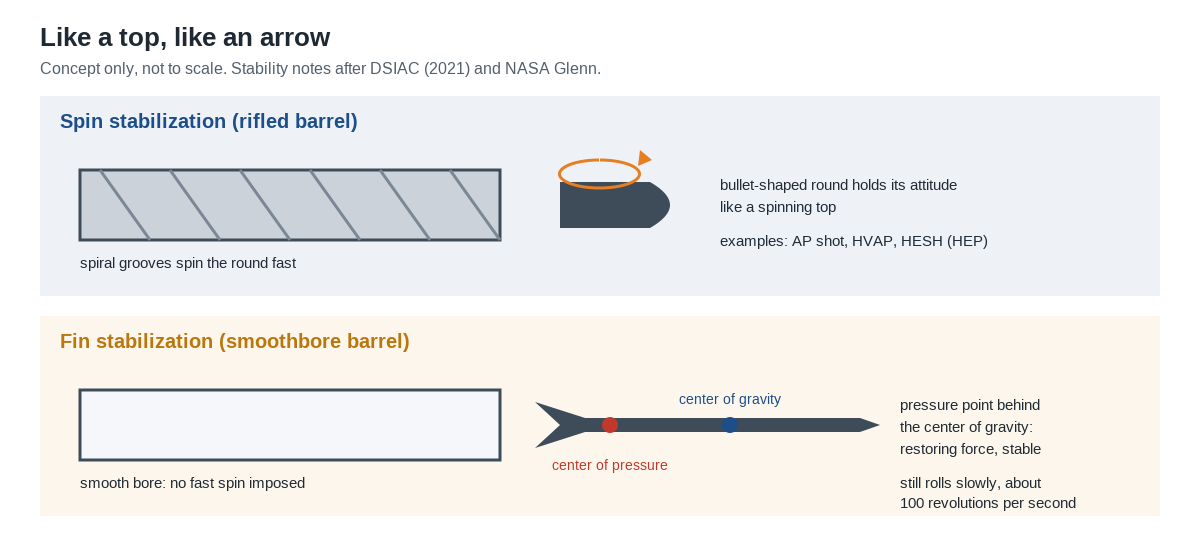
A gun with rifling is a rifled gun, and one without it is a smoothbore. A rifled gun spins the round fast so spin keeps it stable. DSIAC is an information center under the Defense Technical Information Center. According to its monograph, early armor-piercing (AP) shot and hypervelocity AP (HVAP) worked this way and needed a rifled barrel for accuracy.
The other way is the arrow. With tail fins, the forces that act in flight turn the round's nose back toward its direction of travel. NASA explains the same principle with a model rocket.
Lift and drag act through the center of pressure, and if that point sits behind the center of gravity a restoring force appears and the rocket is stable. Fins on a round are a way to move that point toward the tail.
Fin-stabilized rounds still turn a little. The DSIAC monograph says they usually turn at about 100 revolutions per second, which evens out the wobble from small flaws in real rounds. That is still far slower than the spin a rifled barrel gives.
Long rounds dislike spin
Problems began once rounds grew long and thin. A fin-stabilized round with a discarding sabot is actually unstable at the spin rates normal for solid shot. So it must be fired from a smoothbore, or, from a rifled barrel, slowed down with special driving bands. The armor-piercing fin-stabilized discarding sabot (APFSDS) round can be fired from a smoothbore precisely because fins keep it stable.
The monograph also describes how the spin is reduced. The driving band grips the rifling to seal the gas behind it but is allowed to slip in the grooves, so the round never spins up fast. Keeping a rifled gun while firing fin-stabilized rounds brings this kind of extra work.
Spin also scatters a metal jet
Shaped-charge rounds faced a more direct problem. The DSIAC monograph says the shaped charge was first meant to be fired from existing rifled barrels, but the fast spin needed to stabilize the round badly degraded its performance. The cause is conservation of angular momentum.
It is like a figure skater pulling in her arms and spinning faster. As a spinning liner collapses inward, its rotation speeds up and small asymmetries grow. The difference is that this is a metal jet, not a person, and the metal may not be strong enough to hold the fast-spinning jet together. How the metal jet forms is covered in The Shaped Charge: What Is the Munroe Effect?.
Most went smoothbore, a few kept rifling
One sentence in the monograph sums it up. Some nations prefer rifled barrels for maximum accuracy, but most have switched to smoothbore tank guns that take both long-rod penetrators and shaped charges. Both rounds they wanted to fire disliked spin, so the barrel adapted to the rounds.
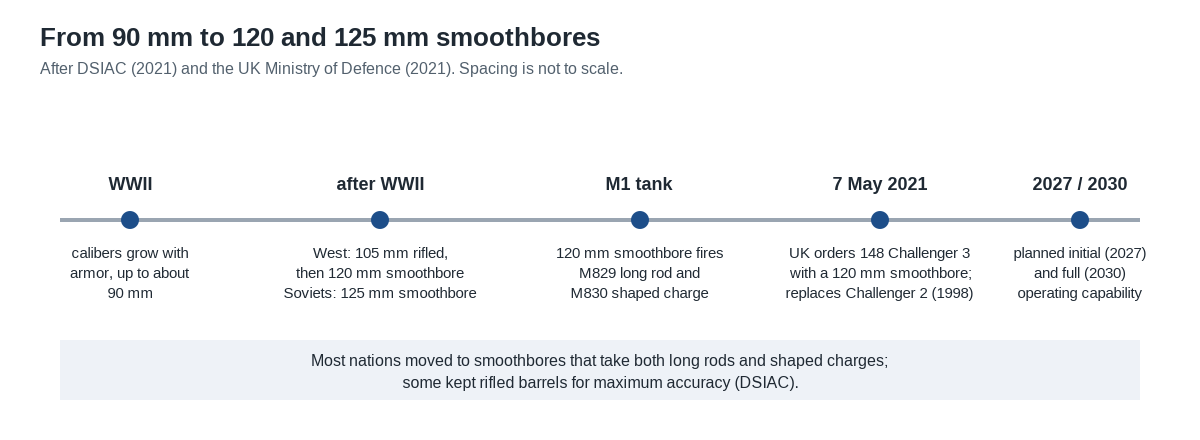
The trend in caliber fits alongside. Through World War II, gun calibers and tank armor grew together, ending with anti-tank guns of about 90 mm. After the war the West added just two steps, the 105 mm rifled gun and the 120 mm smoothbore, while the Soviets built a 125 mm smoothbore.
The 120 mm smoothbore on the U.S. M1 tank fires both the M829 long rod and the M830 shaped charge. The difference between those two rounds continues in APFSDS vs HEAT: Two Different Ways to Get Through Armor.
Britain held on to rifling the longest. The DSIAC monograph notes that the Challenger tank's gun barrel is rifled. Britain has also kept using the high-explosive squash head (HESH) round, and rounds of this family are spin-stabilized, full-bore and bullet-shaped, so they paired with the rifled gun.
Britain goes smoothbore too
Even Britain changed course. On 7 May 2021 the UK Ministry of Defence announced that the British Army would receive 148 Challenger 3 tanks under an £800 million contract. The new turret carries a 120 mm smoothbore gun.
Challenger 3 replaces Challenger 2, which has been in service since 1998. According to the same release, initial operating capability is expected by 2027 and full operating capability is planned for 2030. The release does not give a reason for the change.
What rifling leaves behind
Rifling has not become useless. As the AP and HVAP cases show, for a round that relies on spin, rifling is what delivers accuracy. Tank guns dropped rifling not because rifling is bad, but because the rounds tanks wanted to fire chose fins over spin. How rifling changed small arms is told in The Rifled Musket and the Minié Ball in the Civil War.
What to read next
- Kinetic Energy Penetrators: Why Fin-Stabilized Darts Are So Long: the long round and the discarding sabot
- Tank Gun Stabilization: Why the Gun Stays Steady on the Move: the system that keeps the gun on aim
- HESH: How a Squash Head Round Breaks Off the Inside of Armor: the round that paired with the rifled gun
- The Rifled Musket and the Minié Ball in the Civil War: how rifling changed the rifle