Shine a laser pointer at a wall in a dark room and a red dot appears. You do not have to hold the pointer to see it. Anyone in the room can, because the light hits the wall and spreads out in all directions.
A laser-guided bomb rests on this everyday effect. Someone lights up the target with a laser, and the falling bomb looks for the light scattered from that spot and closes in on it. But how does a bomb pick out a spot that someone else is lighting?
What the bomb follows: one spot of light
A laser-guided bomb is usually not a new bomb. Paveway, a well-known family of laser guidance kits, attaches to unguided bombs. A seeker on the nose looks for the laser that marks the target, and a tail kit at the back steers the bomb onto it.
Johns Hopkins APL describes such weapons as air-launched weapons that home "automatically" on "the bright spot illuminated by a laser." The bomb does not follow the target itself. It follows one spot of light on the target. For what the kit looks like and where it fits among precision-guided bombs, see Precision-guided bombs: what gets added to a plain bomb.
How the light comes back: diffuse reflection
Where does laser light go after it hits a target? That depends on whether the surface is smooth or rough. A smooth surface like a mirror reflects light at set angles. The law of reflection says the angle of reflection equals the angle of incidence, so parallel rays leave in one direction only.
A rough surface behaves differently. Light hits different parts of it at different angles, so it bounces off in many directions. This is called diffuse reflection. It is why a sheet of paper stays visible whichever way you look at it, and why people, clothes, leaves and walls show from every side.
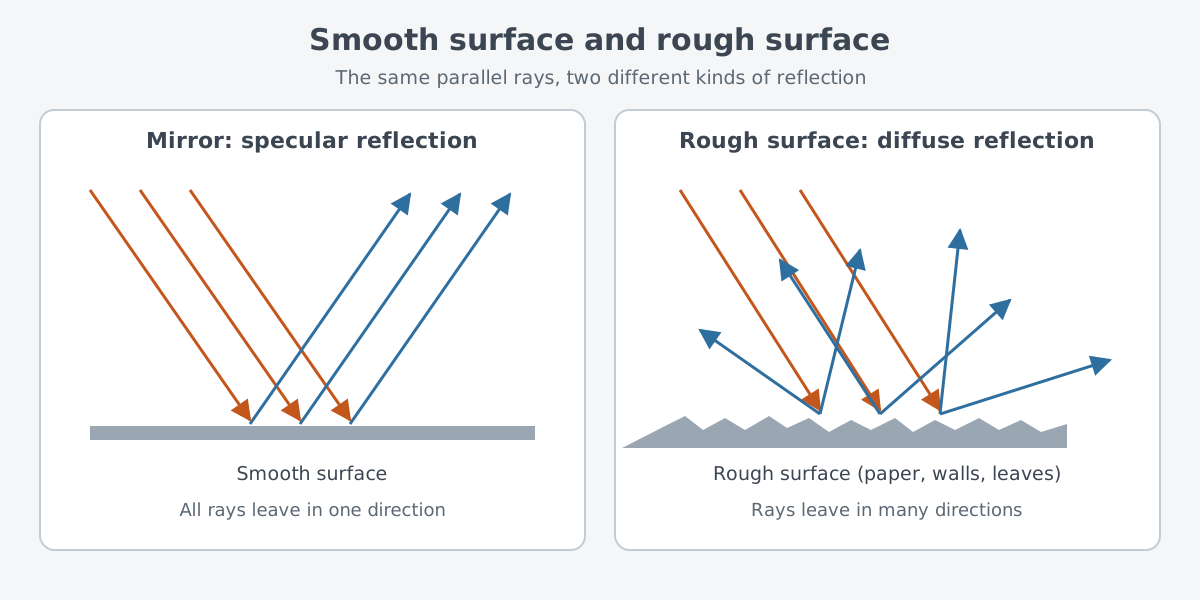
This spreading matters for a laser-guided bomb. Because the target sends light off in many directions, the spot can be seen from places other than where the laser came from. Light bouncing off in many directions is also called scattering in a broader sense.
A seeker is a bit like an eye hunting for the red dot on the wall. The real case differs in two ways. Only part of the scattered light reaches the seeker, and on its way through the air that light is affected by the weather.
One side lights, the other follows: semi-active guidance
Seekers on guided weapons fall into passive, semi-active and active types, depending on what they receive. A laser-guided bomb uses semi-active laser guidance. In a semi-active system, a beam of light, laser, infrared or radio energy is aimed at the target to mark it.
That beam does not come from the weapon. It comes from the launch platform or from somewhere nearby. The weapon's seeker sends out no beam of its own; it tracks the target by the energy that bounces back from it. The device that lights up the target is called a laser designator.
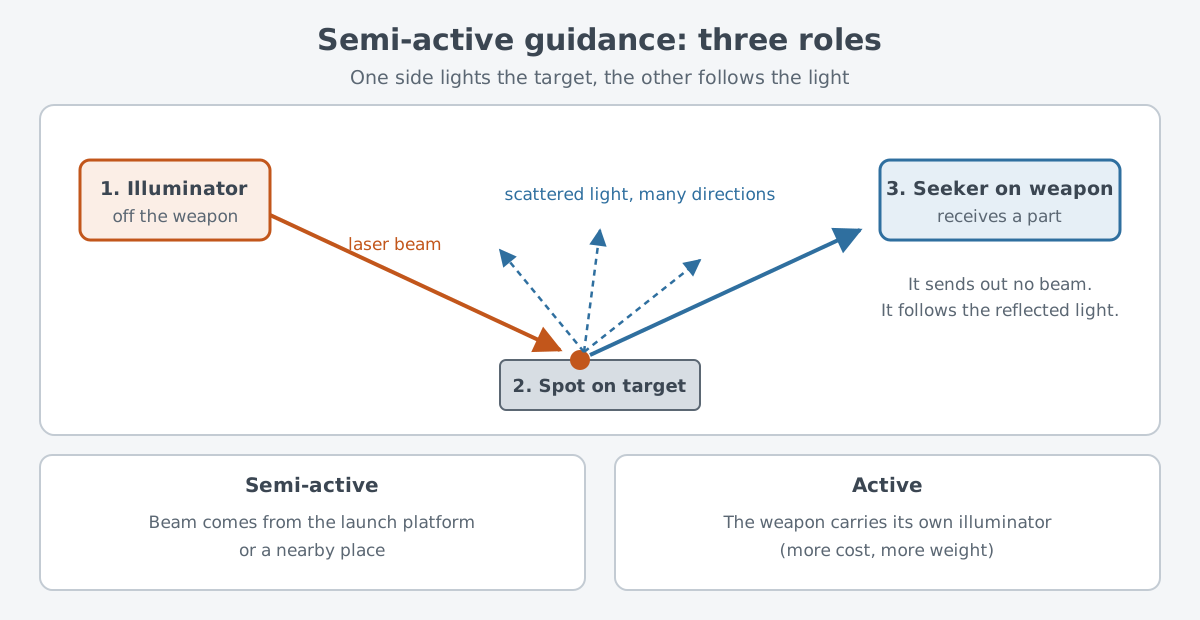
In an active system, the weapon carries its own illuminator and lights the target itself. Adding an illuminator costs money and adds weight. A semi-active system leaves the illuminator off the weapon and hands the job of lighting the target to another device outside it.
How the seeker holds on to the spot
What a seeker does is not unique to laser-guided bombs. APL's primer on homing guidance lists four jobs. The seeker keeps tracking the target after picking it up and measures the angle of the line of sight, or how fast that angle changes. It also holds steady against the shaking of the body and, when it can, measures the closing speed.
Tracking rests on shrinking a gap. A homing seeker usually measures how far the target sits from the center of its view, which is called the tracking error. The gimbaled seeker that APL describes turns toward the side that shrinks the error, and so keeps the target in its field of view. This describes homing seekers in general, so it does not tell us how the seeker in a laser-guided bomb is actually built.
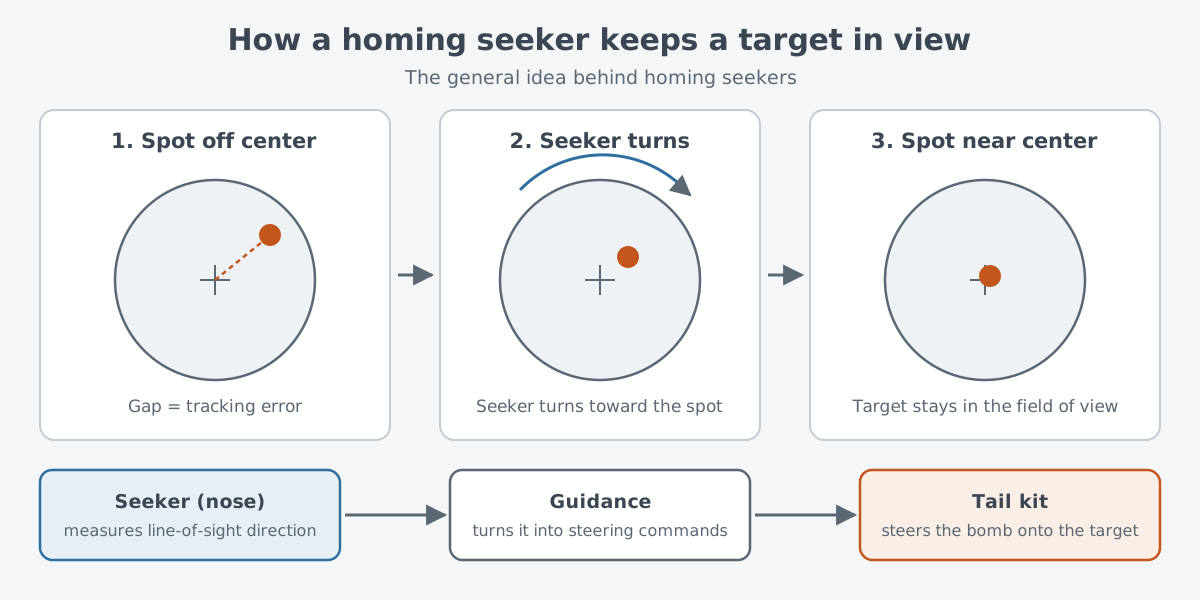
In a homing missile, the next links in the chain are the guidance law and the autopilot. The guidance law takes in target information and decides which way the weapon should head, and the autopilot takes those commands and issues commands for control surfaces such as fins. In a laser-guided bomb, this direction information ends up in the movement of the tail kit that steers the bomb onto the target. No one steers from inside the bomb.
From Vietnam to the Gulf War
Precision-guided munitions (PGMs) gained prominence in the Vietnam War with the arrival of the laser-guided bomb. The example people often cite is the Thanh Hóa Bridge, which a few laser-guided bombs finally dropped in April 1972. The 1960s background and the story of this bridge are in Precision-guided bombs: what gets added to a plain bomb.
After Operation Desert Storm in 1991, a review checked the claims made about these weapons. The maker of the most advanced guidance kit, Paveway III, promoted a "one target, one bomb" capability, and Defense Department officials used the phrase. The U.S. General Accounting Office (GAO) sampled Paveway III targets for a 1997 review. At least two bombs had been dropped on each target, so the claim could not be confirmed.
Still, point targets clearly needed fewer laser-guided bombs than unguided munitions had needed in that war and earlier ones, especially from medium and high altitudes. The sales line and the record did not match, but the gap with unguided bombs showed up in the record too.
When the light cannot get through
Even with diffuse reflection, the light has to travel two paths: out to the target and back to the seeker. What happens when clouds or smoke get in the way? In Desert Storm, aircraft flying at medium and high altitude were more exposed to clouds, haze, smoke and high humidity, and this hampered the laser designators for laser-guided bombs. Even mild weather, humidity included, left such sensors degraded or unable to work.
Kits that add satellite navigation to laser guidance also appeared. Paveway IV, from the late 1990s, added satellite guidance to improve accuracy. The manufacturer RTX says newer Paveway bombs have GPS and inertial navigation. In its words, they join the accuracy and flexibility of laser guidance with the all-weather reach of GPS guidance, which is the maker's own selling point.
Who chooses the target
In a semi-active system, choosing the target sits with the side that lights it rather than with the seeker. APL explains that in such a system, the source of the light does most of the work of picking the target. The bomb follows the lit spot; it does not decide which spot gets lit.
This split also shows up in policy. As summarized by CRS, the Defense Department directive on autonomy in weapon systems does not apply to munitions guided by hand by an operator. Its examples are laser-guided and wire-guided munitions. Where human judgment sits in a weapon is the subject of Autonomous weapons and human control.
Where this meets lasers: eye safety
The laser in a laser-guided bomb is a marker that shows the way, not a weapon that heats the target. It is still a laser. The U.S. Army Combat Readiness/Safety Center says every laser system must carry a warning label giving its class, and that this includes the rangefinders and target designators soldiers use.
The guidance on reflections depends on the class, so the first step is to check the class on the device's warning label. The article quotes a 2007 American National Standards Institute (ANSI) table.
In that table, Class 4 lasers are hazardous for direct exposure to the beam, and some can be hazardous even through diffuse reflections. Class 3 lasers are hazardous to look at directly or by mirror-like specular reflection, but their diffuse reflections are not normally hazardous. For what the classes mean, see laser safety class and Laser safety: classes and how to read eyewear labels.
The first safety rule is never to point a laser at anyone's face. The Army Surgeon General's advice is shorter still: treat lasers with the same respect and care as a loaded weapon. How weather weakens and scatters laser light is the same question for laser weapons, and it continues in Light through air: absorption, scattering, turbulence, thermal blooming.
What to read next
- Missile seekers: the eye at the front: what the seeker that looks for a laser spot is made of.
- Laser Designators: Pointing Out a Target with Light: the principle and history of the side that makes the spot.
- Light through air: absorption, scattering, turbulence, thermal blooming: why clouds and smoke block laser light.