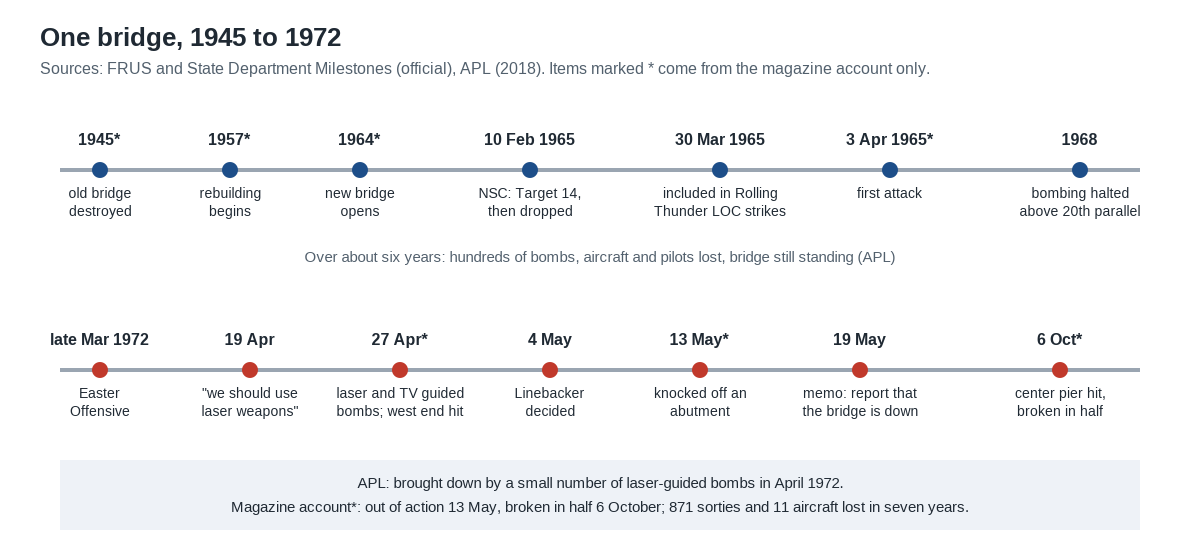
The White House, 10 February 1965, a National Security Council meeting. Defense Secretary McNamara went through the North Vietnamese targets that could be struck that day. The first one he named was Target 14, the Thanh Hoa Bridge.
Then he dropped it from the list, because it lay much farther north than any of the other targets.
Over the next seven years the bridge became something like a symbol of the U.S. bombing campaign. Hundreds of bombs fell on it, but it stayed up, and it came down only in 1972. This article follows what changed in between, using diplomatic records, a technical journal and a magazine account.
The bridge called the Dragon's Jaw
The bridge's official name was the Thanh Hoa Railroad and Highway Bridge. According to an account in Air & Space Forces Magazine, published by the Air & Space Forces Association, the bridge looked to the North Vietnamese like a gaping dragon's mouth. Hence its nickname, Ham Rong, the "Dragon's Jaw." It spanned the Song Ma river three miles northeast of the provincial capital, Thanh Hoa.
The bridge had a history of its own.
In 1945 the Viet Minh, then fighting the French, wrecked the old structure. Work on a new one started in 1957, and Ho Chi Minh came to its opening ceremony in 1964. The new bridge was a steel truss 540 feet long and 56 feet wide. In metric terms that is about 165 m long and about 17 m wide.
1965: onto the target list
Politics also lay behind dropping the bridge in February. The meeting record appears in the State Department's Foreign Relations of the United States (FRUS) series. McNamara proposed a supply depot instead, calling the bridge the "prestige bridge." Acting Secretary of State Ball said a plan without the bridge reduced the chance of a Soviet reaction.
Six weeks later the decision changed. On 30 March the State Department cabled the embassy in Saigon. Rolling Thunder strikes on lines of communication would increase the following week, and the Thanh Hoa Bridge was on the list. According to the magazine account, the first attack came on 3 April, with 46 F-105s backed by F-100s, reconnaissance aircraft and tankers.
Hundreds of bombs and a bridge still standing
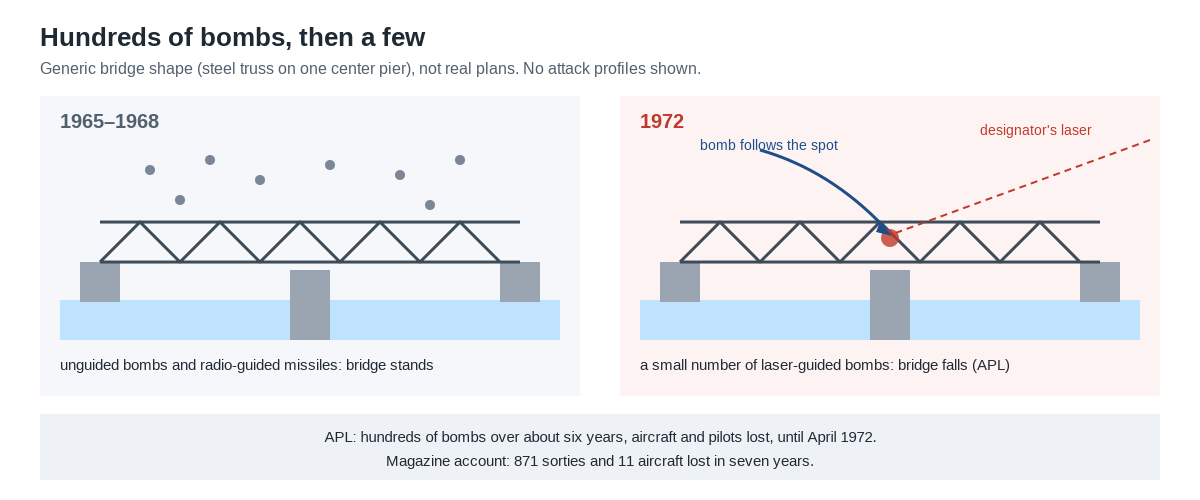
The first attack fell short of hopes. The magazine account says the radio-guided missiles used that day were hard to steer, and the ones that hit did little damage. Navy aircraft carried on the attacks, and even the Walleye precision-guided missile had no significant effect.
The first chapter closed in 1968. President Johnson announced that bombing of North Vietnam would stop above the 20th parallel. A technical journal from the Johns Hopkins Applied Physics Laboratory (APL) sums up this period in one sentence. Over six years the United States dropped hundreds of bombs and lost aircraft and pilots, yet the bridge stood.
1972: one spot lit by a laser
In late March 1972, North Vietnam opened the Easter Offensive in the South. The United States turned north again. FRUS prints a 19 April diary entry by Joint Chiefs chairman Moorer alongside his phone call with Kissinger.
Readying orders for strikes in the Thanh Hoa area, Moorer wrote that laser weapons should be used, or else "Smart walleye bombs on the famous Thanh Hoa bridge." On 4 May, Nixon chose to lay mines in the North's harbors and begin Operation Linebacker, a long air offensive against North Vietnam.
The weapons this time worked on a different principle from 1965. A laser-guided bomb homes on its own toward the bright spot a designator paints with a laser.
The APL journal uses the Thanh Hoa Bridge as its example of such weapons and says a small number of laser-guided bombs brought it down in April 1972. In the magazine account, F-4s of the 8th Tactical Fighter Wing hit the bridge on 27 April with Paveway laser-guided and TV-guided bombs. A section at the western end went into the river.
The day it fell is not one day
The day the bridge "fell" depends on the source. APL gives April 1972. The magazine account says that on 13 May, 14 F-4s used laser-guided bombs of 2,000 and 3,000 pounds. They knocked the bridge off an abutment and put it out of action.
It adds that North Vietnam began repairs right away, so follow-on strikes were needed.
The diplomatic record also carries a trace of those weeks. A memo from Kissinger to Nixon on 19 May passes on a foreign diplomat's report. A North Vietnamese army colonel in Hanoi had learned from a BBC broadcast that the Thanh Hoa Bridge had fallen, and he confirmed it to a visiting American reporter. The same memo says Hanoi's Paul Doumer Bridge had been out since 10 May.
The last scene comes in the autumn. According to the magazine account, on 6 October four A-7s from the carrier America, carrying improved Walleyes and ordinary bombs, hit the center pier and broke the bridge in half. By then seven years had passed, with 871 sorties flown and 11 aircraft lost.
What the bridge left behind
By 1972 both the Navy and the Air Force were better equipped than in 1965, and precision-guided weapons had advanced a great deal. The answer to the same target had shifted from "more" to "more accurate." That is why the Thanh Hoa Bridge comes up so often when people talk about precision-guided weapons.
That accuracy rested on one beam of laser light. Someone had to light the target, and the light had to get through. How the equipment that marks the spot developed continues in Laser Designators: Pointing Out a Target with Light. The wider course of the war is in The Vietnam War at a Glance.
What to read next
- Laser-Guided Bombs: Following a Reflected Laser Spot: how a bomb follows light
- Laser Designators: Pointing Out a Target with Light: the side that marks the spot
- Precision-guided bombs: what gets added to a plain bomb: from laser guidance to satellite-navigation kits
- The Vietnam War at a Glance: 1955 to 1975: the war around this bridge