A low whine passes over a park at night. You look up and see nothing in the sky. You can hear it but not see it, and that moment shows something about drone detection: each sensor catches a different trace of the same small aircraft.
Small drones are hard to find. A report by the Congressional Research Service (CRS) sums up a widely held view. The flying height, speed and size of many drones create major technical and operational challenges, and so does the way drones keep getting more common, cheaper and more capable. That is why cameras, infrared (IR) and sound are used alongside radar and radio detection.
What does each of these three pick up? What is each good at, and where does it run out?
How sensors tell a drone from a bird is covered in "Drone or bird: what sensors look at". This article looks at the sensing methods themselves and at the US laws that apply to them. This article reflects the situation as of October 2026.
Light, heat and sound: three clues
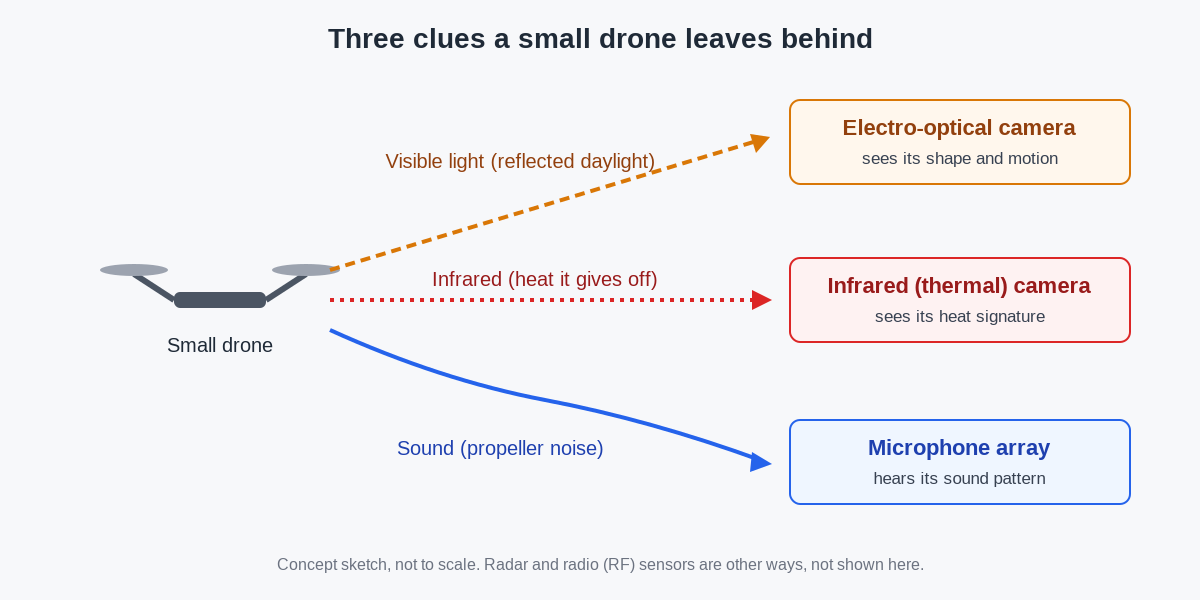
Even a small unmanned aircraft system (sUAS) leaves traces in the sky. Daylight makes its shape visible, it gives off heat as infrared, and its propellers make a pattern of sound. Each sensor picks up one of these.
In 2020 the Federal Aviation Administration (FAA), the Department of Justice (DOJ), the Federal Communications Commission (FCC) and the Department of Homeland Security (DHS) issued a joint advisory. It notes that systems for detecting drones often use radio frequency (RF), radar, electro-optical (EO), infrared or acoustic capabilities, or a mix of them. These capabilities sense either the drone's physical presence or the signals going to and from it.
Cameras, infrared and acoustic sensors belong to the first group. They pick up what the drone's own body reflects or gives off. Acoustic detection and image detection are classed, along with radar and radio signal detection, as noncooperative sensors.
Cameras: clear by day, with limits
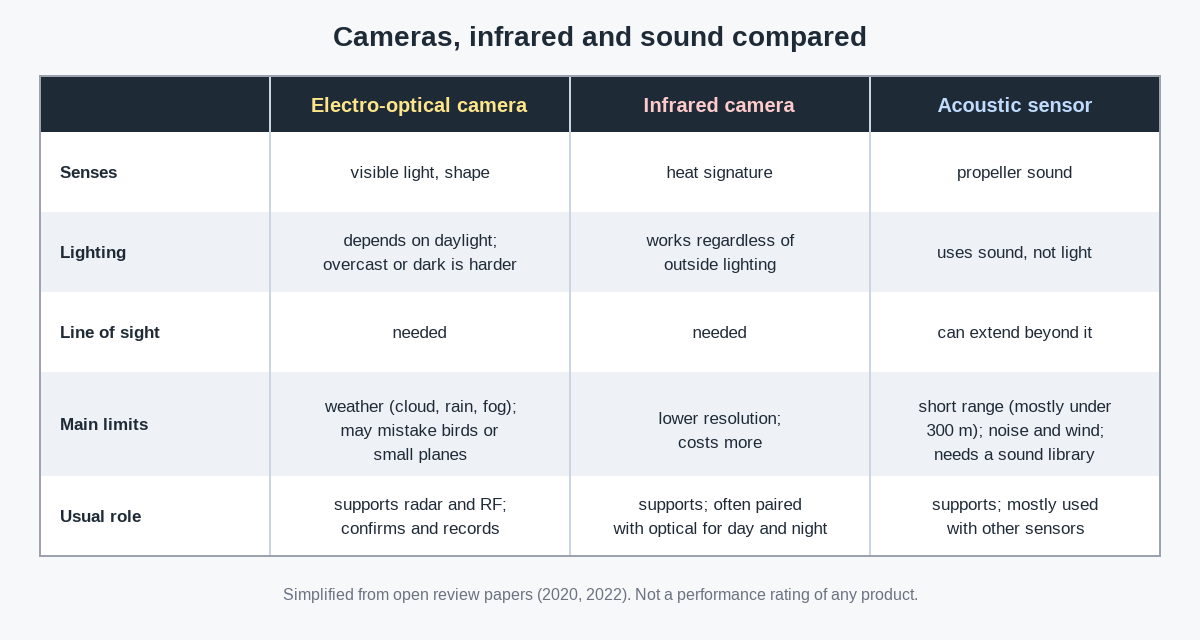
An electro-optical camera records visible light, just like an everyday camera. The clue is what the drone looks like and how it moves. High-end cameras often have strong zoom to bring small, distant objects closer, but how far they can see is still limited.
Finding a drone in video relies mainly on image processing. One method first estimates the background. It then groups the pixels that differ from that background into possible targets. Not everything that changes on the screen is a drone, though, so efficient detection needs a person watching or help from artificial intelligence.
A camera's strength is the record it leaves. Video from a high-end camera can serve as evidence. Cameras also help confirm what a point really is after a radar reports that something is there.
The limits are clear too. A comparison table in a 2020 open paper on airport defense finds that EO cameras rely on daylight and outdoor light. Overcast skies and darkness are a problem.
Weather such as cloud, rain and fog shortens how far they can see. They also need a clear, direct view of the drone, known as line of sight.
They can mix up a drone with a bird or a small plane of similar shape. Drones and birds move in similar ways, which brings many false alarms, while more drone models and hazy air also lead to many misses.
Infrared: seeing by heat
The human eye cannot see infrared, but the body feels it as heat. Very hot things, such as a fire, also give off visible light. Things that are not that hot, such as people, give off only infrared. An infrared camera picks up this invisible light and turns it into a picture of heat.
A thermal camera used to find drones works the same way. It picks up the infrared that a flying object gives off as heat. The airport defense paper gives the band as long-wave infrared, with a wavelength of 9–14 μm. How heat becomes a picture is explained in "Thermal Imaging Sights: Seeing Heat in the Dark".
The advantage of a thermal camera is that light matters less. It shows the scene steadily no matter what the outside lighting and conditions are. Compared with an ordinary color camera, it keeps track of a target better when the lighting changes.
There is a price. Thermal cameras give lower-resolution images and cost more than EO cameras. A source cited in the same paper holds that infrared camera images have such low resolution that they cannot identify a drone on their own. Detection systems therefore usually pair cameras for visible and invisible light to cover both day and night.
Researchers have also published a method that finds a drone's position by combining images from several thermal cameras and triangulating in two and three dimensions.
Sound: listening for propellers
Drone propellers make a distinct sound pattern. Acoustic sensors pick up this sound and use it to locate the drone and sort it by type. Usually a microphone catches the drone's sound, and the position is worked out from the time difference of arrival (TDOA).
Here is what time difference of arrival means. The same sound reaches the microphone nearest the source first and a farther microphone a little later. Comparing how late it arrives at each microphone shows which direction the sound came from.
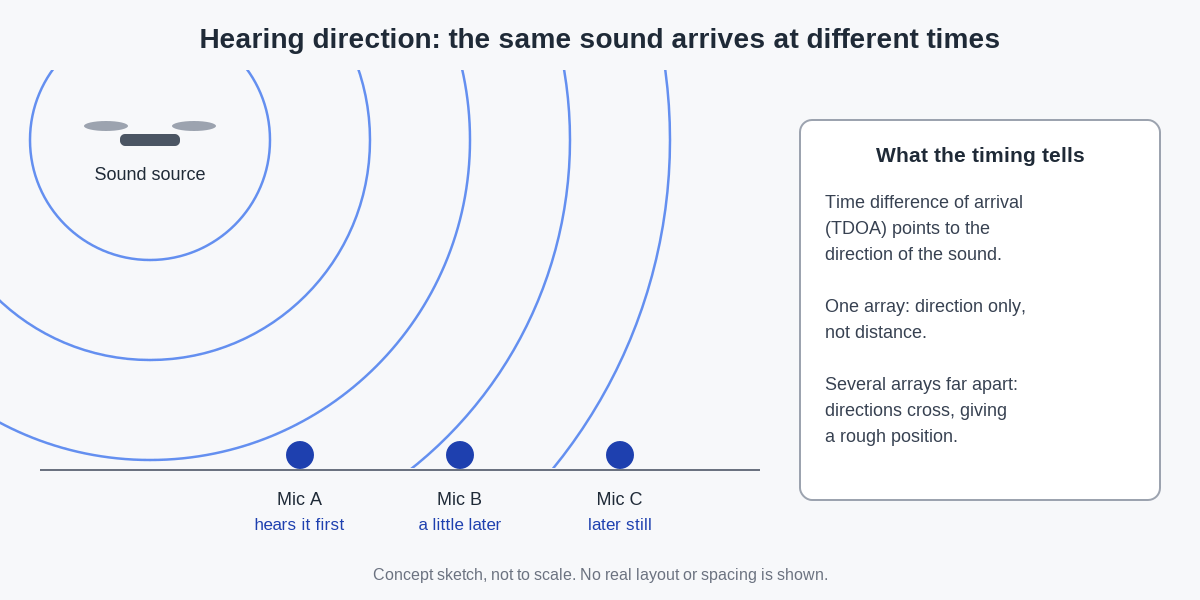
Picture two friends standing at opposite ends of a sports field when a whistle blows. The friend closer to the whistle hears it first. The real sky is different. Wind, temperature, obstacles, the time of day and other sounds can scatter sound waves and even bend the direction the sound seems to come from.
One microphone array gives a direction. In the simulation model of a 2022 open paper, the acoustic sensor also measured only the bearing, from the angle at which the sound arrived. The paper explains that finding distance from sound would need measurements from several places combined. Crossing the directions from several arrays set far apart gives a rough position.
Acoustic sensors have strengths of their own. They can hear a drone that flies on its own without sending radio signals. They can reach beyond the line of sight, and the systems cost less.
Their weak points are range and noise. In most cases, the detection range of acoustic sensors is short, under 300 m. Their chance of detection is medium, the false alarm rate is higher because there are more and more drone models, and they do not show where the operator is. Where aircraft noise is loud and overlapping, as at an airport, they are not a reliable way to detect drones.
To recognize a sound, the sensor first needs a library of known drone sounds. Yet the same drone can sound very different on a hot, calm day over open flat ground than on a cold night with wind in a forest. Collecting these sound fingerprints is itself one of the big challenges of acoustic detection.
Why none of them is enough alone
Each of the three methods has clear strengths and clear gaps. Cameras see well in good light, thermal cameras see in the dark but less sharply, and microphones hear only what is close. At an airport, a single sensor technology cannot give the situational awareness that is needed.
These three therefore usually play a supporting role rather than serving as the main means of detection. Cameras are hard to use for detection alone, so they often work in pairs with radar or radio detection to help with detection, confirmation and later analysis. Acoustic sensors also tend to work together with other detection systems to help with identification.
Products on the market fit this picture. Using open sources, trade publications and press releases, the 2020 paper counted at least 545 products for countering drones. Of these, 40% used cameras to support radio detection, and EO cameras and infrared systems, often used together, each appeared in 20% of products. Acoustic sensors were rarer at 6%, and mostly worked alongside other detection technologies.
The same pairing shows up in open military programs. According to the CRS report, the US Army has a fixed counter-drone system that protects a fixed military installation. Its detection and tracking rely on radars together with EO and infrared cameras.
Bringing data from several sensors together is called data fusion. In drone detection, data fusion can help a whole detection system perform better by overcoming or easing the problems and weak points of each sensor. How many sensors become one picture is explained in "Integrated air defense and sensor fusion".
The law and privacy
Laws apply even to equipment that only finds drones. The 2020 US joint advisory looks at detection systems such as radar, EO/IR and acoustic systems. These sense sound or electromagnetic waves coming from or bouncing off an object, and the advisory holds that they are less likely to raise concerns under federal criminal surveillance laws. These technologies do not grab, store, decode or intercept electronic messages.
"Less likely" does not mean free of limits. The same advisory adds that such systems must still follow the laws and rules run by the FCC and the FAA. RF methods are different. A system that listens in on the link between a drone and its ground station may come under laws such as the Pen/Trap Statute and the Wiretap Act.
Cameras and microphones can also see and hear people. The advisory asks users to check whether detection and mitigation equipment could affect people's privacy, civil rights and civil liberties before using it. It also warns against judging legality or function only from the vendor's word. State and local laws may also apply, but the advisory does not cover them.
Finding a drone and stopping one are also different in law. The US Congress has allowed only the Departments of Defense, Energy, Justice and Homeland Security to carry out limited drone detection and mitigation. US law (47 U.S.C. 302a) bars most non-federal entities from making, importing, selling or using devices such as transmitters built to block or interfere with wireless communications.
In other words, in the United States most private companies and state or local bodies that answer a drone with jamming equipment would break this law. Everything in this section is based on the August 2020 advisory.
Where this meets lasers
Finding a drone and working out what it is still leaves work to do. A laser weapon must keep hold of the point judged to be a drone and keep its beam aimed at that point. This process is called acquisition, tracking and pointing (ATP).
Cameras and infrared cameras receive light in order to see, while a laser weapon sends light out. Holding a beam on one spot is the subject of "Gimbals, pointing and tracking: holding the beam on one spot". The problems a laser weapon faces with weather and distance continue in "Strengths and limits of laser weapons".
What to read next
- Drone or bird: what sensors look at: how cameras and radar tell drones from birds.
- Counter-drone systems: why one device is not enough: the response options and organizations that come after detection.
- Imaging Infrared Seekers: Recognizing a Target from a Heat Picture: another use of heat images to recognize a target.
- Integrated air defense and sensor fusion: how several sensors are tied together.
- Articles in the same series still being written: "The Counter-Drone Chain: Detect, Identify, Track, Defeat", "Radars That Find Small Drones" and "Finding Drones by Their Radio Signals: RF Detection and Direction Finding".